Cann's 2019 Seed deck is a masterclass in brand-led storytelling for a stigmatized industry. By defining 'low dose' as 5mg or less (Slide 2) and positioning their product as a healthier social alternative to alcohol (Slide 4), Cann successfully moved cannabis out of the 'stoner' subculture and into the mainstream wellness and social beverage categories. The deck relies heavily on lifestyle imagery and comparative calorie counts—showing Cann at 30 calories versus a 150-calorie cider—to appeal to health-conscious consumers. While the deck lacks traditional financial projections and a team slide…
Key takeaways
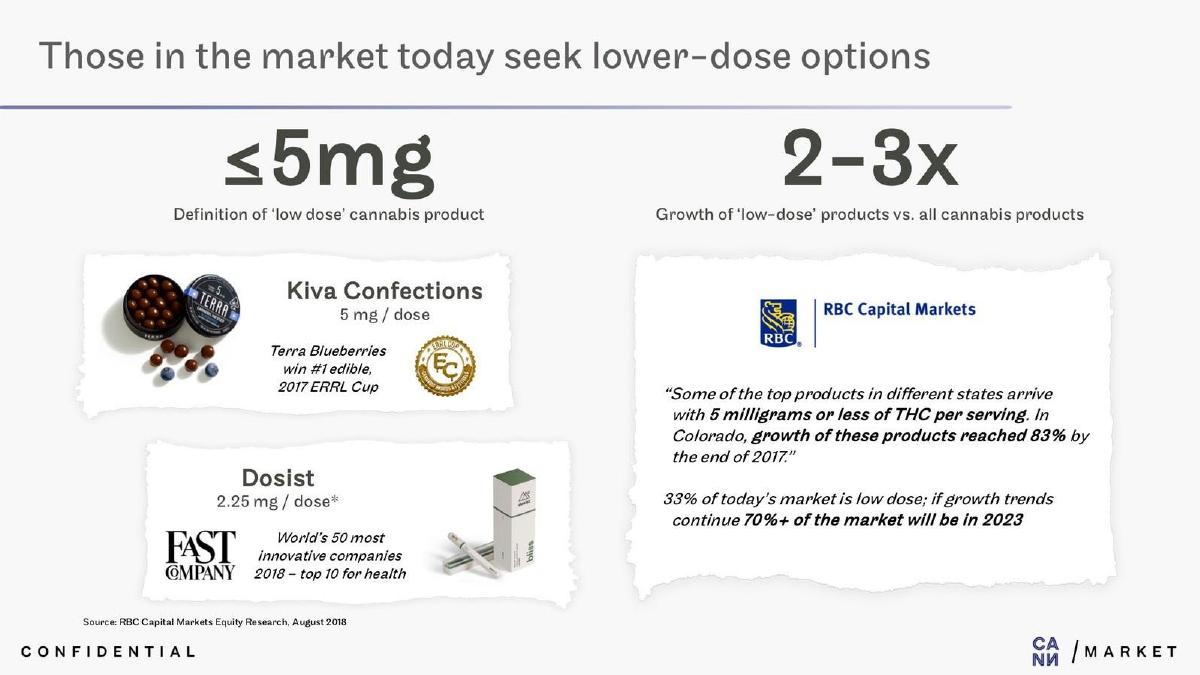
- Cann defines the 'low dose' market as products containing 5mg or less of THC per serving on Slide 2.
- The deck cites RBC Capital Markets data stating that low-dose products grew 83% in Colorado by the end of 2017 (Slide 2).
- Cann positions its 30-calorie beverage against high-calorie competitors like Bud Light (110 cals) and Magners (150 cals) on Slide 4.
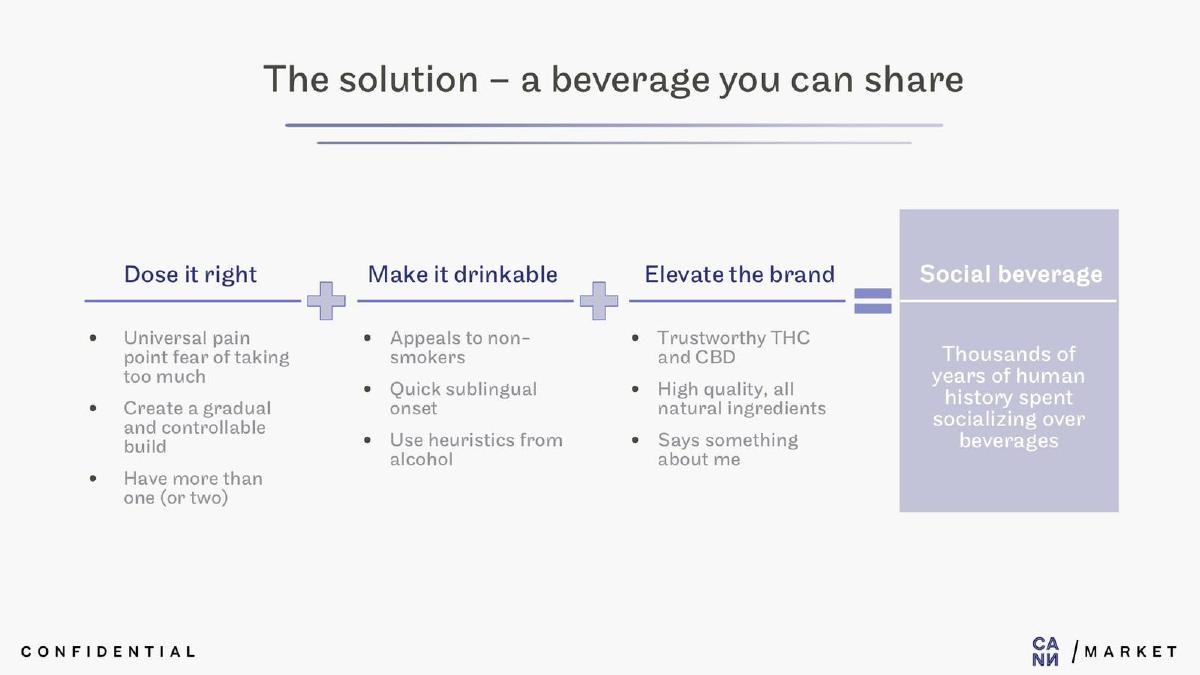
- The product strategy focuses on a 'quick sublingual onset' to mimic the social timing of alcohol consumption (Slide 3).
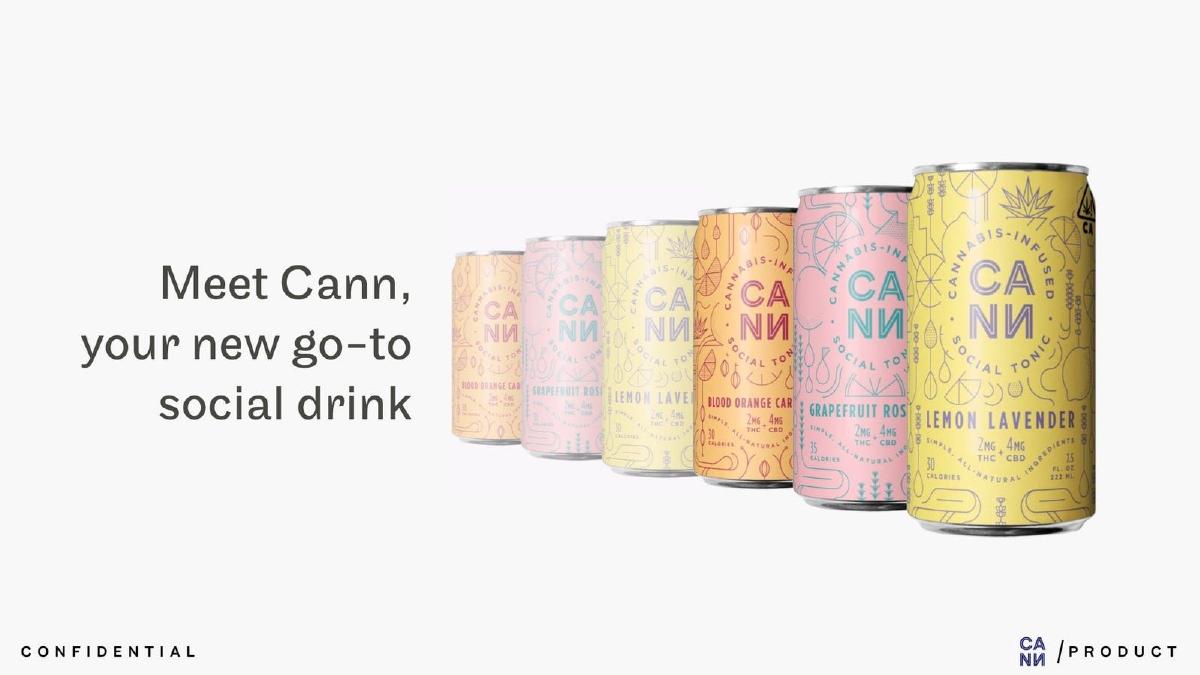
- Flavor profiles are intentionally sophisticated, featuring combinations like Grapefruit Rosemary and Lemon Lavender (Slide 5).
- The marketing strategy relies on 'Instagrammable' pop-up events to drive viral brand awareness (Slide 6).
- The deck identifies a target consumer who takes pride in 'healthy choices' and 'wellness kicks' (Slide 7).
- Cann predicts that if growth trends continue, 70%+ of the cannabis market will be low-dose by 2023 (Slide 2).
The Shift from Pot to Premium CPG
Cann’s 2019 Seed deck arrived at a pivotal moment for the cannabis industry. As reported by Business Insider, the company successfully raised $5M in a round that signaled a shift away from high-potency products toward 'social tonics.' The deck is less about the technicalities of cultivation and more about the lifestyle of the modern consumer. It frames cannabis not as a drug, but as a functional ingredient in a premium consumer packaged good (CPG).
Slide 1: The Visual Hook
The cover slide sets the tone immediately. It features the Cann logo—'Cannabis-Infused Social Tonic'—centered between two cans pouring liquid into a splash. The tagline 'The future is fluid' is a double entendre, referring both to the beverage format and the changing social norms regarding intoxicants. The aesthetic is clean, minimalist, and looks more like a high-end sparkling water brand than a traditional cannabis product.
Slide 2: Defining the Low-Dose Opportunity
Slide 2 is the most data-heavy portion of the deck. It establishes the 'Why Now?' by defining the market. It sets a clear threshold: low dose is defined as ≤5mg of THC. By citing RBC Capital Markets, Cann provides institutional credibility to their claim that low-dose products are growing 2-3x faster than the broader market. The slide notes that in Colorado, growth for these products reached 83% by the end of 2017. Most importantly, it makes a bold prediction: 70%+ of the market will be low-dose by 2023. This slide effectively argues that the 'stoner' market is saturated, and the 'social' market is the true growth engine.
Slide 3: The Social Solution
Slide 3 breaks down the product philosophy into a simple equation: Dose it right + Make it drinkable + Elevate the brand = Social beverage. It addresses the 'fear of taking too much,' a common barrier for new cannabis users. By promising a 'gradual and controllable build' and 'quick sublingual onset,' Cann positions itself as a direct substitute for the experience of drinking a beer. The mention of 'heuristics from alcohol' is a sophisticated way of saying they want to mimic the behavior of social drinking without the negative side effects.
Slide 4: The Calorie Comparison
In the wellness-obsessed market of 2019, calories were a primary battleground. Slide 4 is a simple, effective bar chart using product photography. It places Cann (30 cals) next to a gin and tonic (100 cals), White Claw (110 cals), Bud Light (110 cals), and Magners Cider (150 cals). The headline 'Significantly healthier than low-cal social drinks' directly attacks the 'healthy' perception of hard seltzers, which were booming at the time.
Slide 5: Sophisticated Flavor Profiles
Slide 5 focuses on the culinary aspect of the brand. Instead of 'Green Apple' or 'Watermelon'—flavors often associated with candy-like edibles—Cann lists Blood Orange Cardamom, Grapefruit Rosemary, and Lemon Lavender. This reinforces the 'sophisticated' and 'savory' positioning. The bottom of the slide features four icons: Non-GMO, No Stevia, No Artificial Flavors, and No Gluten. This is a checklist for the Whole Foods-adjacent consumer.
Slide 6: Marketing and Virality
Slide 6 moves into the 'Go-to-Market' strategy. It shows a photograph of a modern, wood-paneled retail pop-up. The text emphasizes 'Instagrammable' events. This is a crucial distinction for a cannabis brand; because federal regulations often limit traditional advertising (like Facebook or Google ads), Cann identifies physical, shareable experiences as their primary engine for customer acquisition.
Slide 7: The Target Persona
The final slide in this sequence uses a collage of lifestyle photography—young, diverse, attractive people in social settings. The quotes are designed to represent the brand's target psychographic: 'My friends tell me I have good taste,' 'I’m not drinking alcohol tonight... but I bet you won’t notice the difference,' and 'I take pride in making healthy choices.' This slide isn't about the product; it's about the identity the consumer adopts by holding the can.
What Cann Got Right
Category Creation: Cann didn't just launch a drink; they helped define the 'Social Tonic' category. By anchoring the deck in the 5mg dose limit, they created a safe space for investors who were wary of the 'too high' reputation of edibles.
Competitive Benchmarking: Comparing themselves to White Claw and Bud Light rather than other cannabis brands was a brilliant move. It expanded their Total Addressable Market (TAM) from the 'cannabis market' to the 'global beverage market.'
Visual Consistency: The deck is beautiful. The use of whitespace, high-quality photography, and a consistent color palette (lavender and navy) communicates a level of professionalism often missing in early-stage cannabis pitches.
What is Missing
The Team: In the provided 14-slide sequence, there is no mention of the founders' backgrounds. For a Seed round, the 'Why this team?' is usually as important as the 'Why this product?'
Financials and Unit Economics: There is no mention of the cost to produce a can, the wholesale price, or the retail price. Investors in the CPG space typically want to see gross margins and a path to profitability.
Distribution Strategy: While pop-ups are mentioned, the deck doesn't explain how they will navigate the complex, state-by-state regulatory environment of cannabis distribution. Getting on shelves is the hardest part of the industry, and it is unaddressed here.
The Ask: The deck ends without a clear call to action or a breakdown of how the $5M will be spent.
Founder Takeaways
Sell the 'Why,' not the 'What': Cann spends very little time talking about the cannabis plant itself. Instead, they talk about social connection, health, and flavor. If you are in a regulated or stigmatized industry, focus on the universal human benefit of your product.
Use Third-Party Validation: The inclusion of the RBC Capital Markets data (Slide 2) and the Fast Company 'Top 10 for Health' mention for Dosist (used as a market proxy) gives the pitch an air of inevitability. It shows the founder has done their homework on market trends.
Design Matters: If you are building a consumer brand, your pitch deck is your first product. Cann’s deck looks like their packaging. It proves they understand brand identity before they even have a conversation with the investor.
Frequently asked questions
- How does Cann define its competitive advantage over alcohol?
- Cann focuses on health and social parity. Slide 4 shows Cann has only 30 calories, significantly lower than White Claw (110) or Bud Light (110). Slide 3 emphasizes 'heuristics from alcohol,' meaning the drink is designed to be consumed at the same pace and in the same social settings as a beer or cocktail, but without the hangover or high caloric intake.
- What market data does Cann use to justify the low-dose category?
- On Slide 2, Cann references RBC Capital Markets Equity Research from August 2018. The data highlights that low-dose products are growing 2-3x faster than the general cannabis market and that 33% of the market was already low-dose at the time of the pitch.
- What are the specific ingredients and health claims mentioned?
- Slide 5 lists 'sophisticated, natural, savory flavors' and explicitly highlights that the product is Non-GMO, contains no stevia, no artificial flavors, and is gluten-free. The primary flavors listed are Blood Orange Cardamom, Grapefruit Rosemary, and Lemon Lavender.
- How does Cann plan to acquire customers?
- According to Slide 6, the company focuses on 'Pop-up events.' The goal is to create 'highly visible (and Instagrammable) events' that educate consumers and encourage social media sharing to achieve viral growth, rather than relying solely on traditional dispensary foot traffic.
- What is missing from this pitch deck?
- This version of the deck is heavily focused on brand and market positioning. It lacks a team slide (founder backgrounds), a specific financial 'Ask' (how much they are raising and for what), a roadmap, and detailed unit economics or revenue projections.