Kora’s 11-slide deck is a masterclass in leveraging team pedigree to justify a high-capital hardware play. By positioning themselves directly against Tesla, the founders simplify a complex energy problem into a clear 'better, faster, stronger' hardware comparison. The deck highlights a 4-in-1 system that includes smart panels, modular storage up to 112 kWh, and a virtual power plant platform. While the deck succeeds in establishing technical credibility and market need—citing $1.2B in wasted renewable energy in California alone—it notably lacks a business model slide, financial projections, o…
Key takeaways
- The deck leads with a 'Proven Team' slide featuring a CEO who generated $500M in revenue and a CTO who exited Sonnen to Shell for $500M (Slide 2).
- Kora identifies a massive inefficiency in the status quo, stating California 'throws away up to $1.2B of renewable energy each year' (Slide 3).
- The product is positioned as a '4-in-1 system' comprising a Smart Panel, Home App, Powerblocks, and Energy Trading (Slide 4).
- Hardware specs are used to directly challenge the market leader, claiming 112 kWh of storage compared to Tesla Powerwall 3’s 94.5 kWh (Slide 5).
- The software interface focuses on 'Circuit Priorities,' allowing users to manage high-priority loads like water heaters and refrigerators (Slide 6).
- The deck omits a traditional 'Ask' slide, business model details, and go-to-market strategy in the provided 11-slide sequence.
- Kora successfully raised $2.6M in a 2024 Seed round as reported by Business Insider.
- The technical team includes a 35-year veteran who worked at Apple under Jobs and Wozniak (Slide 2).
The Kora Pitch Deck Analysis
Kora enters the crowded home energy sector with a clear target: the Tesla Powerwall. In a market often bogged down by regulatory complexity and installation friction, Kora’s deck focuses on hardware superiority and a 'proven' executive team. Based in North America and raising a $2.6M Seed round in 2024, the company presents an 11-slide narrative that prioritizes technical specs and founder pedigree over traditional financial modeling.
Slide 1: Title Slide
The deck opens with a minimalist title slide featuring the Kora logo and the tagline 'Wield Your Power.' The branding is clean, utilizing a light blue background that suggests 'clean energy' without relying on clichéd green imagery. It sets a professional, consumer-electronics-first tone rather than a utility-heavy vibe.
Slide 2: The 'Proven Team'
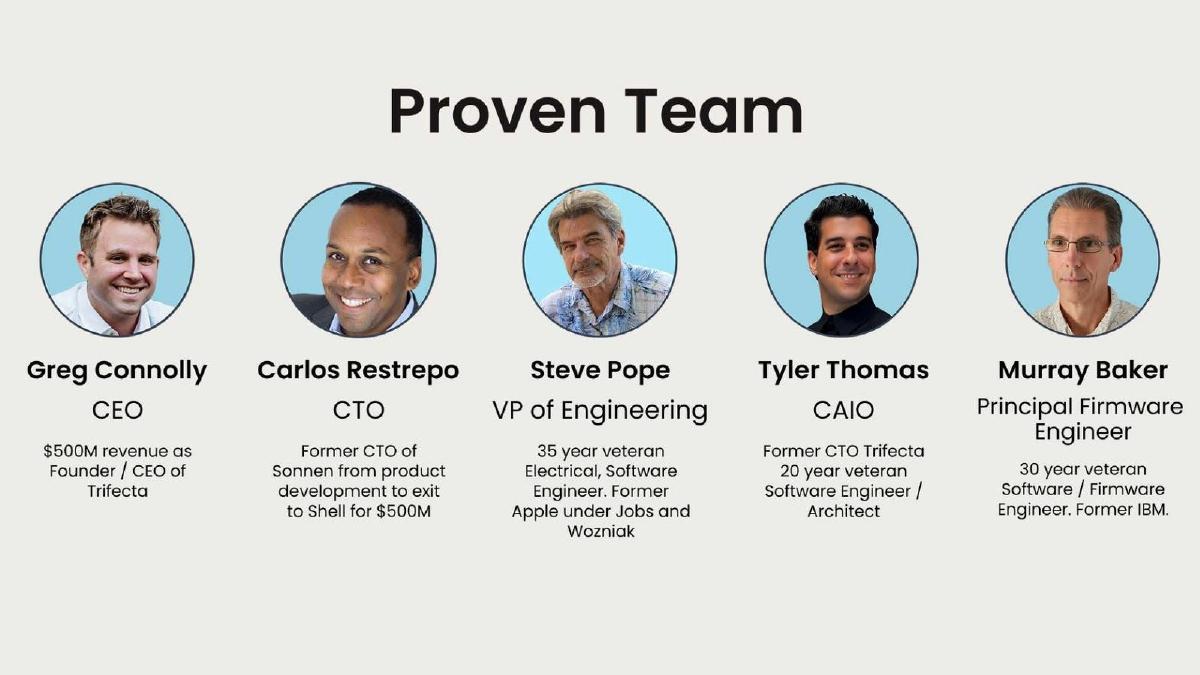
Kora makes a strategic choice to place the team slide second, immediately following the title. This is a common tactic for 'second-time' founders or teams with significant exits. The slide lists five key members, emphasizing their 'proven' nature. CEO Greg Connolly is credited with $500M in revenue at Trifecta. CTO Carlos Restrepo is highlighted for his role at Sonnen, which exited to Shell for $500M. The technical depth is further bolstered by Steve Pope (VP of Engineering), a 35-year veteran of Apple under Jobs and Wozniak, and Murray Baker (Principal Firmware Engineer), a 30-year veteran of IBM. By leading with this, Kora tells investors that the $2.6M they are asking for is being managed by people who have already built and sold companies at scale.
Slide 3: Wasted Energy, Lost Value
The problem slide focuses on the inefficiency of the current renewable grid. It cites a specific, high-impact figure: 'California alone throws away up to $1.2B of renewable energy each year.' This slide establishes the 'Why Now?'—as solar adoption climbs, the inability to store and deploy that energy becomes a billion-dollar problem. The slide uses a high-quality image of a residential solar array to ground the problem in the consumer home.
Slide 4: Kora Home Energy System
This slide introduces the solution as a 'fully integrated 4-in-1 system.' It breaks the product down into four components: the Smart Panel (control), the Home App (automation), Powerblocks (modular storage), and Energy Trading (the Virtual Power Plant). The key takeaway here is the modularity; the slide notes storage capacity 'up to 112 kWh,' which positions the product for both small homes and large estates. This is the first mention of the 'Virtual Power Plant' concept, which is the software layer that turns a battery from a cost-saving tool into a revenue-generating asset.
Slide 5: Competitive Comparison (Tesla)
Slide 5 is perhaps the most aggressive and effective in the deck. Titled 'Tesla Built a Battery. We Built a System,' it directly compares Kora’s specs to the Tesla Powerwall 3. It claims Kora can store 112 kWh versus Tesla’s 94.5 kWh. It also highlights 'circuit-level visibility' as a built-in feature, contrasting it with the 'Frankenstein add-on brands' required by competitors. This slide is designed to appeal to investors who believe Tesla’s dominance in the space is vulnerable to a more integrated, higher-capacity alternative.
Slide 6: The Future of Home Energy
The final slide in the provided sequence showcases the mobile app interface. It displays 'Grid Interaction' metrics, showing a user earning $136 by selling energy back to the grid. It also highlights 'Circuit Priorities,' showing how a user can prioritize power to a refrigerator or water heater during a discharge event. This slide visualizes the 'Energy Trading' and 'Smart Panel' features mentioned earlier, proving that the software interface is as considered as the hardware.
What Works in the Kora Deck
1. Extreme Team Credibility: In hardware-heavy startups, the 'can they actually build it?' question is the biggest hurdle. By showcasing a CTO who already exited a home energy company (Sonnen) for half a billion dollars, Kora effectively de-risks the technical execution in the eyes of investors.
2. Direct Competitive Positioning: Instead of hiding from the 800-pound gorilla in the room, Kora puts Tesla front and center. By winning on specific metrics (kWh capacity and integrated circuit visibility), they create a clear 'better' narrative that is easy for a Seed-stage investor to grasp.
3. The 'Virtual Power Plant' Upside: The deck moves beyond simple hardware sales by mentioning energy trading. This suggests a recurring revenue model or a platform play where Kora takes a cut of wholesale energy trades, though the specifics of the business model are not detailed in these slides.
What is Missing from the Kora Deck
1. Business Model and Unit Economics: The deck explains what the product does, but not how the company makes money. Is it a direct-to-consumer sale? Do they partner with solar installers? What is the margin on a 112 kWh system? These are critical questions for a $2.6M Seed round that remain unanswered in the provided slides.
2. Go-To-Market (GTM) Strategy: Hardware is notoriously difficult to distribute. The deck does not explain how Kora plans to acquire customers or navigate the complex landscape of electrical contractors and utility regulations.
3. The 'Ask' and Use of Funds: There is no slide detailing how much capital is being raised or what the milestones are for the next 18 months. While we know from external reporting that they raised $2.6M, a standard pitch deck should clearly state the funding goal and how it will be deployed (e.g., R&D, manufacturing setup, initial pilot program).
Lessons for Founders
Leverage 'The Giant' to define yourself: Kora’s comparison to Tesla (Slide 5) is a textbook example of how to use a market leader as a benchmark. If you are entering a category with a dominant player, don't ignore them. Find the 2-3 technical specs where you win and make those the centerpiece of your product slide.
Quantify the 'Waste': The $1.2B figure on Slide 3 is a 'hair on fire' problem. It moves the conversation from 'it would be nice to have a battery' to 'we are losing billions of dollars by not having this.' Always look for the macro-economic cost of the problem you are solving.
Team first, product second: For deep-tech or hardware companies, your resume is your most valuable asset. Kora spent nearly 10% of their deck (Slide 2) just on the team's past successes. If your team has 'been there, done that,' make sure that is the first thing an investor sees after the title slide.
Final Thoughts
Kora’s deck is a lean, technical presentation that relies heavily on the 'who' and the 'what.' It successfully paints a picture of a superior hardware system backed by an elite team. While it leaves significant gaps regarding the 'how' (business model and distribution), the strength of the founders and the clarity of the hardware advantages were clearly enough to secure their $2.6M Seed round. For founders in the consumer electronics or energy space, Kora provides a strong template for high-level positioning against industry incumbents.
Frequently asked questions
- What is Kora's primary competitive advantage?
- Kora differentiates itself by offering a fully integrated 'system' rather than just a battery. According to Slide 5, they offer higher storage capacity (112 kWh vs. Tesla's 94.5 kWh), circuit-level visibility without third-party add-ons, and direct access to wholesale energy markets through their Virtual Power Plant platform.
- How does Kora plan to help homeowners save money?
- The deck outlines a two-pronged approach: internal efficiency and external trading. Slide 4 mentions a Home App that automates savings based on weather and real-time rates, while the Energy Trading feature allows users to sell excess power back to the grid at wholesale rates.
- Who are the key people behind Kora?
- The team is highly experienced, featuring CEO Greg Connolly (formerly Trifecta), CTO Carlos Restrepo (formerly Sonnen), and VP of Engineering Steve Pope (formerly Apple). The slide also lists Tyler Thomas as CAIO and Murray Baker as Principal Firmware Engineer, totaling over 100 years of combined technical experience (Slide 2).
- What specific problem is Kora solving in the energy market?
- Kora addresses 'Wasted Energy' and 'Lost Value.' Slide 3 notes that California alone wastes $1.2B in renewable energy annually because the current grid cannot harness and deploy it effectively. Kora aims to capture this wasted solar energy for residential use and grid stabilization.
- Is there information on the company's financials or valuation in the deck?
- No. The 11-slide deck provided does not include revenue projections, unit economics, or a valuation. While Business Insider reports a $2.6M Seed round raise in 2024, the deck itself focuses almost entirely on the team, the problem, and the hardware specifications.