Carta’s 2018 Series D deck, which secured $80M led by Tribe Capital and Meritech, is notable for its minimalist design and aggressive focus on network effects. Rather than dwelling on features, the deck positions Carta as a financial utility—the 'cables' of the equity world. It leverages impressive growth metrics, including $50M in ARR and 10,000 subscription customers, to argue that equity management is just the first node in a much larger asset ownership graph. The deck successfully transitions the narrative from a B2B SaaS cap table tool to a global financial infrastructure play, targeting…
Key takeaways
- The deck reports a significant scale of $50M in ARR and approximately 10,000 subscription customers by the time of the Series D (Slide 15).
- Carta identifies Venture Capital as its 'first network,' utilizing the natural connections between companies, employees, and VCs to drive growth (Slide 9).
- The company explicitly defines its second network effect through Limited Partners (LPs), creating a multi-layered ecosystem of data (Slide 10).
- Payback periods are shown to fluctuate between 11.4 and 21.1 months, providing transparent unit economics for a late-stage round (Slide 18).
- The vision expands beyond startups to include Private Equity, Public Companies, and Real Estate as the next logical steps in the asset ownership graph (Slide 12).
- The deck omits a traditional team slide and a specific 'ask' slide, focusing instead on the momentum and the 'utility' nature of the business (Slides 1-23).
- Growth in shareholders on the platform reached approximately 700,000 by late 2018, illustrating the massive reach of their data set (Slide 19).
- The narrative concludes by comparing Carta to the Bell System, positioning their software as the 'financial cables' for the next century (Slide 22).
The Infrastructure of Ownership: A Series D Analysis
Carta's Series D deck is a departure from the typical high-growth SaaS presentation. By 2018, Carta had already established itself as the dominant player in cap table management. This deck wasn't designed to prove product-market fit; it was designed to prove that Carta was becoming a financial utility. The $80M raised in this round was predicated on the idea that equity management was merely the entry point into a global registry of all assets.
Slides 1-4: The Problem and the Core Solution
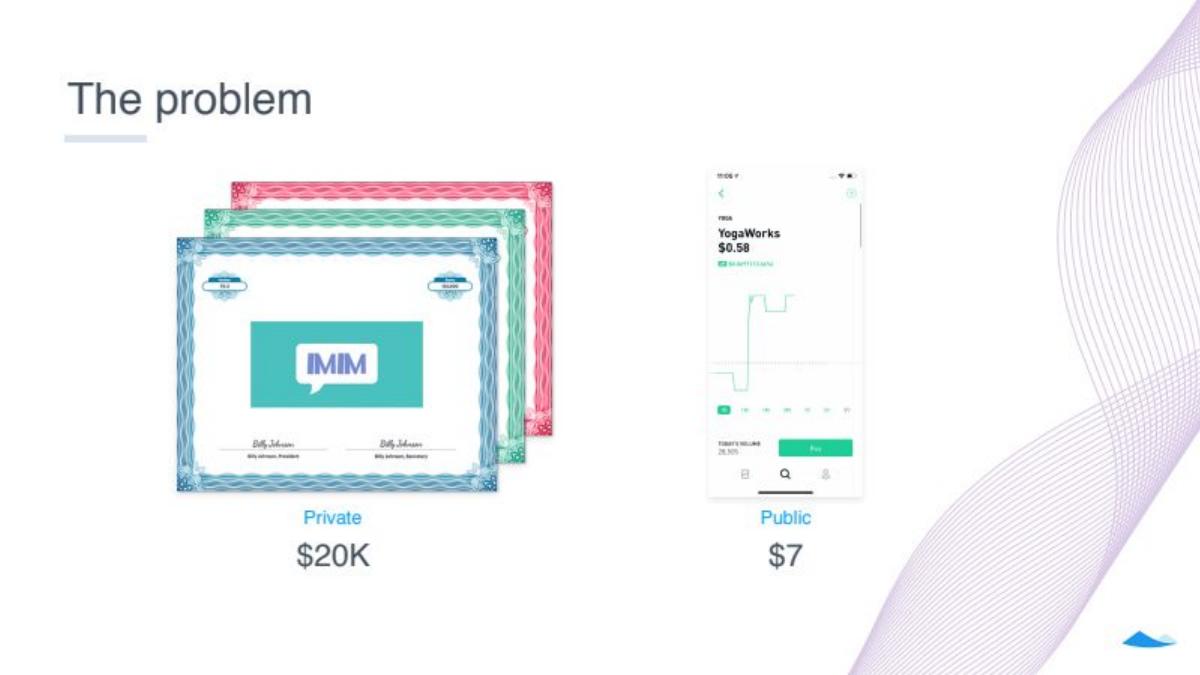
The deck opens with a minimalist title slide (Slide 1) and moves immediately into a visual representation of the problem on Slide 2. It contrasts 'Private' ownership, represented by physical paper certificates costing $20K in legal/admin friction, against 'Public' ownership, represented by a mobile app (resembling Robinhood) where the friction cost is $7. This $20K vs. $7 comparison is the core thesis of the company's existence.
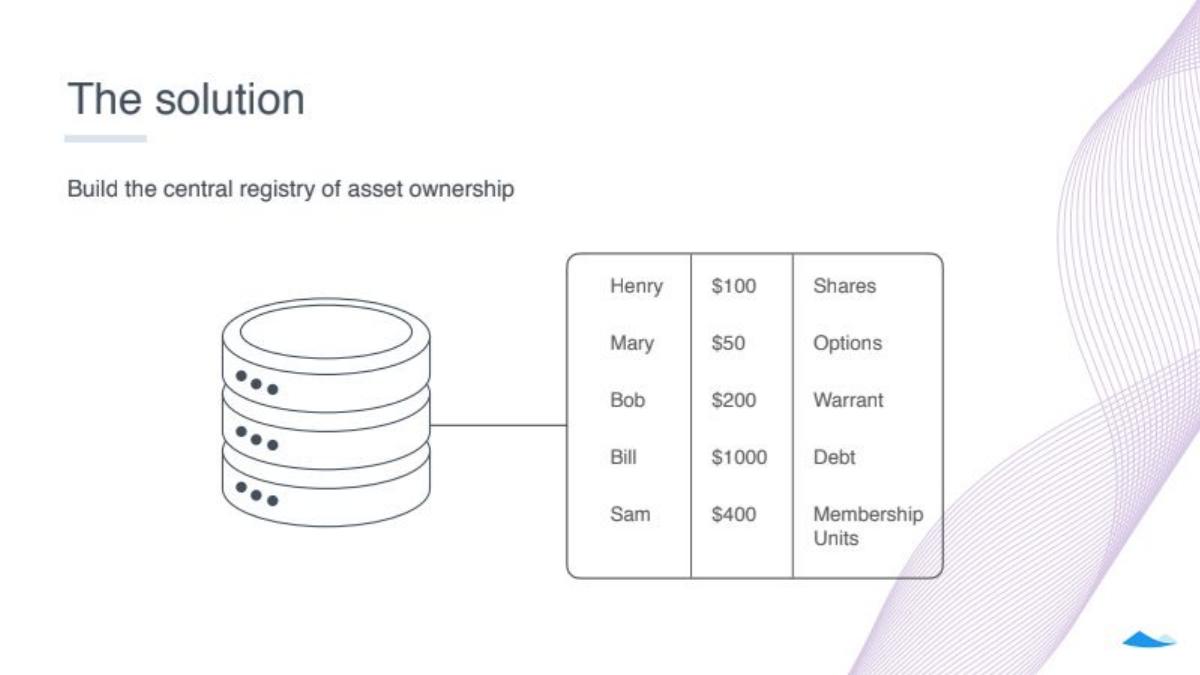
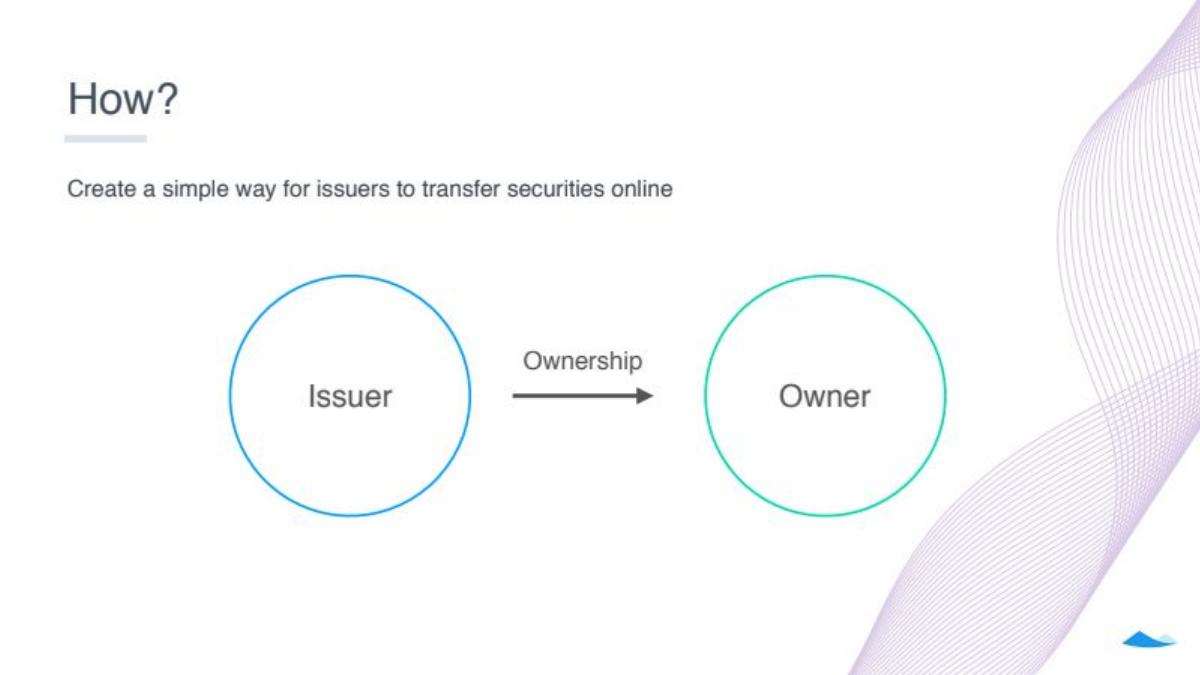
Slide 3 defines the solution simply: 'Build the central registry of asset ownership.' The visual is a database connected to a table listing names like Henry, Mary, and Bob, alongside asset types like Shares, Options, Warrants, Debt, and Membership Units. Slide 4 simplifies the 'How' into a single arrow moving from 'Issuer' to 'Owner,' emphasizing the goal of creating a simple way to transfer securities online.
Slides 5-8: Product Capabilities and Data Integrity
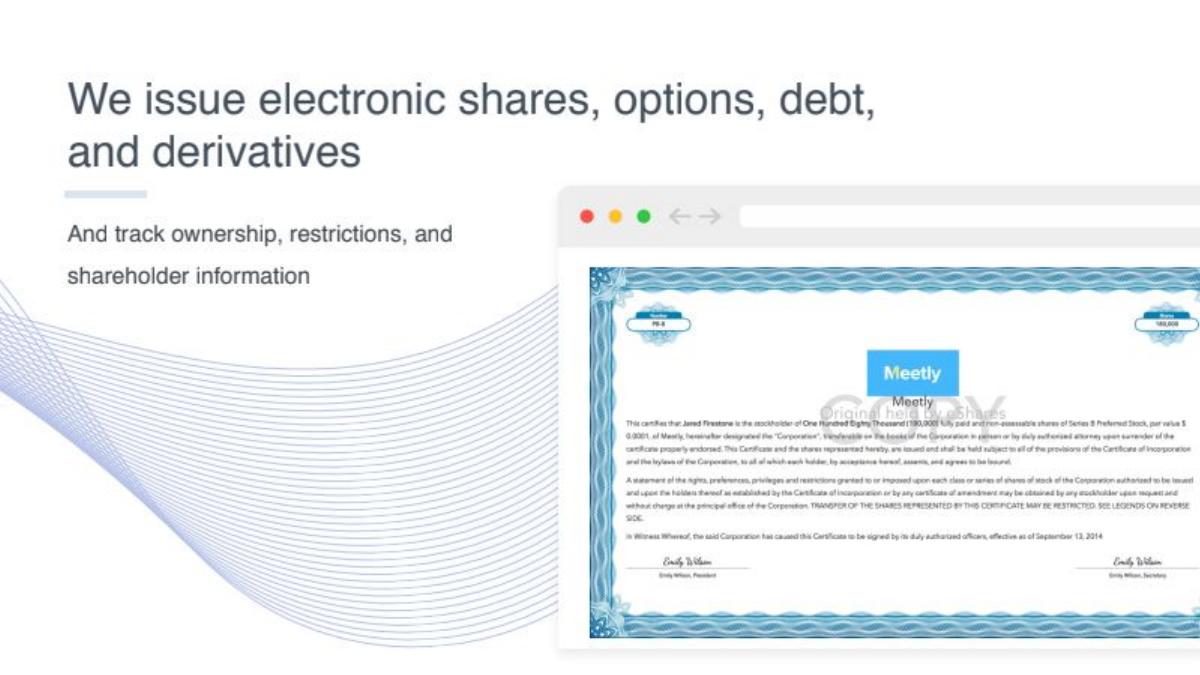
Slides 5 through 8 serve as a product walkthrough, but with a focus on the legal and administrative weight the software carries. Slide 5 shows the issuance of electronic shares, while Slide 6 highlights the automation of 'approval, and compliance,' featuring a screenshot of an option grant acceptance workflow. Slide 7 and 8 demonstrate the two sides of the platform: the cap table view for the issuer (tracking liabilities) and the portfolio view for the owner (tracking assets). By showing both sides, Carta reinforces its position as the single source of truth for both parties in a transaction.
Slides 9-12: The Network Effect Strategy
This is the most critical section of the deck. Slide 9 introduces the concept of 'Venture capital is our first network.' It uses a hub-and-spoke diagram showing how one company connects to multiple VCs and employees. Slide 10 expands this to the 'second network': Limited Partners (LPs). This diagram is significantly more complex, showing how VCs connect to LPs, banks, and other companies. The text notes that membership in funds is a 'larger and more valuable network effect.'
Slide 11 distills the business strategy: 'Sell software and financial products into each node in the network.' This explains how Carta moves from a simple tool for startups to a platform for the entire financial ecosystem. Slide 12, titled 'And keep going...', shows a bar chart of market expansion. It starts with VC and LPs, then moves to PE (Private Equity), All Private Companies, Public Companies (including transfer agents and employee equity brokerages), and finally Real Estate. This slide transforms Carta from a 'startup tool' into a 'TAM-less' infrastructure play.
Slides 13-19: The Hard Metrics of Scale
After the vision, Carta provides the proof. Slide 14, 'Carta at a glance,' lists 7 offices, 450 employees, $50M in ARR, ~700,000 shareholders, and ~10,000 subscription customers. These are massive numbers for a Series D in 2018. Slide 16 and 17 provide the growth curves for ARR and subscription customers from Q1 2016 to Q4 2018 (estimated). The growth is remarkably linear and consistent, which is exactly what late-stage VCs look for.
Slide 18 is a rare inclusion in public decks: a detailed 'Payback period' chart. It tracks Customer Acquisition Cost (CAC) against Average New ARR, showing a payback period ranging from 11.4 months to 21.1 months. While a 21-month payback is on the higher side for SaaS, the deck presents it transparently, likely justified by the high retention and network effects mentioned earlier. Slide 19 concludes the data section by showing the growth of shareholders on the platform, reaching the 700K mark.
Slides 20-23: The Visionary Close
The final section shifts back to the 'Big Idea.' Slide 21, 'Ownership as simple as payroll,' uses logos of Uber, Cargill, and Airbnb to show how ownership could expand to drivers, employees, and hosts. A small note at the bottom clarifies these are 'not current customers,' but rather a vision of the future. Slide 22 provides the ultimate analogy: Carta as a utility company. It compares the company to the Bell System, stating, 'Our software forms the electronic cables that will endure for the next century.' This is a bold claim intended to justify a high valuation multiple by suggesting permanent market dominance.
What Works in This Deck
The Network Effect Narrative: By explicitly mapping out how VCs lead to LPs and how LPs lead to more companies, Carta makes their growth seem inevitable rather than hard-won. · Infrastructure Positioning: Comparing software to 'financial cables' (Slide 22) is a powerful way to move away from being viewed as a 'discretionary' SaaS spend to an 'essential' utility. · Unit Economics Transparency: Including the payback period (Slide 18) shows a level of financial maturity and honesty that builds significant trust with Series D investors. · Visual Simplicity: The deck uses very little text. It relies on clear diagrams and large-font metrics, making it easy to digest in a single sitting.
What Is Missing
Team Slide: There is no mention of the founders or the executive team. While common in late-stage rounds where the numbers speak for themselves, it is a notable omission for any founder looking to copy this format. · Competition: The deck does not mention competitors like Solium (later acquired by Morgan Stanley) or Computershare. It assumes a position of market leadership where the only competition is the 'old way' of doing things (paper certificates). · The Ask: There is no slide detailing how much they are raising or what the funds will be used for. This information was likely handled in the verbal pitch or the data room, but its absence in the deck makes the presentation feel more like a 'state of the union' than a request for capital.
Founder Takeaway: The 'Utility' Playbook
If you are a founder in a space that involves data exchange between multiple parties (marketplaces, fintech, supply chain), the Carta deck is your blueprint. Don't just sell your product; sell the network that your product creates. By showing how each new customer makes the platform more valuable for existing customers (the VC-LP-Company link), you change the conversation from 'cost per seat' to 'value of the node.'
Furthermore, Carta's use of the 'Asset Ownership Graph' (Slide 12) is a masterclass in showing a path to a massive TAM without sounding unrealistic. They didn't say they were doing Real Estate today; they showed it as the logical fifth step in a proven sequence. This allows investors to price in future potential without fearing that the company is losing focus on its core business.
Frequently asked questions
- What is the core business model presented in the Carta deck?
- Carta operates as a B2B SaaS platform. According to the editorial context and Slide 15, they generate revenue through subscription customers, reaching approximately 10,000 subscribers and $50M in ARR. Their model focuses on managing equity, compliance, and ownership data for companies, investors, and employees.
- How does Carta justify its expansion into new markets?
- Slide 12 introduces the 'asset ownership graph.' Carta argues that by mastering the VC and LP networks, they can naturally progress into Private Equity, Public Companies, and Real Estate. They view these not as separate businesses, but as deeper layers of the same fundamental problem: tracking who owns what.
- What are the key growth metrics shared in the Series D deck?
- The deck is heavy on traction. Slide 16 shows a consistent quarterly increase in ARR from Q1 2016 to an estimated Q4 2018. Slide 17 mirrors this with subscription customer growth, and Slide 19 highlights reaching over 700,000 shareholders on the platform, demonstrating a strong network effect.
- Does the deck include information on the founding team?
- No. The 23-slide deck completely omits a team slide. For a Series D round, investors are typically already familiar with the leadership, or the company's metrics and market position are considered strong enough that the 'people' risk is secondary to the 'execution' and 'scale' opportunity.
- What is the 'utility' analogy used at the end of the deck?
- On Slide 22, Carta compares itself to the Bell System (AT&T). They argue that while phones change, the underlying cables remain. Carta positions its software as the 'financial cables' of the next century, suggesting that their platform will be the permanent infrastructure for all global asset transfers.