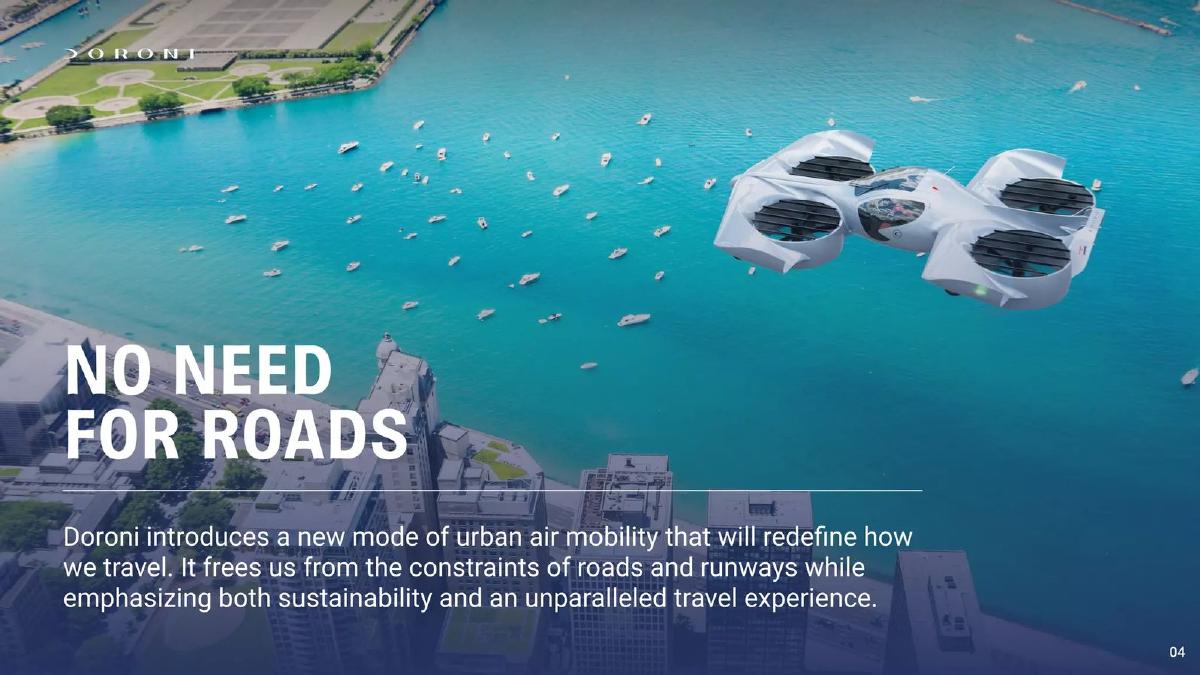
Doroni’s 30-slide investor presentation outlines a vision for personal air mobility centered on the H1, a two-seater electric vertical takeoff and landing (eVTOL) aircraft. The deck highlights significant technical progress, including over 70 test flights and the completion of a 13,000 sq. ft. R&D facility in Florida. With $4.5M already raised and 320+ pre-orders secured, the company is targeting FAA certification under LSA MOSAIC rules. The financial model is exceptionally aggressive, projecting a jump from zero revenue in 2024 to over $1 billion by 2029, predicated on scaling production to…
Key takeaways
- The company has raised over $4.5M to date and operates out of a 13,000 sq. ft. R&D facility in Pompano Beach, Florida (Slide 06).
- Doroni claims a significant technical milestone with over 70 test flights completed, including manned flights (Slide 06).
- The H1 aircraft features enclosed ducted propellers, which the company cites as a unique safety and efficiency advantage in the personal eVTOL market (Slide 09).
- Safety systems include an energy-dissipating body, triple-redundant batteries, 10 independent propulsion systems, and a whole-frame ballistic parachute (Slide 12).
- The roadmap includes a plan to raise a total of $30M between 2023 and 2025 to achieve FAA certification and first deliveries (Slide 20).
- Production targets are highly ambitious, aiming to reach a capacity of 7 units per day by the 2026-2027 period (Slide 20).
- Financial projections estimate $1.019B in sales by 2029, supported by a projected 41.8% gross margin (Slide 27).
- The team is led by CEO Doron Merdinger, an Israeli Air Force veteran, supported by a 15-person core team (Slides 06, 24).
Executive Summary: The Personal Aviation Ambition
Doroni’s investor presentation is a high-gloss vision for the future of urban air mobility. The deck focuses on the H1, a personal eVTOL designed to bypass ground-level congestion. With a clear emphasis on safety, engineering pedigree, and a roadmap that leads to mass production, the company seeks to convince investors that personal flight is no longer science fiction but a looming commercial reality. The deck is structured to move from the macro problem of traffic to the specific technical solutions offered by the H1, ending with a highly optimistic financial forecast.
Slide 01: Title and Vision
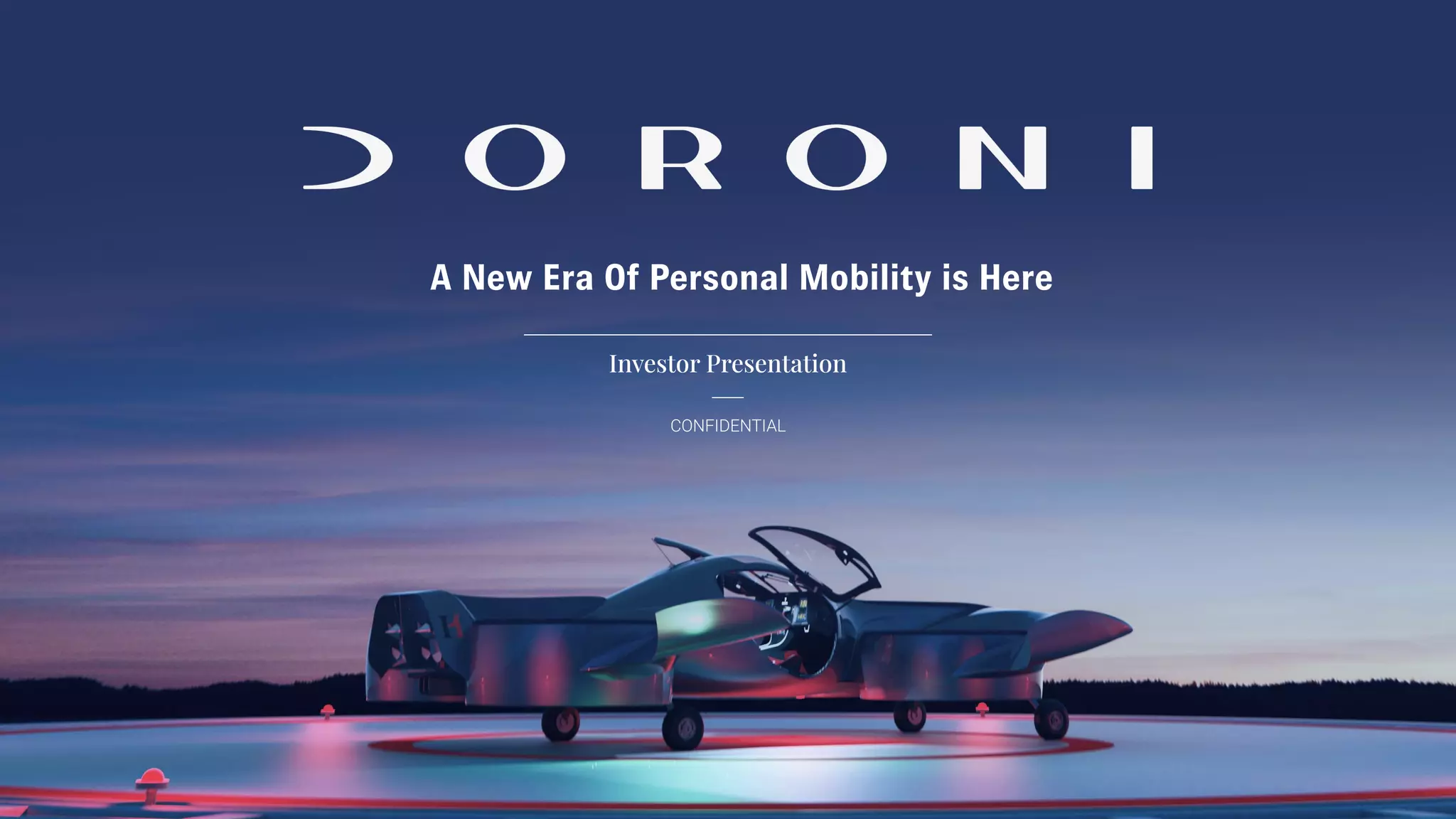
The cover slide introduces the brand with a clean, minimalist logo and the tagline "A New Era Of Personal Mobility is Here." The background image features a high-fidelity render of the H1 aircraft on a landing pad at dusk, establishing a premium, futuristic aesthetic. It clearly labels the document as an "Investor Presentation" and marks it as "CONFIDENTIAL."
Slide 03: The Problem – Roads Are Limited
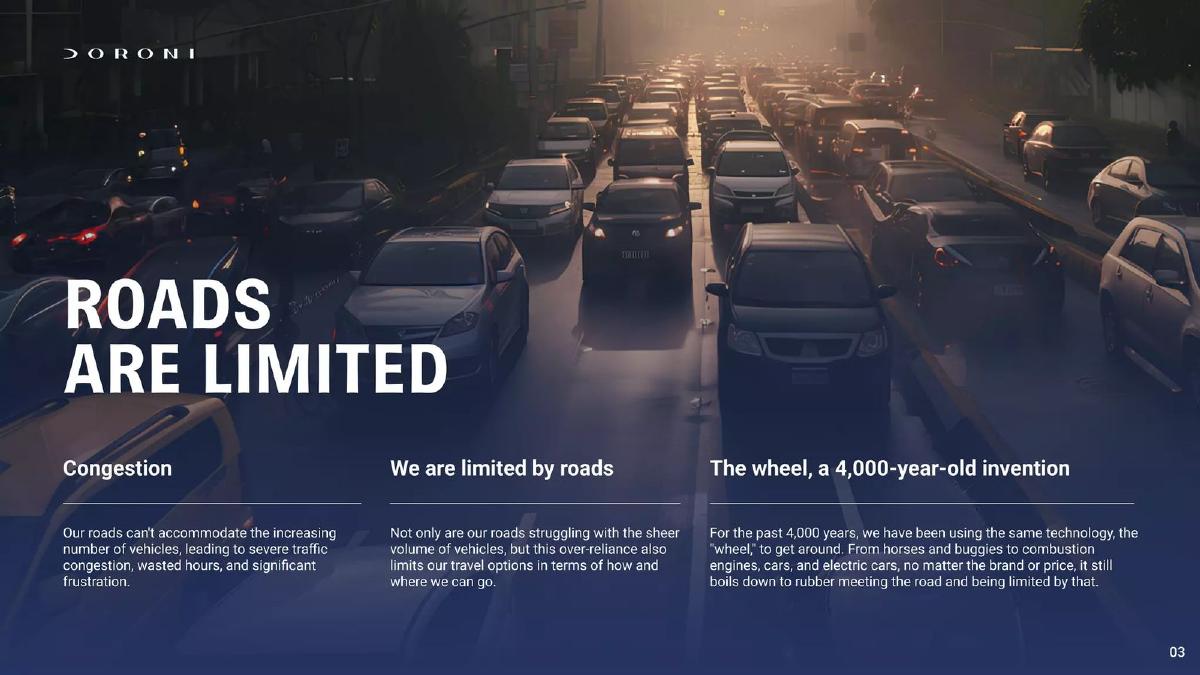
This slide establishes the "Why." It uses a high-contrast image of a traffic jam to highlight three pain points: Congestion, the physical limitation of roads, and the stagnation of the wheel as a 4,000-year-old technology. The copy argues that regardless of the power source (combustion or electric), cars are fundamentally limited by "rubber meeting the road." This sets the stage for a three-dimensional transportation solution.
Slide 06: Company Snapshot
Slide 06 provides the hard data required to establish credibility. Key metrics include:
Raised over $4.5M . · 15 core team members. · 13,000 sq. ft. R&D facility in Pompano Beach, Florida. · Collaboration with Space Florida to scale production. · Over 320 pre-order requests. · Over 70 test flights, including manned flights.
The slide also mentions that they are targeting FAA certification under LSA MOSAIC rules, which is a critical regulatory pathway for light sport aircraft.
Slide 09: Key Aircraft Features
This slide focuses on the H1's primary differentiator: Enclosed Ducted Propellers. Doroni claims to be the "Only Personal eVTOL" with this feature. The listed benefits include enhanced safety compared to exposed blades, higher lift efficiency, reduced noise levels, and a "sleek and sexy design." The visual is a top-down render emphasizing the ducting system.
Slide 12: Safety Systems
Safety is often the biggest hurdle for investor buy-in in aviation. Doroni addresses this with four pillars: Energy dissipating body , Multiples redundancy batteries , 10 independence propulsion systems (noting a typo in the slide text), and a Whole Frame ballistic parachute . The use of icons alongside a side-profile render of the aircraft makes the complex safety architecture easy to digest.
Slide 17: Inspiration and Brand Positioning
This slide uses a classic "The [Famous Brand] of [New Industry]" comparison. It aligns the Doroni H1 with the Porsche 911 and the Tesla Roadster. The narrative is that just as those vehicles defined their respective brands and eras, the H1 will define Doroni and the era of personal flight. It signals an intent to start with a high-end flagship before moving to a broader range of models.
Slide 20: The Roadmap
2017-2021: Foundation, including prototype Y6 and X8 configurations and winning the Florida Aerospace Forum. · 2022-2023: Execution, featuring the H1 P1 lift-off, 70+ flights, and securing the R&D facility. · 2023-2025 (Projected): Scaling, with a goal to raise $30M, reach 700 pre-orders, and obtain FAA certification. · 2026-2027 (Projected): Mass production, aiming for a capacity of 7 units per day.
Slide 23: Regulatory Environment
Titled "This Is Happening Now," this slide addresses the regulatory and infrastructure landscape. It cites NASA and FAA efforts to integrate flying cars into U.S. airspace. It highlights three areas: Safety standards, infrastructure development (using existing helipads), and Geofencing technology to monitor aircraft locations automatically. This slide is intended to de-risk the investment by showing that the government is actively preparing for this technology.
Slide 24: The Team
The team slide features 13 individuals, led by CEO & Founder Doron Merdinger. Merdinger is described as an Israeli Air Force veteran and NYU Stern alumnus with 25+ years in design and manufacturing. Other key roles include Chief Aerospace Engineering (David Gambill), Chief Electrical & Electronics Engineer (Derek Barger), and a Certification Manager (Kyle Turner). The inclusion of a Certification Manager is a notable detail for an aviation startup.
Slide 27: Financial Model
The final data-heavy slide presents an "Attractive Long Term Financial Model." The projections are significant:
2024: 55 units sold, $1.9M in sales (no revenue recognized yet). · 2027: 1,530 units sold, $423M in sales, turning cash flow positive. · 2029: 3,078 units sold, $1.019B in sales , with a 41.8% gross margin.
The slide notes a total cash burn of $96M until 2027 and mentions that full financial details require an NDA.
What Works in This Deck
The deck is visually cohesive and uses high-quality renders to make a futuristic concept feel tangible. The "Company Snapshot" (Slide 06) is particularly effective because it leads with traction—specifically the 70+ test flights and the 320+ pre-orders. In the eVTOL space, where many companies exist only as CAD drawings, showing a physical R&D facility and flight history is a major advantage. Furthermore, the safety slide (Slide 12) addresses the most common objection to personal flight by listing multiple layers of redundancy, including the ballistic parachute.
What Is Missing
Despite the 30-slide length, several critical components are absent from this selection. First, there is no Competitor Analysis . The eVTOL market is crowded with well-funded players like Joby, Archer, and Lilium, as well as personal-focused competitors like Jetson. Doroni does not explain how it wins against these specific rivals beyond the ducted propeller design. Second, the Unit Economics are vague. While Slide 27 shows gross margins, it doesn't break down the Bill of Materials (BOM) or the projected retail price per unit. Finally, there is no Go-to-Market (GTM) strategy . Selling 3,000 aircraft a year requires a massive sales, service, and pilot-training infrastructure that isn't detailed here.
Founder Takeaways
Lead with physical proof: If you are building hardware, follow Doroni’s lead on Slide 06. Mentioning the square footage of your facility and the number of successful tests builds immediate trust. Address regulation early: For highly regulated industries, include a slide like Slide 23 that shows you are aligned with governing bodies like the FAA. Be careful with hyper-growth projections: While the $1B revenue target on Slide 27 is impressive, the jump from $1.7M in 2025 to $77M in 2026 is a massive leap that will require intense scrutiny of the production plan. Founders should ensure they have the operational detail to back up such steep curves.
Frequently asked questions
- What is Doroni's primary product?
- Doroni’s flagship product is the H1, a personal electric vertical takeoff and landing (eVTOL) aircraft. It is designed as a two-seater vehicle intended to provide an alternative to traditional road-based commuting. The deck positions the H1 as the foundational model for a future range of diverse aerial mobility products, drawing parallels to how the Roadster defined Tesla.
- How much capital has the company raised and what is the next target?
- According to the deck, Doroni has raised over $4.5M as of the time of the presentation. Their roadmap indicates a plan to raise a total of $30M during the 2023-2025 window. This capital is intended to fund the completion of the H1 P2 prototype, obtain FAA certification, and reach the milestone of first unit deliveries.
- What is the current level of market validation for the H1?
- Doroni cites two primary forms of validation: technical and commercial. Technically, they have completed over 70 test flights, including manned flights. Commercially, they report having over 320 pre-order requests. By the 2023-2025 period, they project this number to grow to 700 pre-order requests.
- What are the key safety features of the aircraft?
- Safety is a central theme of the deck. The H1 utilizes enclosed ducted propellers to protect bystanders and improve efficiency. Internally, the aircraft features ten independent propulsion systems and multiple redundant battery packs. For catastrophic failures, the vehicle is equipped with an energy-dissipating body and a whole-frame ballistic parachute system.
- What are the projected financial outcomes by 2029?
- The financial model projects a rapid scale-up. By 2029, Doroni expects to sell 3,078 units annually, generating $1.019 billion in sales. They project a gross profit of $414.5 million (41.8% margin) and expect to turn cash flow positive in 2027 after a total cash burn of $96 million.