Doxa Holdings' Pre-Series A deck, dated Q1 2022, positions the company as a 'Collaborative Trade Ecosystem' primarily serving the construction and real estate sectors, referred to as the Built Environment. The 12-slide presentation highlights a strong focus on the Singaporean market, citing strategic partnerships with major banks like DBS, OCBC, and UOB. Doxa aims to solve inefficiencies in procurement and financing by creating a 'many-to-many' network where buyers and suppliers connect through a single platform. While the deck demonstrates significant regional traction with '7 Renowned Compa…
Key takeaways
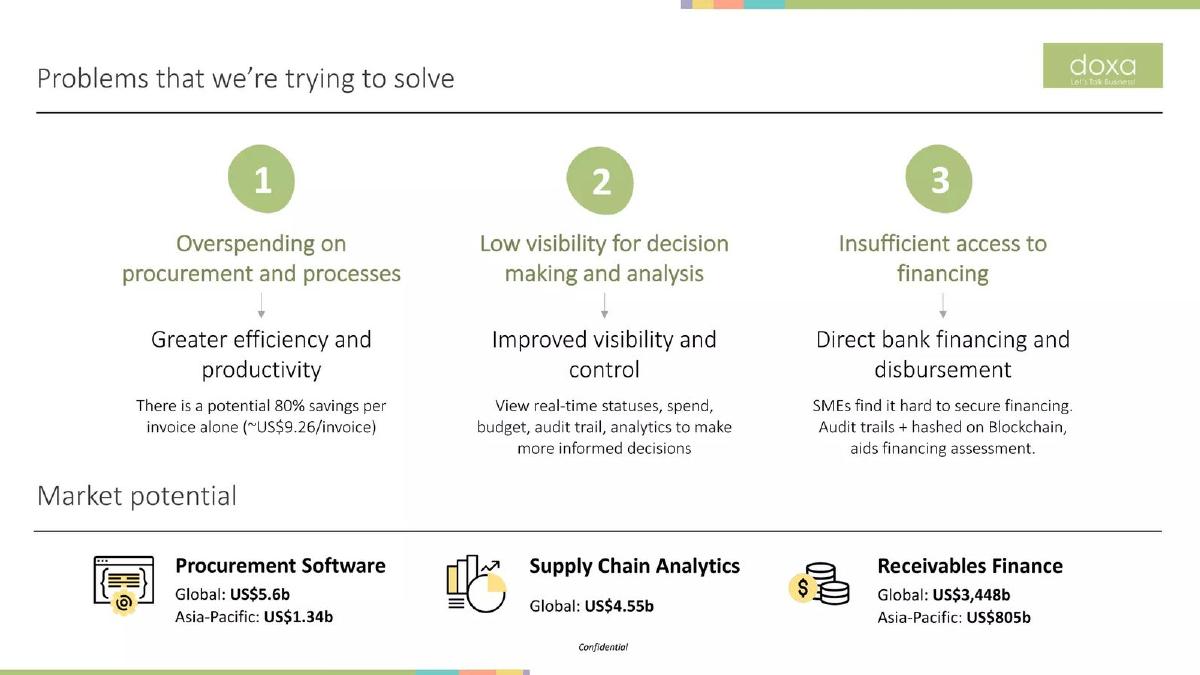
- The platform claims a potential 80% savings per invoice, estimated at approximately US$9.26 per invoice (Slide 5).
- Doxa identifies three core problems: overspending on procurement, low visibility for decision-making, and insufficient access to financing (Slide 5).
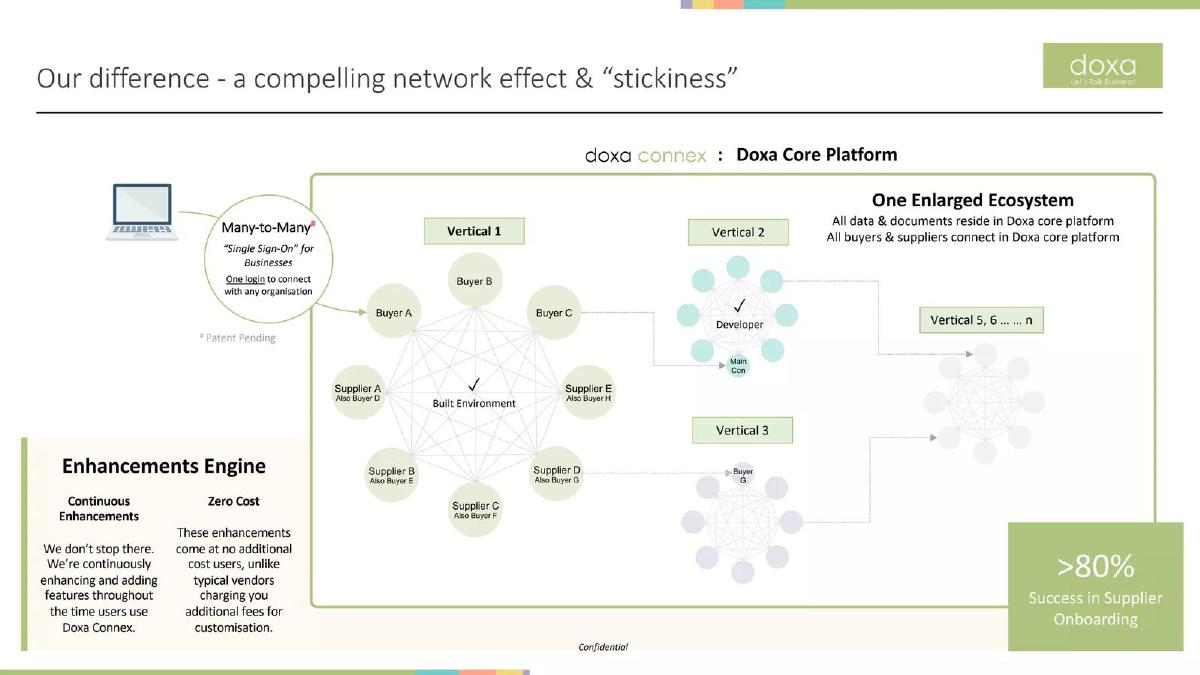
- The company utilizes a 'many-to-many' network effect, claiming a patent-pending 'Single Sign-On' for businesses to connect with any organization (Slide 6).
- Strategic partnerships are a cornerstone of their growth, featuring collaborations with DBS, OCBC, and UOB banks (Slide 7).
- The team boasts over 60 years of combined experience, with leaders having backgrounds at S&P Global and Wood Mackenzie (Slides 3 and 9).
- Doxa targets a serviceable market of over S$185m across Singapore, Malaysia, and Indonesia (Slide 9).
- The deck highlights a successful supplier onboarding rate of greater than 80% (Slide 6).
- Future expansion plans include moving into new verticals such as leasing and rental using the existing core modules (Slide 11).
Slide-by-Slide Teardown
Slide 1: Title Slide
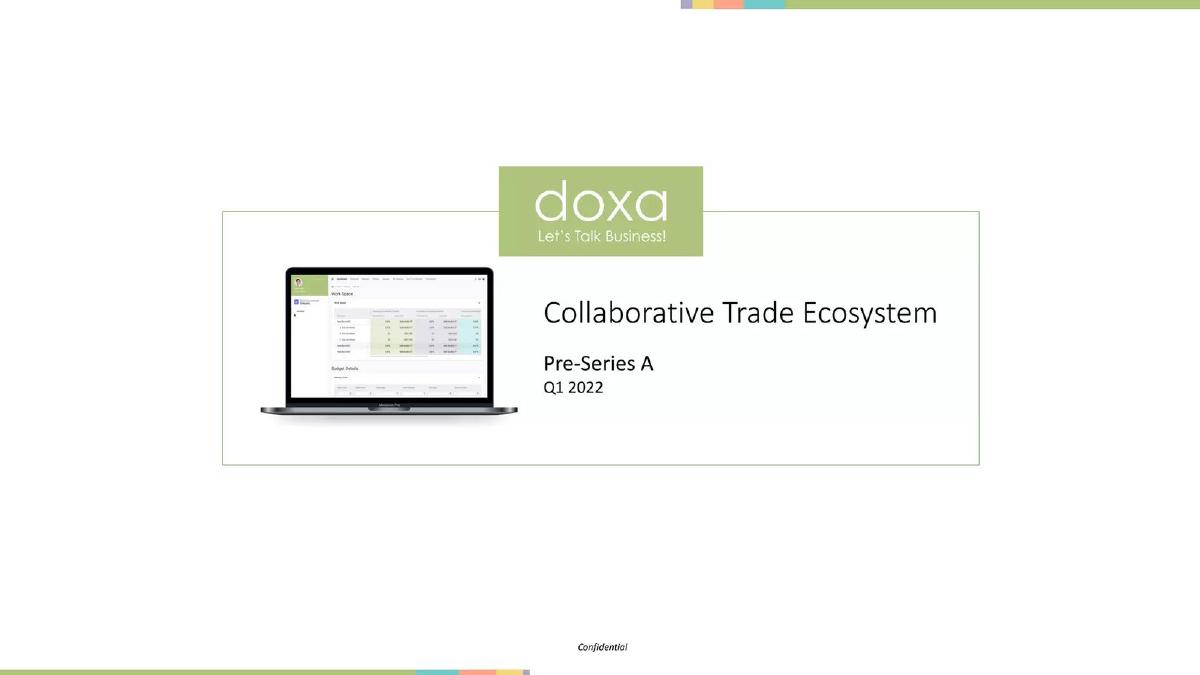
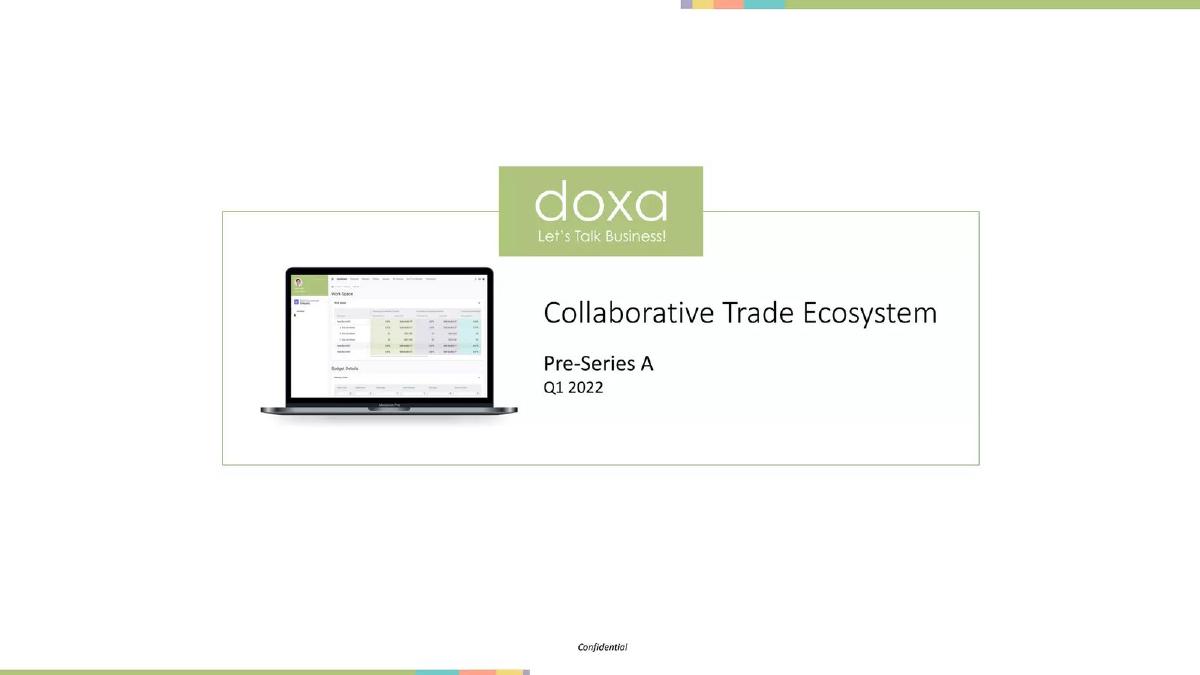
The cover slide introduces Doxa as a "Collaborative Trade Ecosystem." It specifies the funding stage as "Pre-Series A" and the date as "Q1 2022." A product mockup on a laptop shows a dashboard interface with columns for "Budget Details" and "Work Space," establishing the company as a software-driven solution from the outset.
Slide 2: Agenda
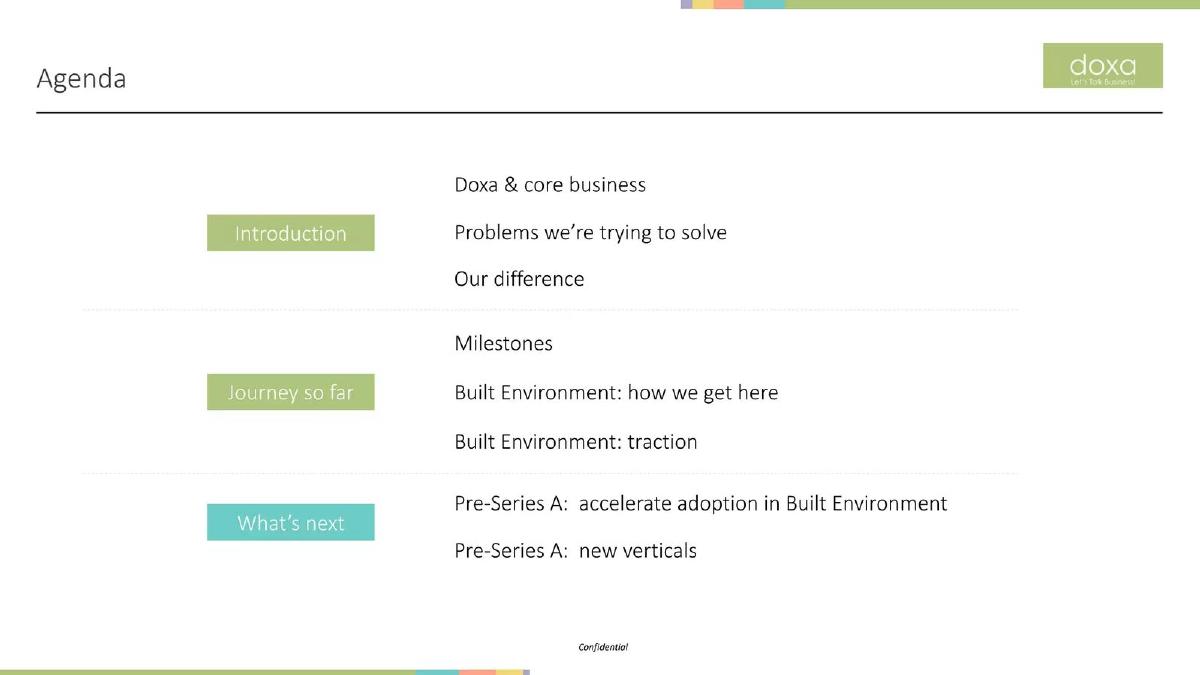
A standard table of contents divided into three sections: Introduction (Core business, Problems, Difference), Journey so far (Milestones, Built Environment traction), and What’s next (Pre-Series A goals and new verticals). This provides a logical flow for a 12-slide deck.
Slide 3: Who we are (Team)
The team slide focuses on three key figures. Edmund Ng (MD, Business & Product Development) is credited with 20+ years in fintech and supply chain, having founded three startups and taken one to a $20m valuation. Leon Yeo (Commercial & Operations) brings experience from S&P Global and Wood Mackenzie, highlighting his history of managing revenue between US$10m and US$300m. Henry Kwan is listed as an Advisor and Co-founder with a background in Big Data. The slide emphasizes "60 years of combined experience" later in the deck, positioning the founders as industry veterans rather than first-time entrepreneurs.
Slide 4: What’s our core business
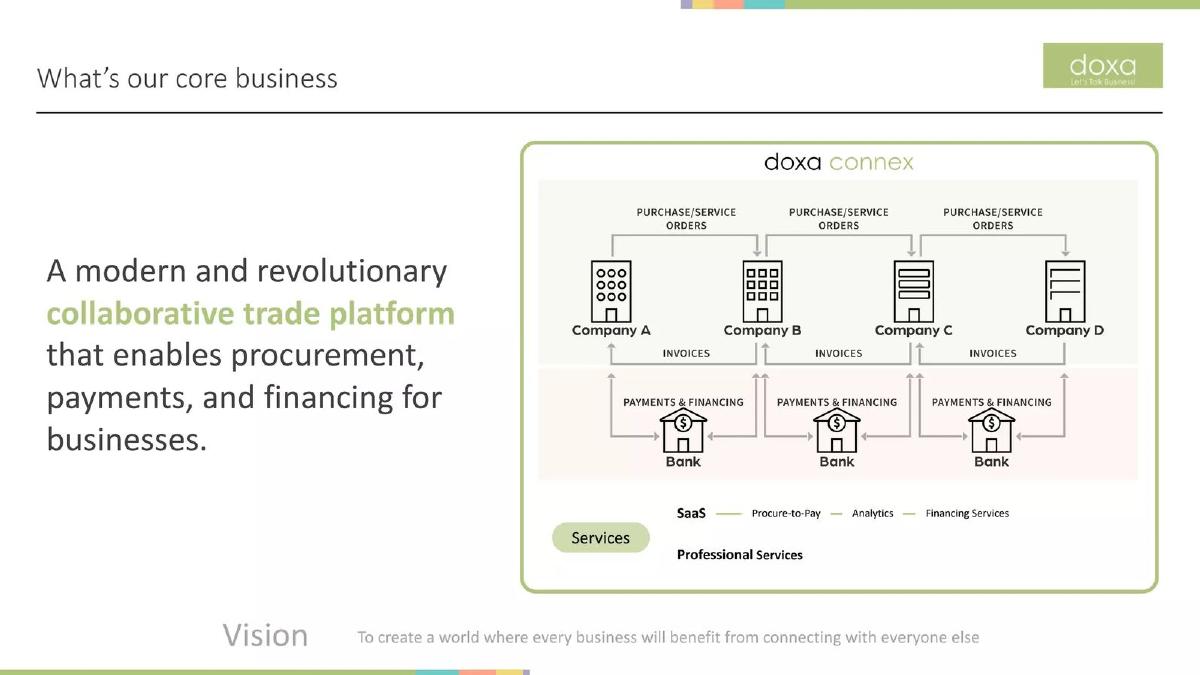
This slide defines "Doxa Connex" as a collaborative trade platform for procurement, payments, and financing. A diagram illustrates a linear flow between Company A, B, C, and D, showing how purchase orders and invoices move between them, while banks provide the underlying payments and financing. It categorizes their offerings into SaaS (Procure-to-Pay, Analytics, Financing Services) and Professional Services.
Slide 5: Problems that we’re trying to solve
Doxa identifies three pain points: 1) Overspending on procurement, 2) Low visibility for decision-making, and 3) Insufficient access to financing. They quantify the solution by claiming a potential 80% savings per invoice (~US$9.26). The slide also includes "Market potential" figures, citing a global procurement software market of US$5.6b and a massive receivables finance market of US$3,448b globally, with US$805b in Asia-Pacific.
Slide 6: Our difference - a compelling network effect & "stickiness"
This slide introduces the "Many-to-Many" concept, which they claim is patent-pending. It visualizes an ecosystem where multiple buyers and suppliers in the "Built Environment" (Vertical 1) are interconnected. The strategy is to replicate this model across other verticals. A key metric provided here is a ">80% Success in Supplier Onboarding," which is a critical KPI for B2B platforms that rely on network density.
Slide 7: Milestones
A detailed timeline from 2019 to 2022. Key events include being approved as an NTP VAS by Singapore Customs in 2019, expanding to Malaysia in late 2019, and securing strategic partnerships with DBS (2020), OCBC (2021), and UOB (2021). The timeline also shows the rollout of specific modules: Construction, Sub-Con, Developer, and Financing. The inclusion of logos like Tiong Seng and GuocoLand provides social proof of their enterprise adoption.
Slide 8: Built Environment - our traction
This slide serves as a visual proof of market acceptance. It features headlines from The Business Times regarding Doxa's launch with DBS and its pilot with GuocoLand and OCBC. It also shows photos of the team receiving the "Rising Star Award" and being named a "Top 15 Finalist" for the Emerging Enterprise Award. This slide reinforces the "Market Recognition" and "Market Adoption" claims made earlier.
Slide 9: Pre-Series A: Built Environment
This slide summarizes the investment thesis for the current round. It claims "no direct competition in APAC" and highlights a strong pipeline. It quantifies their current reach: 7 renowned companies plus approximately 300 suppliers, with a combined revenue of over S$2.5b. The serviceable market is stated as >S$185m across Singapore, Malaysia, and Indonesia.
Slide 10: Built Environment – accelerate adoption
This acts as the "Use of Funds" slide. It outlines four pillars: 1) Ramp up Sales & Marketing (increasing headcount from 4 to 13), 2) Strengthen Product Offerings (mobile apps, data analytics), 3) Expand outside Singapore (Malaysia and Indonesia), and 4) Drive usage and stickiness (implementation specialists and customer care). It is specific about headcount but lacks a dollar amount for the total raise.
Slide 11: Series A: new verticals
Looking beyond the current round, this slide explains how the core modules (Purchasing, Rental, Leasing, Sourcing, etc.) can be applied to new industries. It suggests that because the applications are already "ready," the cost of development for each new vertical will be lower, allowing for quicker development and leveraging existing bank partnerships.
Slide 12: Thank You
A standard closing slide with the company logo and "Let's Talk Business!" tagline. It lacks contact information or a call to action, which is common in "confidential" versions of decks intended for live presentation.
What Doxa Holdings Does Well
Strategic Partnerships: The deck does an excellent job of highlighting its relationships with major financial institutions (DBS, OCBC, UOB). In the fintech and construction space, these partnerships serve as a massive barrier to entry and provide immediate credibility for a Pre-Series A startup.
Vertical Focus: By focusing specifically on the "Built Environment" (construction and real estate), Doxa avoids the trap of being a generic B2B procurement tool. They demonstrate a deep understanding of the specific workflows (e.g., Sub-Con modules, Developer modules) required in this sector.
Social Proof: The use of newspaper clippings and award photos (Slide 8) effectively communicates that the company is a recognized player in the Singaporean ecosystem. This is bolstered by the timeline in Slide 7, which shows a consistent pace of development and partnership acquisition over three years.
What Is Missing From the Doxa Holdings Deck
Financial Specifics: The deck is notably silent on revenue figures, burn rate, and the specific amount of capital being raised for the Pre-Series A. While it mentions the combined revenue of its clients (S$2.5b), it does not state Doxa's own Annual Recurring Revenue (ARR) or Take Rate on transactions.
Unit Economics: There is no mention of Customer Acquisition Cost (CAC) or Lifetime Value (LTV). For a SaaS platform claiming a network effect, investors would typically want to see how the cost of onboarding the "300 suppliers" compares to the revenue generated from the "7 renowned companies."
Competitive Landscape: Slide 9 claims there is "no direct competition in APAC." This is a bold statement that often invites skepticism from analysts. The deck would benefit from a competitive matrix comparing Doxa to legacy ERP systems or other emerging construction-tech players to define exactly what "direct competition" means in their context.
Founder's Guide: What to Copy
The 'Many-to-Many' Visualization: Slide 6 provides a clear, simple graphic to explain a complex network effect. Founders building marketplace or ecosystem platforms should copy this method of showing how one vertical connects to another, making the "scale" argument visual rather than just verbal.
Milestone Clarity: The timeline on Slide 7 is a model of clarity. It separates product development (bottom) from business milestones and client acquisitions (top). This allows an investor to see at a glance if the company meets its product deadlines and how those releases correlate with market growth.
Problem-Solution-Market Alignment: Slide 5 does a great job of linking a specific problem (overspending) to a specific metric (US$9.26 savings per invoice) and then immediately showing the total addressable market for that solution. This three-step logic is very persuasive for establishing market-product fit.
Frequently asked questions
- What is Doxa's primary value proposition for the construction industry?
- Doxa's primary value proposition is the digitization of the 'Procure-to-Pay' workflow. By connecting developers, main contractors, and suppliers on a single platform, they aim to reduce administrative costs by up to 50% and provide SMEs with better access to financing through blockchain-verified audit trails. This ecosystem approach is designed to eliminate manual processes and improve real-time visibility into spend and budgets.
- How does Doxa plan to use the Pre-Series A funding?
- According to slide 10, the funding is intended to accelerate adoption in the Built Environment sector. Specifically, they plan to ramp up their sales and marketing team from 4 to 13 members, expand geographically into Malaysia and Indonesia, and strengthen their product offerings with mobile apps, sourcing tools, and data analytics. They also intend to integrate with third-party applications to increase platform 'stickiness'.
- What evidence of market traction does the deck provide?
- The deck provides several layers of traction evidence. Slide 7 shows a timeline of client acquisitions including Tiong Seng and GuocoLand. Slide 8 displays media coverage from The Business Times and awards such as the 'Rising Star Award' and being a 'Top 15 Finalist' for the Emerging Enterprise Award. Slide 9 quantifies this by stating they have been adopted by 7 major players with a combined revenue exceeding S$2.5 billion.
- What is the 'Enhancements Engine' mentioned in the deck?
- The 'Enhancements Engine' (Slide 6) is Doxa's approach to product development where they continuously add features at 'Zero Cost' to the user. Unlike typical vendors who charge for customization, Doxa claims to provide these updates as part of the standard service to increase user retention and platform value, though the deck does not specify how this impacts their internal margins.
- Which geographic markets is Doxa targeting?
- Doxa is currently focused on the Singapore market but identifies Malaysia and Indonesia as key expansion targets. Slide 9 mentions a serviceable market of over S$185 million across these three countries. The expansion strategy involves leveraging the local networks of co-founders and existing partnerships with regional banks to identify and onboard early adopters in these new territories.