Doorkee is a peer-to-peer rental platform that aligns the incentives of landlords, departing tenants, and apartment seekers. The deck highlights a significant market opportunity, noting that the top 10 U.S. cities generate $202B in rent revenue. Their core value proposition is the 'Transformation' of the leasing timeline, moving the search process 90 days ahead of lease expiration to eliminate the standard 25-day vacancy gap. With a revenue model based on a 5% closing fee (split between the departing tenant and Doorkee), the company demonstrates early traction with 4,100+ units onboarded and…
Key takeaways
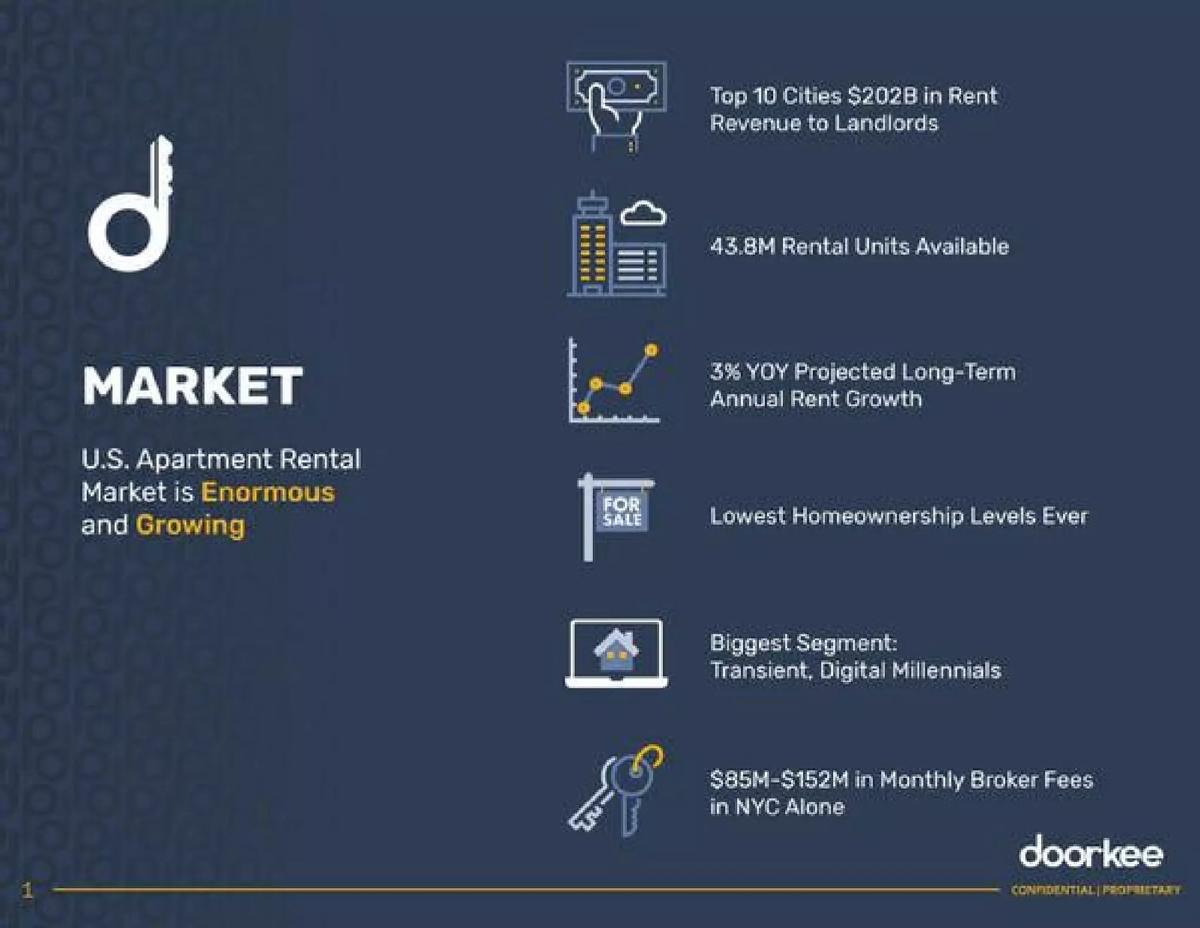
- The U.S. apartment rental market includes 43.8M available units with a 3% projected long-term annual rent growth (Slide 1).
- Broker fees in New York City alone account for $85M to $152M in monthly spend (Slide 1).
- The platform aims to reduce the average 25-day vacancy between tenants down to just 4 days (Slide 8).
- Landlords are charged a 5% closing fee, of which Doorkee nets approximately 50% after paying the departing tenant (Slide 7).
- Doorkee claims a unit pipeline of 96,000+ units with 4,100+ already onboarded at the time of the deck (Slide 10).
- Beta traction data shows a 67-day average advance notice provided by tenants regarding their intention to move (Slide 11).
- The company estimates that a landlord with 10,000 units could save $19,253,400 per year by using the platform (Slide 8).
- The leadership team includes a Co-Founder/CEO with a background in Kaizen process efficiency and a Co-Founder/COO who is a former litigator (Slide 13).
Executive Summary: The Peer-to-Peer Rental Pivot
Doorkee’s pitch deck presents a compelling case for disrupting the traditional apartment rental model by focusing on the 'dead time' between leases. The deck, produced in 2017, targets the inefficiencies of the New York City rental market, where high broker fees and long vacancy periods create friction for landlords and tenants alike. By creating a three-sided marketplace, Doorkee attempts to solve the coordination problem that usually requires an expensive middleman (a broker). The deck is structured to emphasize the massive scale of the market and the specific, quantifiable savings their platform provides to institutional landlords.
Slides 1-2: Market Opportunity and The Multi-Party Problem
The deck opens with a 'Market' slide (Slide 1) that establishes the scale of the U.S. rental industry. It cites 43.8M available rental units and a $202B rent revenue pool across the top 10 U.S. cities. Crucially, it identifies the 'Transient, Digital Millennials' as the biggest segment and highlights the specific pain point of NYC: $85M to $152M in monthly broker fees. This slide sets the stage for a high-frequency, high-value problem.
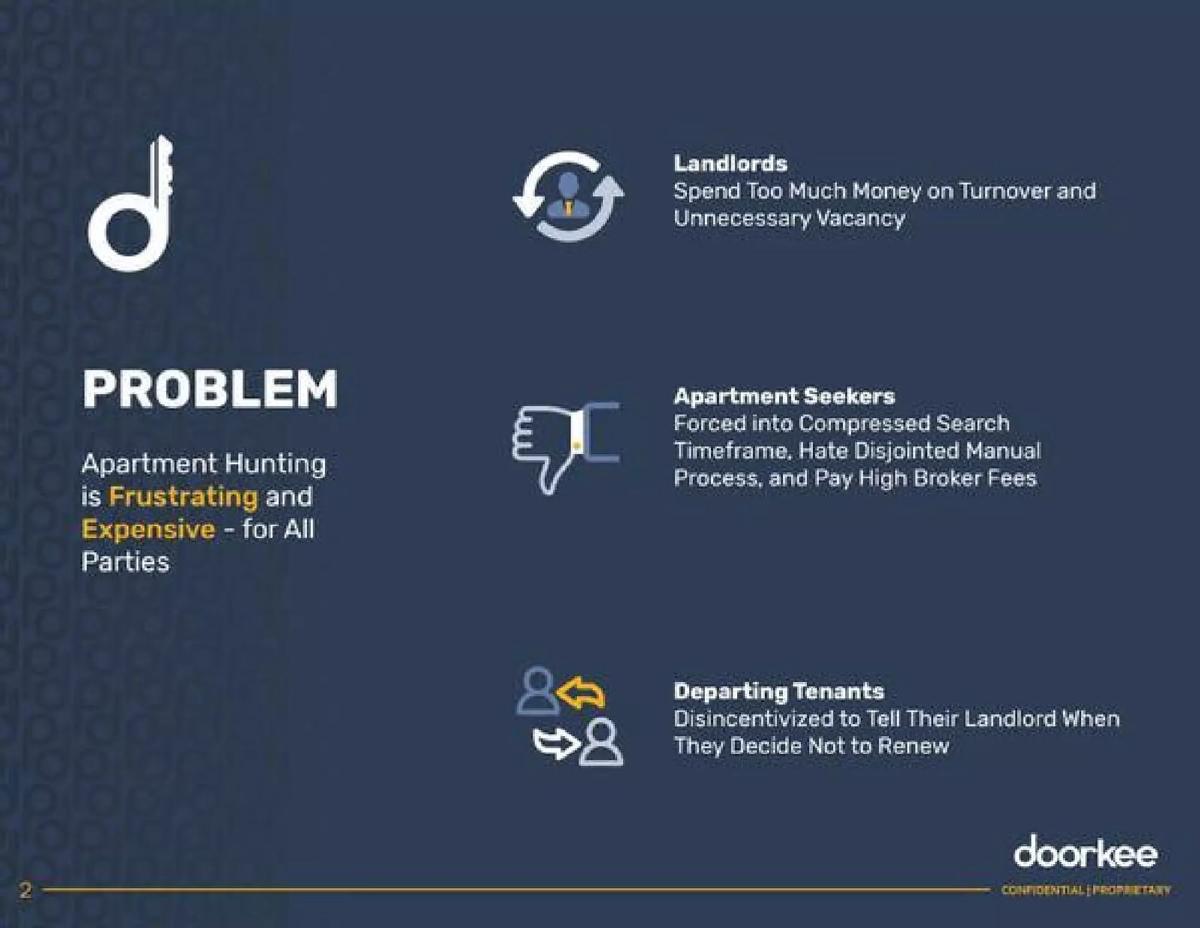
Slide 2 defines the 'Problem' as a three-headed monster. Landlords lose money on vacancy; apartment seekers are forced into a 'compressed search timeframe' and high fees; and departing tenants have no incentive to give early notice. By framing the problem this way, Doorkee positions itself as the only solution that addresses all three stakeholders simultaneously.
Slides 3-6: The Doorkee Solution and Process Transformation
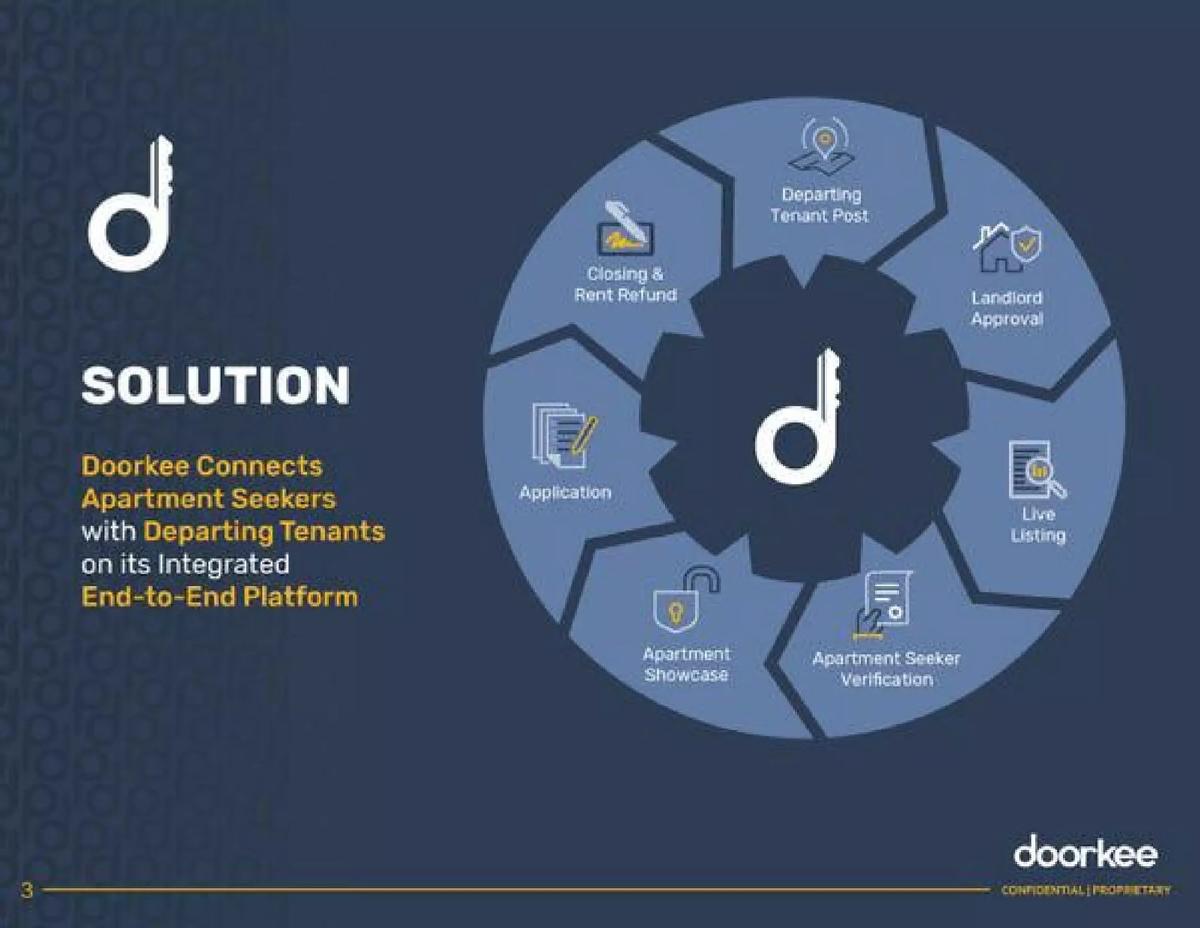
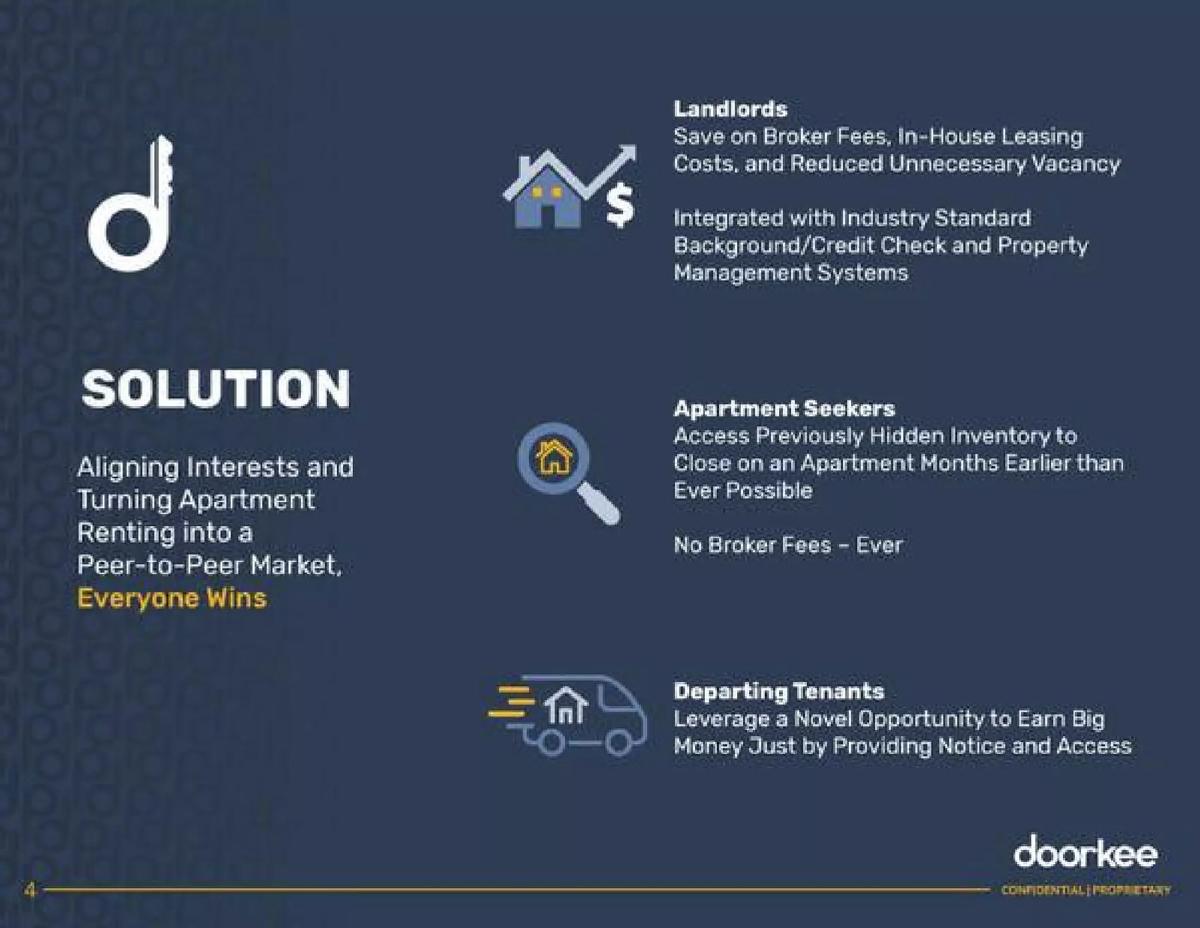
Slides 3 and 4 introduce the 'Solution.' The deck uses a circular flow diagram to show the end-to-end platform, covering everything from the 'Departing Tenant Post' to 'Closing & Rent Refund.' The value proposition is clear: landlords save on fees, seekers get 'hidden inventory' with no broker fees, and departing tenants earn money.
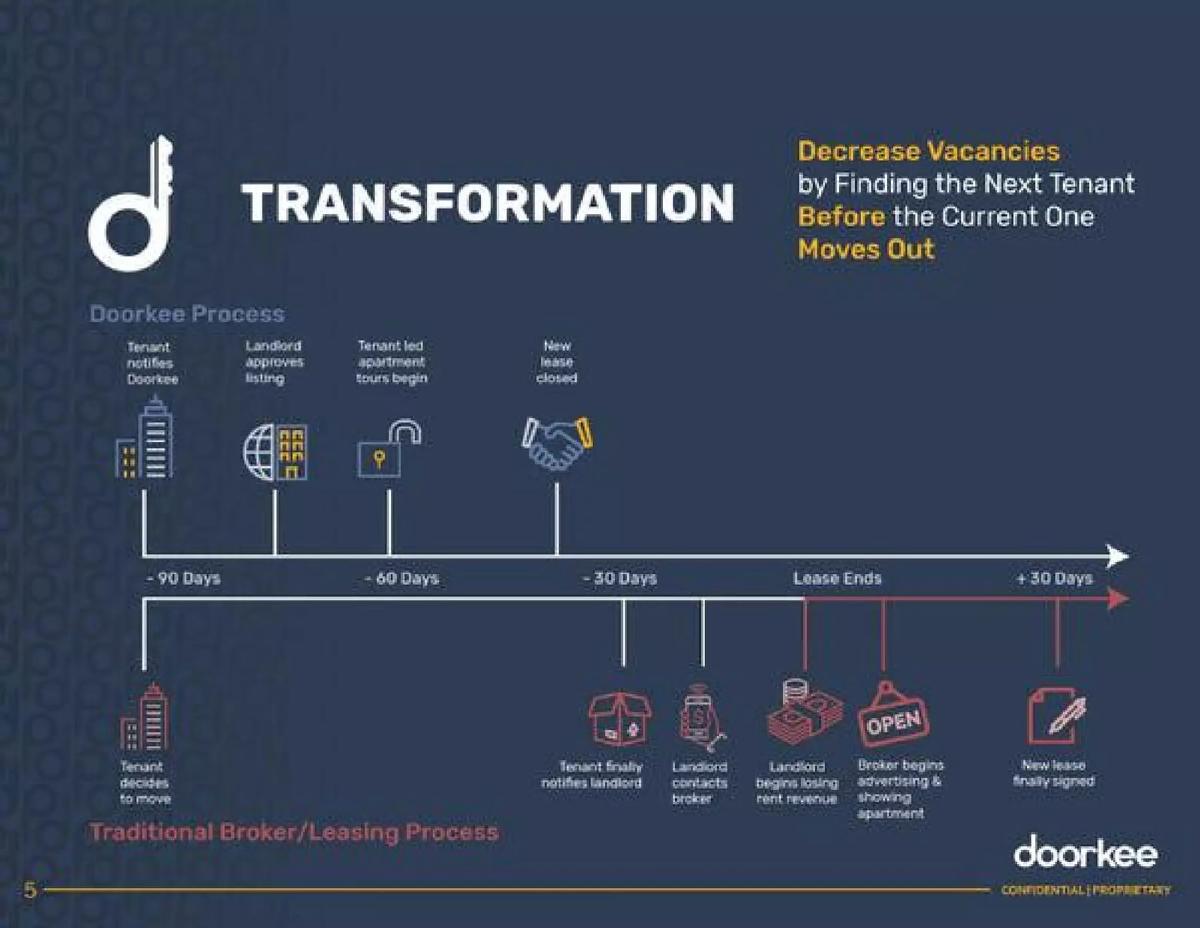
Slide 5, titled 'Transformation,' is perhaps the most important slide in the deck. It provides a side-by-side timeline comparison between the 'Doorkee Process' and the 'Traditional Broker/Leasing Process.' It shows that Doorkee starts the cycle 90 days before a lease ends, whereas the traditional process often doesn't begin until the lease has already expired. This visual effectively communicates how they 'decrease vacancies by finding the next tenant before the current one moves out.'
Slide 6 emphasizes 'Control' for the landlord. It lists features like setting lease terms before listings go live and selecting only the most qualified tenants. This is a strategic inclusion to reassure institutional landlords that they aren't losing oversight by moving to a peer-to-peer model.
Slides 7-8: Revenue Model and Quantifiable Savings
Slide 7 breaks down the 'Revenue' model using a clear table. It shows that for a monthly rent of $4,500, the landlord pays a 5% fee ($2,700). This fee is then split: $1,350 goes to the departing tenant as a refund, and $1,350 is the 'Doorkee Net.' This transparency is helpful for investors to understand the unit economics and the incentive alignment.
Slide 8, 'Savings,' doubles down on the value to the landlord. It compares a 10,000-unit portfolio to a 1,000-unit portfolio. For the larger portfolio, Doorkee estimates total annual savings of $19,253,400. These savings come from three buckets: eliminating vacancies (reducing the average from 25 days to 4 days), slashing broker fees, and providing free advertising. The footnotes on this slide provide the necessary assumptions, such as an 8.5% average broker fee and a 50% annual turnover rate.
Slides 9-12: Platform, Traction, and Beta Results
Slide 9 shows the 'Platform' with screenshots of the web interface and a video placeholder, proving the product is more than just a concept. Slides 10, 11, and 12 focus on 'Traction.' Slide 10 lists specific landlord partners like A&E and Plaza Management, claiming 4,100+ units onboarded and a pipeline of 96,000+.
Slide 11 provides 'Beta Traction' metrics from their September 10th, 2019 launch. Key figures include a 37% departing tenant adoption rate and a 67-day average advance notice period. The claim that '100% of Market Rate Units have Successfully Closed prior to Lease Expiration' is a strong indicator of product-market fit. Slide 12 adds 'social proof' with photos of the team at physical locations and marketing materials used in buildings.
Slides 13-15: Leadership and Conclusion
Slide 13 introduces the 'Leadership' team. It highlights Co-Founder & CEO John J. Fagan’s background in 'Kaizen' (continuous improvement) and Co-Founder & COO Jordan A.E. Franklin’s background as a litigator and emergency responder. The slide also lists heads of Engineering, Marketing, Product, and Growth, noting their previous experience at companies like Amazon, Google, and Sony. The deck concludes with a simple 'Thank You' slide (Slide 15) containing contact information for the founders.
What Works in This Deck
Clear Incentive Alignment: The deck does an excellent job of explaining why every party in the marketplace would want to use the service. The revenue table on Slide 7 is a masterclass in showing how a single fee can be distributed to satisfy both the platform and the user providing the value (the departing tenant).
The Timeline Comparison: Slide 5 is the 'aha' moment. By visualizing the 90-day head start Doorkee provides, the founders make the efficiency gain obvious. It moves the conversation from 'we are a rental site' to 'we are a logistics and timing optimizer.'
Hard Savings Calculations: For B2B or enterprise-facing startups, showing the ROI is critical. Slide 8 provides a very specific dollar amount for savings ($19M+ for a large landlord), which makes the pitch much more persuasive to institutional investors who understand the bottom-line impact of vacancy rates.
What Is Missing
Competitive Landscape: The deck completely omits a competitor slide. While they mention 'Traditional Brokers,' they do not address other prop-tech platforms or listing sites like Zillow, StreetEasy, or Compass. Investors would likely want to know how Doorkee protects its 'hidden inventory' from being scraped or bypassed.
Customer Acquisition Cost (CAC): While the deck shows how much landlords save, it does not detail how much it costs Doorkee to acquire a landlord or a tenant. There is no mention of the sales cycle length for onboarding these large property management firms.
The 'Ask': The deck does not include a slide detailing how much money they are raising, the valuation, or how the funds will be allocated. While this is sometimes left for a separate document, its absence here leaves the narrative unfinished.
Unit Economics Beyond the Fee: Slide 7 shows the gross margin on a single transaction, but it doesn't account for the operational costs of verifying tenants or integrating with property management systems (mentioned on Slide 4).
What a Founder Should Copy
The 'Transformation' Visual: If your startup changes a traditional workflow, use a timeline comparison like Slide 5. It is the fastest way to communicate value without using a wall of text.
The Revenue Breakdown Table: Don't just say 'we take a commission.' Show exactly how that commission is split and who gets paid what. Slide 7 removes all ambiguity about how the departing tenant is incentivized.
Segmented Problem Statements: Slide 2 breaks the problem down by stakeholder. This is a great way to show that you understand the nuances of a complex marketplace. It demonstrates that you aren't just solving a 'rental problem,' but specifically a 'vacancy problem' for one group and a 'fee problem' for another.
Footnoted Assumptions: On Slide 8, the founders include small-print footnotes explaining their math. This builds credibility. It shows that the $19M savings figure isn't just a random number, but the result of a specific formula based on industry averages.
Final Thoughts: Doorkee's deck is a strong example of a process-driven pitch. It identifies a massive inefficiency in a specific high-value market (NYC) and proposes a logical, incentive-aligned fix. While it lacks a competitive analysis and a clear 'ask,' the traction data and the ROI calculations for landlords make a compelling case for the platform's viability.
Frequently asked questions
- How does Doorkee make money?
- Doorkee generates revenue through a service fee structure where the landlord pays a 5% closing fee based on the annual rent. According to slide 7, Doorkee nets approximately 50% of this fee, while the other half is paid out as a 'Departing Tenant Refund' to incentivize the current occupant to facilitate the transition and show the apartment to new seekers.
- What is the primary problem Doorkee is solving for landlords?
- The primary problem for landlords is 'unnecessary vacancy' and high turnover costs. Slide 5 illustrates that in a traditional process, landlords often don't start advertising until a lease ends, leading to rent loss. Doorkee moves this process 90 days earlier, aiming to find the next tenant before the current one moves out, reducing vacancy from 25 days to 4 days.
- What incentive do departing tenants have to use the platform?
- Departing tenants are incentivized financially. Slide 4 mentions they can 'earn big money just by providing notice and access.' Specifically, slide 7 shows that for an apartment with a $4,500 monthly rent, the departing tenant receives a $1,350 refund. This encourages them to allow tours and give early notice to the landlord.
- How much traction did Doorkee have at the time of this deck?
- Doorkee reported significant early interest, citing a unit pipeline of over 96,000 units and 24,000+ units committed. Slide 10 notes that 4,100+ units were already onboarded. Additionally, slide 11 claims that 100% of market-rate units on the platform successfully closed prior to lease expiration during their beta phase.
- Is there a specific geographic focus in the deck?
- Yes, the deck is heavily focused on the New York City market. Slide 1 cites NYC broker fees specifically ($85M-$152M monthly), slide 7 uses NYC rent examples ($3,519 to $5,000) for its revenue table, and slide 8 bases its savings calculations on the average NYC rent and turnover premises.