The Nylas pitch deck is a highly professional, data-driven presentation that successfully bridges the gap between technical infrastructure and massive business value. By framing their API as the 'Universal Data Engine' for business productivity, they move beyond being a simple integration tool to a foundational layer of the modern software stack. The deck shines in its use of momentum metrics—specifically highlighting a 7X YoY growth in developer sign-ups and a 3X+ YoY increase in new ARR. While it lacks a specific dollar amount for the 'Ask,' it clearly outlines four pillars for capital allo…
Key takeaways
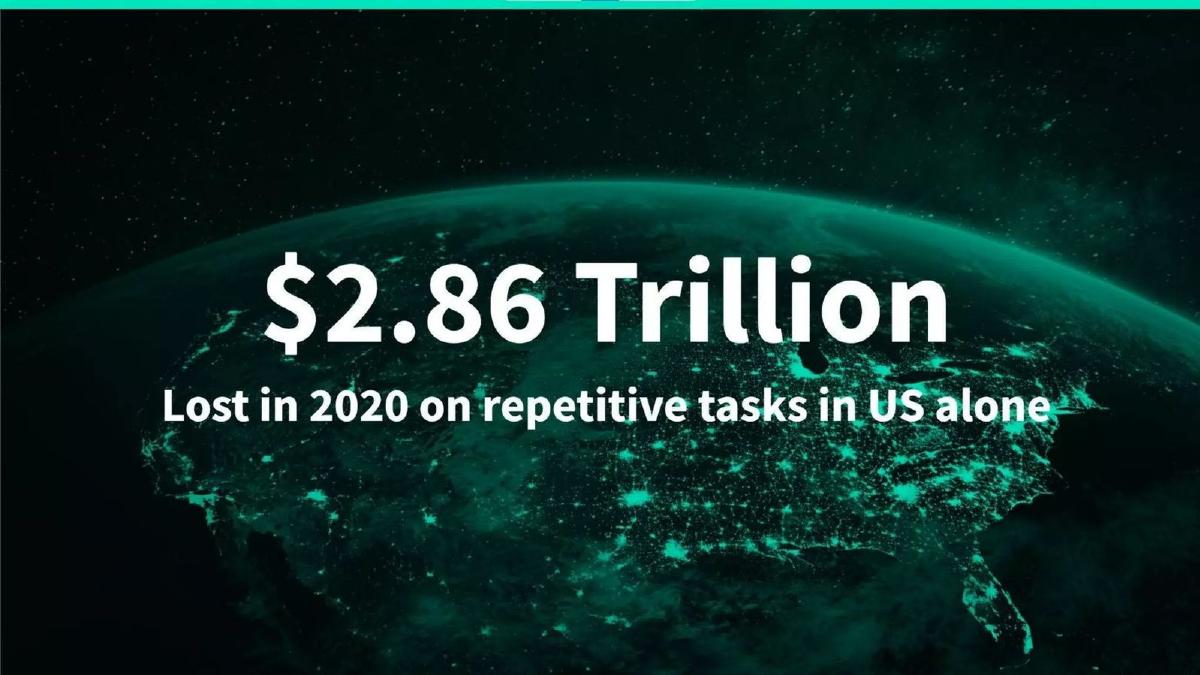
- Nylas identifies a $2.86 trillion loss in 2020 due to repetitive tasks in the US alone (Slide 2).
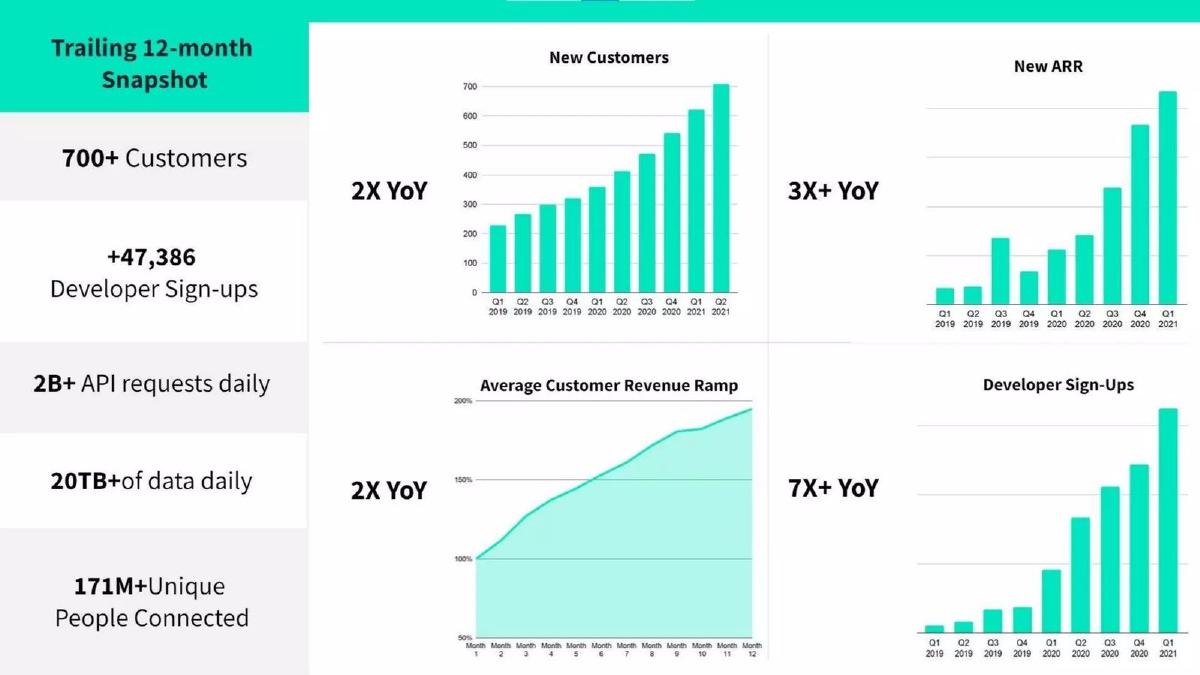
- The company demonstrates massive scale with 2B+ daily API requests and 171M+ unique people connected (Slide 4).
- Developer traction is a core highlight, showing 7X YoY growth in sign-ups and 47,386 total sign-ups (Slide 4).
- The 'Abstraction Layer' positioning places Nylas alongside industry giants like Stripe, Twilio, and Plaid (Slide 8).
- A detailed recruiting use case illustrates the shift from manual scheduling to automated interview workflows (Slide 10).
- The deck projects a TAM expansion from $17B in 2019 to a $200B long-term goal by 2023 (Slide 14).
- Retention is framed as 'Hypergrowth,' supported by a 2X YoY average customer revenue ramp (Slide 13).
- The leadership slide features heavy-hitting advisors including Tony Fadell (Nest) and John Chambers (Cisco) (Slide 15).
Introduction: The Abstraction of Productivity
Nylas is a communications platform-as-a-service (CPaaS) that provides the underlying API infrastructure for email, calendar, and contacts. This 16-slide deck, dating from approximately 2021 based on the data points, serves as a masterclass in how to pitch developer-centric infrastructure to a broad audience of investors. It successfully balances high-level economic impact with granular technical metrics.
Slides 1-3: The Macro Opportunity and Social Proof
Slide 1: Title Slide. The deck opens with a clear, bold value proposition: "Business Productivity Automation." It defines the product as "API Infrastructure for high value data and rapid application development." This immediately tells the investor that this is a B2B infrastructure play, not a consumer app.
Slide 2: The $2.86 Trillion Problem. Nylas uses a classic "Big Number" slide to establish the stakes. By stating that $2.86 trillion was lost in 2020 on repetitive tasks in the US alone, they frame their solution not as a "nice-to-have" tool, but as a massive economic necessity. The use of a dark, satellite-view map of the US adds a sense of scale and gravity.
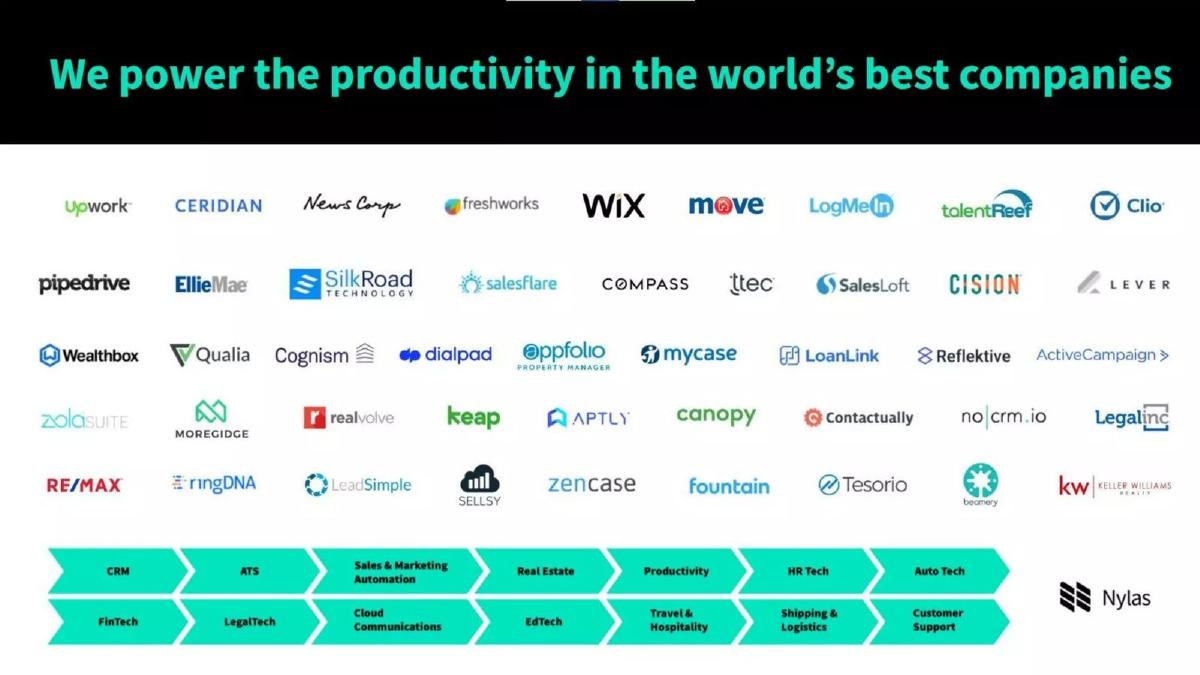
Slide 3: Customer Logos. Before explaining how the product works, Nylas provides immediate validation. The slide features a dense grid of logos including Upwork, News Corp, Wix, and RE/MAX. Below the logos, they list the industries they serve, ranging from CRM and ATS to FinTech and EdTech. This proves that their API is horizontal and has found product-market fit across diverse sectors.
Slides 4-7: Traction and the Technical Gap
Slide 4: Trailing 12-month Snapshot. This is the "momentum" slide. It is packed with impressive figures: 700+ customers, 47,386 developer sign-ups, and 2B+ daily API requests. The four charts show exponential growth: 2X YoY in new customers, 3X+ YoY in new ARR, and a staggering 7X+ YoY in developer sign-ups. The "Average Customer Revenue Ramp" chart (2X YoY) is particularly important as it hints at strong net revenue retention (NRR).
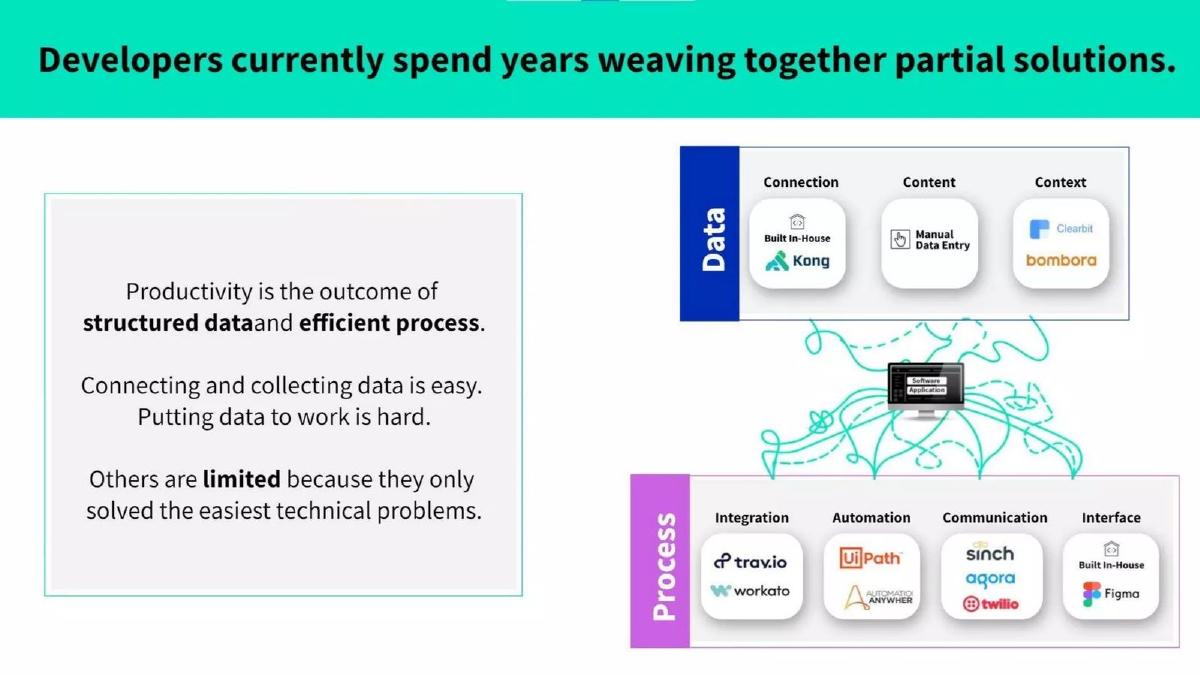
Slide 5: The Developer Pain Point. This slide explains the "Why Now." It argues that developers currently waste years "weaving together partial solutions." It categorizes the competition into "Data" (Kong, Clearbit) and "Process" (UiPath, Twilio), claiming these others are limited because they only solved the "easiest technical problems."
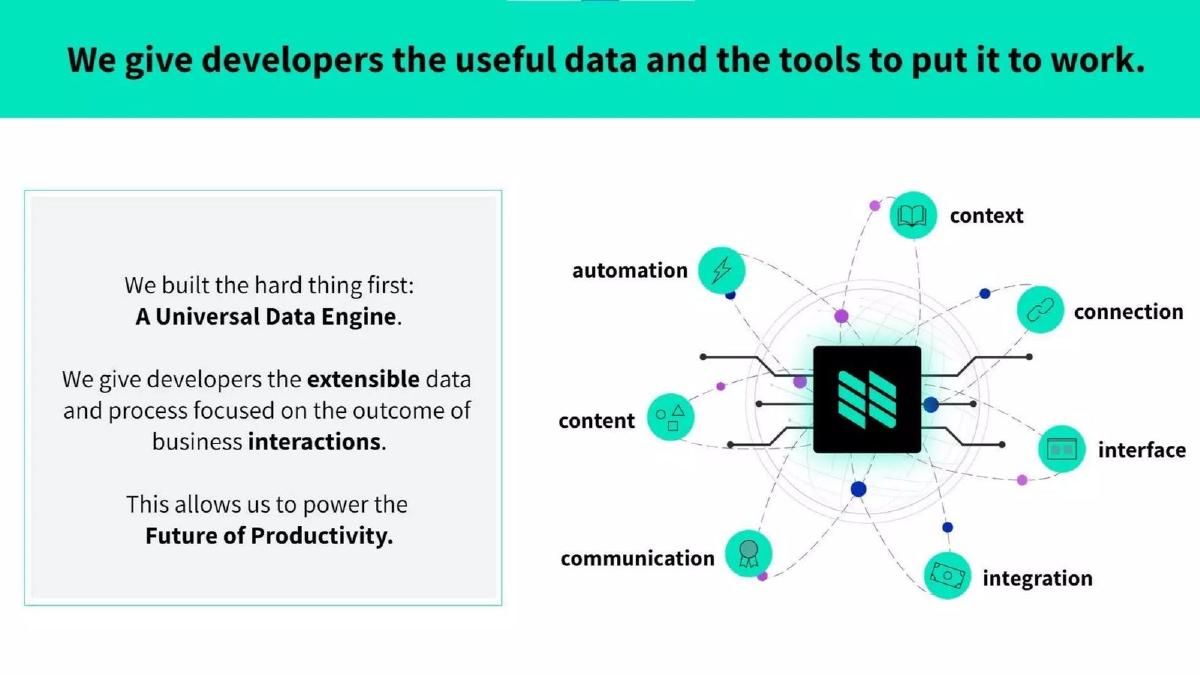
Slide 6: The Solution. Nylas introduces its "Universal Data Engine." The graphic shows the Nylas logo at the center of a web connecting automation, context, connection, interface, integration, communication, and content. The core message is: "We built the hard thing first."
Slide 7: The Infrastructure Flow. This slide visualizes the technical process. It shows "Raw Unstructured High Value Enterprise Data" being fed into the "Nylas Infrastructure," which performs "Mining & Extraction" to produce "Structured, Contextualized Data" that powers applications. It’s a clean way to explain a complex ETL (Extract, Transform, Load) process for communications data.
Slides 8-11: Platform Strategy and Use Cases
Slide 8: The Abstraction Layer. This is perhaps the most strategic slide in the deck. It places Nylas in the "Abstraction Layer" alongside legendary companies like Twilio (communications), Plaid (finance), and Stripe (payments). By positioning themselves between the Infrastructure Layer (AWS/Azure) and the Application Layer (Slack/Salesforce), they are claiming a spot in the most valuable part of the modern software stack.
Slide 9: The Nylas Platform Pyramid. This slide breaks down the product hierarchy. At the base is Connectivity (email/calendar/contacts), followed by Security, Intelligence, Automation, and finally, User Experience (pre-built UI components). This shows the roadmap from a simple API to a full-stack developer platform.
Slide 10: Example Recruiting Use Case. To make the abstract concrete, Nylas provides a "Before vs. After" for a recruiter. The "Before" involves manual data entry and days of scheduling emails. The "After" shows automated engagement campaigns and interview scheduling that takes "minutes." This slide is essential for non-technical investors to understand the end-user value.
Slide 11: Use Cases Today and Tomorrow. This matrix expands on the recruiting example, showing current use cases in Sales, Real Estate, and CS, while projecting future expansion into Healthcare (prioritized inboxes), eCommerce (purchase extraction), and Logistics (asset resourcing).
Slides 12-14: The Business Case and TAM
Slide 12: The Buyer Personas. Nylas demonstrates a deep understanding of their Go-To-Market (GTM) strategy by identifying four key buyers. For each, they list what gets them "Promoted" and what gets them "Fired." For example, a VP of Engineering gets promoted for delivering features ahead of schedule but fired for unreliable products or security breaches. This level of empathy for the customer is a strong signal of a mature sales organization.
Slide 13: Retention and Hypergrowth. This slide focuses on the "Land and Expand" model. It lists four reasons for expansion, such as adding additional data types or cross-selling to other business units. The churn chart is particularly honest, distinguishing between "Regrettable" and "Unavoidable" churn, with total churn staying around 1.0% of ARR.
Slide 14: Long Term Platform Play (TAM). The deck projects a massive expansion of their Total Addressable Market. It shows the TAM growing from $17B in 2019 to $60B in 2021, with a long-term goal of $200B by 2023. They justify this by moving from simple connectivity into "industry specific intelligence models."
Slides 15-16: Team and The Ask
Slide 15: Leadership and Advisors. The team slide is exceptionally strong. Beyond the founders (Gleb Polyakov and Christine Spang), it highlights a leadership team with experience at Oracle, Flexport, and Autodesk. The "World Class Advisors" section is a "who's who" of tech, featuring Tony Fadell (Nest), John Chambers (Cisco), and executives from Slack and Twilio. The investor list includes 8VC, Spark Capital, and ScaleUP.
Slide 16: Investing in Growth. The final slide outlines where the capital will go: Product (innovation), GTM (scaling), Momentum (capturing market share), and M&A. A notable stat included here is that "30% of all apps accessing Gmail data were built on Nylas in 2020." This is a powerful closing argument for their market dominance.
What Works in the Nylas Pitch Deck
Developer-First Metrics: Highlighting developer sign-ups (47k+) and daily API requests (2B+) proves that the product has real utility and a "bottom-up" adoption engine. · Strategic Positioning: Slide 8, which places Nylas in the same category as Stripe and Twilio, is a brilliant way to anchor the company's valuation and potential in the minds of investors. · The "Promoted/Fired" Framework: Slide 12 is a unique and effective way to show that the company understands the internal politics and motivations of their enterprise customers. · Clarity of Use Cases: The recruiting example on Slide 10 takes a complex infrastructure product and makes the benefits tangible and easy to understand.
What is Missing from the Nylas Pitch Deck
Specific Financial Ask: While the final slide mentions "Investing in Growth," the deck does not state the specific amount of capital being raised or the valuation target. This is common in later-stage decks but leaves a gap for a pure teardown. · Unit Economics: While the deck shows ARR growth and churn, it lacks specific details on Customer Acquisition Cost (CAC) or LTV/CAC ratios, which are critical for evaluating the efficiency of their GTM scaling. · Competitive Landscape Detail: Slide 5 mentions competitors like Kong and UiPath, but it doesn't provide a direct feature-by-feature comparison or address how they defend against larger incumbents like Microsoft or Google potentially closing off their APIs.
What a Founder Should Copy
The "Abstraction Layer" Slide: If you are building infrastructure, find the "Stripe of [Your Industry]" and visually place yourself in that layer. It is the fastest way to communicate your business model. · Momentum over Totals: Nylas doesn't just say they have customers; they show 3X and 7X YoY growth. Rate of change is always more impressive than static numbers. · The Use Case Walkthrough: Don't just list features. Show a "Before and After" workflow. It bridges the gap between the "what" and the "so what." · Advisor Credibility: If you have high-profile advisors, don't just list their names. Use their photos and former titles (e.g., "CEO, Nest") to maximize the halo effect.
Frequently asked questions
- What is the core problem Nylas aims to solve?
- Nylas focuses on the massive economic drain caused by manual, repetitive business tasks. According to Slide 2, this resulted in a $2.86 trillion loss in the US in 2020. They argue that while connecting data is easy, 'putting data to work is hard' because developers currently spend years weaving together partial, fragmented solutions (Slide 5).
- How does Nylas demonstrate market traction?
- Traction is presented through multiple lenses on Slide 4: 700+ customers, 47,386 developer sign-ups, and 2B+ daily API requests. Most importantly, they show a 3X+ YoY growth in New ARR and a 7X+ YoY growth in developer sign-ups, indicating both commercial and community momentum.
- What is the 'Universal Data Engine' mentioned in the deck?
- The Universal Data Engine is Nylas's technical solution to unstructured enterprise data. As shown on Slide 7, it involves mining and extracting raw data to create structured, contextualized data that powers automation and UI components. This allows them to move from simple connectivity to providing 'Intelligence' and 'User Experience' layers (Slide 9).
- Who are the target buyers for the Nylas platform?
- Slide 12 identifies four key personas: the VP of Engineering (buys for delivery/scalability), the Developer (buys to ship code), the CEO/Business Exec (buys for market opportunity), and the Head of Product (buys to build better products). The deck explicitly maps out what gets these personas promoted or fired to align their value proposition.
- What are the company's long-term growth plans?
- Nylas plans to expand from its initial focus on connectivity and abstraction into industry-specific intelligence models and omni-channel connectivity. Slide 14 shows a path to a $200B TAM by 2023, while Slide 16 notes that future investment will go toward product innovation, GTM scaling, and M&A opportunities.