The Oakland Ballers pitch deck is a masterclass in opportunistic positioning. Rather than pitching a standard independent baseball team, the founders framed the venture as a 'media platform' and a community response to the departure of Major League Baseball from Oakland. The deck successfully utilizes a 'David vs. Goliath' narrative, directly referencing the Oakland A's exit to create urgency and local sentiment. With a lean $7M startup cost and a $6M pre-money valuation for the initial $2M note, the deck highlights low dilution and high upside by citing the $80M valuation of the Oakland Root…
Key takeaways
- The deck positions the team as a media platform, citing 'Welcome to Wrexham' and 'Angel City' as content-driven precedents for sports valuation (Slide 4).
- The financial ask is clearly stated: $2M on a convertible note at a $6M pre-money valuation, with an additional $5M planned post-announcement (Slide 5).
- The founders use the Oakland Roots soccer club as a direct valuation comparable, noting their ~$80M crowdfunding valuation (Slide 5).
- The team emphasizes low startup costs of approximately $7M to argue for minimal investor dilution compared to traditional franchises (Slide 5).
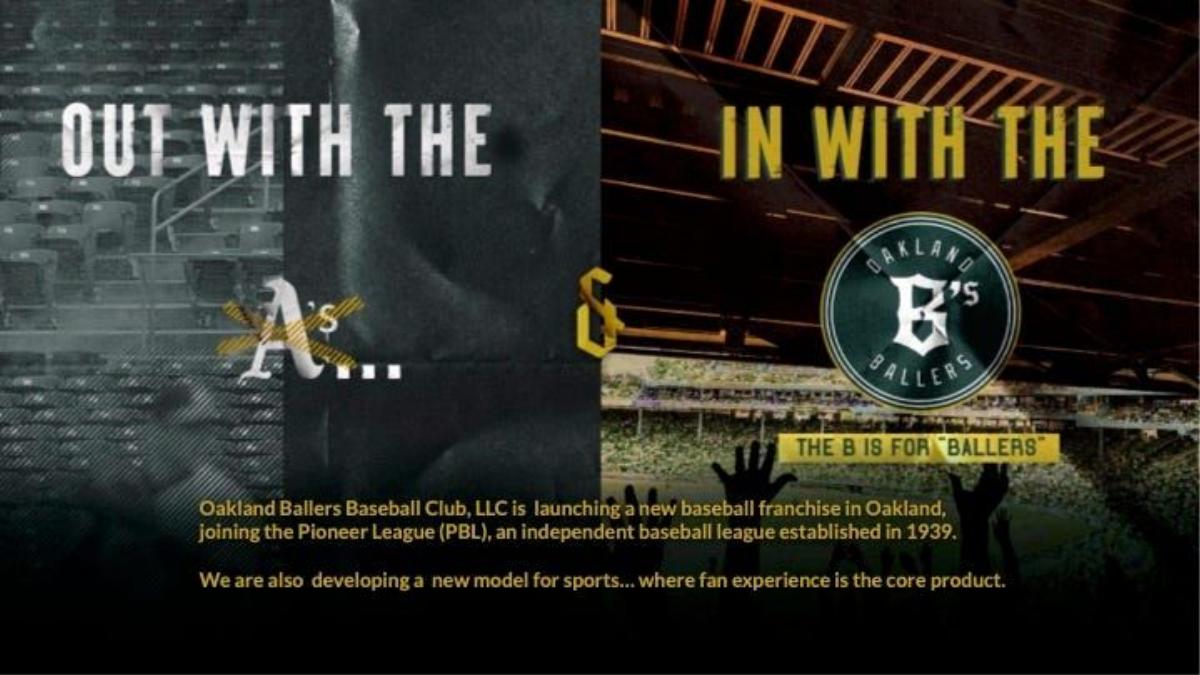
- The 'Why Now' factor is built on the departure of the Oakland A's, using the phrase 'Out with the A's... In with the B's' (Slide 2).
- Founder Paul Freedman brings significant exit credibility, having been President of Guild Education, a $4.3B B Corp (Slide 6).
- Founder Bryan Carmel provides the media 'engine' for the platform, with a background producing for HBO, ESPN, and Comedy Central (Slide 6).
- The deck identifies the Pioneer League (PBL), established in 1939, as the operational home for the franchise (Slide 2).
Oakland Ballers Pitch Deck Teardown
The Oakland Ballers pitch deck is a fascinating example of how to sell a traditional brick-and-mortar business—a minor league baseball team—as a high-growth, scalable media venture. In 2024, the team raised $2M in Seed funding by tapping into the void left by the Oakland A's departure and promising a 'new model for sports' where fan experience and digital content drive the valuation.
Slide 1: Title Slide
The deck opens with a high-contrast, atmospheric image of a baseball stadium at night. The central focus is the 'Oakland B's Ballers' logo. It is a clean, professional start that immediately establishes the brand identity. There are no taglines here, just the visual weight of a professional sports franchise.
Slide 2: The Opportunity and The League
Slide 2 sets the narrative hook. It uses a split-screen visual: 'OUT WITH THE A's...' (with a cross through the logo) and 'IN WITH THE B's.' This positioning is critical. It frames the startup not as a random new business, but as a necessary replacement for a departing incumbent. The text explicitly states the company is joining the Pioneer League (PBL), an independent league established in 1939. This provides immediate operational legitimacy—they aren't building a league from scratch; they are buying into an existing system. The slide also introduces the core thesis: 'where fan experience is the core product.'
Slide 3: The Mission
Titled 'Baseball Belongs to Everybody,' this slide leans into the emotional and social value of the team. It argues that professional sports have lost sight of 'shared joy' and that the Ballers will center their franchise around it. While mission statements can sometimes feel like filler, in the context of Oakland—a city that has recently lost several major sports teams—this is a strategic play for community and investor alignment.
Slide 4: The Media Platform Strategy
This is arguably the most important slide for a venture investor. It moves the conversation from 'selling hot dogs and tickets' to 'digital scale.' By showing posters for 'Angel City,' 'Welcome to Wrexham,' and 'The Battered Bastards of Baseball,' the founders are using the 'X for Y' strategy. They are positioning the team as a content engine. The slide notes that they will optimize for 'short, shareable moments' to capture the 8 hours per day consumers spend on digital content. This is the 'Media' industry classification in action, justifying a venture-style investment in a sports team.
Slide 5: The Financials and Ask
Slide 5 is refreshingly direct. It states the ask: $2M on a convertible note with a $6M pre-money valuation. It also forecasts a total capital need of $7M, which they claim leads to 'little investor dilution.' The most compelling part of this slide is the comparable: the Oakland Roots soccer club, which they state is crowdfunding at an ~$80M valuation. This gives investors a clear 'exit' or 'markup' target. If the Ballers can replicate the Roots' success, the $6M entry point looks like a bargain.
Slide 6: The Founders
The pedigree on this slide is significant. Paul Freedman is not a typical 'sports guy'; he is a high-scale tech executive (President of Guild Education, a $4.3B company). This suggests operational maturity and the ability to scale a business. Bryan Carmel provides the creative muscle, with a resume that includes HBO, ESPN, and Comedy Central. Together, they represent the 'Business' and 'Media' pillars of the pitch. This slide answers the 'Why this team?' question effectively.
Slide 7: The Advisors
The advisors listed are not just names; they have specific functional roles. Colton Heward-Mills (Strategy), Dustin Canalin (Brand and Design), Mike Wang (Experience Design), and Jack Gray (Brand and Apparel). Notably, Dustin Canalin is credited with creating the Golden State Warriors' 'The Town' logo. This adds massive local credibility to the brand's aesthetic and community appeal. Jack Gray's experience at Adidas and with LeBron James' brand 'Ladder' suggests they have the expertise to move merchandise—a key revenue stream for any sports team.
Slide 8: Closing Brand Visual
The final slide returns to the branding, showing a variation of the logo with crossed bats. It reinforces the 'Oakland B's' identity. While it lacks a 'Contact Us' or 'Next Steps' call to action in this version, it serves to leave the investor with the visual identity of the team.
What Works in the Oakland Ballers Deck
The 'Why Now' is Unbeatable: By launching exactly when the Oakland A's were exiting the market, the founders turned a local tragedy into a business opportunity. Investors love a clear market gap.
The Media Pivot: Traditional minor league sports are often seen as low-margin, lifestyle businesses. By framing the team as a 'media platform' and citing 'Welcome to Wrexham,' the founders shifted the valuation conversation from EBITDA multiples to tech/media multiples.
High-Caliber Team: Having a founder who was the President of a $4.3B B Corp (Paul Freedman) immediately de-risks the operational side of the business. It signals that this isn't just a passion project; it's a professional venture.
Clear Comparables: Using the Oakland Roots as a valuation benchmark is a smart move. It provides a local, recent, and relevant proof of concept for the 'community-owned/focused' model.
What is Missing from the Oakland Ballers Deck
Unit Economics: The deck is silent on the actual cost of running a Pioneer League team. There is no mention of player salaries, stadium lease costs, or projected ticket prices. While the $7M total cost is mentioned, a breakdown of how that money is spent would be helpful for a Seed round.
Revenue Projections: While the 'media platform' is a great vision, the deck doesn't provide a breakdown of expected revenue streams (e.g., % from tickets vs. % from merch vs. % from media rights). Investors usually want to see a path to profitability.
Stadium Strategy: For a sports team, the venue is everything. The deck doesn't specify where they will play or the status of any negotiations for a home field. In Oakland, real estate and stadium logistics are notoriously difficult.
Competition: While they mention the A's leaving, they don't mention other local entertainment options or other independent leagues that might compete for the same fan dollars.
What Founders Should Copy
The Narrative Arc: Start with a problem (the city is losing its identity/teams) and provide a solution that feels like a movement, not just a product.
Use of Comparables: If you are in a 'niche' industry, find a 'neighbor' who has recently raised at a high valuation and use them to anchor your own valuation expectations.
Visual Branding: The deck uses high-quality, consistent imagery that makes the 'Oakland B's' feel like a 100-year-old franchise rather than a 2024 startup. Professional design matters when you are selling a 'brand.'
The 'X for Y' Strategy: Even if you are a physical business, find the digital angle. Every business today is, in some way, a content business. Highlighting that can open doors to venture capital that might otherwise be closed to 'traditional' industries.
Frequently asked questions
- What is the primary business model proposed by the Oakland Ballers?
- The deck proposes a dual-revenue model. First, it functions as a traditional independent baseball team in the Pioneer League. Second, and more importantly for investors, it is framed as a 'media platform.' The founders plan to create a slate of 'sticky, funny Baller-themed video content' to build a global digital audience, optimizing for the 8 hours per day consumers spend on digital content.
- How does the company justify its valuation to Seed investors?
- The company uses a 'comparable asset value' strategy. Specifically, they point to the Oakland Roots, a minor league soccer club that achieved an ~$80M valuation through crowdfunding. By raising their initial $2M at a $6M pre-money valuation, they suggest that achieving a similar outcome to the Roots would represent a massive return for early investors.
- Who are the founders and what is their background?
- The team consists of Paul Freedman and Bryan Carmel. Freedman is a seasoned education entrepreneur who was President of Guild Education ($4.3B valuation) and sold several companies. Carmel is a veteran media producer and showrunner who has worked with major networks like HBO and ESPN, and produced the award-winning documentary 'Kumaré.'
- What is the total capital requirement mentioned in the deck?
- The deck outlines a total capital need of approximately $7M. This is broken down into an initial $2M raise via a convertible note and a planned subsequent raise of ~$5M after the team is officially announced to the public. They describe this as 'low start-up costs' for a sports franchise.
- What specific league are the Oakland Ballers joining?
- According to slide 2, the Oakland Ballers are joining the Pioneer League (PBL). The deck notes that this is an independent baseball league that was established in 1939, providing the venture with an established competitive framework and history despite being a new franchise.