Octave’s 12-slide deck is a masterclass in narrative-driven fundraising, focusing heavily on the 'why now' of agentic workflows rather than dense financial metrics. The company, reported by Business Insider to have raised $5.5M in a 2024 Seed round, positions itself as a solution to the slow adaptation cycles of traditional marketing teams. By highlighting a specific technical moat—a 'bespoke metadata architecture'—the deck attempts to differentiate itself from generic LLM wrappers. The presentation relies heavily on the founders' previous successful exit (Smyte) and their experience at scale…
Key takeaways
- The deck introduces the concept of 'Agentic GTM' on Slide 1, signaling a shift from manual tools to autonomous AI agents.
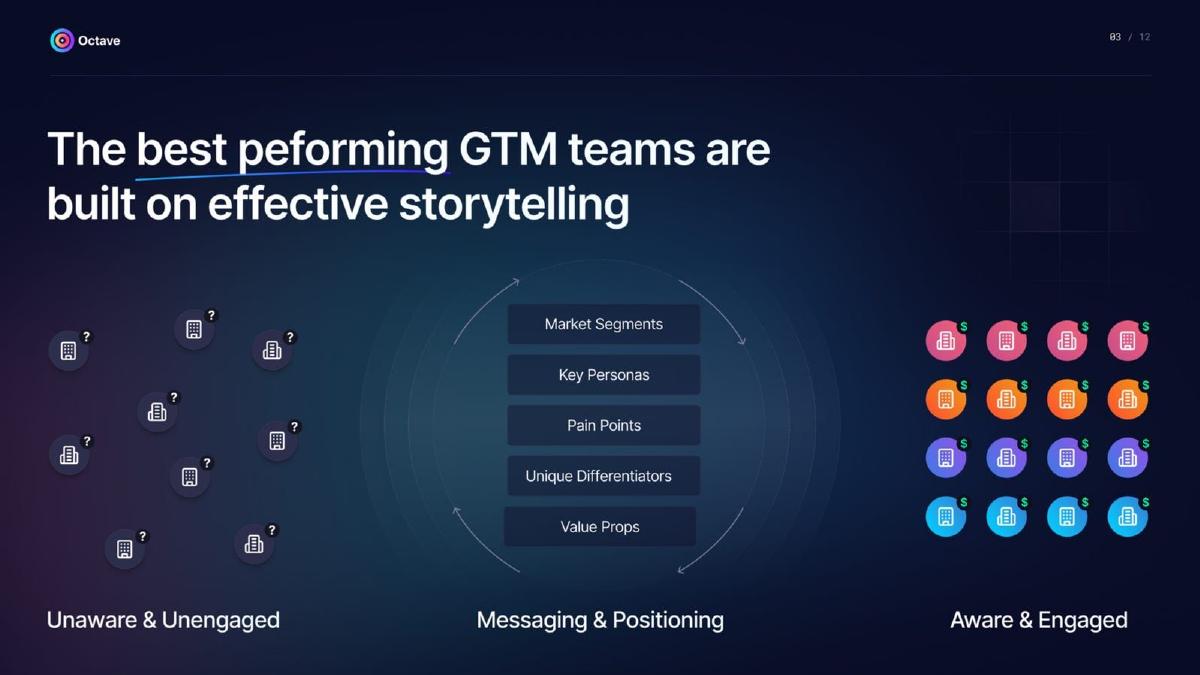
- Slide 3 identifies 'effective storytelling' as the core of high-performing GTM teams, framing the product as a narrative engine.
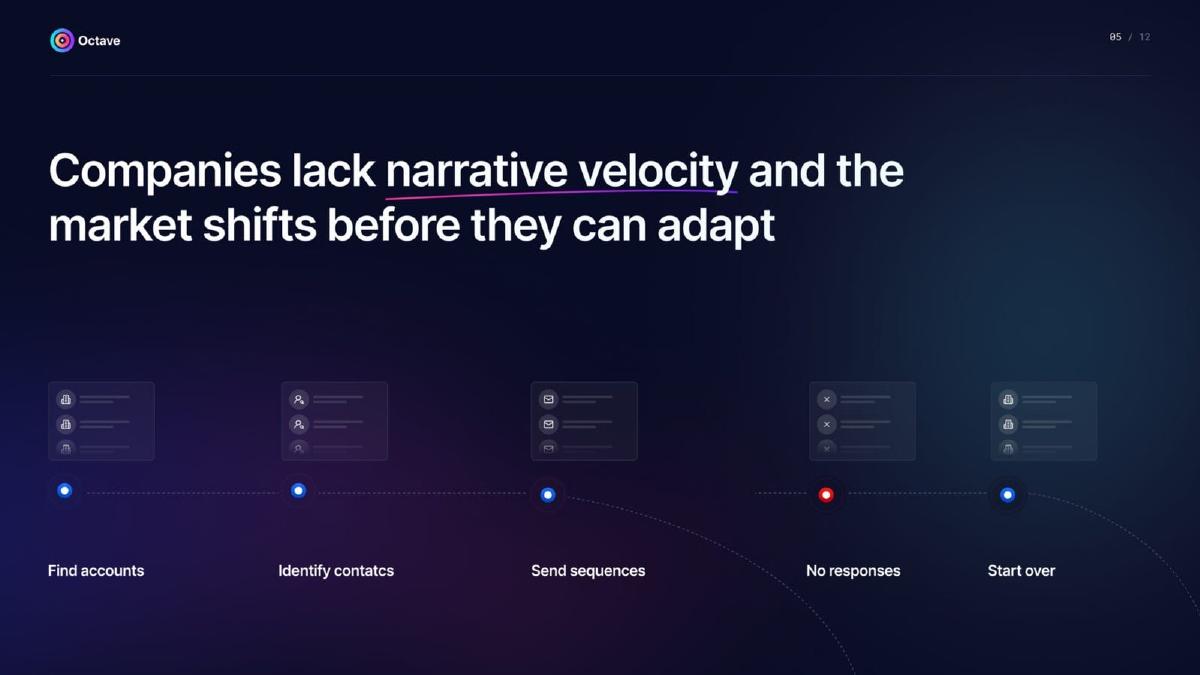
- The problem is defined on Slide 5 as a lack of 'narrative velocity,' where market shifts outpace a company's ability to adapt.
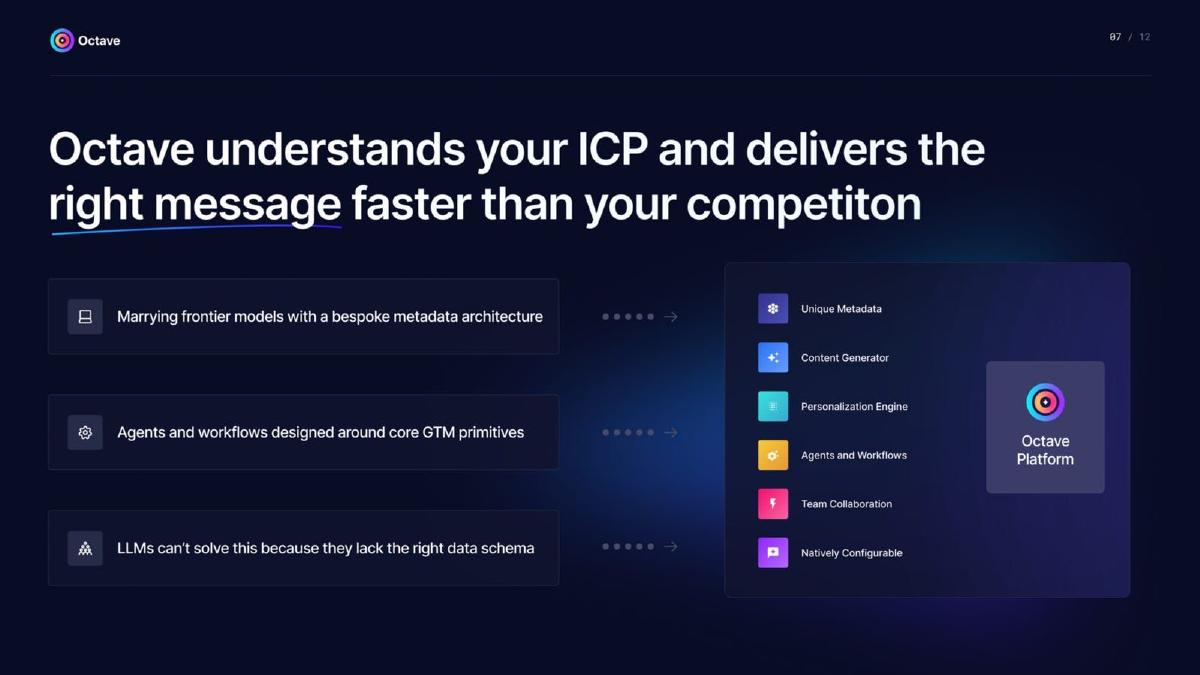
- Slide 7 claims a technical moat by stating that standard LLMs fail due to a lack of the 'right data schema,' which Octave provides via bespoke metadata.
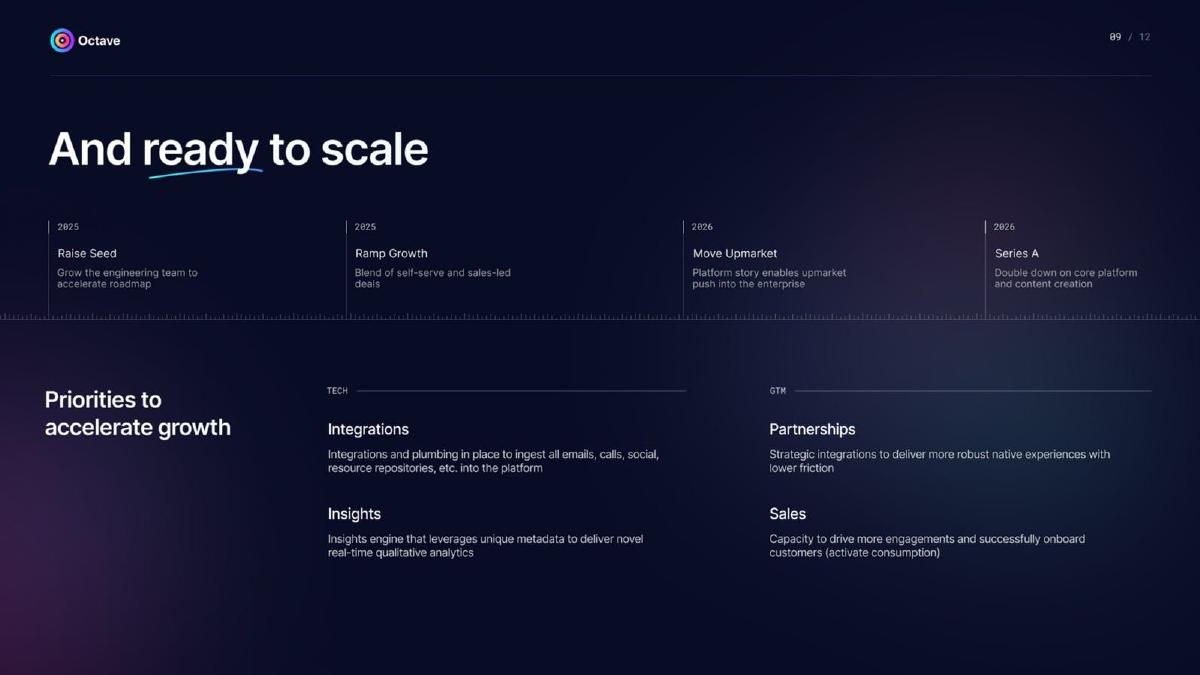
- The roadmap on Slide 9 explicitly targets a Series A in 2026, following a 2025 focus on self-serve and sales-led growth.
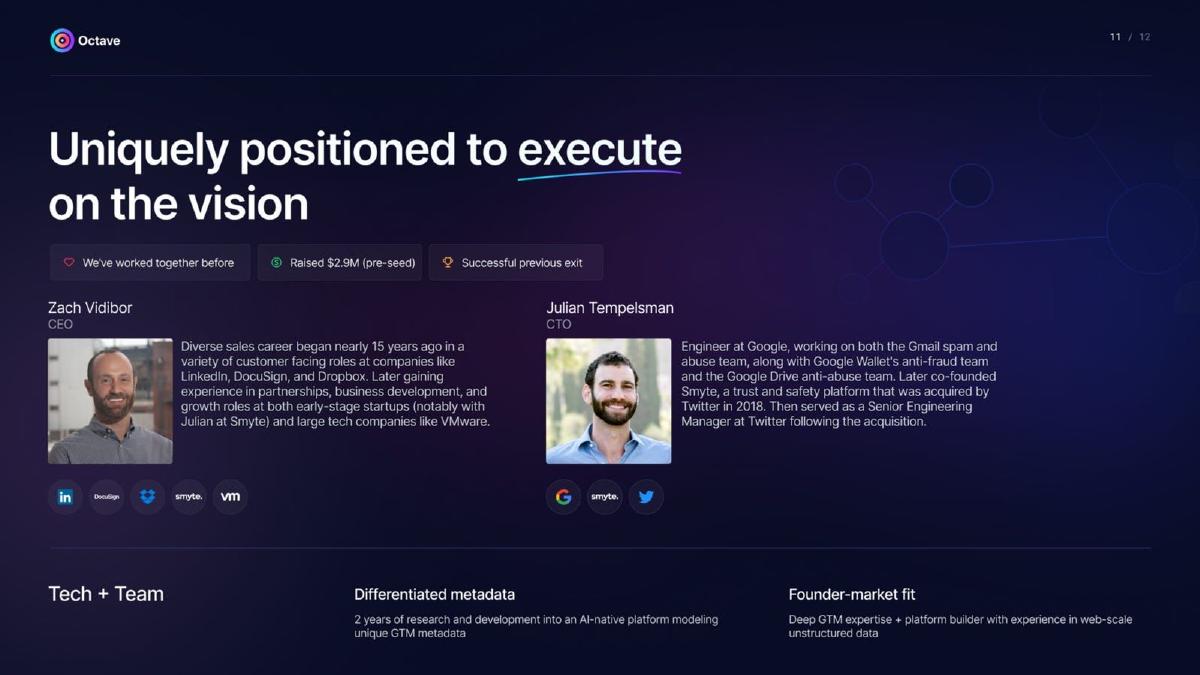
- Founder pedigree is a central pillar, with Slide 11 highlighting a 'successful previous exit' and experience at Google, LinkedIn, and Twitter.
- The team previously raised $2.9M in pre-seed funding, as noted on the team slide (Slide 11).
- The deck omits a specific 'Ask' slide detailing how the $5.5M will be allocated across departments.
Slide 1: Title Slide
The deck opens with a minimalist dark theme, featuring the Octave logo—a concentric circle design—and the tagline 'Welcome to Agentic GTM.' This immediately sets the stage for a pitch centered on autonomous AI agents within the Go-To-Market (GTM) stack. The use of 'Agentic' is a deliberate nod to the 2024 trend of moving beyond simple chatbots toward autonomous workflows.
Slide 2: [Contextual Transition]
Slide 2 is not visually provided in the detail but serves as a transition into the market narrative. In a 12-slide deck, this is typically where the 'status quo' is established.
Slide 3: The Core Philosophy
Slide 3 asserts that 'The best performing GTM teams are built on effective storytelling.' The visual layout shows a transition from 'Unaware & Unengaged' prospects on the left to 'Aware & Engaged' prospects on the right. In the center, a circular process lists five pillars: Market Segments, Key Personas, Pain Points, Unique Differentiators, and Value Props. This slide frames the product not just as a technical tool, but as a strategic asset for brand positioning.
Slide 4: [Market Dynamics]
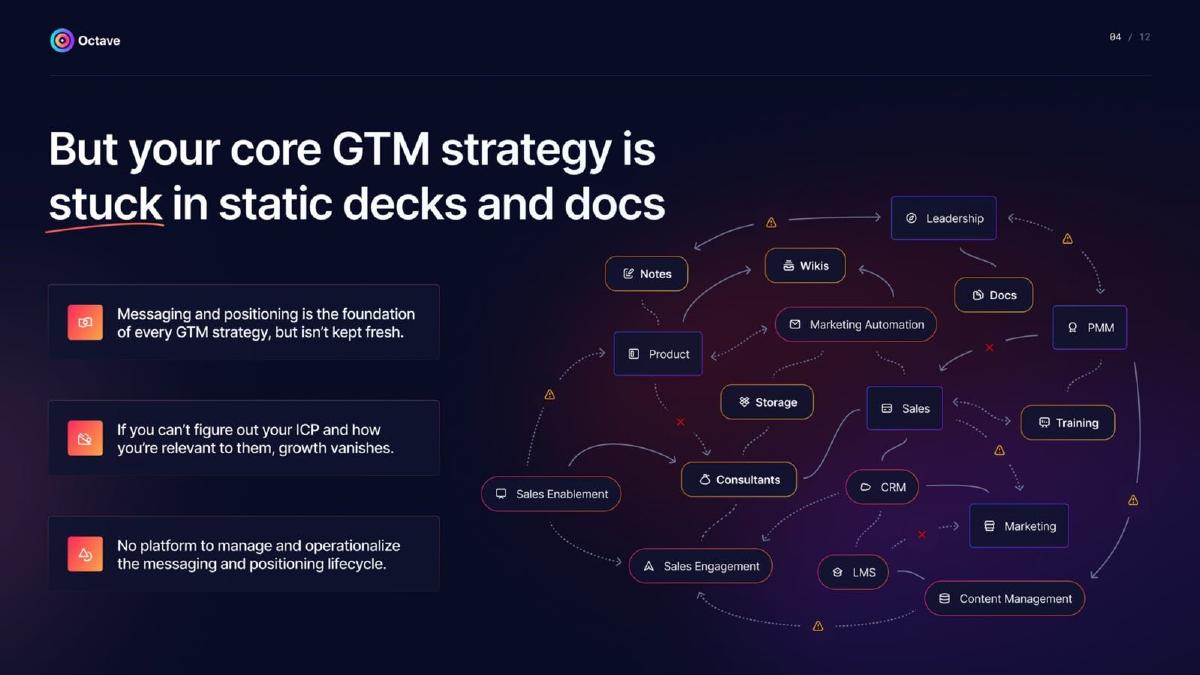
Slide 4 continues the narrative build, likely detailing the complexity of modern sales cycles or the noise in current digital marketing channels.
Slide 5: The Problem - Narrative Velocity
Slide 5 introduces the primary pain point: 'Companies lack narrative velocity and the market shifts before they can adapt.' It illustrates a linear, failing workflow: Find accounts, Identify contacts, Send sequences, No responses, and Start over. The term 'narrative velocity' is the key takeaway here, suggesting that the speed at which a company can refine and deploy its story is the bottleneck to growth.
Slide 6: [The Solution Gap]
Slide 6 likely bridges the gap between the failing manual sequences shown on Slide 5 and the proposed AI-driven future, highlighting why current software-as-a-service (SaaS) tools are insufficient.
Slide 7: The Solution - The Octave Platform
Slide 7 presents Octave as the solution that 'understands your ICP and delivers the right message faster than your competition.' The slide lists three technical pillars: marrying frontier models with bespoke metadata, designing agents around GTM primitives, and solving the 'data schema' problem that generic LLMs face. The right side of the slide lists platform features: Unique Metadata, Content Generator, Personalization Engine, Agents and Workflows, Team Collaboration, and Natively Configurable.
Slide 8: [Product Deep Dive]
Slide 8 typically contains product screenshots or a more detailed look at the user interface, though the visual is not provided in the primary set. Based on the text, it likely reinforces the 'Agentic' nature of the platform.
Slide 9: Roadmap and Scaling
Slide 9, titled 'And ready to scale,' provides a timeline from 2025 to 2026. For 2025, the goals are to 'Raise Seed' (which matches the publisher-reported $5.5M round) and 'Ramp Growth' via self-serve and sales-led deals. For 2026, the plan is to 'Move Upmarket' and raise a 'Series A.' The bottom of the slide lists priorities: Integrations and Insights for Tech, and Partnerships and Sales for GTM.
Slide 10: [Market Opportunity]
Slide 10 likely addresses the Total Addressable Market (TAM) or the competitive landscape, providing the macro-economic justification for the $5.5M investment.
Slide 11: The Team
Slide 11 is a high-signal slide titled 'Uniquely positioned to execute on the vision.' It features CEO Zach Vidibor and CTO Julian Tempelsman. Key highlights include a 'Successful previous exit' and a 'Raised $2.9M (pre-seed)' badge. Vidibor’s background includes LinkedIn, DocuSign, and Dropbox. Tempelsman’s background includes Google and co-founding Smyte (acquired by Twitter). The slide emphasizes 'Founder-market fit' and 'Differentiated metadata' as their core strengths.
Slide 12: [Closing/Contact]
The final slide concludes the deck, typically providing contact information and a final call to action for investors.
What Works in the Octave Deck
Strong Founder Pedigree: The team slide (Slide 11) is the strongest part of the deck. By highlighting a previous exit (Smyte) and experience at 'web-scale' companies like Google and LinkedIn, the founders reduce the perceived risk of the investment. The fact that they have worked together before is a specific 'green flag' for seed-stage investors.
Specific Technical Moat: Many AI startups struggle to explain why they aren't just a wrapper for OpenAI. Octave addresses this on Slide 7 by claiming that LLMs lack the 'right data schema' and that Octave provides a 'bespoke metadata architecture.' This gives investors a technical hook to believe in long-term defensibility.
Clear Narrative Category: The deck avoids generic terms like 'AI Marketing' in favor of 'Agentic GTM' and 'Narrative Velocity.' Creating new terminology helps a startup own a specific niche in an investor's mind, making the company feel like a category creator rather than a fast follower.
What is Missing from the Octave Deck
Traction Metrics: While the deck mentions a $2.9M pre-seed round, it does not provide any hard data on what was achieved with that capital. There are no mentions of current revenue, number of active pilots, or user engagement metrics. For a $5.5M seed round in 2024, investors usually expect to see some evidence of product-market fit beyond the founders' resumes.
The 'Ask' Details: Slide 9 mentions raising a Seed round, but the deck does not specify the amount being raised (reported as $5.5M by Business Insider) or how the funds will be specifically allocated. A breakdown of hiring plans (e.g., 'X number of engineers') would have added more concrete detail to the roadmap.
Competitive Landscape: The deck mentions delivering messages 'faster than your competition' (Slide 7) but does not include a competitive matrix or a list of incumbents. In the crowded GTM and sales automation space, failing to acknowledge competitors like Apollo, Outreach, or newer AI-native entrants can be seen as an oversight.
What a Founder Should Copy
The 'Problem-Solution' Alignment: The way Slide 5 (the problem of narrative velocity) leads directly into Slide 7 (the solution of bespoke metadata and agents) is logically sound. Founders should ensure their 'solution' slide directly addresses the specific bottlenecks identified in their 'problem' slide.
Roadmap Transparency: Slide 9 is an excellent example of a forward-looking roadmap. It doesn't just list features; it lists business milestones (Series A, Move Upmarket) and the specific levers (Integrations, Sales capacity) needed to reach them. This shows investors that the founders are thinking about the business, not just the product.
Visual Consistency: The deck uses a consistent dark-mode aesthetic with high-quality icons and a clear hierarchy of text. This professional polish is essential for seed rounds where the product might still be in early stages; the deck itself serves as a proxy for the team's attention to detail and design standards.
Frequently asked questions
- What is 'Agentic GTM' as described in the deck?
- Based on Slide 7, Agentic GTM refers to a platform where AI agents and workflows are designed around core GTM primitives. Unlike static tools, these agents use a bespoke metadata architecture and a personalization engine to deliver messages faster than competitors, effectively automating the 'narrative velocity' required to keep up with market shifts.
- How does Octave differentiate itself from other AI marketing tools?
- Slide 7 explicitly states that 'LLMs can’t solve this because they lack the right data schema.' Octave claims to marry frontier models with a unique metadata architecture. This positioning suggests that their value lies not in the AI model itself, but in the structured data and GTM-specific primitives they provide to make the AI effective.
- What are the founders' backgrounds?
- As shown on Slide 11, CEO Zach Vidibor has 15 years of sales experience at LinkedIn, DocuSign, and Dropbox. CTO Julian Tempelsman was an engineer at Google (Gmail spam/abuse and Google Drive anti-abuse) and co-founded Smyte, which was acquired by Twitter. The slide emphasizes that the duo has worked together previously at Smyte.
- What is the company's growth strategy for 2025 and 2026?
- According to the roadmap on Slide 9, Octave plans to ramp growth in 2025 using a blend of self-serve and sales-led deals. In 2026, they intend to 'move upmarket' into the enterprise sector and raise a Series A to double down on their core platform and content creation capabilities.
- Does the deck include financial projections or current traction?
- No. The 12-slide deck focuses on the problem, the technical solution, the roadmap, and the team. It mentions a previous $2.9M pre-seed raise on Slide 11, but it does not list current ARR, customer names, or specific growth metrics from their early operations.