OctoML’s 23-slide deck serves as a strategic roadmap for deep-tech companies transitioning from open-source projects to commercial platforms. Founded by the creators of Apache TVM, the company uses its pedigree to establish immediate credibility. The narrative centers on the 'efficiency gap' in AI, arguing that manual engineering cannot scale with the explosion of hardware and model diversity. By highlighting a case study with Apple’s M1 chip—achieving a 3X CPU speedup—they move from abstract theory to concrete ROI. While the deck lacks traditional financial projections or a specific 'Ask' sl…
Key takeaways
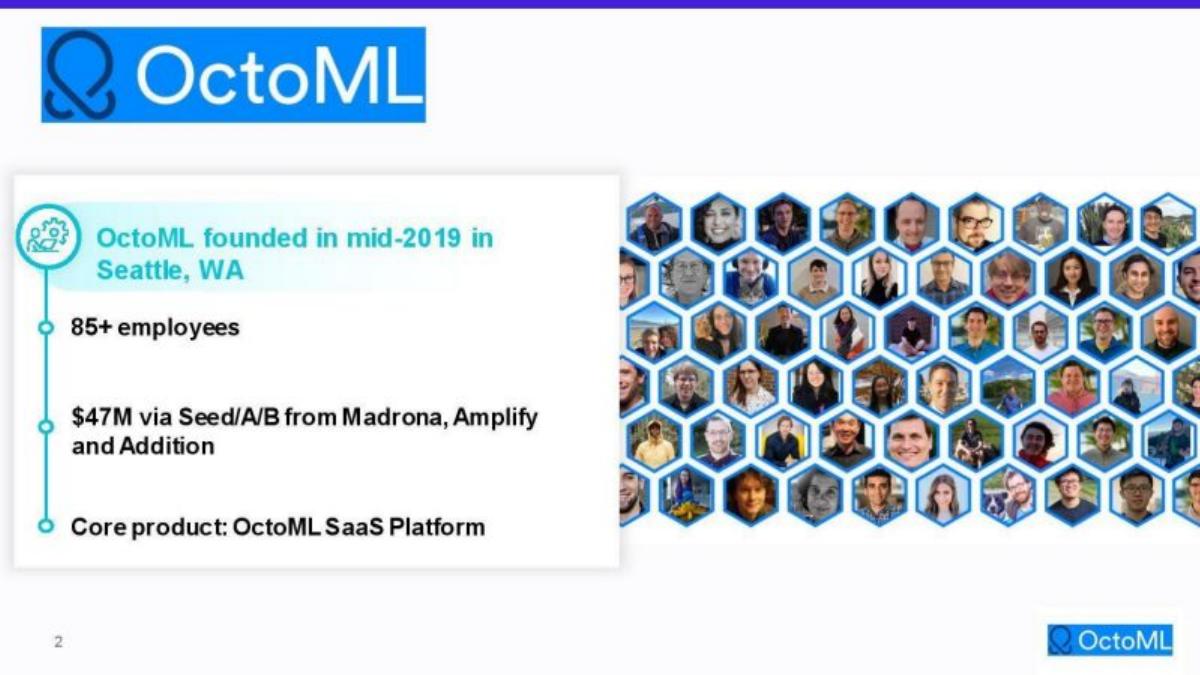
- The company was founded in mid-2019 in Seattle and had grown to 85+ employees by the time of this deck (Slide 2).
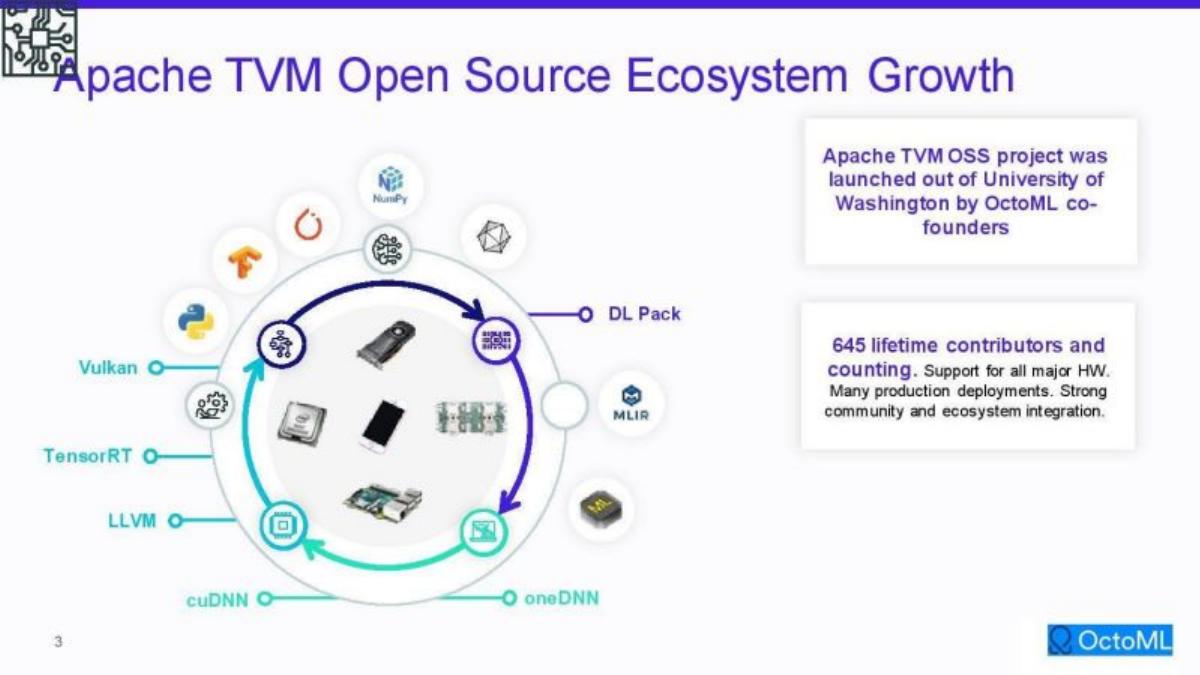
- OctoML leverages the Apache TVM open-source ecosystem, which boasts 645 lifetime contributors and support for all major hardware (Slide 3).
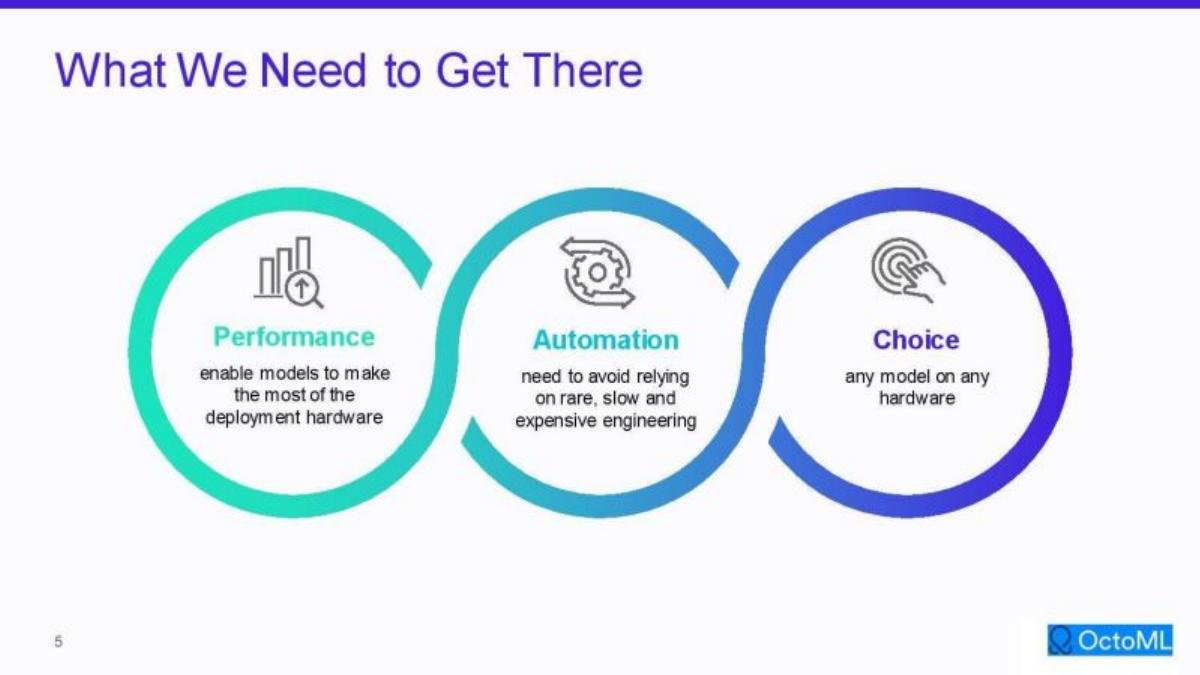
- The core value proposition is built on three pillars: Performance, Automation, and Choice (Slide 5).
- The deck identifies a massive efficiency problem, noting that a recommendation model at scale can consume as much energy as 170 American homes in a year (Slide 8).
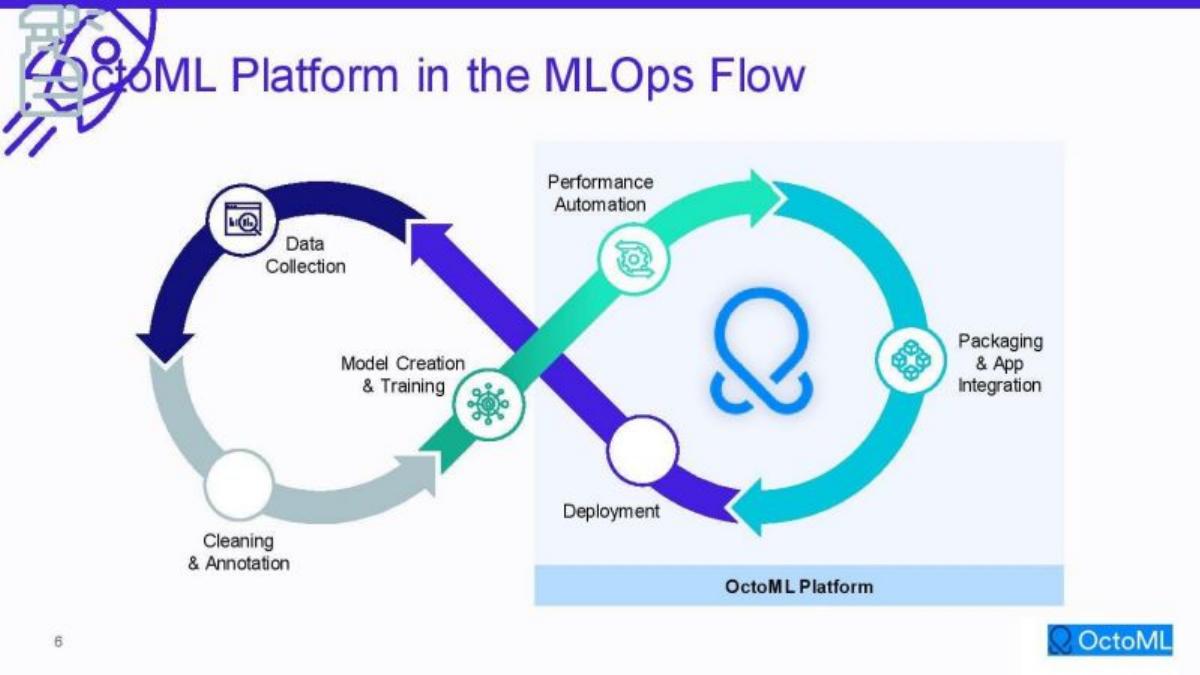
- OctoML positions itself as the 'Performance Automation' layer within the standard MLOps flow, sitting between model training and deployment (Slide 6).
- A key technical proof point is the Apple M1 case study, showing a reduction in CPU latency from 113.63ms to 36.36ms using TVM (Slide 17).
- The vision is to 'break ML from the HW box,' creating a performance portability layer analogous to operating systems in the 1980s (Slide 19).
- Strategic partnerships are highlighted with major industry players including Azure, AWS, and Qualcomm (Slide 20).
Introduction
OctoML occupies a unique space in the machine learning infrastructure stack. This teardown examines their 23-slide deck used during their 2021 growth phase. The company, which emerged from the University of Washington, focuses on the intersection of model efficiency and hardware diversity. The deck is less about 'selling' a product and more about 'defining' a new category of performance portability.
Slide 1: Title Slide
The deck opens with a clean, geometric design. The subtitle is direct: Machine Learning Deployment Platform . It establishes the company's territory immediately without using overly flowery language.
Slide 2: Company Overview
This slide provides the 'vital signs' of the business. It notes that OctoML was founded in mid-2019 in Seattle, WA . It highlights a team of 85+ employees and mentions $47M raised via Seed/A/B from Madrona, Amplify and Addition . The core product is identified as the OctoML SaaS Platform . The use of a team photo collage reinforces the human capital behind the technical product.
Slide 3: The Apache TVM Pedigree
OctoML’s greatest asset is its lineage. Slide 3 focuses on the Apache TVM Open Source Ecosystem Growth . It notes that the project was launched out of the University of Washington by OctoML co-founders. With 645 lifetime contributors and support for all major hardware, this slide proves that the underlying technology is already battle-tested and industry-standard.
Slide 4: Mission Statement
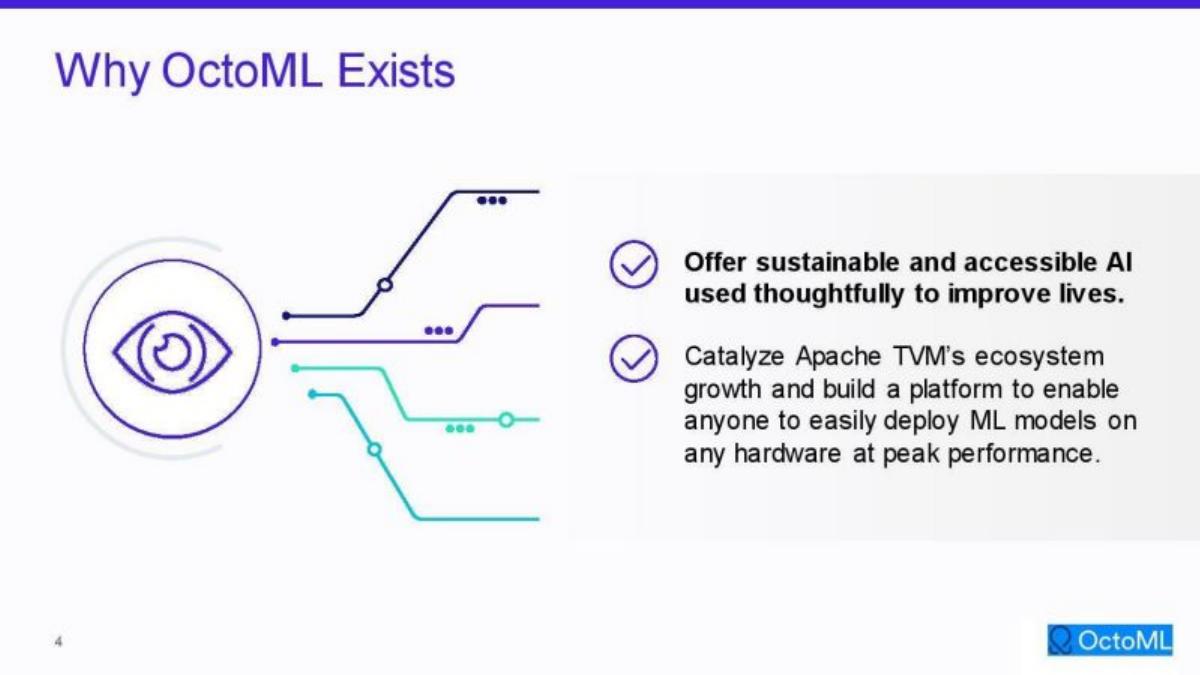
Titled 'Why OctoML Exists,' this slide sets a high-level vision: to offer sustainable and accessible AI and to catalyze Apache TVM's ecosystem growth . It frames the company as an enabler that allows 'anyone to easily deploy ML models on any hardware at peak performance.'
Slide 5: The Strategic Pillars
This is a foundational slide that introduces the three themes repeated throughout the deck: Performance, Automation, and Choice . Performance is about hardware utilization; Automation is about replacing expensive engineering; Choice is about model and hardware flexibility.
Slide 6: The MLOps Flow
Deep-tech decks often struggle to show where they fit in a customer's workflow. Slide 6 uses an infinity loop diagram to place the OctoML Platform between 'Model Creation & Training' and 'Deployment.' It specifically handles Performance Automation and Packaging & App Integration .
Slides 7-9: The Performance Problem
Slide 7 serves as a transition, stating that 'Performance is Critical to ML Innovation.' Slide 8 gets specific about the costs of inefficiency, citing that a recommendation model at scale has a carbon footprint equivalent to 170 American homes for a full year . Slide 9 visualizes the benefits of performance: 2x faster, 1/2 energy use, 1/2 infrastructure, and 1/2 cost.
Slides 10-11: The Talent Gap
Slide 10 argues that 'Achieving Performance is Hard,' requiring engineers to know model details, optimization techniques (like quantization), and computer architecture. Slide 11 points out that not enough people know how to do this , creating a bottleneck for innovation.
Slides 12-14: The Automation Solution
Slide 12 introduces 'Automation' as the key to scaling. Slide 13 notes that getting a model to production can take months . Slide 14 shows the technical solution: TVM uses ML-based optimizations to obviate the need for hand-tuning, producing optimized code specific to target HW (NVIDIA, Intel, AMD).
Slides 15-17: The Apple M1 Case Study
This is the 'proof' section of the deck. Slide 16 explains how OctoML enabled M1 and M1 Pro/Max support weeks after their release. Slide 17 provides hard data: ~3X CPU performance speedups (113.63ms vs 36.36ms) and ~2X GPU speedups (19.68ms vs 10.88ms). This is a powerful demonstration of their automation's speed and effectiveness.
Slides 18-20: The Power of Choice
Slide 18 transitions to 'Choice.' Slide 19 makes a bold claim: 'Breaking ML from the HW box' will be as transformative as operating systems were in the 80s. Slide 20 shows that they aren't doing this alone, listing partners like Azure, AWS, and Qualcomm , alongside the TVM contributor base.
Slide 21: The Synthesis
This slide ties the themes together: Performance + Automation = Sustainability, and Sustainability + Choice = More Innovation. It’s a logical wrap-up of the pitch’s narrative arc.
Slides 22-23: Conclusion
The deck ends with a simple 'Thank You' and a placeholder for the bestpitchdeck.com library. Notably, there is no 'Ask' slide detailing the specific dollar amount or valuation targets for the Series C, nor is there a detailed financial roadmap.
What Works in This Deck
1. Technical Credibility: By leading with their status as the creators of Apache TVM, OctoML bypasses the 'can they build it?' question. The open-source traction serves as a massive top-of-funnel for their commercial product.
2. Concrete Benchmarks: The Apple M1 case study is the strongest part of the deck. It moves the conversation from theoretical 'optimization' to specific, measurable latency reductions on the most talked-about hardware of the year.
3. The Sustainability Angle: Framing performance as an environmental necessity (Slide 8) is a clever way to align with ESG (Environmental, Social, and Governance) mandates that many large enterprise customers and investment funds prioritize.
What is Missing
1. The Business Model: While Slide 2 mentions a 'SaaS Platform,' the deck does not explain the pricing tiers, seat costs, or how they monetize the transition from the free open-source TVM to the paid OctoML platform.
2. Competitive Landscape: The deck assumes a vacuum. There is no mention of internal tools at big tech companies (like Google’s XLA or NVIDIA’s TensorRT) or other startups in the MLOps space. Investors would certainly ask how OctoML differentiates from these hardware-specific optimizers.
3. Financials and Projections: There are no slides showing revenue growth, customer logos (beyond partners), or burn rate. This suggests this version of the deck was likely a 'vision and product' deck used to anchor a deeper due diligence process where financials were shared separately.
Founder Takeaways
Lead with your 'Unfair Advantage': If your team created the industry standard for your niche, make that the first thing investors see. · Use Case Studies, Not Just Features: Don't just say your software is fast; show a bar chart comparing your speed to the industry leader (TensorFlow) on a specific, recognizable piece of hardware (Apple M1). · Define the 'Why Now': OctoML successfully argued that the explosion of hardware diversity (ARM, RISC-V, custom silicon) makes manual engineering impossible, creating a 'now or never' moment for their automation platform. · Keep the Design Consistent: The use of the three-pillar framework (Performance, Automation, Choice) throughout the deck helps the audience retain the core message even through complex technical explanations.
Frequently asked questions
- What is OctoML's primary product?
- According to slide 2, the core product is the OctoML SaaS Platform. It is designed to automate the optimization and deployment of machine learning models across diverse hardware targets, building upon the foundations of the Apache TVM open-source project.
- How does OctoML justify the need for its platform?
- The deck argues that manual 'hand engineering' for ML deployment does not scale. Slide 13 states that getting a model to production can take months and there are not enough specialized engineers to keep up with the demand for model-hardware tuning.
- What specific performance gains does the deck claim?
- On slide 17, OctoML showcases a case study on the Apple M1 Max chip. They claim a ~3X CPU performance speedup (reducing latency from 113.63ms to 36.36ms) and a ~2X GPU performance speedup (reducing latency from 19.68ms to 10.88ms) compared to standard TensorFlow.
- Who are the investors in OctoML?
- Slide 2 lists Madrona, Amplify, and Addition as investors who participated in the $47M raised across Seed, Series A, and Series B rounds prior to the Series C mentioned in the catalogue facts.
- What is the 'Efficiency Gap' mentioned in the deck?
- Slide 8 highlights that AI/ML impact is limited by efficiency. It points out the massive carbon footprint of large-scale models, suggesting that performance optimization is not just a technical requirement but a sustainability necessity for the industry.