This teardown of Brex's iconic pitch deck reveals how the fintech giant used a surgical go-to-market strategy to disrupt corporate banking. By focusing on the specific pain points of venture-backed startups and utilizing a unique underwriting model based on cash balances rather than credit scores, Brex created a high-growth engine. The deck serves as a masterclass in identifying a lucrative beachhead, building a product moat through software integrations, and proving a business model where revenue scales automatically with customer success.
Key takeaways
- Use a three-act problem structure to move from personal founder frustration to systemic industry-wide technological failure.
- Identify a specific beachhead market where you can apply underwriting arbitrage to serve customers legacy banks deem risky.
- Build a 'wedge' product that is easy to switch to, then layer on software integrations to make it hard to switch from.
- Demonstrate 'negative churn' by showing how customer spending grows automatically as they scale through funding stages.
- Establish immediate credibility by highlighting a team with deep domain expertise and backing from industry-leading investors.
The Teardown: Brex's Unicorn Blueprint
This teardown revisits the iconic pitch deck that helped Brex become a decacorn. We're looking at a version likely used around their 2018 Series B or C, a pivotal moment for the company. At the time, the startup ecosystem was awash in venture capital, yet the financial tools available to these same high-growth companies were archaic. Founders were putting company expenses on their personal AmEx cards, and finance teams were drowning in manual reconciliation. Brex didn't just see a gap; they saw a systemic failure. This deck is a masterclass in identifying a precise, lucrative beachhead market and executing a flawless go-to-market strategy. It's a story of turning a specific, visceral pain point into a multi-billion dollar financial operating system.
The Problem: A Vicious Cycle of Exclusion and Inefficiency
Most decks present a problem. Great decks make an investor feel the problem. Brex's deck does the latter with a brilliant three-act structure, widening the aperture of the problem from personal frustration to systemic rot.
Act 1: The Founder's Pain
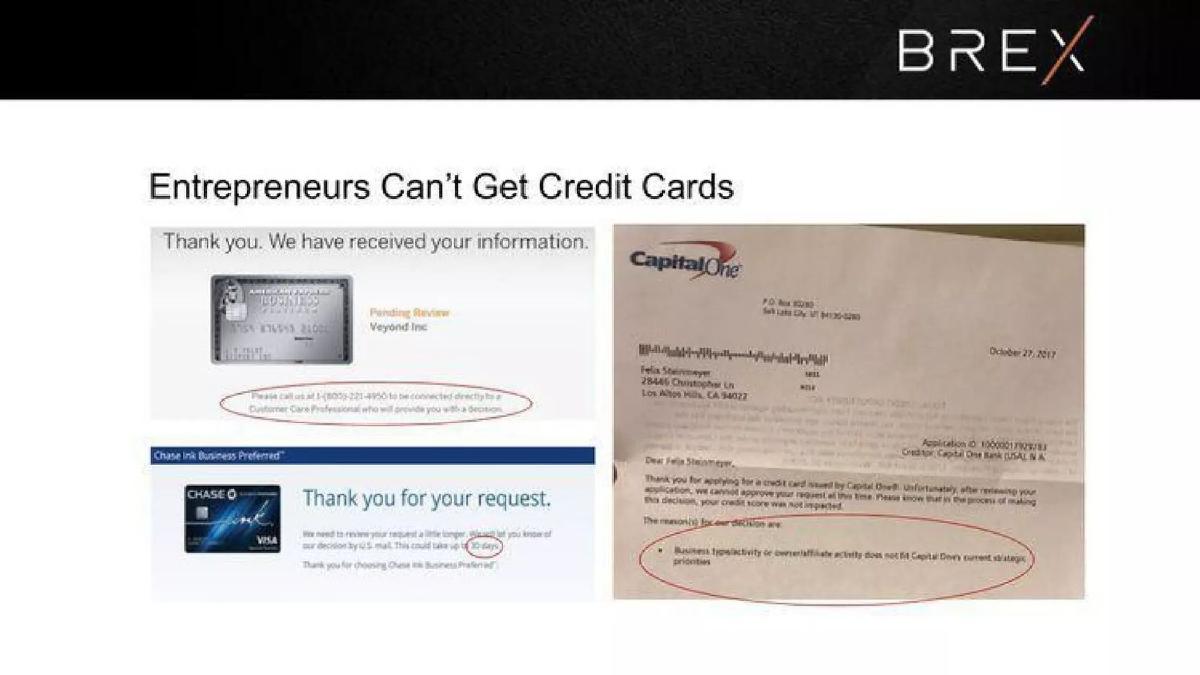
The deck leads with a slide titled, "Entrepreneurs Can’t Get Credit Cards," featuring images of rejection letters from Capital One and Dun & Bradstreet. This isn't a statistic; it's a shared trauma for their target audience. Every founder in the room had likely faced this exact situation: sitting on millions in VC funding but being deemed 'un-creditworthy' by a legacy FICO score model. It’s a visceral, infuriating paradox. By starting here, Brex immediately builds empathy and demonstrates a native understanding of the customer. They aren't an outsider looking in; they are part of the tribe they aim to serve.
Act 2: The CFO's Nightmare
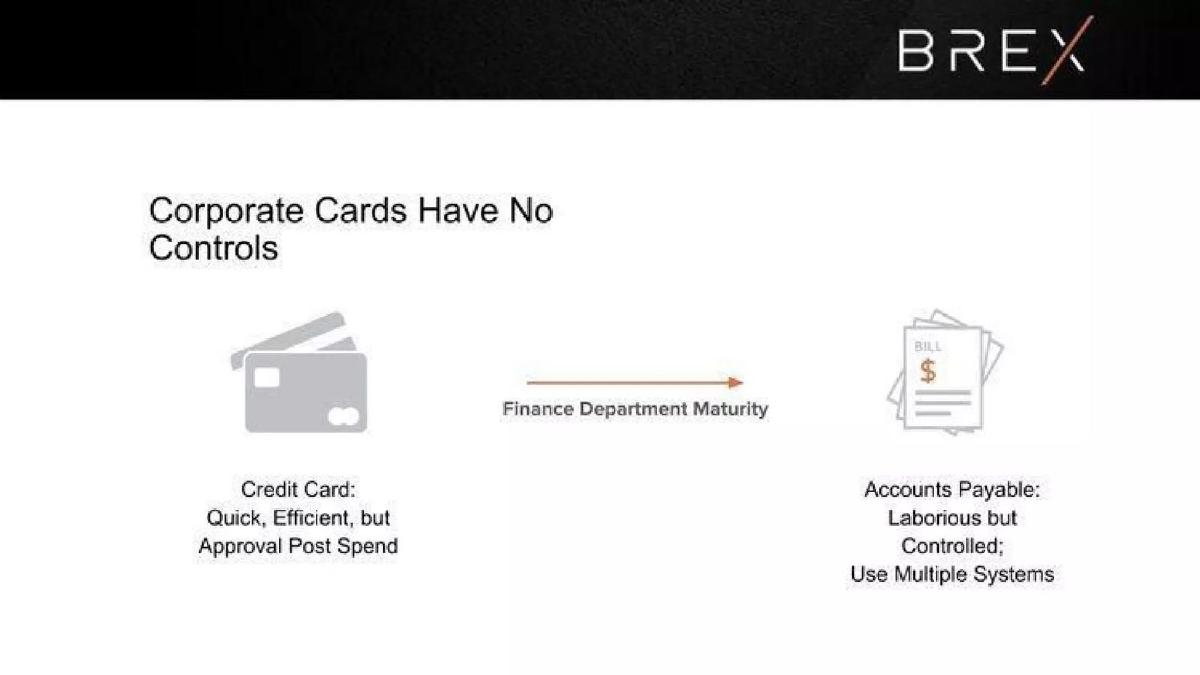
Next, Brex pivots from the problem of getting a card to the problem of managing it. The slide "Corporate Cards Have No Controls" introduces a maturity matrix for finance departments. On one side, you have credit cards: fast and efficient for employees, but a chaotic free-for-all with no pre-spend approval. On the other, you have traditional Accounts Payable: controlled and auditable, but slow and laborious. Finance teams were forced to choose between speed and control. This demonstrates that Brex understands the entire organization's pain, not just the founder's initial frustration. They are setting the stage for a solution that serves the end-user (employee), the manager (founder), and the finance function (CFO) simultaneously.
Act 3: The Systemic Sickness
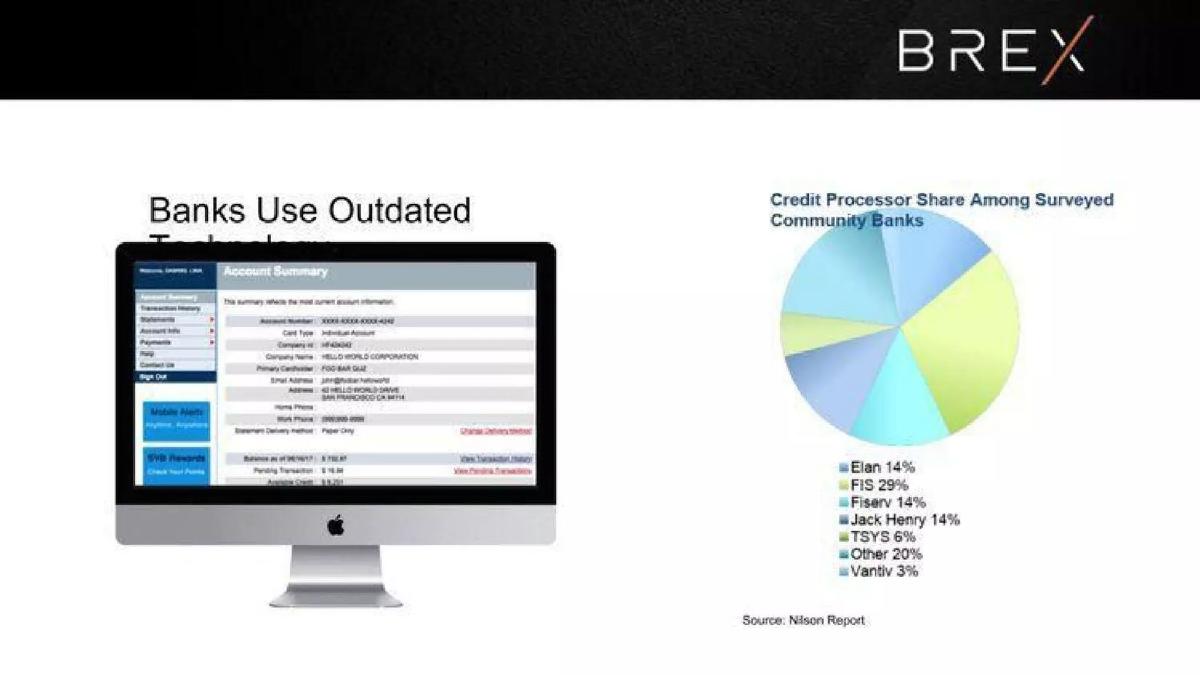
The final problem slide, "Banks Use Outdated Technology," elevates the issue to an industry-wide indictment. A simple chart shows the credit processing market dominated by a handful of legacy players like FIS, Fiserv, and TSYS. The unspoken message is powerful: the entire financial backend is built on decades-old technology by incumbents who have no incentive to innovate for a niche (but rapidly growing) market like startups. This slide provides the crucial 'Why Now?'. It frames Brex not just as a better product, but as a modern tech company poised to disrupt a technologically stagnant industry. This is the arbitrage opportunity. The problem isn't just bad policy; it's bad tech.
The Beachhead: A Masterclass in Go-to-Market Strategy
If there is one slide to steal from this deck, it's "Initial Focus on Technology Companies." This isn't a vague TAM slide; it's a surgical strike plan. Brex breaks down exactly why startups aren't just a customer segment, but the perfect customer segment. The logic is flawless:
Underwriting Arbitrage: This is the genius at the core of the business model. Brex recognized that traditional underwriting, based on credit history and profitability, was the wrong model for startups. Startups are often pre-revenue but cash-rich from VC funding. Brex decided to underwrite based on the cash in their bank account, not their FICO score. Legacy banks saw risk; Brex saw a massive, mispriced opportunity. · Big Spenders: Startups spend a disproportionate amount of money on categories that are perfect for corporate cards: SaaS subscriptions, cloud servers (AWS), and digital ads (Google/Facebook). This means high volume per customer from day one. · Early Adopters: This segment is inherently focused on better technology and is willing to adopt new tools that solve real pain points, especially those related to efficiency and integration. They aren't tied to legacy systems. · High Growth / LTV: As startups grow and raise more money, their spending grows exponentially. Brex correctly predicted this would lead to 'negative churn,' a holy grail metric we'll see later in the deck. · Concentrated: The target market is geographically and digitally concentrated in specific cities (SF, NYC) and online communities (like Y Combinator, which Brex was part of). This makes customer acquisition incredibly efficient through referrals and targeted marketing.
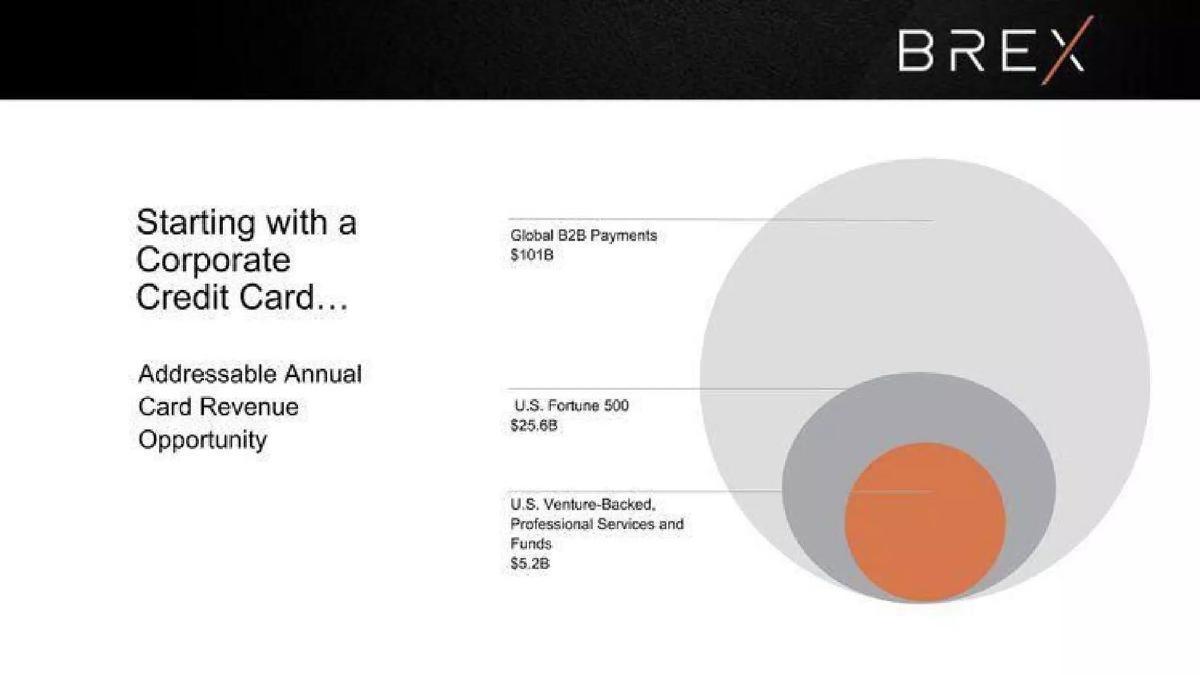
This single slide de-risks the go-to-market strategy entirely. It tells investors that Brex has a clear, defensible, and highly profitable plan to dominate a key market before expanding. The market sizing slide, which shows a $5.2B initial opportunity within a $101T global B2B payments landscape, feels credible because of this focused entry strategy.
The Solution: A Wedge with a Deep Moat
Brex frames its product strategy as a two-step process: win the customer, then lock them in. The deck title "It's Easy to Switch To, and Hard to Switch From" perfectly encapsulates this.
Part 1: The Wedge - Winning the Customer
The initial value proposition directly attacks the problems identified on the first slide. Three simple, powerful promises designed for acquisition:
Higher Limits: Based on cash balance, not credit history, giving startups the spending power they actually need. · No Personal Guarantee or Security Deposit: This was revolutionary. It decoupled the founder's personal financial health from the business, a massive point of friction and risk for entrepreneurs. · Instant Signup: By leveraging modern tech, they could onboard customers online in minutes, contrasting sharply with the weeks-long, paper-heavy process of traditional banks.
These features weren't just nice-to-haves; they were the keys that unlocked a frustrated and underserved market. This was the wedge.
Part 2: The Moat - Keeping the Customer
Once a customer was using the Brex card, the focus shifted to retention by layering on software that solved the CFO's problems. The deck highlights four key feature categories that build this moat:
Better Data: A clean, modern dashboard providing real-time visibility into company spending. · Better Controls: This is where Brex truly differentiates from a standard corporate card. They introduced software-based controls like virtual cards for specific vendors, approval flows for large transactions, and granular limits by user, team, or category. This solved the 'chaos' problem for finance teams. · Receipt Capture: Using OCR and email fetching, Brex automated one of the most hated parts of expense management. This created deep value for the end-user (the employee), driving bottom-up adoption and love for the product. · ERP Integrations: By connecting seamlessly with accounting software like QuickBooks, NetSuite, and Xero, Brex embedded itself into the core financial workflow of the company, making it incredibly sticky.
Finally, they added a targeted rewards program. Instead of generic airline miles, Brex offered discounts on AWS, SaaS tools, and other products their startup customers were already buying. This brilliant move reinforced their understanding of the customer and created a self-reinforcing flywheel where rewards provided real business value.
The Proof: Traction That Tells an Unstoppable Story
Great story, but does it work? Brex answers with two of the most effective traction slides you'll ever see.
First, a classic hockey-stick graph showing "Growing Volume." Crucially, this growth was achieved while the product was in a "Referral Only, Private Beta." This context is vital. It signals to investors that the explosive growth is organic and driven by intense product-market fit, and that there is massive pent-up demand waiting to be unlocked by a public launch.
But the second traction slide is the true masterpiece: "Customers Exhibit ‘Negative Churn’." This slide visualizes customer spending cohorts mapped directly to their venture capital funding stage. It shows that a company spending $1.5k/month at Pre-Seed graduates to spending $50k/month at Series A, and $1.5M/month at Series D. This is a profound insight. It demonstrates that Brex's revenue doesn't just grow; it grows automatically and predictably as its customers succeed. Brex's growth is indexed to the growth of the entire venture ecosystem. For a VC, this is the ultimate investment thesis: a platform that harnesses the momentum of all their other portfolio companies. It transforms Brex from a single company investment into a proxy for the entire innovation economy. This slide alone likely secured the funding round.
The Foundation: The Credibility Engine
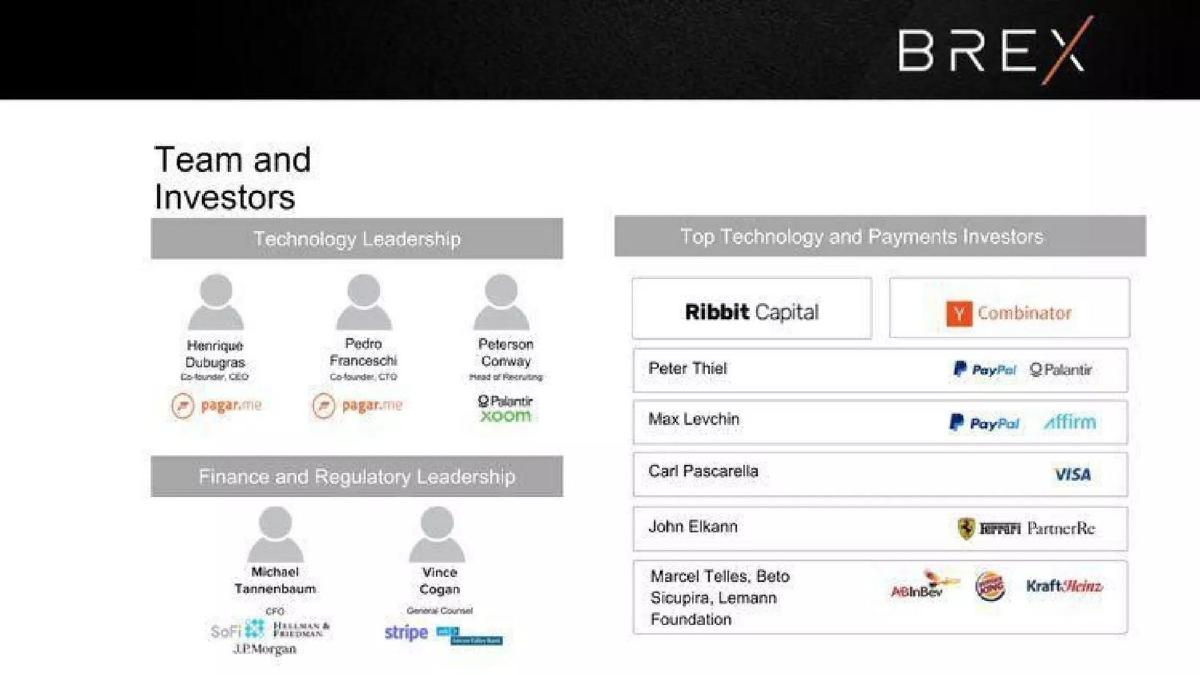
None of this ambitious vision would be believable without the very first slide after the cover: "Team and Investors." Before explaining the problem or the market, Brex establishes unquestionable authority. The founders, Henrique Dubugras and Pedro Franceschi, had a prior exit with Pagar.me, a major payments company in Brazil. The team included leaders from SoFi. The investor list was a who's who of fintech royalty: Peter Thiel, Max Levchin (co-founder of PayPal), Ribbit Capital (one of the top fintech VCs), and the founders of Affirm and Palantir.
In a heavily regulated industry like finance, where trust and execution risk are paramount, this slide is everything. It tells investors: "We know payments. We've done this before. The smartest money in the world is already backing us." This pre-emptive de-risking makes all the ambitious claims that follow feel not just possible, but probable.
Where Brex is Now vs. The Deck's Promise
So, how did the story play out? The deck promised to start with startups and then build a large enterprise finance company. This is largely what happened, but the path was not linear. Brex successfully used the corporate card wedge to acquire tens of thousands of startups. They expanded their vision to become the "Financial Operating System" for businesses, launching Brex Empower, a full-fledged software platform for global spend management. They also expanded beyond their beachhead market to serve more traditional SMBs.
However, in 2022, they made the tough, controversial decision to off-board many of those same SMB customers and refocus squarely on their core of venture-backed startups and larger enterprises. This move, while painful for those affected, was a reaffirmation of the core thesis in this very deck: Brex's unique advantage lies in serving the specific needs of high-growth, venture-backed companies. The "underwriting arbitrage" and "negative churn" dynamics that made the initial model so powerful were less applicable to other business types. The deck's promise held true, and its GTM strategy proved so potent that deviating from it was a mistake they had to correct. Brex today is a testament to the power of the initial vision laid out in these slides: a financial tech giant built by understanding its first customer better than anyone else.
Frequently asked questions
- Why was starting with the 'Team' slide so effective for Brex?
- In fintech, execution and regulatory risk are massive hurdles. By starting with a slide showcasing founders with a major payments exit (Pagar.me) and backing from fintech legends like Peter Thiel and Max Levchin, Brex immediately established deep credibility. It told investors, 'We are the right team to navigate this complex space,' de-risking the entire pitch before the first problem was even stated.
- What is 'underwriting arbitrage' and why was it key to Brex's strategy?
- Underwriting arbitrage was Brex's core insight. Legacy banks underwrote companies based on FICO scores and profitability, models that systematically rejected cash-rich but pre-revenue startups. Brex chose to underwrite based on a company's real-time cash balance. This allowed them to profitably serve a huge, valuable market that their competitors literally could not see, creating a massive and defensible competitive advantage.
- How did Brex create a product that was 'hard to switch from'?
- While instant signup and no personal guarantee got customers in the door (easy to switch to), the moat was built with software. By integrating deeply into a company's financial stack with ERP integrations (QuickBooks, NetSuite) and providing indispensable tools for finance teams (spend controls, virtual cards) and employees (receipt capture), Brex became the central nervous system for spending. Ripping it out would be a major operational headache, creating immense stickiness.
- The deck shows a 'Negative Churn' slide. Why is this metric so powerful for investors?
- Negative churn means that the revenue growth from your existing customers is greater than the revenue you lose from customers who leave. Brex's slide brilliantly showed this by linking customer spending to VC funding rounds. It demonstrated a predictable, scalable growth model where Brex's revenue would automatically compound as their customers grew. For VCs, this transforms a company from a risky bet into a near-certain growth engine tied to the success of the entire startup ecosystem.
- What was the biggest risk in Brex's strategy presented in this deck?
- The biggest risk was being entirely dependent on the health of the venture capital ecosystem. The entire model of underwriting based on cash-on-hand and benefiting from negative churn relies on a steady stream of startups getting funded and growing. A downturn in VC funding or a collapse in the startup market would directly threaten Brex's core business model, a risk that became very real in the market correction of 2022 and partly influenced their decision to refocus on their most resilient customers.