Bright.md’s 20-slide deck is a highly structured argument for asynchronous healthcare automation. Founded in 2014 and based in Portland, the company addresses the 'crushing provider shortage' by automating 90% of the clinical workflow. The deck excels at identifying why current solutions—specifically EMRs and traditional video-based telehealth—fail to solve the capacity crisis. By citing a 15-20x multiplier on physician capacity and a positive ROI in less than a year, Bright.md moves beyond a simple 'better patient experience' pitch to a 'systemic efficiency' pitch. While the deck lacks a spe…
Key takeaways
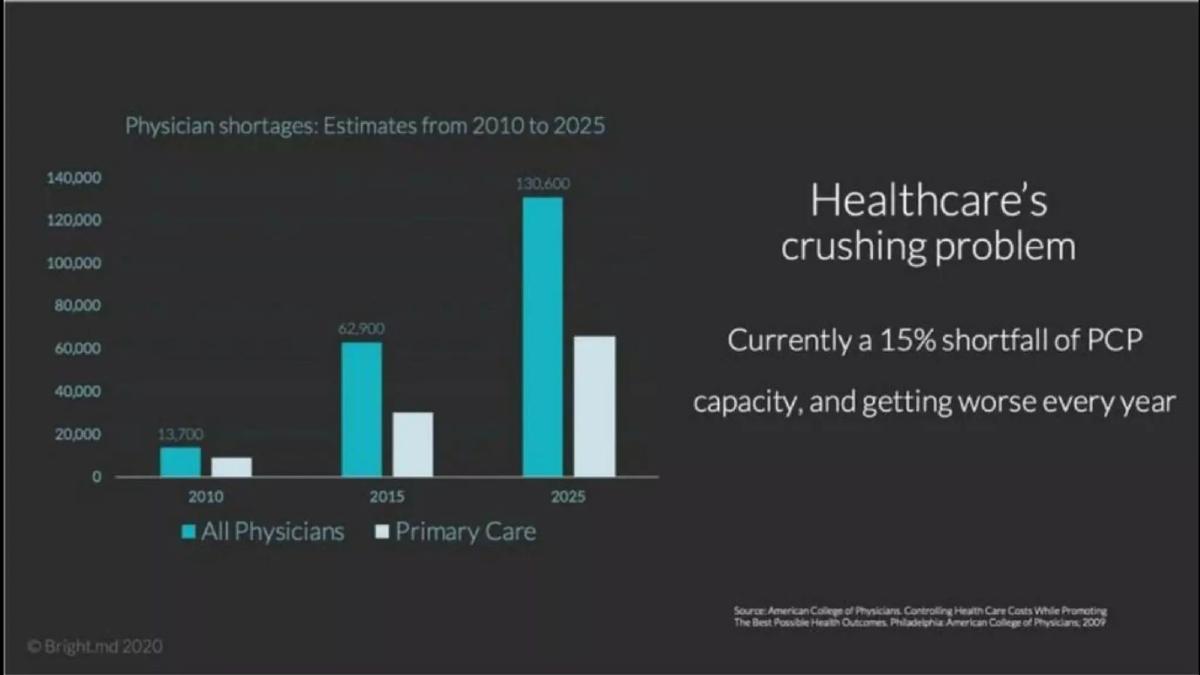
- The deck identifies a 15% shortfall in Primary Care Physician (PCP) capacity as the core market driver on slide 3.
- It explicitly positions traditional video telehealth as a failure, noting that video visits take the same amount of clinician time as in-person visits on slide 5.
- The SmartExam platform claims to automate 90% of the work, reducing clinician time to less than 2 minutes per encounter on slide 7.
- Efficiency gains are quantified as a 15-20x multiplier on physician capacity on slide 10.
- The company demonstrates proven value through a 30% new patient acquisition rate and a 90% patient satisfaction score on slide 11.
- Third-party validation is a core pillar, featuring a dedicated slide for Gartner's 'Cool Vendor' status and 'Transformational' rating on slide 16.
- The competitive landscape slide (17) uses a 2x2 grid to position Bright.md as the high-efficiency, platform-based leader compared to service-heavy competitors.
- The leadership team slide (18) emphasizes collective skills in clinical expertise and provider system operations rather than just technical backgrounds.
The Strategic Narrative of Healthcare Automation
Bright.md’s 2020 pitch deck is a clinical, data-driven argument for the necessity of automation in a failing healthcare infrastructure. Rather than focusing solely on patient convenience—a common trope in telehealth—this deck focuses on the provider's pain. By framing the problem as a 'crushing provider shortage' that digitization has historically made worse, Bright.md sets the stage for a solution that prioritizes clinician efficiency above all else.
Slides 1-5: The Macro Problem and the Failure of Current Solutions
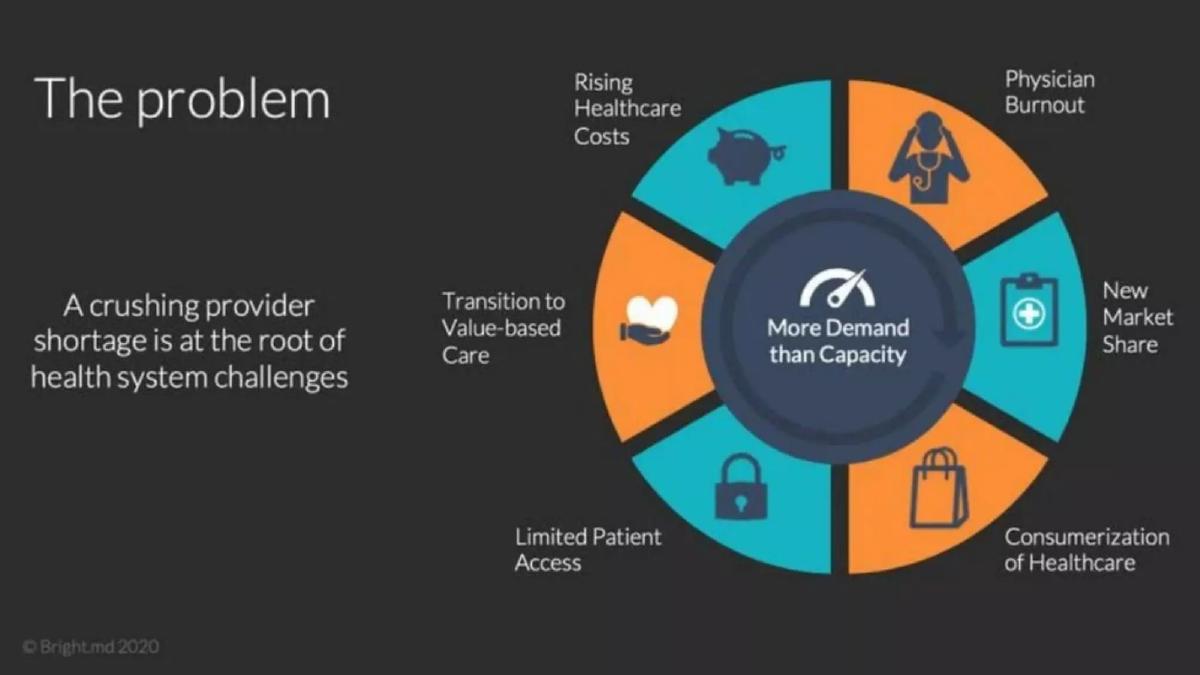
The deck opens with a clear mission statement on Slide 1 : 'Automating Healthcare Delivery.' This immediately signals that the company is a software-first platform rather than a service-based provider network. Slide 2 introduces the 'crushing provider shortage' as the root of all health system challenges, including rising costs, physician burnout, and limited patient access.
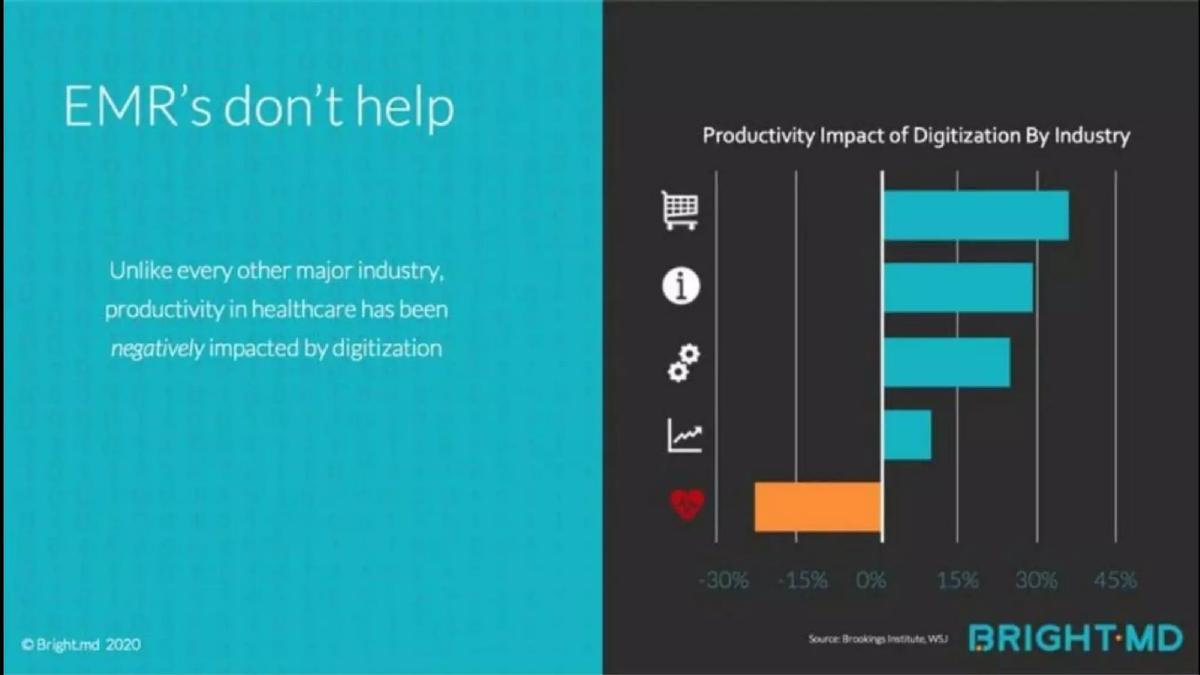
Slide 3 provides the data to back this up, citing a 15% shortfall in Primary Care Physician (PCP) capacity and showing a bar chart where physician shortages are projected to grow from 13,700 in 2010 to 130,600 by 2025. This establishes a massive, growing market need. Slide 4 takes a bold stance by stating 'EMR’s don’t help,' showing a chart from the Brookings Institute where healthcare is the only industry where digitization has negatively impacted productivity (-15%).
Slide 5 continues this contrarian narrative by claiming 'Telehealth does not help.' It cites the Advisory Board to argue that video visits take the same amount of clinician time as in-person visits. This is a critical strategic move: by invalidating the two most common 'solutions' (EMRs and Video Telehealth), Bright.md creates a vacuum that only their specific product can fill.
Slides 6-10: The SmartExam Solution and Workflow
Slide 6 introduces SmartExam as the solution to 'radically decrease time and cost.' Slide 7 is the 'How it Works' slide, breaking down the encounter into three phases: the patient takes a 10-minute interview, the clinician spends less than 2 minutes reviewing, and the system automates 90% of the work, including billing and EMR integration. This '90% automation' figure is the deck's most powerful value proposition.
Slide 8 and Slide 9 detail the Patient and Clinician experiences respectively. The patient experience includes eligibility checks, EHR reviews, and personalized treatment, while the clinician experience highlights the 'chart-ready SOAP note' and 'billing file' generation. These slides emphasize that the platform handles the administrative overhead that typically causes burnout.
Slide 10 summarizes the 'Unique Benefits,' most notably a '15-20x multiplier on physician capacity.' It also mentions COVID-19 evaluation based on CDC guidelines, dating this deck to the early pandemic era when healthcare systems were under unprecedented strain. The mention of 'real-time medically certified translation' for Spanish-speaking patients adds a layer of clinical depth often missing from generic tech pitches.
Slides 11-13: Proven Value and Market Fit
Slide 11 is the 'Proven Value' slide. It moves from theoretical benefits to hard metrics: >30% new patient acquisition, <2 mins provider time, and 90% patient satisfaction. The most compelling figure here is the 'Creation of 7 FTE of clinical capacity; a value of $1.75M!' This gives the investor a concrete ROI to model. It also claims a positive ROI in less than a year.
Slide 12 illustrates the versatility of the platform, showing it works for 'All types of healthcare systems,' from Fee-for-Service to Accountable Care Organizations and Academic Medical Centers. Slide 13 provides social proof through 'Accolades from Patients & Providers,' using quotes that emphasize speed and thoroughness. One quote specifically compares a 3-hour Minute Clinic visit to a 15-minute SmartExam experience.
Slides 14-17: Credibility and Competition
Bright.md leans heavily on institutional validation. Slide 14 displays a wall of logos from major publications like WSJ, Gartner, and Wired. Slide 15 features a deep dive into a report by Chilmark Research, which named Bright.md a 'Vendor to Watch.' Slide 16 is dedicated entirely to Gartner, highlighting their 'Cool Vendor' status and the 'Transformational' rating of the technology.
Slide 17 is the competitive landscape. It uses a 2x2 grid with 'Efficiency' on the Y-axis and 'Business Model' (Service vs. Platform) on the X-axis. Bright.md places itself in the top-right quadrant as the high-efficiency platform leader. The bubble sizes represent 'visit volume supported by current clinical scope,' showing Bright.md has a significant footprint compared to smaller, service-oriented competitors.
Slides 18-20: Team and Capitalization
Slide 18 introduces the 'Leadership Team.' Notably, it focuses on 'Collective Skills & Experience' rather than just resumes. It highlights clinical expertise, provider system operations, and growth scaling. The team is led by Ray Costantini, MD (Founder & CEO) and Mark Swinth (Founder & CFO).
Slide 19 details the 'Capitalization History.' It states a total of $20M raised, with the most recent round being $8M in August 2017. The slide lists prominent investors including B Capital Group and Pritzker Group. This transparency regarding previous funding rounds helps set the context for the current Series-stage discussion. The deck concludes on Slide 20 with contact information.
What Works in This Deck
The 'Anti-Solution' Strategy: By spending three slides (3, 4, and 5) explaining why EMRs and video telehealth fail to solve the core problem of capacity, Bright.md makes their asynchronous model feel like the only logical choice. This is a sophisticated way to handle competition without naming names.
Quantified Efficiency: The deck is obsessed with time. 'Less than 2 minutes' of clinician time and a '15-20x multiplier' are metrics that resonate deeply with hospital administrators who are struggling with labor costs and physician shortages.
Heavy Third-Party Validation: Most decks have a single logo slide. Bright.md has three (14, 15, 16). In the highly risk-averse healthcare sector, showing that Gartner and Chilmark Research have vetted the technology is more valuable than any self-reported metric.
What Is Missing
The Current Ask: While the deck lists previous funding, it does not state what they are raising now, the valuation they are seeking, or the specific milestones they intend to hit with new capital. This makes it feel more like a general capabilities deck than a targeted fundraising pitch.
Financial Projections: There are no slides showing revenue growth, ARR, or future projections. While the ROI for the customer is clear, the ROI for the investor (in terms of company growth) is left to the imagination.
Detailed Go-To-Market: The deck mentions they work with all types of systems, but it doesn't explain how they win those contracts. A slide on sales cycles, implementation timelines, or partnership strategies would have strengthened the 'Growth Scaling' claim on the team slide.
What a Founder Should Copy
The Problem-Solution-Proof Loop: Bright.md follows a perfect logical flow: The problem is a shortage (Slide 3), current tech makes it worse (Slide 4), our tech automates 90% (Slide 7), and here is the $1.75M value we created for a client (Slide 11). Every claim is immediately backed by a metric or a case study.
Focus on the 'Job to be Done': The deck doesn't get bogged down in the 'AI' buzzword (though the catalogue mentions it). Instead, it focuses on the result of the AI: a 'chart-ready SOAP note.' Founders should copy this focus on the end-product rather than the underlying technology.
Visual Consistency: The use of a dark theme with high-contrast teal and orange accents makes the data visualizations pop. The deck looks professional, clinical, and modern, which aligns perfectly with the brand's promise of modernizing healthcare.
Conclusion Bright.md’s deck is a masterclass in B2B healthcare positioning. It successfully pivots the conversation from 'telehealth as a convenience' to 'automation as a necessity.' By grounding the pitch in the undeniable reality of physician shortages and the failure of first-generation digital health tools, they create a compelling case for their platform. While it lacks the specific financial 'Ask' typical of a pure fundraising deck, its strength lies in its ability to prove massive, quantifiable value to a skeptical, over-burdened industry.
Frequently asked questions
- What is the primary problem Bright.md aims to solve?
- Bright.md targets the physician shortage and the resulting 'More Demand than Capacity' crisis in healthcare. Slide 3 highlights that there is currently a 15% shortfall in Primary Care Physician capacity, which is projected to worsen. They argue that existing digital tools like EMRs and video telehealth have actually decreased productivity or failed to save time, creating a need for their asynchronous automation platform.
- How does SmartExam differ from traditional telehealth?
- Unlike traditional telehealth which relies on synchronous video calls, SmartExam is asynchronous and automated. Slide 7 explains that the patient completes a 10-minute digital interview, after which the system generates a provisional diagnosis and chart note. This reduces the clinician's active involvement to less than 2 minutes, whereas slide 5 notes that video visits take as much time as in-person appointments.
- What specific ROI metrics does the deck provide for healthcare systems?
- Slide 11 outlines several key financial and operational metrics: delivering care at half the cost of a nurse advice line, creating 7 Full-Time Equivalent (FTE) of clinical capacity (valued at $1.75M), and achieving a positive ROI in less than a year. They also claim a 30% increase in new patient acquisition.
- Who are the key investors mentioned in the deck?
- Slide 19 lists the company's capitalization history, showing $20M raised previously. The featured investors include B Capital Group, Pritzker Group Venture Capital, Seven Peaks Ventures, Oregon Venture Fund, and SpringRock. The catalogue listing indicates the total amount raised eventually reached $29.2M.
- What is missing from the Bright.md pitch deck?
- The deck lacks a clear 'Ask' slide detailing how much capital they are currently seeking and how it will be deployed. It also omits detailed financial projections, a specific go-to-market strategy for the next 18-24 months, and a breakdown of unit economics (CAC/LTV). While it mentions 'All types of healthcare systems' as customers, it does not list specific current logos or contract sizes.