Briq raised $30M in 2021 for its Series B round using a deck that prioritizes high-level positioning over granular data. The presentation identifies a massive $10T market opportunity and positions Briq as the first 'money workflow' platform, distinct from design-focused Autodesk or document-focused Procore. While the deck is visually polished and presents a compelling 'before and after' impact narrative—claiming to reduce project workflow time from weeks to just one hour—it is notably light on hard financial metrics, growth charts, and team biographies beyond the CEO. This suggests a deck des…
Key takeaways
- The deck targets a massive $10T construction industry market, as stated on slide 2.
- Briq positions itself as a new category, 'Money Workflow,' to differentiate from Autodesk and Procore (slide 9).
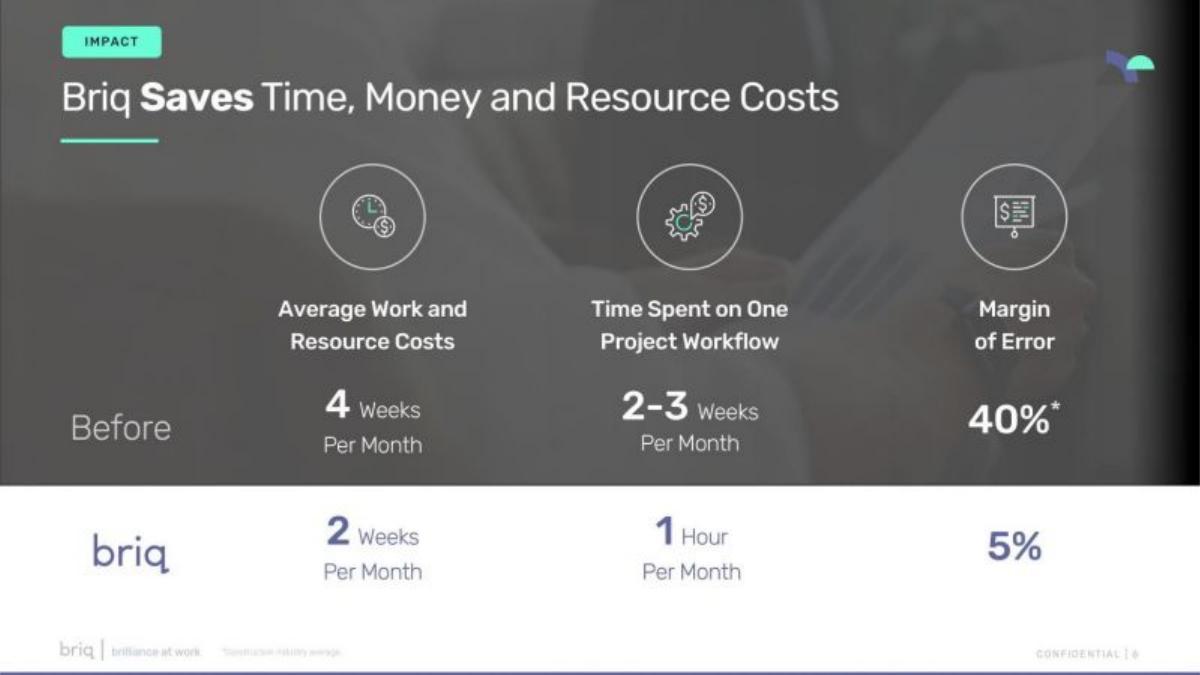
- The platform claims to reduce the time spent on one project workflow from 2-3 weeks to just 1 hour (slide 6).
- The business model is a SaaS platform fee combined with module and per-user pricing (slide 10).
- Briq aims to manage 80% of money workflow automation in the construction industry within 10 years (slide 2).
- The deck lacks a traditional team slide, only featuring CEO Bassem Hamdy on slide 2.
- There are no specific revenue, churn, or CAC metrics included in this 13-slide version of the deck.
- The impact slide claims to reduce the margin of error in construction finance from 40% to 5% (slide 6).
The Visionary Playbook for Construction Technology
Briq's 2021 Series B deck is a study in high-level strategic positioning. At 13 slides, it is remarkably concise for a mid-stage round. The deck avoids the typical 'data dump' often seen in Series B presentations, opting instead to sell a vision of total market dominance in a neglected niche of the construction industry: the money. By defining a new category—the 'Money Workflow'—Briq successfully carved out a space between established giants like Autodesk and Procore.
Slides 1-2: The Hook and the Ambition
Slide 1 introduces Briq as a 'Smart, dynamic money workflow management platform.' The branding is clean, utilizing a concrete-textured background that subtly nods to the construction industry without being literal. The date '2021' and the label 'Investment Opportunity' set a professional, standard tone.
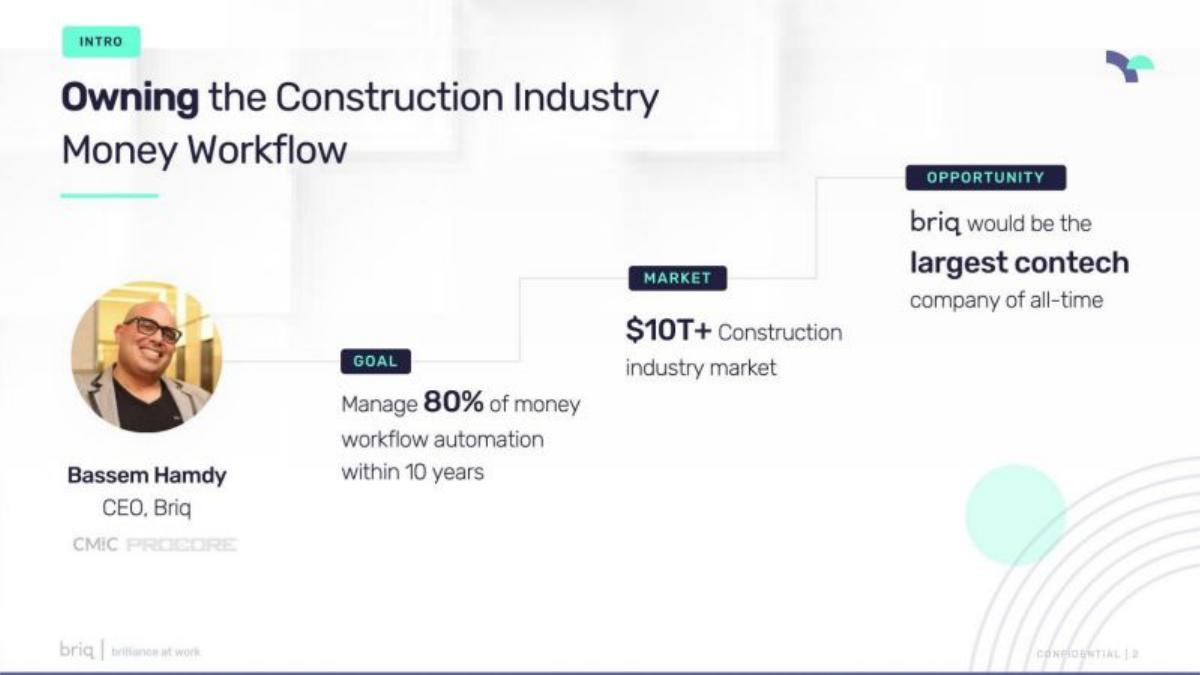
Slide 2 is the 'Intro' slide, but it functions more as a 'North Star' slide. It features CEO Bassem Hamdy and highlights his pedigree with logos for CMiC and Procore. The slide sets an incredibly high bar for the company's future, stating a goal to 'Manage 80% of money workflow automation within 10 years.' It also defines the market as '$10T+' and makes the bold claim that 'briq would be the largest contech company of all-time.' This is a classic Series B move: shifting the narrative from 'we have a product' to 'we are going to own this entire industry.'
Slides 3-5: Problem, Solution, and Mechanism
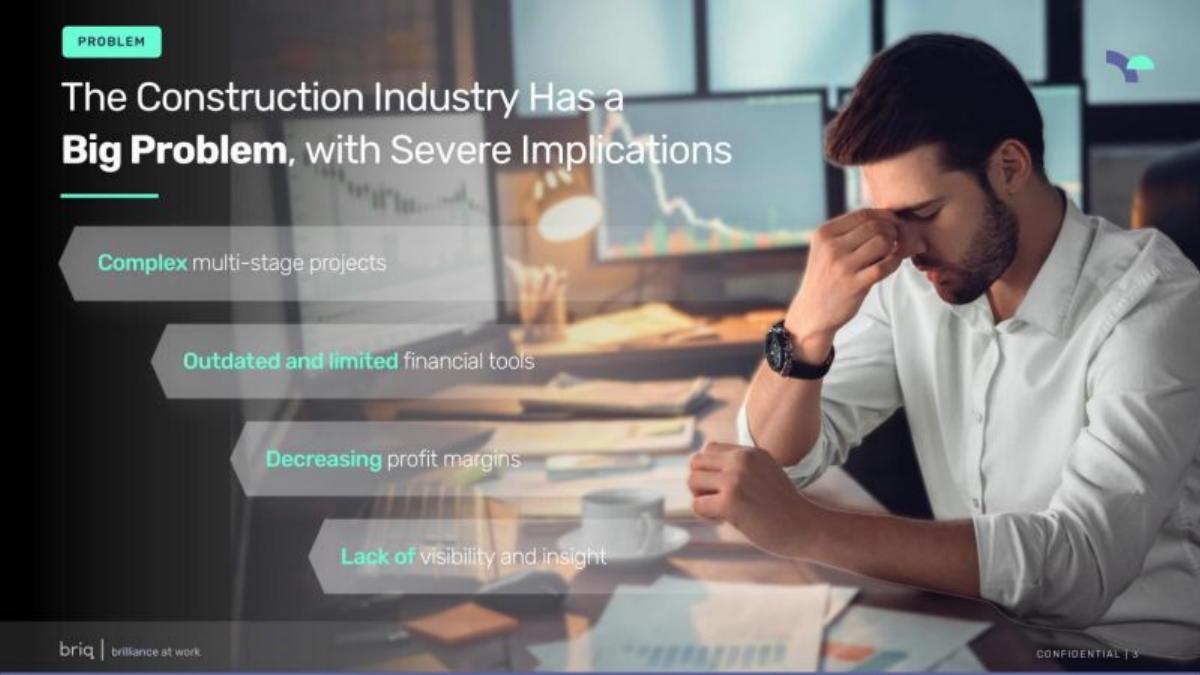
Slide 3 outlines the 'Big Problem' in construction: complex projects, outdated tools, decreasing margins, and a lack of visibility. The imagery of a stressed professional reinforces the pain point. It’s a standard problem slide that sets the stage for a 'financial operating system.'
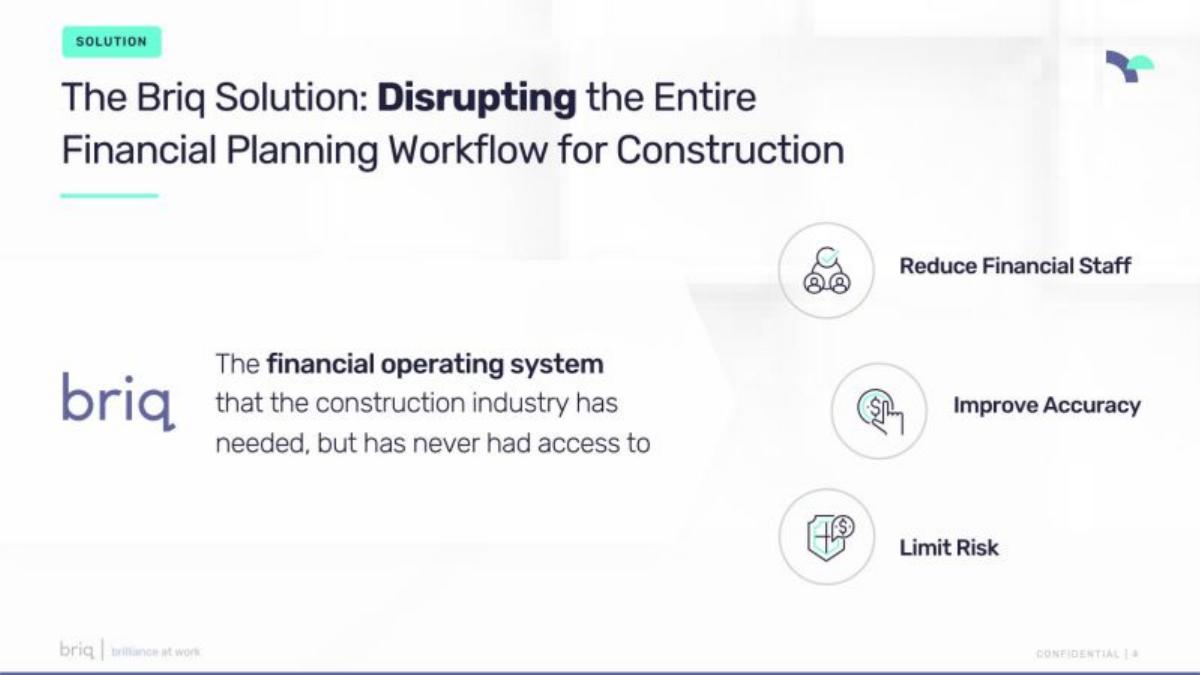
Slide 4 introduces the 'Briq Solution.' It promises to 'Reduce Financial Staff,' 'Improve Accuracy,' and 'Limit Risk.' By calling itself a 'financial operating system,' Briq moves its perceived value up the stack from a simple tool to a mission-critical infrastructure component.
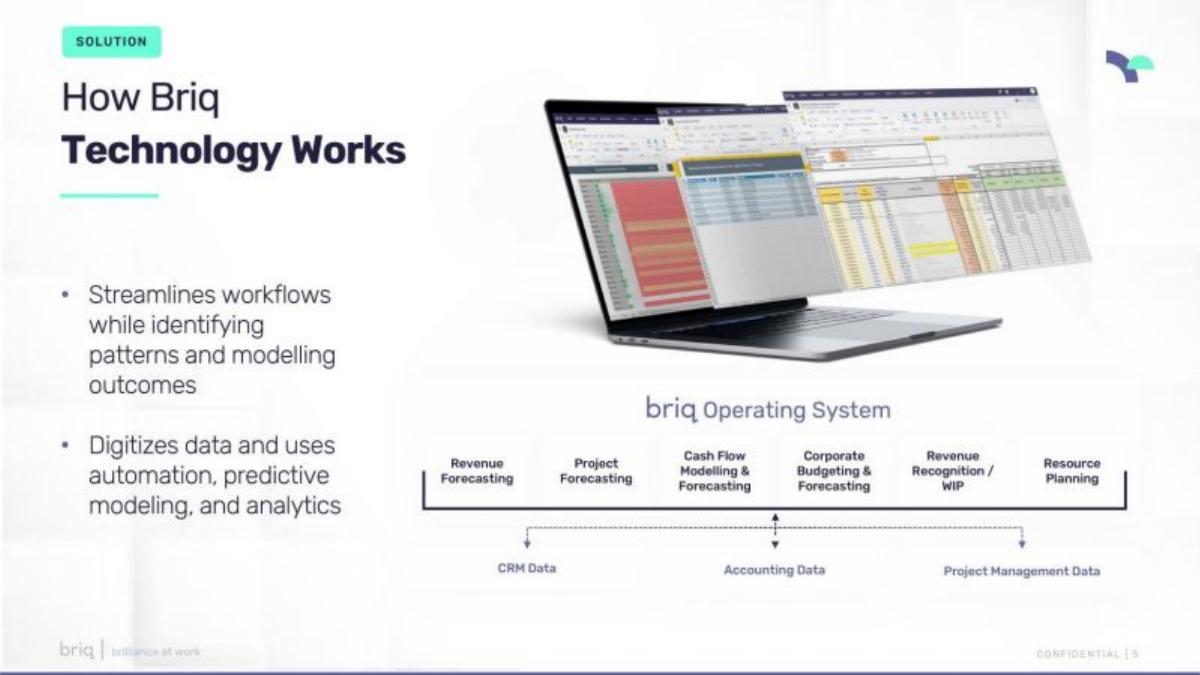
Slide 5 explains 'How Briq Technology Works.' It shows a laptop with complex spreadsheets being transformed into the 'briq Operating System.' The diagram at the bottom is crucial: it shows Briq sitting on top of CRM, Accounting, and Project Management data to feed modules like Revenue Forecasting and Resource Planning. This slide effectively communicates that Briq is an integration layer that turns raw data into actionable financial insights.
Slides 6-8: Impact and Validation
Slide 6 is perhaps the most compelling slide in the deck. It uses a 'Before vs. Briq' comparison to show massive efficiency gains. The claim that a project workflow taking '2-3 weeks' can be reduced to '1 hour' is a powerful value proposition. It also highlights a reduction in the 'Margin of Error' from 40% to 5%, which, in a low-margin industry like construction, is a direct line to increased profitability.
Slide 7 reinforces Briq as the 'System of Record.' It mentions a 'Standardized Playbook' and the democratization of financial know-how. The inclusion of logos like Sage 300 and Procore in the background suggests deep integration with existing industry standards.
Slide 8 provides social proof through three testimonials from CFOs and finance executives at construction firms. The quotes emphasize that Briq provides a 'true source of truth' that their existing ERP systems could not achieve. This validates the 'System of Record' claim made on the previous slide.
Slides 9-10: Competition and Monetization
Slide 9 is a masterclass in competitive positioning. Instead of a standard feature-comparison grid, Briq uses a horizontal axis to show where it sits. It concedes 'Design Workflow' to Autodesk and 'Document Workflow' to Procore, while claiming 'Money Workflow' for itself. This 'blue ocean' strategy makes the company seem less risky to investors because it isn't fighting a head-to-head battle with incumbents.
Slide 10 covers 'Monetization.' It describes a 'SAAS Platform with an Expansive Pricing Model' consisting of a platform fee, module fees, and per-user pricing. The wheel diagram shows the various modules (Project Forecasting, Cash Flow, etc.) that can be up-sold, indicating a clear path to increasing Average Revenue Per User (ARPU) over time.
Slides 11-13: Closing and Contact
Slide 11 (labeled as Slide 12 in the footer) summarizes the impact: Forecast Accurately, Reduce Time Spent, Plan Resources, and Save Money. It uses the tagline 'Engineering the future of the construction industry, briq by briq.'
Slide 12 (labeled as Slide 13) is a simple 'Thank you' slide with the CEO's name and the company website (br.iq). It features a skyline image, maintaining the urban/construction theme.
What Works in the Briq Deck
Category Creation: The 'Money Workflow' label is brilliant. It gives the company a unique identity in a crowded market and makes their $10T market claim feel more plausible. · Quantifiable Impact: Slide 6 provides the 'magic numbers' (2 weeks to 1 hour) that investors love to see. It makes the ROI of the software immediately obvious. · Visual Clarity: The deck is not cluttered. Each slide has a single, clear message, and the use of whitespace makes the presentation feel premium and 'Series B ready.' · Strategic Concessions: By acknowledging Autodesk and Procore as leaders in their respective workflows, Briq gains credibility. It shows the founders understand the ecosystem and aren't making unrealistic claims about replacing every tool in a contractor's stack.
What is Missing from the Briq Deck
Hard Metrics: For a Series B deck, the lack of revenue figures, growth rates (YoY or MoM), and customer acquisition costs (CAC) is surprising. This information was likely moved to a separate data room, but its absence here makes the deck feel more like a Series A or even a Seed vision deck. · Team Depth: Only the CEO is mentioned. Investors at the Series B stage usually want to see the 'bench'—the VPs of Engineering, Sales, and Product who will help scale the company to the next level. · The Ask: There is no slide detailing how much capital is being raised or how it will be deployed (e.g., hiring, international expansion, R&D). · Unit Economics: While the pricing model is mentioned, there is no data on the lifetime value (LTV) of a customer or how long it takes to recoup the cost of acquisition.
Founder Takeaways: What to Copy
Use the 'Before and After' Slide: If your product saves time, don't just say 'it's fast.' Use a slide like Briq's Slide 6 to show exactly how much time is saved across specific workflows. · Define Your Category: If you are entering a market with large incumbents, don't try to be 'Procore but better.' Try to be 'The [New Category] for [Industry].' It changes the conversation from a feature war to a strategic necessity. · Integrate Your Logo into the Narrative: Briq uses its logo and name ('briq by briq') as a recurring motif for building and stability. This helps with brand recall. · Keep it Lean: You don't need 40 slides to raise $30M. If your vision is clear and your impact is provable, a short, punchy deck can be more effective than a long, rambling one.
Frequently asked questions
- What is Briq's core value proposition?
- Briq positions itself as the 'financial operating system' for the construction industry. According to slide 4, the platform aims to reduce financial staff requirements, improve accuracy, and limit risk. By automating the 'money workflow,' Briq helps construction firms move away from manual, error-prone spreadsheets toward a centralized, automated system of record.
- How does Briq differentiate itself from competitors like Procore?
- Slide 9 explicitly addresses this by placing Briq in a 'New Category with No Direct Competitors.' It contrasts Briq's focus on 'Money Workflow' with Autodesk's 'Design Workflow' and Procore's 'Document Workflow.' This positioning allows Briq to be viewed as a complementary system of record rather than a direct replacement for existing construction management tools.
- What specific financial workflows does the platform automate?
- Slide 5 and slide 10 list the core modules: Revenue Forecasting, Project Forecasting, Cash Flow Modelling & Forecasting, Corporate Budgeting & Forecasting, Revenue Recognition/WIP, and Resource Planning. The platform integrates data from CRM, Accounting, and Project Management systems to create a unified financial view.
- What are the claimed efficiency gains for customers?
- Slide 6 provides a 'Before and After' comparison. It claims that average work and resource costs drop from 4 weeks per month to 2 weeks. More significantly, it states that time spent on a single project workflow is reduced from 2-3 weeks per month to just 1 hour, while the margin of error is slashed from 40% to 5%.
- Is the fundraising 'ask' included in the deck?
- No, the 13 slides provided do not include a specific 'Ask' slide detailing the amount being raised or the intended use of funds. While catalogue data indicates this was a $30M Series B, the deck itself focuses entirely on the market opportunity, product impact, and category positioning.