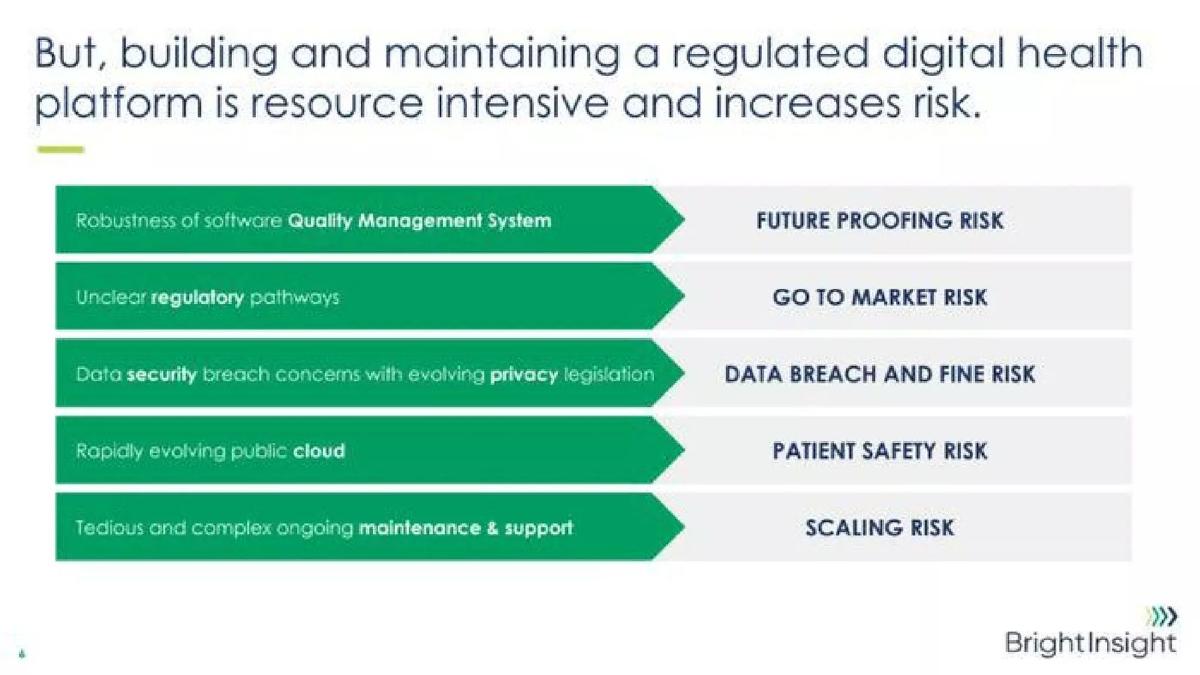
BrightInsight’s deck is a masterclass in risk-based selling for the enterprise healthcare sector. Rather than focusing solely on features, the presentation anchors its value proposition in the pain of regulatory compliance and the prohibitive costs of internal infrastructure. The deck claims that building a custom platform can cost up to $20M and requires $10M in annual maintenance, effectively framing BrightInsight as a cost-saving necessity rather than a discretionary software spend. With a heavy emphasis on 'medical-grade' security and pre-built functionality like EHR integration and dosin…
Key takeaways
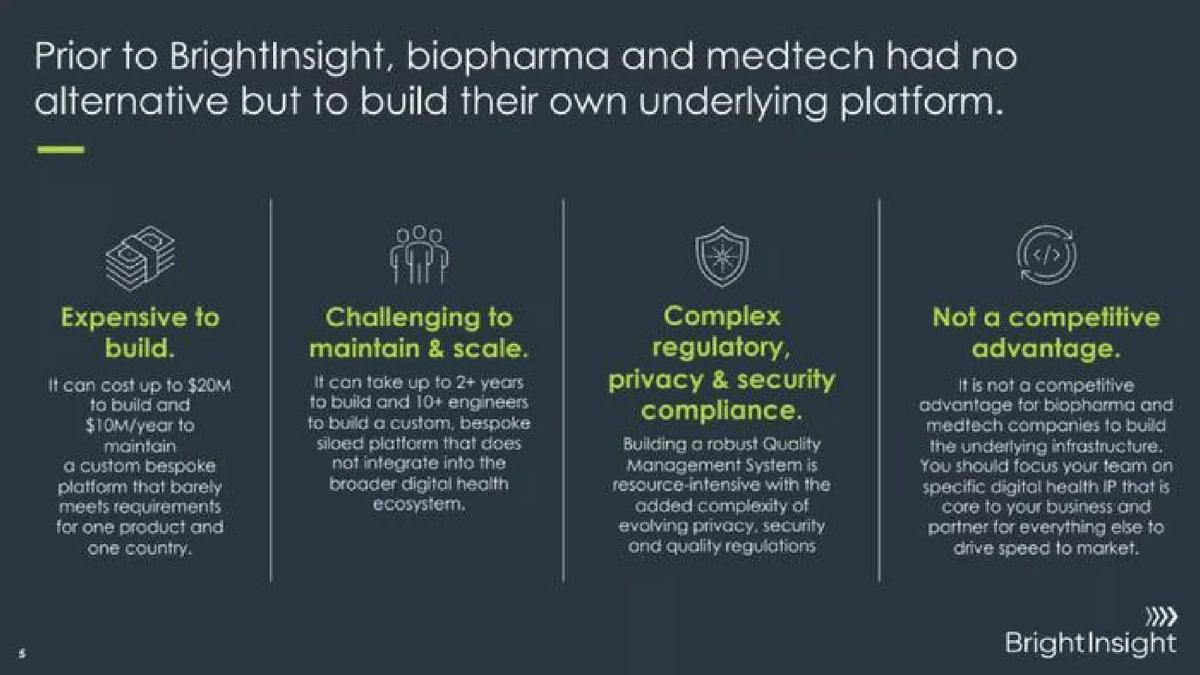
- The deck quantifies the problem by stating internal builds cost up to $20M and $10M/year to maintain (Slide 5).
- BrightInsight positions itself as a 'managed service model' to offload regulatory and security risks from the customer (Slide 9).
- The platform highlights specific technical capabilities including APIs, starter software assets, and EHR integration (Slide 11).
- Regulatory compliance is treated as a core product feature, citing ISO 13485:2016 and FDA Master Files (Slide 13).
- The company uses specific use cases like connected insulin pens and implantable neuromodulation to demonstrate versatility (Slide 15).
- Social proof is established through a CE-marked dosing calculator developed for Roche (Slide 17).
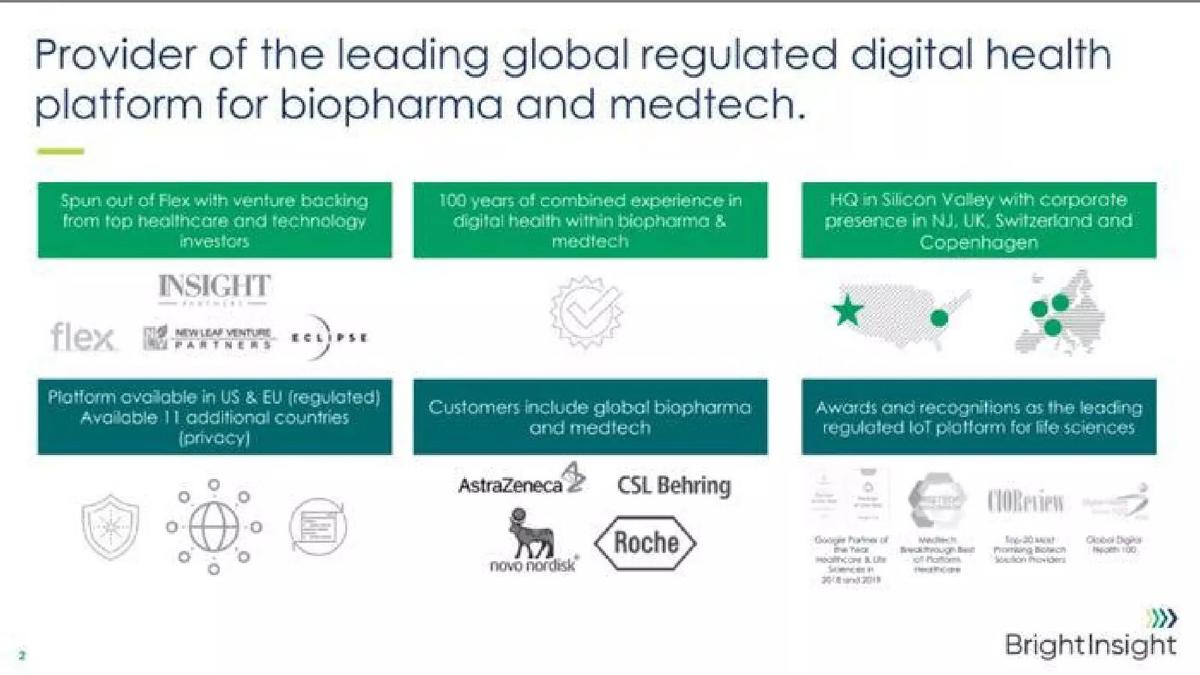
- The leadership team is marketed as having over 100 years of combined digital health experience (Slide 21).
- The deck leverages third-party validation by highlighting its status as Google Cloud's Technology Partner of the Year for two consecutive years (Slide 23).
The Regulated Platform Play
BrightInsight’s pitch deck, dated June 2020, represents a sophisticated approach to B2B enterprise sales in the healthcare sector. At this stage, the company had already moved past the conceptual phase and was focused on scaling its 'medical-grade' platform. The narrative is built on a foundation of risk mitigation—specifically, the regulatory and financial risks that biopharma companies face when attempting to digitize their product offerings.
Introduction and Mission
Slide 1: Title Slide The deck opens with a clean, professional aesthetic. The title 'BrightInsight Overview' and the date 'June 2020' suggest this was used during their Series B or subsequent growth discussions. The branding is corporate and stable, fitting for a company selling to pharmaceutical giants.
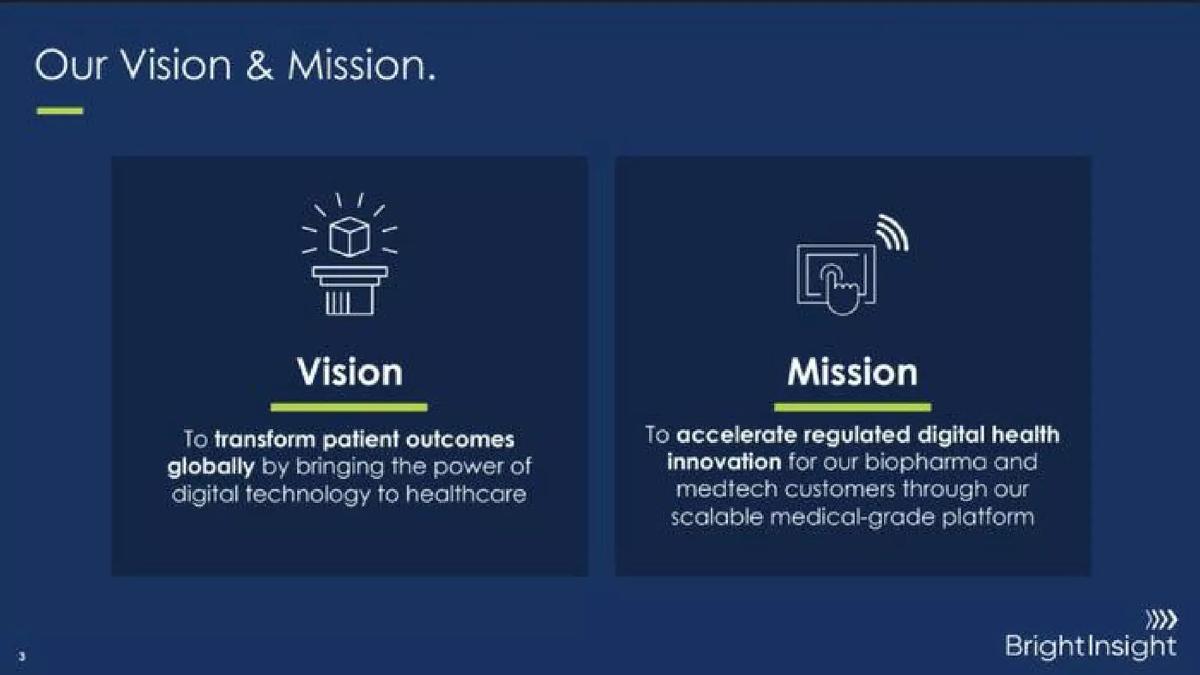
Slide 3: Our Vision & Mission The vision is 'To transform patient outcomes globally by bringing the power of digital technology to healthcare.' The mission is more specific: 'To accelerate regulated digital health innovation for our biopharma and medtech customers through our scalable medical-grade platform.' The use of the term 'medical-grade' is a deliberate keyword used throughout the deck to differentiate from consumer-grade IoT platforms.
The Problem: The 'Build vs. Buy' Dilemma
Slide 5: The Problem Statement This is the most critical slide for establishing the market need. BrightInsight argues that prior to their existence, companies had 'no alternative but to build their own underlying platform.' They quantify the pain of building internally with four pillars:
Expensive to build: Costs up to $20M to build and $10M/year to maintain. · Challenging to scale: Takes 2+ years and 10+ engineers for a 'siloed platform' that barely meets requirements. · Complex regulatory: Building a Quality Management System (QMS) is resource-intensive. · Not a competitive advantage: Infrastructure is not core to a pharma company's business; they should focus on 'digital health IP' instead.
The Solution and Value Proposition
Slide 7: Product Overview The solution is presented as 'the leading regulated digital health platform.' A tablet mockup shows a dashboard with heat maps, funnel analysis, and launch monitoring, signaling that the platform provides actionable data, not just raw storage.
Slide 9: Five Factors for Choice The deck summarizes its competitive edge into five categories: Robust QMS, Comprehensive functionality, Privacy/Security compliance, Managed service model, and 'Unrivalled pedigree.' This slide acts as a transition from 'why this matters' to 'how we do it.'
Slide 11: Pre-built Functionality To prove the 'speed to market' claim, BrightInsight lists its technical assets: APIs, Customer dashboards, Starter software assets, Modular architecture, and Electronic Health Record (EHR) integration. This tells the investor that the product is a platform, not a consultancy.
Regulatory as a Moat
Slide 13: Managed Service Model In healthcare, compliance is the product. This slide lists the 'boring' but essential details that win enterprise contracts: ISO 13485:2016, ISO/IEC 62304, and FDA Master Files. They also highlight 'Cloud change control,' which is a specific technical hurdle in regulated environments where software updates must be validated to ensure they don't violate regulatory filings.
Slide 15: Use Cases The deck demonstrates versatility by showing the platform can handle everything from 'Connected Insulin Pens' and 'Inhalers' to 'Implantable Neuromodulation' and 'Dose Management Algorithms.' This suggests a massive Total Addressable Market (TAM) across multiple therapeutic categories.
Social Proof and Traction
Slide 17: Roche Case Study The deck moves from theory to practice by showcasing a 'CE-marked Dosing Calculator for Roche.' This is a high-value proof point, as Roche is one of the largest healthcare companies in the world. It proves the platform can successfully launch a 'Software as a Medical Device' (SaMD) product in a regulated market.
Slide 19: CSL Behring Partnership A testimonial from Brian Johnson, Director of Digital Health at CSL Behring, reinforces the 'Focus on innovation, not infrastructure' message. The quote explicitly states they chose BrightInsight because it was the 'only regulated solution' with a robust QMS.
The Team and External Validation
Slide 21: Leadership Team The team slide claims '100+ years of combined digital health experience.' It features 10 individuals, including CEO Kal Patel, MD, and CTO Ferry Tamtoro. The roles are specialized, including 'Regulatory & Quality Management System' and 'Lead - Digital Health Europe,' showing the company is built for global regulatory navigation.
Slide 23: Google Cloud Partnership The final proof point is being named 'Google Cloud's Technology Partner of the Year for Healthcare' in both 2018 and 2019. This aligns BrightInsight with a major tech incumbent and suggests their infrastructure is vetted at the highest level.
What Works in This Deck
The 'Build vs. Buy' quantification on Slide 5 is excellent. By putting a $20M price tag on the alternative, they make their own platform seem like a bargain. The focus on 'Managed Services' for regulatory compliance is also a strong strategic move; it turns a customer's biggest headache (FDA/ISO compliance) into a recurring revenue stream for BrightInsight. The use of specific, high-tier logos like Roche and Google Cloud provides the necessary 'de-risking' for a Series B/C investor.
What is Missing
The provided slides are heavily focused on the product and the 'why.' However, several key investor requirements are missing:
Financials: There are no slides showing revenue growth, burn rate, or unit economics (CAC/LTV). · The Ask: The deck does not state how much money they are looking for or what the milestones for the next round will be. · Competition: While they mention the 'internal build' as a competitor, they do not address other middleware or IoT platforms in the healthcare space. · Market Size: There is no explicit TAM/SAM/SOM analysis, although the use cases slide hints at a large market.
What a Founder Should Copy
Founders building in highly regulated or 'unsexy' infrastructure spaces should copy the way BrightInsight frames compliance as a feature. Instead of treating the FDA as an obstacle, they treat their ability to navigate the FDA as a product. Additionally, the 'Problem' slide (Slide 5) is a perfect template for any B2B SaaS company: identify the cost of the status quo, the time wasted, and the lack of competitive advantage in doing it the old way. Finally, the use of a specific, branded case study (Roche) is far more effective than a generic 'Our Customers' slide with twenty small logos.
Frequently asked questions
- What is the primary value proposition of BrightInsight?
- BrightInsight positions itself as a regulated digital health platform that allows biopharma and medtech companies to avoid the high costs and risks of building their own infrastructure. According to Slide 5, building a custom platform can cost $20M and take over two years. BrightInsight provides a 'medical-grade' platform that handles the underlying data, security, and regulatory compliance, allowing customers to focus on their core therapeutic innovations.
- How does BrightInsight handle regulatory compliance?
- The company treats compliance as a managed service. Slide 13 lists specific certifications and regulatory assets, including ISO 13485:2016, ISO/IEC 62304, a Master File with the FDA, and EC Certification for Software as a Medical Device (SaMD). They also offer a 'one-of-a-kind' cloud change control process with Google Cloud to ensure that platform updates do not break regulatory compliance.
- Who are BrightInsight's key customers and partners?
- The deck highlights major industry players to build credibility. Slide 17 details a partnership with Roche for a CE-marked dosing calculator. Slide 19 features a testimonial from CSL Behring. Additionally, Slide 23 emphasizes a deep technical partnership with Google Cloud, where BrightInsight was named Technology Partner of the Year for Healthcare in 2018 and 2019.
- What specific medical devices does the platform support?
- Slide 15 lists a variety of use cases across therapeutic areas, including dose management algorithms, connected insulin pens, connected eye droppers, connected thermometers, dose calculators, connected inhalers, implantable neuromodulation devices, and connected alarms. This demonstrates the platform's ability to handle both software-only solutions and hardware-integrated IoT devices.
- What information is missing from this deck?
- The provided slides omit several standard venture capital pitch components. There are no financial slides showing historical revenue or future projections. There is no mention of the competitive landscape beyond the 'build it yourself' option. Most importantly, the deck lacks a 'The Ask' slide, meaning it does not specify how much capital is being raised or the intended use of funds.