Brigad’s Series B pitch deck is a masterclass in narrative-driven fundraising, focusing on the emotional and structural 'Genesis' of the company rather than just raw financial metrics. By framing the problem as a 'vocation crisis' where passionate professionals are abandoning traditional industries, Brigad positions its platform as the essential solution for the 103 million skilled deskless workers in Europe. The deck successfully balances high-level mission statements with concrete market data, such as the 3.2% job vacancy rate in French hospitality. While it lacks explicit unit economics or…
Key takeaways
- The deck identifies a massive total addressable market of 103 million skilled deskless workers in Europe, representing 45% of the workforce (Slide 7).
- Brigad targets a specific €1,000bn market segment where 32% of the labor force is already operating flexibly (Slide 7).
- Market data shows a sharp rise in job vacancies in France, reaching 3.2% for hospitality and 3.0% for healthcare by 2021 (Slide 8).
- The platform operates on a two-sided marketplace model, charging service fees directly to freelancers (Slide 15).
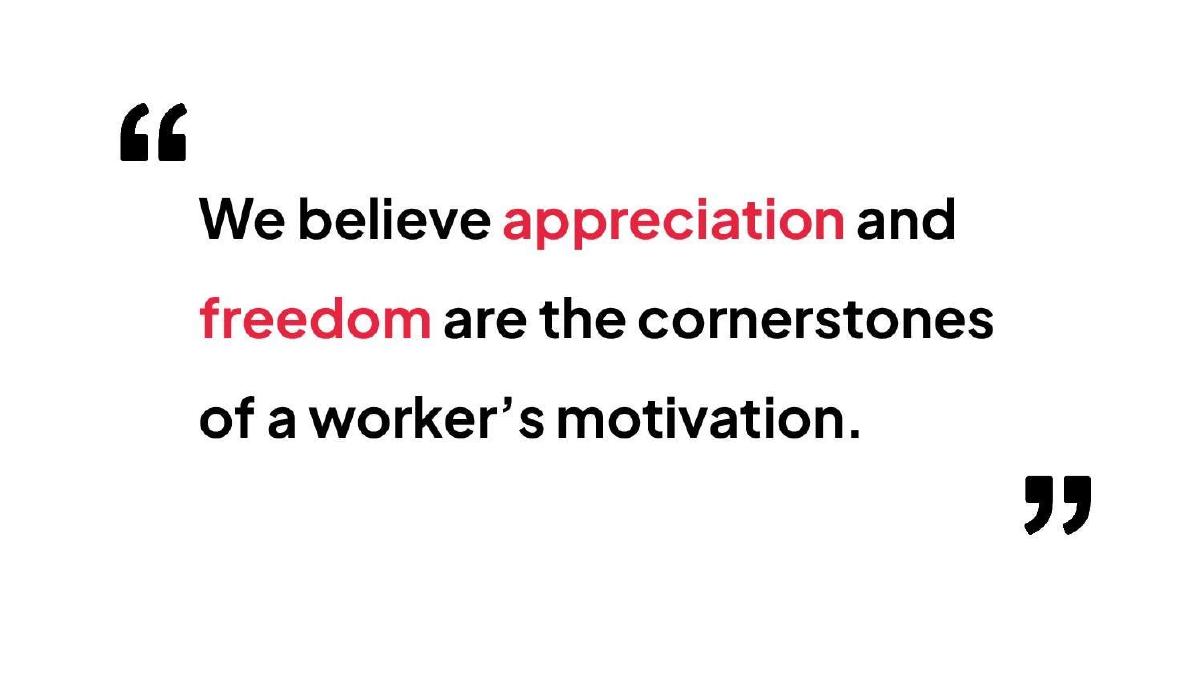
- The company emphasizes a 'mission-driven' status adopted in 2020, focusing on making work attractive and accessible (Slide 20).
- The team slide showcases significant scale, citing a total headcount of over 130 employees (Slide 17).
- Brigad positions itself as a 'sophisticated tech' layer that automates complex administrative tasks like KYCs, contracts, and insurance (Slide 15).
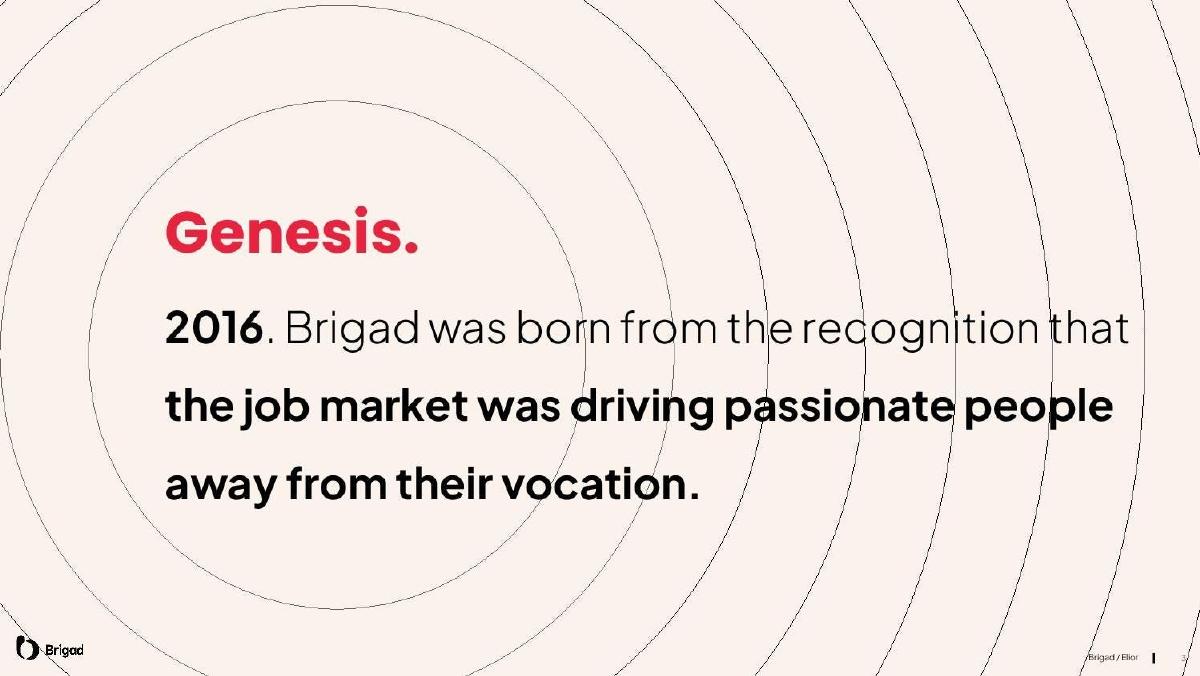
- The narrative focuses on 'vocational abandonment,' suggesting that traditional job markets drive talent away from their passions (Slide 3).
Brigad Pitch Deck Analysis
Brigad’s Series B deck, used to secure $35M in 2022, is a study in how to sell a vision of labor reform. Rather than leading with a spreadsheet, the company leads with a 'Genesis' story, framing the platform not just as a staffing tool, but as a remedy for a broken vocational system in Europe. The deck is visually clean, utilizing a consistent 'ripple' motif that suggests the company’s impact spreading across the labor market.
Slide 1-3: The Mission and Genesis
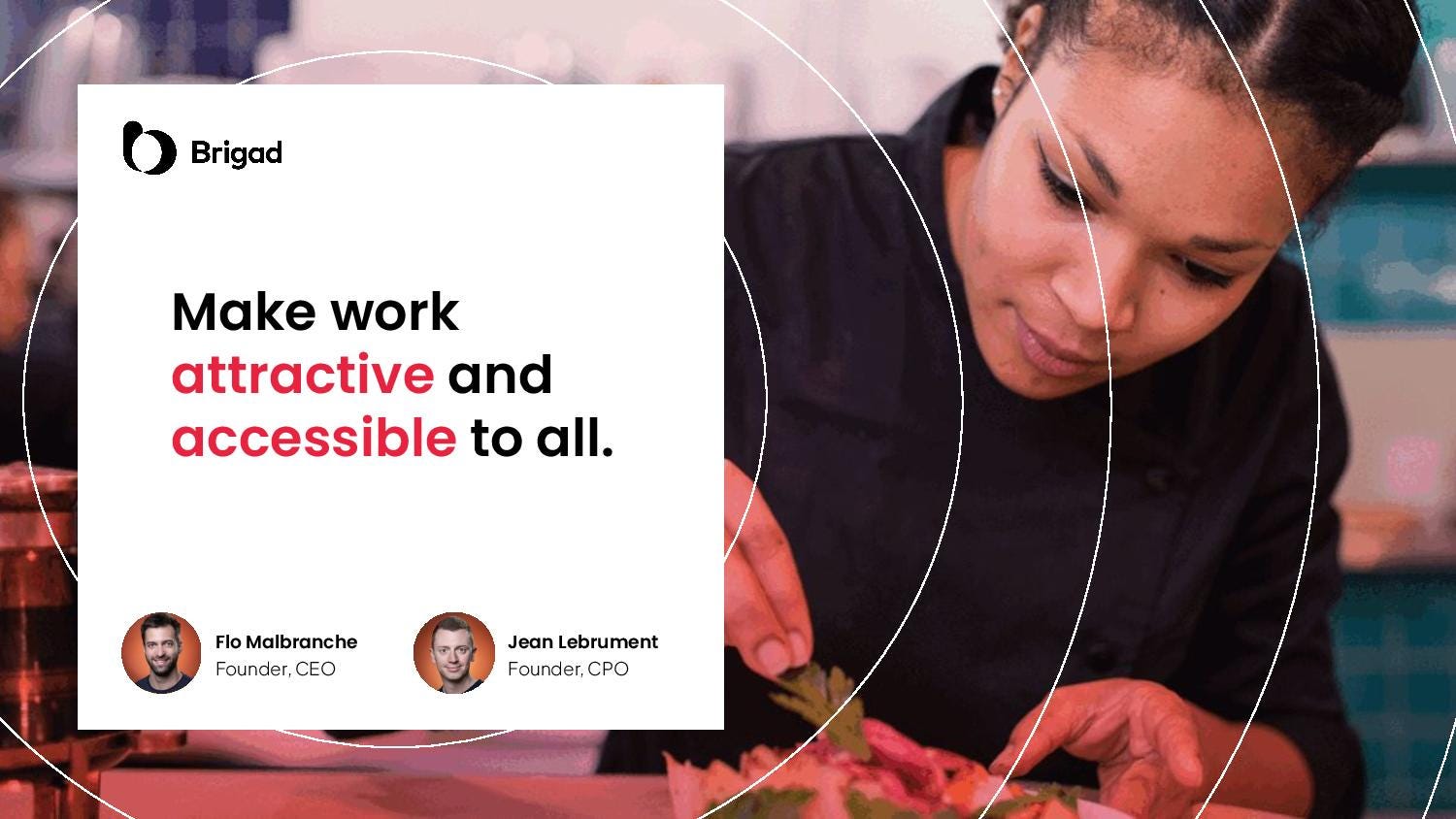
Slide 1 introduces the founders, Flo Malbranche and Jean Lebrument, alongside the core mission: "Make work attractive and accessible to all." This sets a social-impact tone immediately. Slide 2 and 3 establish the 'Genesis' of the company in 2016. The narrative hook is that the job market was "driving passionate people away from their vocation." By using the word 'vocation' instead of 'jobs,' Brigad elevates the stakes from a simple labor shortage to a cultural crisis of professional identity.
Slide 4-6: The Problem of Abandonment
Slide 4 continues the narrative, stating that talents are abandoning industries they are passionate about. This is a crucial setup for a Series B deck; it suggests that the problem isn't just a lack of workers, but a lack of sustainable ways to work. Slides 5 and 6 are transition slides that reinforce the brand identity without adding new data, maintaining the pacing of the presentation.
Slide 7: Quantifying the Deskless Market
This is one of the most important slides in the deck. It segments the European workforce into three distinct buckets. Brigad identifies its primary target as the "Deskless - Skilled" category, which accounts for 103 million workers (45% of the workforce). By highlighting that 32% of this market is already flexible, they justify a €1,000bn market valuation. This slide successfully moves the conversation from a niche hospitality app to a massive infrastructure play for nearly half of the European labor force.
Slide 8: Market Dynamics and Vacancy Rates
Slide 8 provides the statistical proof for the 'Genesis' story told earlier. Using data from the French Labors Statistics Administration (Dares), it shows a steady climb in job vacancies from 2011 to 2021. Specifically, hospitality vacancies rose from approximately 0.7% to 3.2%, and healthcare followed a similar trajectory to 3.0%. This data visualizes the 'abandonment' mentioned in slide 4, proving that the labor shortage is a long-term trend rather than a temporary post-pandemic blip.
Slide 11-14: The Solution and Value Proposition
Slide 11 defines the product: "We connect skilled deskless freelancers with businesses for flexible missions." Slide 14 breaks down the benefits for both sides of the marketplace. For 'Talent,' the promise is higher pay, improved work-life balance, and career development. For 'Businesses,' the value is access to highly motivated professionals, quality assurance through vetting, and easy-to-use technology. This slide addresses the 'why' for both users, which is essential for any marketplace business.
Slide 15: Product Workflow and Monetization
Slide 15 illustrates the 'sophisticated tech' behind the 'simple workflow.' It shows a circular ecosystem where businesses post missions and talents accept them. Crucially, it lists the administrative tasks Brigad handles: KYCs, contracts, payment, invoices, and insurance. The slide also reveals the revenue model: "Service fees invoiced to freelancers." This is a significant detail, as many staffing platforms charge the business; Brigad’s model suggests a talent-centric approach where the freelancer pays for the access and administrative ease provided by the platform.
Slide 17: The Team
At Series B, the team slide is less about the founders and more about the 'bench' of leadership. Brigad highlights a team of 130+ people. The key hires listed include a COO with McKinsey and Airbnb experience, a CFO from Eight Advisory, and VPs from Canal+, FreeNow, and Ogilvy. This slide is designed to signal to investors that the company has the operational maturity to handle $35M in new capital.
Slide 20: Mission-Driven Status
The deck concludes by reiterating that Brigad has been a "mission-driven company since 2020." This aligns with European corporate trends (like the French 'Société à mission' status) and serves to bookend the presentation with the same social-impact focus it started with.
What Brigad's Deck Does Well
Narrative Consistency: The deck tells a cohesive story. It starts with a problem (vocational abandonment), proves it with data (rising vacancy rates), defines the massive scale (103m workers), and presents the team capable of solving it. The transition from emotional 'vocation' talk to hard '€1,000bn market' data is seamless.
Market Segmentation: By splitting the deskless workforce into 'skilled' and 'unskilled,' Brigad avoids being compared to general gig-economy apps like Uber or Deliveroo. They are positioning themselves as a premium marketplace for professionals, which justifies higher margins and a more robust vetting process.
Visual Simplicity: The deck avoids clutter. Each slide has a single clear message. The use of white space and the recurring ripple graphic makes the deck feel modern and high-end, reflecting the 'sophisticated tech' they claim to build.
What is Missing from the Brigad Deck
Unit Economics: There is no mention of Customer Acquisition Cost (CAC), Lifetime Value (LTV), or contribution margins. For a Series B, investors usually expect to see the efficiency of the marketplace at scale.
Growth Metrics: While the deck mentions the team size and market size, it omits Brigad’s own growth figures. There are no charts showing Gross Merchandise Value (GMV) growth, revenue growth, or the number of active freelancers/businesses on the platform.
Competitive Landscape: The deck does not mention other players in the flexible staffing space. In a crowded market with competitors like Zenjob or Catapult, failing to address how Brigad wins against specific rivals is a notable omission.
The Ask: The deck does not explicitly state how much money they are raising or how they plan to spend it. While the publisher reports a $35M raise, the deck itself functions more as a brand and mission overview than a tactical investment memorandum.
Founder Takeaways
Lead with the 'Why': Brigad doesn't start with a feature list; they start with a societal shift. If your company is solving a deep-seated structural problem, frame it as a 'Genesis' story to build emotional resonance. · Use Macro Data to Validate Micro Problems: The vacancy rate chart (Slide 8) is powerful because it uses third-party government data to prove that the founder's intuition about 'vocational abandonment' is a measurable economic reality. · Segment Your TAM: Don't just say your market is 'everyone.' By excluding 'unskilled' and 'desk' workers, Brigad makes their 103 million worker target feel more attainable and specific. · Highlight Operational Maturity: If you are raising a Series B, your team slide should look like Slide 17. It’s not just about the founders anymore; it’s about showing you have hired experts in Legal, Finance, People, and Sales from top-tier global companies.
Frequently asked questions
- What is Brigad's core business model?
- Brigad operates as a digital marketplace connecting skilled deskless freelancers with businesses in the hospitality and healthcare sectors. According to slide 15, the company generates revenue through service fees invoiced to the freelancers. The platform automates administrative burdens including contracts, payments via Stripe, invoicing, and insurance, allowing businesses to post missions and talents to accept them freely.
- How does Brigad define its target market?
- Brigad focuses on 'skilled deskless workers' in Europe. Slide 7 breaks down the European workforce into three categories: unskilled deskless (32m), skilled deskless (103m), and skilled desk jobs (94m). Brigad specifically targets the 103 million skilled deskless professionals, noting that 32% of this market is already flexible, creating a €1,000bn opportunity.
- What problem is Brigad trying to solve?
- The deck frames the problem as a structural failure of the 'traditional' job market. Slide 3 and 4 argue that current working conditions lead professionals to abandon their vocations. This is supported by slide 8, which shows job vacancy rates in France climbing significantly from 2011 to 2021, particularly in hospitality and healthcare, as workers move away from traditional employment.
- Who are the key leaders at Brigad?
- The company was founded by Florent Malbranche (CEO) and Jean Lebrument (CPO). The leadership team includes experienced executives such as Nicolas Ferrary (COO, formerly GM of France at Airbnb and McKinsey) and Marc de la Fayolle (CFO, ex-Eight Advisory). The team slide (17) highlights a total staff of over 130 people.
- Does the deck include financial projections or a specific use of funds?
- No. The provided slides focus on the mission, market dynamics, product workflow, and team. There are no slides detailing historical revenue, burn rate, future financial projections, or a specific breakdown of how the $35M Series B capital will be allocated. This is common in 'teaser' or narrative-heavy decks used to anchor investor interest.