Brewpublik’s 2014 pitch deck is a masterclass in brevity, consisting of only nine slides that rely heavily on iconography and high-level metrics. The company positioned itself as a data-driven 'central nervous system' for the craft beer industry, addressing the logistical nightmare of 3,000 distributors across 50 states. While the deck lacks traditional components like a team slide, a detailed financial breakdown, or a specific 'ask,' it successfully highlighted a $750,000 annual run rate and a growing B2B client base including WeWork and Google Play. This teardown explores how Brewpublik lev…
Key takeaways
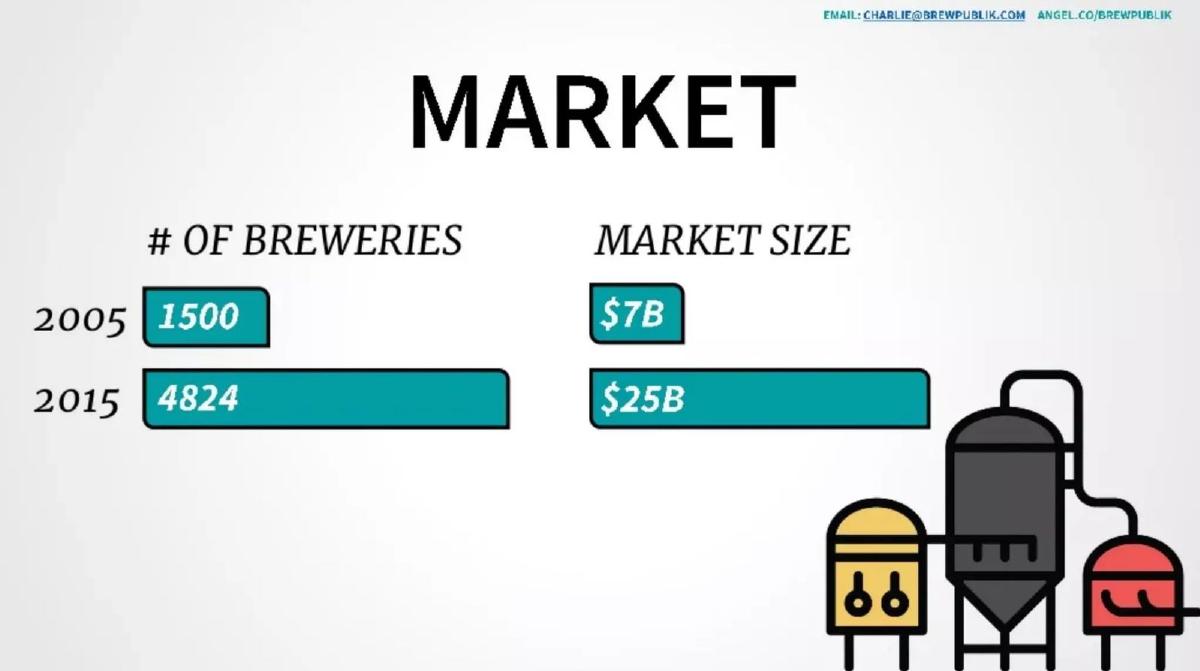
- The deck highlights a significant market expansion, noting the number of breweries grew from 1,500 in 2005 to 4,824 in 2015 (Slide 3).
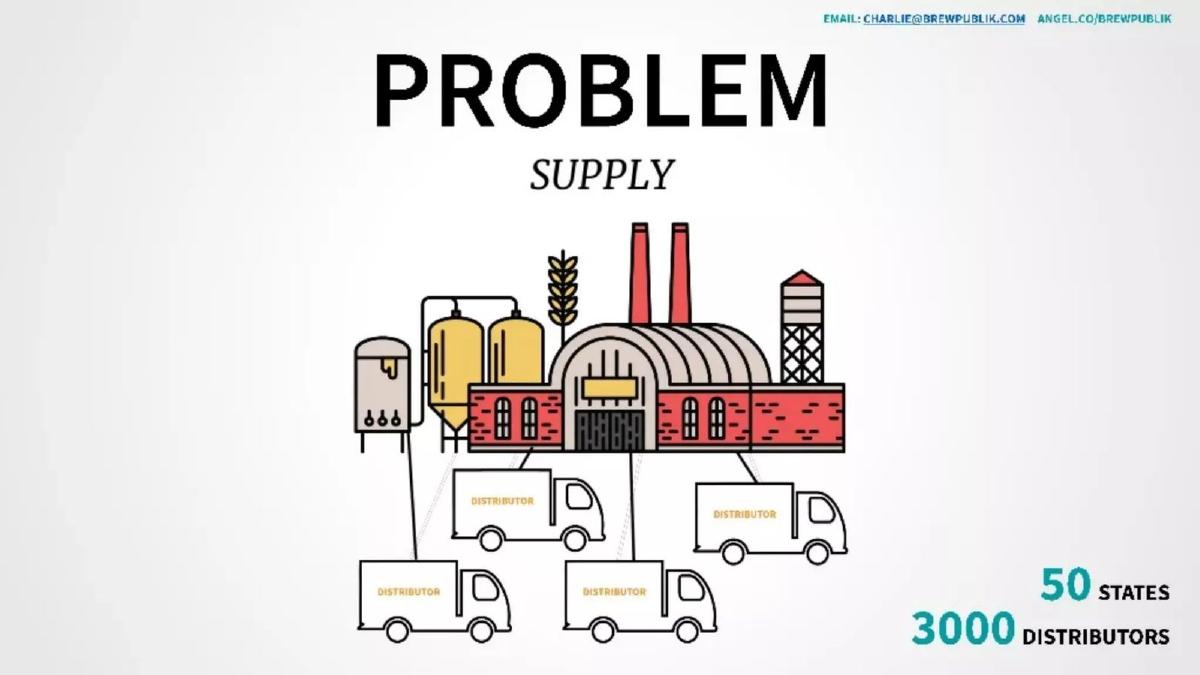
- Brewpublik identifies a fragmented supply chain consisting of 3,000 distributors across 50 states as a primary industry problem (Slide 4).
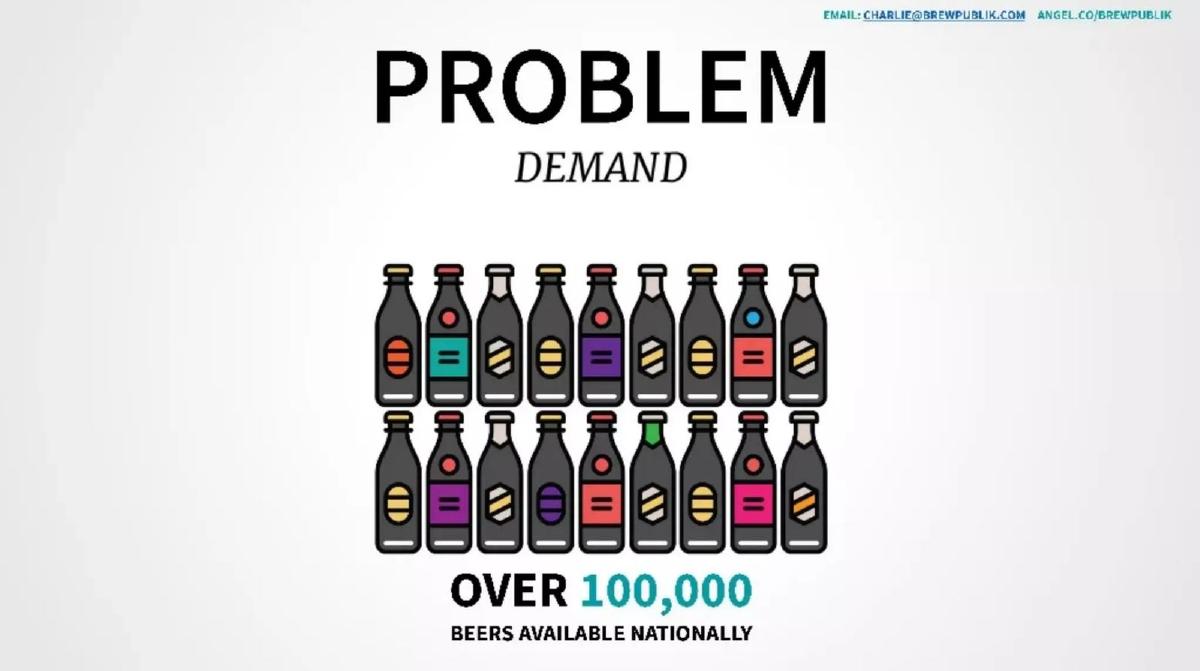
- The company claims to manage a 'demand' problem where over 100,000 beers are available nationally, necessitating a recommendation engine (Slide 5).
- At the time of the deck, Brewpublik reported a $750k annual run rate (Slide 7).
- The B2B segment showed strong early adoption with 100 companies spending an average of $300 per month (Slide 7).
- High-profile logos like WeWork, Google Play, and Intercom are used to validate the B2B traction (Slide 7).
- The business model spans three distinct channels: Direct to Consumer, B2B, and On-Premises (Slide 8).
- The deck completely omits a team slide, a roadmap, and a specific funding request, relying entirely on current traction to drive interest.
The Minimalist Demo Day Deck
Brewpublik’s pitch deck is an artifact of the 'Demo Day' era of startup fundraising. With only nine slides and almost no body text, it is designed to be spoken over, not read in isolation. The deck relies on large, bold headers and simple vector illustrations to convey a narrative of market growth and logistical complexity. In 2014, the craft beer industry was in the midst of a massive boom, and Brewpublik positioned itself as the technological layer sitting atop that chaos.
Slide 1: Title and Social Proof
The title slide is as simple as it gets: the company name 'BREWPUBLIK' in a bold, serif font. However, the most important element on this slide is the 500 Startups logo in the bottom right corner. For a 2014-era investor, this logo acted as a significant filter, signaling that the company had already been vetted by a top-tier accelerator. The slide also includes contact information for 'Charlie' and a link to their AngelList profile, which was the standard for fundraising at the time.
Slide 2: The Hook
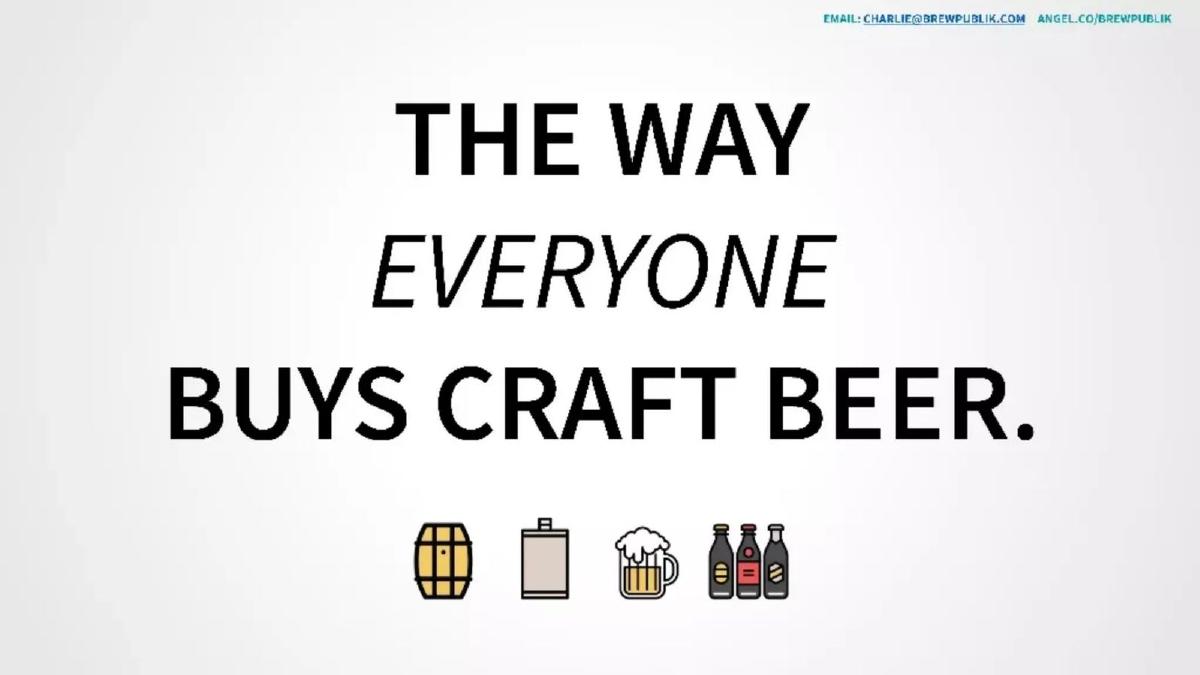
Slide 2 presents a bold statement: 'THE WAY EVERYONE BUYS CRAFT BEER.' This is a classic 'vision' slide. It doesn't explain how yet; it simply asserts a future state where Brewpublik is the default gateway for the industry. The icons at the bottom (a barrel, a growler, a mug, and bottles) represent the various ways beer is currently consumed, setting the stage for a unified solution.
Slide 3: Market Growth
This is one of the few slides with hard data. It compares the state of the industry in 2005 versus 2015 (noting that 2015 was a projection at the time of the 2014 deck). According to Slide 3 , the number of breweries grew from 1,500 to 4,824 , and the market size ballooned from $7B to $25B . This 3.5x growth in market value over a decade provides the 'why now' for investors.
Slide 4 & 5: The Two-Sided Problem
Brewpublik breaks the problem into two distinct categories: Supply and Demand. On Slide 4 , they highlight the supply chain mess: 50 states and 3,000 distributors . This implies a massive fragmentation that makes it difficult for small breweries to reach customers and for customers to find specific beers. On Slide 5 , they address the consumer side: 'OVER 100,000 BEERS AVAILABLE NATIONALLY.' This is a 'choice overload' problem. The visual of 16 identical-looking bottles with slightly different labels effectively communicates the confusion a consumer faces in a liquor store aisle.
Slide 6: The Solution
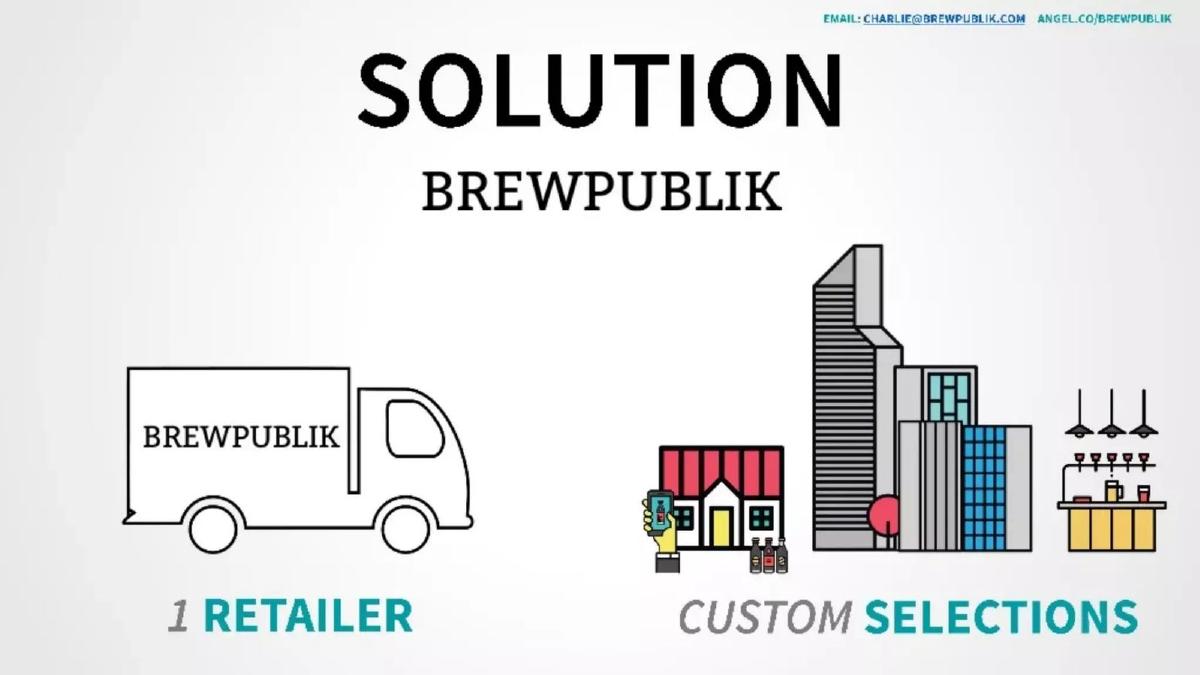
The solution slide ( Slide 6 ) is a simple 'Before and After' comparison. It positions Brewpublik as the '1 RETAILER' that replaces the fragmented system, offering 'CUSTOM SELECTIONS.' The illustration shows a Brewpublik truck delivering to homes, offices, and bars, suggesting a full-stack logistics play.
Slide 7: Traction and Validation
This is the 'money slide.' Slide 7 provides three key metrics that likely did the heavy lifting for their $125,000 raise: 100 companies spending $300/month , 1,300+ retail subscribers , and a $750K annual run rate . By including logos for WeWork, Google Play, and Intercom , they prove that their B2B model has legs with high-growth tech companies—a demographic that investors understand well.
Slide 8: The Recommendation Engine
Slide 8 introduces the 'RECOMENDATION ENGINE' as the core technology. It shows three pillars: Direct to Consumer, B2B, and On-Premises. This slide attempts to move the company away from being 'just a delivery service' and toward being a data company. The implication is that their value lies in the 'taste profile' data they collect, which allows them to predict what a user will want to drink next.
Slide 9: The Closing
The final slide is a playful call to action: 'DID ALL THIS BEER TALK MAKE YOU THIRSTY? WE HAVE BEER!' This is a classic demo day closer, usually followed by the founder inviting the audience to a happy hour. It reinforces the brand identity but offers no further business information.
What Works in the Brewpublik Deck
The primary strength of this deck is its clarity of purpose . Within 60 seconds of clicking through, an investor understands exactly what the company does: they use data to deliver craft beer to offices and homes. The traction metrics on Slide 7 are impressive for a 2014 seed-stage company, particularly the $750k run rate. Most startups at this stage are pre-revenue or have negligible income; showing nearly a million dollars in pacing is a massive differentiator.
The use of social proof is also handled well. By placing the 500 Startups logo on the first slide and the WeWork/Google logos on the traction slide, Brewpublik borrows credibility from established brands to offset the risk of their own early stage.
What is Missing from the Brewpublik Deck
This deck is remarkably thin on structural details. The most glaring omission is the Team Slide . Investors at the seed stage are primarily betting on the founders' ability to execute. Without knowing who Charlie is or what his background in logistics or data is, the deck feels incomplete as a standalone document.
There is also no Unit Economics slide. While a $750k run rate is great, beer is a low-margin, heavy-weight product with complex legal and shipping requirements. Investors would want to know the Customer Acquisition Cost (CAC) versus the Lifetime Value (LTV), especially for the 1,300 retail subscribers.
Finally, the Competition is ignored. In 2014, companies like Drizly and Minibar were already gaining ground. Brewpublik doesn't explain how their 'recommendation engine' provides a moat against larger, better-funded delivery platforms.
What a Founder Should Copy
Founders should emulate Brewpublik’s distillation of the problem . Slides 4 and 5 are excellent examples of how to take a complex industry (alcohol distribution laws) and turn it into a simple visual narrative (too many distributors, too much choice). If you can explain your industry's biggest headache in under 10 words and one illustration, you have won half the battle.
Additionally, the focus on B2B traction is a smart move for any marketplace or delivery startup. While D2C (Direct to Consumer) is flashy, the $300/month recurring revenue from 100 companies (Slide 7) represents a much more stable and scalable business model than individual retail subscriptions. Highlighting these 'high-value' customers separately from the general user base shows a sophisticated understanding of revenue quality.
Final Analysis
Brewpublik’s deck is a product of its time—a visual aid for a high-energy pitch. While it lacks the depth required for a modern remote-first fundraise where decks are often read before a meeting is even granted, its focus on market timing and immediate traction remains a gold standard. By proving that people were already paying for the service at scale, they made the 'how' and 'who' secondary to the 'what.' For a $125,000 raise, this level of detail was sufficient to prove product-market fit and secure the next stage of growth.
Frequently asked questions
- How much did Brewpublik raise with this deck?
- According to the catalogue facts from pitchdeckhunt.com, Brewpublik raised $125,000 in 2014. This was likely their pre-seed or seed round, coinciding with their participation in the 500 Startups accelerator program, as indicated by the logo on the first slide.
- What is Brewpublik's core value proposition?
- The deck positions Brewpublik as a '1 Retailer' solution that provides 'Custom Selections' (Slide 6). By using a recommendation engine (Slide 8), they solve the choice paralysis caused by having over 100,000 beers available nationally while simplifying a supply chain that involves thousands of distributors.
- Who were Brewpublik's early customers?
- Slide 7 specifically lists WeWork, Google Play, and Intercom as clients. The deck notes that they had 100 companies spending $300 per month, suggesting a strong focus on office beer delivery as a primary revenue driver alongside their 1,300+ retail subscribers.
- Is there a financial projection in the deck?
- No. The deck is strictly focused on historical and current data. It mentions a $750k annual run rate (Slide 7) and market growth figures (Slide 3), but it does not provide future revenue projections, burn rate, or a path to profitability.
- What is missing from this pitch deck?
- This deck is missing several 'standard' slides: there is no Team slide, no Competition slide, no Marketing/GTM strategy, and no Ask slide. It functions more as a visual aid for a demo day presentation than a standalone document for deep due diligence.