Brandvertisor is a marketplace designed to facilitate direct relationships between advertisers and premium publishers, bypassing traditional opaque ad networks. The deck, presented at a Founder Institute Demo Day, emphasizes transparency and granular audience targeting. With a business model based on a fixed 10% transaction commission, the company targets a specific niche in the growing US display ad market, which was projected to reach $37.5 billion by 2017. While the deck provides clear unit economics—citing a CAC of $208 against an LTV of $290—the early-stage traction remains modest, with…
Key takeaways
- The company positions itself as a 'Transparency Advertising Marketplace' to match advertisers with specific publishers (Slide 1).
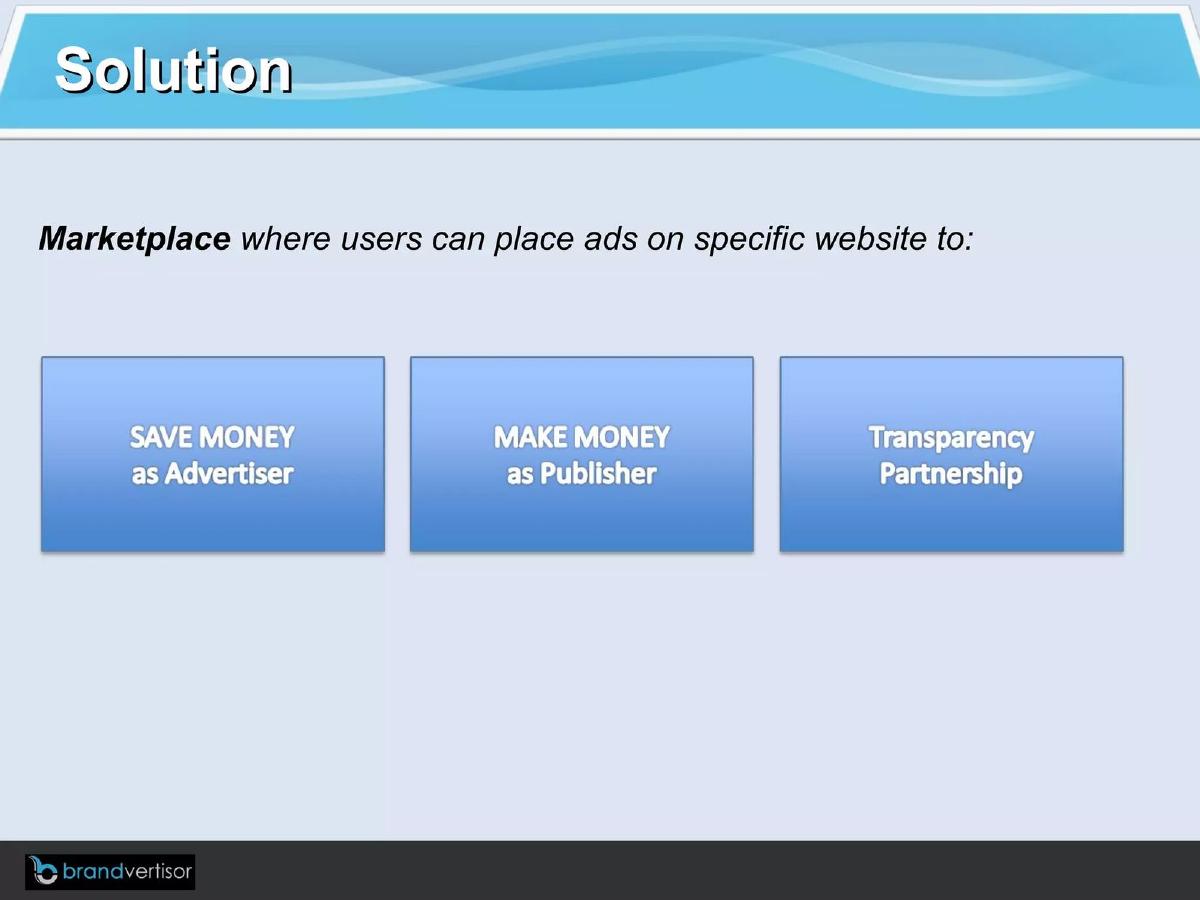
- The solution aims to save money for advertisers and increase earnings for publishers through a direct partnership model (Slide 2).
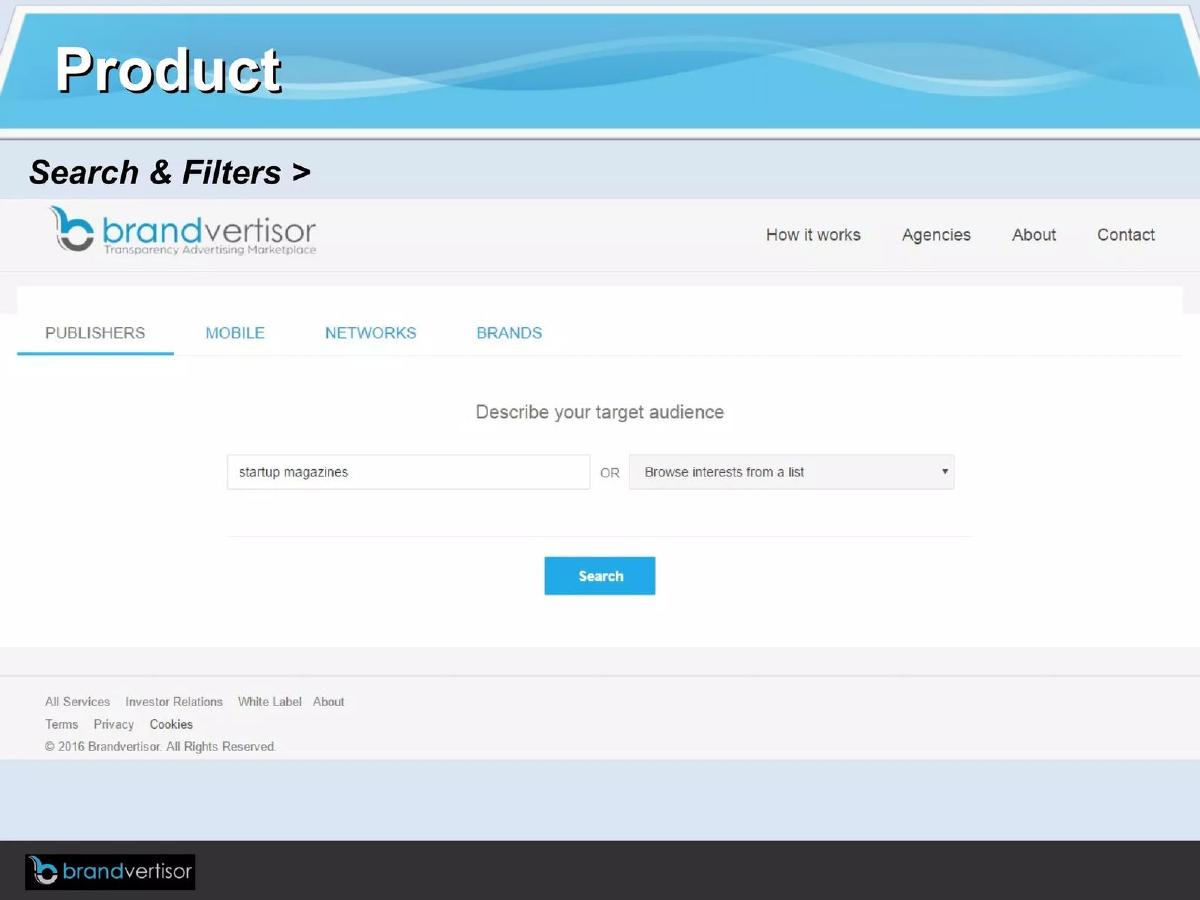
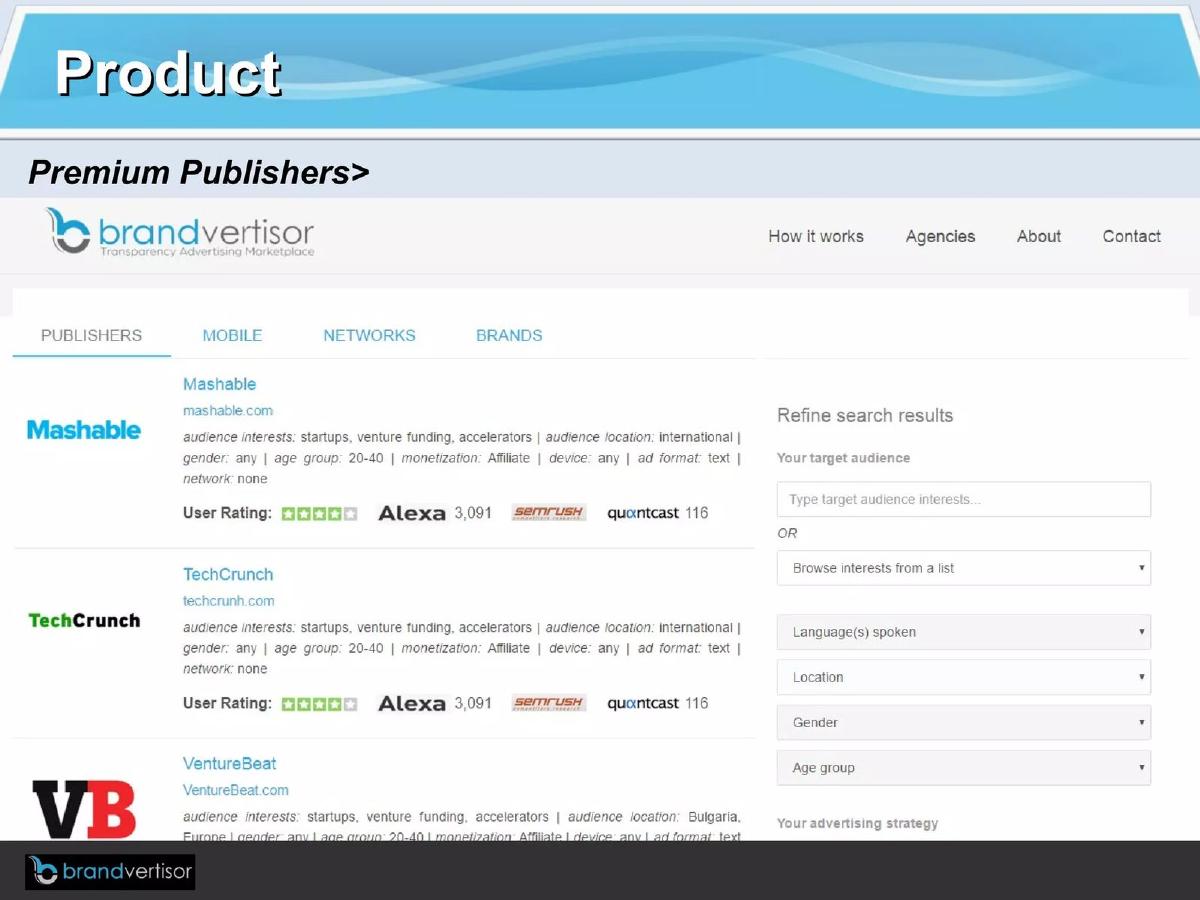
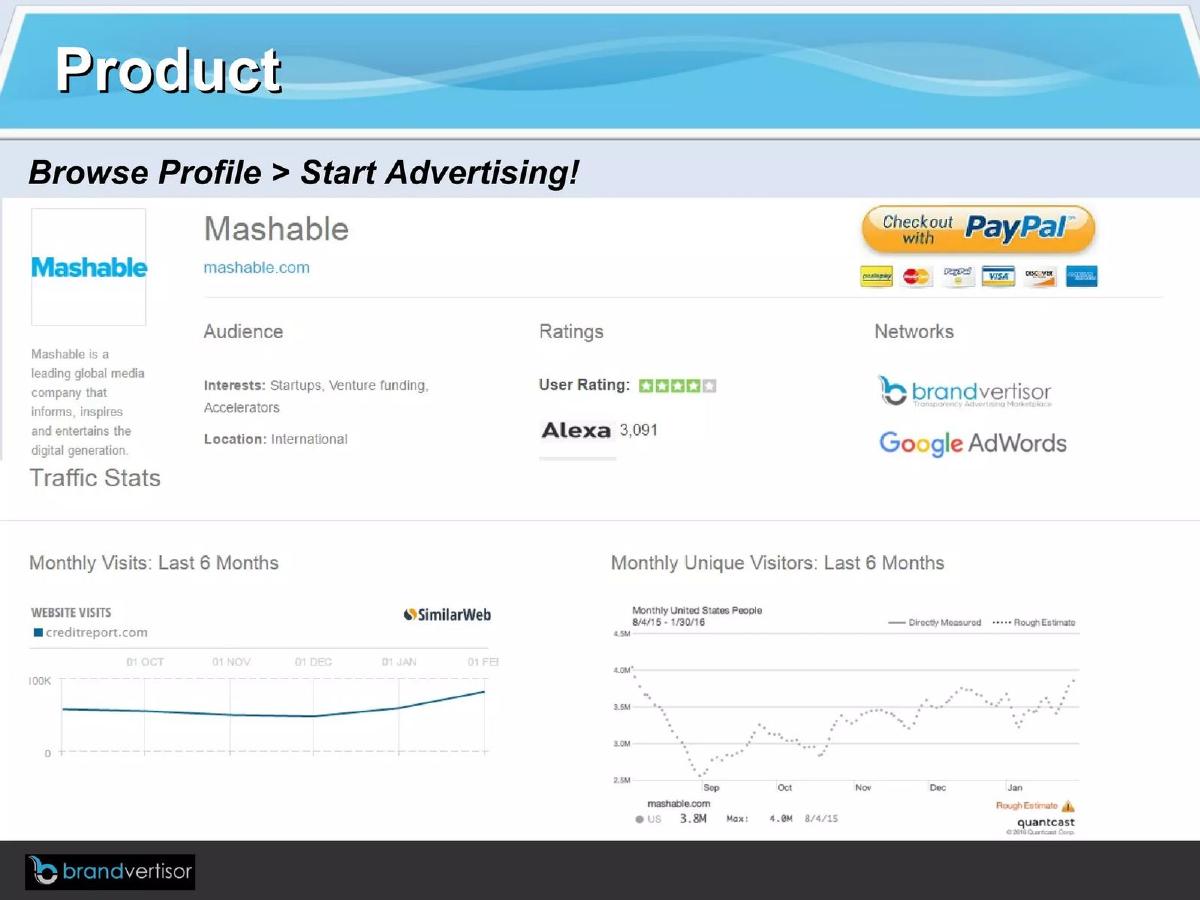
- Product screenshots show a filtering system for publishers based on audience interests, location, gender, and age (Slide 3).
- Market data from eMarketer projects US display ad spending to grow at 24% per year, reaching $37.5B in 2017 (Slide 5).
- The business model is a fixed 10% commission per transaction (Slide 6).
- Unit economics are defined as a CAC of $208, an LTV of $290, and an ARPPU of $82 (Slide 6).
- Breakeven is calculated at 80 paying users per month (Slide 6).
- Early traction includes an MVP demo, 800 opt-ins from a startup campaign, and $350 in direct sales (Slide 7).
Brandvertisor: The Transparency Marketplace Pitch
Brandvertisor presented this deck at a Founder Institute Demo Day, targeting the display advertising market. The deck focuses on the mechanics of a two-sided marketplace that connects premium publishers directly with advertisers, emphasizing a move away from the 'black box' nature of traditional programmatic advertising.
Slide 1: Title and Value Proposition
The cover slide introduces Brandvertisor as a 'Transparency Advertising Marketplace.' The central claim is that it is the first marketplace to match advertisers with specific publishers through 'detailed and complete profiles.' The contact information for Nedko M. Nedkov is provided in the corner, establishing the primary point of contact for the venture.
Slide 2: The Solution
The solution is presented as a marketplace where users can place ads on specific websites. The slide breaks down the value into three pillars: 'SAVE MONEY as Advertiser,' 'MAKE MONEY as Publisher,' and 'Transparency Partnership.' This slide sets the stage for a classic marketplace play where the platform acts as a facilitator rather than an intermediary that obscures the transaction details.
Slide 3: Product Interface - Publisher Discovery
This slide provides a screenshot of the actual product interface. It shows a list of 'Premium Publishers' including recognizable names like Mashable, TechCrunch, and VentureBeat. The interface allows advertisers to 'Refine search results' based on target audience interests, language, location, gender, and age group. Notably, it integrates third-party data such as Alexa rankings, SEMRush data, and Quantcast scores to provide social proof and traffic validation for the publishers listed.
Slide 4: Product Interface - Ad Placement
The second product slide shows a live example of 'Real & Targeted Traffic!' using a Mashable article as a backdrop. It displays an ad for 'eleven Accelerator Venture Fund' and 'LAUNCHub' placed prominently at the top of the page. This visual serves to demonstrate the end result of the marketplace transaction: a high-visibility placement on a reputable site.
Slide 5: Market Size and Growth
Brandvertisor uses eMarketer data from March 2015 to justify the market opportunity. The chart shows US Display Ad Spending by device from 2014 to 2017. The slide highlights that US Display Traffic was valued at $27 billion in 2015 and was projected to reach $37.5 billion by 2017, representing a 24% annual growth rate. The data emphasizes the shift from desktop to mobile spending, which is a critical trend for any ad-tech company in this era.
Slide 6: Business Model and Unit Economics
This is arguably the most detailed slide in the deck. It defines the revenue model as 'Commission based' with a 'Fixed 10% per transaction.' It also lists specific unit economics: a churn rate of 40%, an ARPPU (Average Revenue Per Paying User) of $82, a CAC (Customer Acquisition Cost) of $208, and an LTV (Lifetime Value) of $290. The slide concludes with a breakeven target of 80 paying users per month and lists four acquisition channels: Google SEO, B2B Mailing, Forum Campaigns, and Direct Sales.
Slide 7: Traction
The traction slide is brief and indicates the company's early stage. It lists an 'MVP Demo,' a 'Startups advertising campaign' that resulted in 800 opt-ins, and '$350' in direct sales. While the sales figure is low, it proves that the mechanism for transaction and payment is functional.
Slide 8: The Team
The final slide in this set introduces the two founders. Nedko Nedkov (CEO) is credited with being a founder in a PPC network and having skills in marketing and SEO. Petar Telbiyski (CTO) is described as a senior front-end developer with expertise in Node.js. This suggests a lean team capable of building and marketing the initial product without heavy external reliance.
What Brandvertisor Does Well
The deck is highly specific about its unit economics. Many early-stage decks hide behind vague 'market potential' figures, but Brandvertisor explicitly states their CAC, LTV, and breakeven point. Even if these figures are based on limited data, they show a founder who is thinking about the business as a financial engine rather than just a product.
The product screenshots are also effective. By showing recognizable brands like TechCrunch and Mashable, the founders leverage the 'halo effect' of these established publishers to make their own platform seem more substantial. The integration of Alexa and Quantcast data directly into the UI shows a commitment to the 'transparency' mentioned in the title.
What is Missing from the Deck
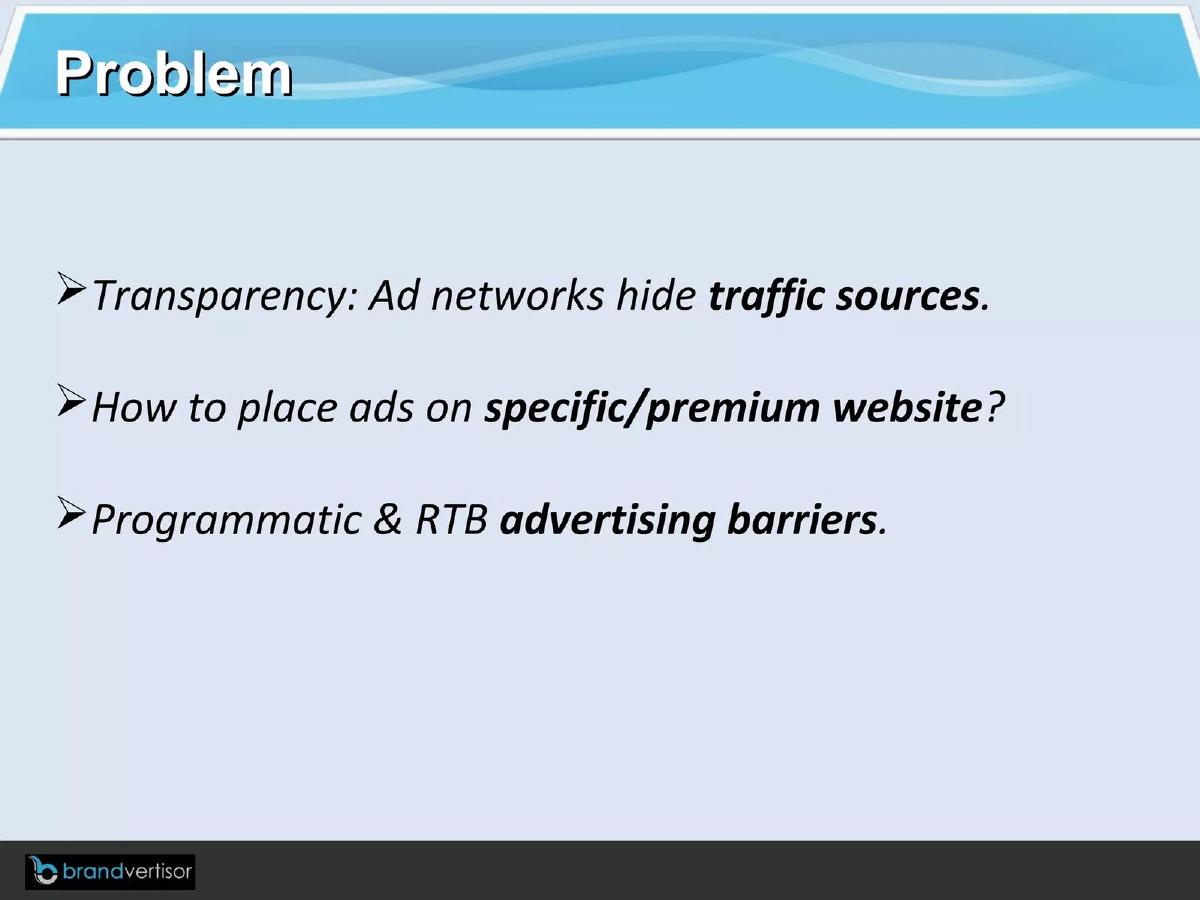
The most glaring omission in this 8-slide sequence is a clear 'Problem' slide. While the solution implies that the market lacks transparency, the deck doesn't explicitly quantify the pain point for advertisers (e.g., how much money is wasted on fraudulent traffic or hidden fees in traditional networks). Without a strong problem statement, the 'Transparency' solution feels like a feature rather than a necessity.
There is also no mention of a competitive landscape. The ad-tech space is notoriously crowded with giants like Google and Facebook, as well as smaller direct-placement competitors like BuySellAds. Failing to acknowledge how Brandvertisor differs from these incumbents is a significant gap for potential investors.
Finally, the 'Ask' is missing from these slides. It is unclear how much capital the company is seeking to raise and what specific milestones that capital will fund. In a Demo Day setting, the 'Ask' is usually the climax of the presentation.
Lessons for Founders
Founders should take note of the 'Breakeven' calculation on Slide 6. Identifying the exact number of customers needed to reach sustainability is a powerful way to demonstrate operational clarity. It turns a vague goal into a tangible sales target.
Additionally, the use of third-party validation (Alexa/Quantcast) within the product demo is a smart way to build trust in a marketplace. If you are building a platform that relies on the quality of your supply side, find ways to bake external verification into the user experience. It reduces the friction for the demand side to pull the trigger on a purchase.
However, founders should be careful not to present traction that is too low without context. Stating '$350 in sales' can sometimes do more harm than good if not framed as a 'first week' or 'alpha test' result. If your revenue is negligible, it is often better to focus on user engagement metrics or the growth rate of your 'opt-ins' until the revenue reaches a more significant milestone.
Frequently asked questions
- What is the core problem Brandvertisor is trying to solve?
- While the deck does not have a dedicated 'Problem' slide, the solution and title slides imply that the current advertising landscape lacks transparency. By positioning itself as a 'Transparency Advertising Marketplace,' Brandvertisor aims to solve the opacity of traditional ad networks by allowing advertisers to see exactly where their ads are placed and providing publishers with a more direct way to monetize their specific audience segments.
- How does Brandvertisor generate revenue?
- Brandvertisor utilizes a standard marketplace commission model. According to slide 6, they charge a fixed 10% fee on every transaction that occurs through the platform. This aligns their incentives with both the advertiser and the publisher, as they only make money when a successful ad placement is purchased.
- What are the key metrics for their business model?
- The deck provides specific unit economics on slide 6. They report a Customer Acquisition Cost (CAC) of $208 and a Lifetime Value (LTV) of $290. Additionally, they cite an Average Revenue Per Paying User (ARPPU) of $82 and a churn rate of 40%. They have identified that they need 80 paying users per month to reach breakeven.
- What stage of development is the company in based on this deck?
- The company is in the very early stages, likely pre-seed or seed. Slide 7 (Traction) notes that they have an 'MVP Demo' and have generated only $350 in direct sales. The presence of 800 'opt-ins' suggests they are still in the lead-generation and validation phase rather than having a fully scaled user base.
- Who is behind the company?
- The team consists of two members shown on slide 8. Nedko Nedkov serves as CEO, bringing a background as a founder in a PPC (Pay-Per-Click) network with expertise in marketing and SEO. Petar Telbiyski serves as CTO, described as a senior front-end developer with experience in Node.js.