Fictiv’s 15-slide deck is a highly polished example of a late-stage growth narrative. Rather than focusing on the mechanics of 3D printing or CNC machining, the deck centers on the 'productivity problem'—specifically the 15% of engineering time wasted on fragmented sourcing. By positioning themselves as an 'operating system' for custom parts, Fictiv moves the conversation from commodity manufacturing to high-value digital infrastructure. The deck excels at demonstrating enterprise readiness through a detailed Honeywell case study and a team slide featuring alumni from Apple, SpaceX, and Ford.…
Key takeaways
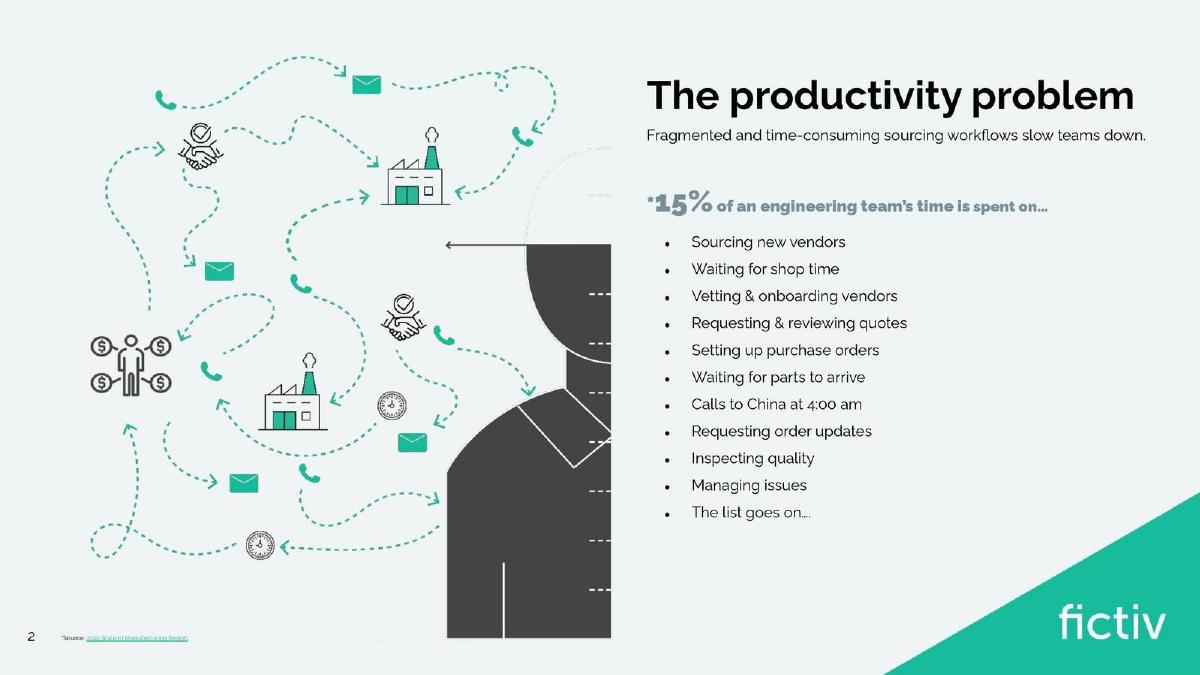
- Slide 2 quantifies the problem by stating that 15% of an engineering team's time is spent on administrative sourcing tasks.
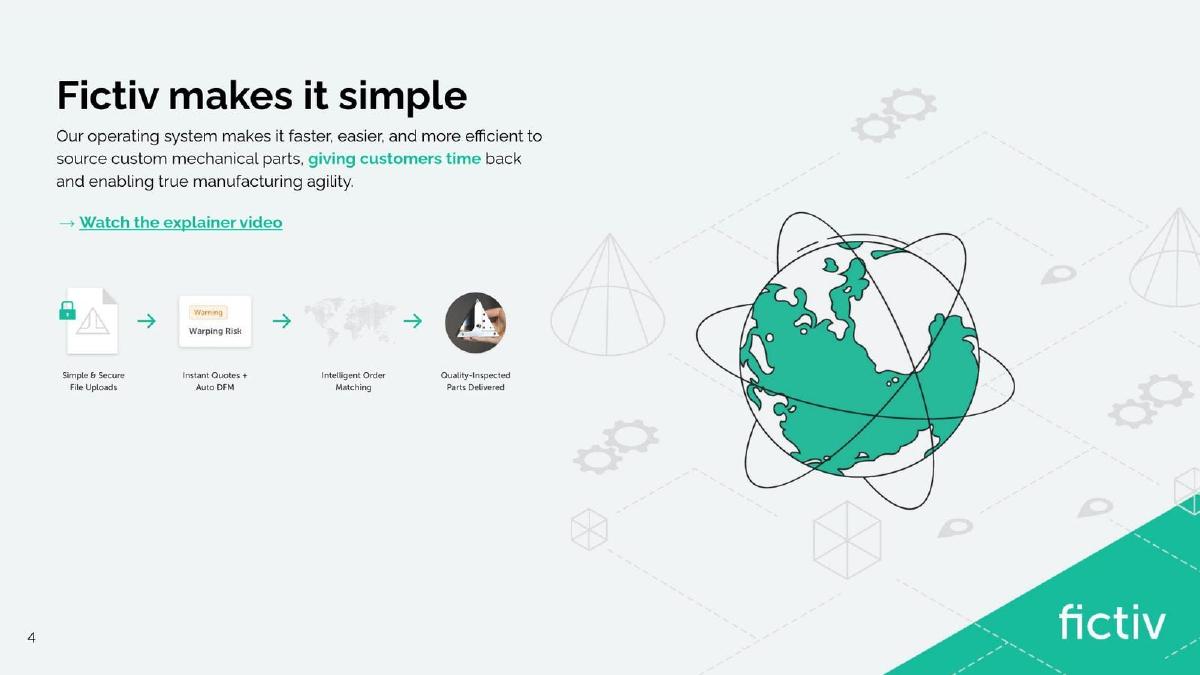
- The platform is positioned on Slide 4 as an 'operating system' that provides instant quotes and intelligent order matching.
- Slide 6 highlights the company's enterprise-grade security by featuring an AICPA SOC logo.
- Fictiv claims access to over 10,000 hours per month of networked machine capacity on Slide 8.
- The supply chain is diversified across 4 regions: U.S., China, Taiwan, and India, as noted on Slide 8.
- A direct comparison on Slide 10 shows Fictiv reducing a 27-week traditional sourcing process to a significantly shorter timeline for Honeywell.
- The executive team includes leaders with experience from high-stakes companies like SpaceX, Tesla, and Microsoft (Slide 12).
- Publisher reports indicate this deck supported a $100M Series E round in 2024.
Introduction: The Shift from Hardware to Infrastructure
Fictiv’s Series E deck represents a significant evolution in how manufacturing startups pitch. In earlier rounds, companies in this space often focused on the novelty of 3D printing. By 2024, as Fictiv raised $100M, the narrative shifted toward supply chain resilience and workflow automation . The deck is less about 'making things' and more about the 'operating system' that manages the making. This teardown examines how Fictiv used a 15-slide narrative to secure one of the largest rounds in the sector.
Slide 1-3: The Visual Hook and Problem Definition
Slide 1 is a minimalist title slide featuring the tagline 'Sourcing simplified.' It uses a high-contrast image of a technician inspecting a precision-machined part, immediately signaling that this is a high-end industrial play, not a consumer hobbyist platform.
Slide 2, titled 'The productivity problem,' is the most important slide for establishing the 'Why now?' factor. It claims that 15% of an engineering team's time is spent on administrative tasks like vetting vendors, waiting for shop time, and 'calls to China at 4:00 am.' By quantifying the pain in terms of engineering hours—a high-cost resource for any enterprise—Fictiv transforms a logistics problem into a bottom-line productivity problem. The visual on the left uses a chaotic dotted-line map to represent the current fragmented state of the industry.
Slide 4-6: The 'Operating System' Solution
Slide 4 introduces the Fictiv solution. The phrasing is specific: 'Our operating system makes it faster, easier, and more efficient to source custom mechanical parts.' The use of the term 'operating system' is a deliberate move to align with SaaS (Software as a Service) multiples rather than lower manufacturing multiples. The slide outlines a four-step process: Simple & Secure File Uploads, Instant Quotes + Auto DFM, Intelligent Order Matching, and Quality-Inspected Parts Delivered.
Slide 6 provides a deep dive into the 'One easy-to-use platform.' It features a high-fidelity screenshot of the Fictiv dashboard, showing lead time selections, pricing ($1,112.70 for a sample order), and design feedback. Crucially, this slide includes the AICPA SOC logo . For a Series E company targeting enterprise clients like Honeywell, demonstrating data security and process integrity is a non-negotiable requirement for closing large contracts.
Slide 7-9: Global Scale and Network Effects
Slide 8, 'The world’s most agile custom parts supply chain,' shifts the focus to the supply side. Fictiv doesn't claim to own the machines; they operate a 'network of highly vetted and managed partners.' They cite 10,000+ hours of monthly machine capacity and 2,000+ combinations of materials and finishes. By highlighting four supply regions (U.S., China, Taiwan, and India), they address the 'reduced risk' of supply chain disruptions—a major selling point in the post-2020 industrial landscape.
Slide 10-11: The Honeywell Case Study
Slide 10 is the deck's 'killer' evidence. It features a success story from Honeywell, comparing the 'Traditional Sourcing Process' against the 'Fictiv Process.' The visual comparison is stark: the traditional process involves a 13-week casting fabrication and 9-week machining fabrication, stretching across 7 months. Fictiv’s process shows CNC Machining completed in 3 weeks . This isn't just a marginal improvement; it is a fundamental shift in speed-to-market. The inclusion of a specific, recognizable enterprise logo like Honeywell provides the social proof necessary for a $100M round.
Slide 12-15: The Executive Team and Closing
Slide 12 presents the 'Industry-leading and experienced executive team.' The pedigree here is exceptional. The founders (Dave and Nate Evans) bring experience from Ford and Microsoft. The supporting C-suite includes veterans from Apple, SpaceX, Tesla, and Intel . For investors, this team composition suggests that the company has the operational maturity to handle the complexities of global logistics and enterprise sales.
The deck concludes on Slide 15 with a repeat of the 'Sourcing Simplified' branding, maintaining a consistent, professional aesthetic throughout.
What Fictiv Does Well
Quantifying the Pain: By identifying that 15% of engineering time is wasted, Fictiv gives investors a clear metric to calculate the potential ROI for their customers. It moves the product from a 'nice to have' to a 'must have' for efficiency.
Enterprise Readiness: The inclusion of SOC compliance, global supply regions, and the Honeywell case study signals to Series E investors that the company has already cleared the high hurdles required to serve Fortune 500 clients.
Platform Positioning: Fictiv avoids being labeled as a 'machine shop.' By consistently using terms like 'digital infrastructure,' 'operating system,' and 'intelligent order matching,' they position themselves as a technology company that happens to produce physical parts.
What is Missing from the Deck
Financial Transparency: As is common with many publicly shared versions of late-stage decks, there are no slides detailing Revenue, Gross Margins, or EBITDA. Investors at the Series E level would typically require a deep dive into the unit economics of the 'networked machine capacity' model.
Competitive Landscape: There is no mention of competitors like Protolabs or Xometry. A growth-stage deck usually includes a 'moat' slide explaining why their 'intelligent matching' is superior to the competition's algorithms.
The Ask: The deck does not state how much they are raising or what the specific milestones for the next 18-24 months are. While we know from external reports that they raised $100M, the deck itself is a narrative tool rather than a complete financial prospectus.
Founder Takeaways: How to Copy the Fictiv Strategy
Focus on Time, Not Just Cost: Fictiv wins by showing they save months of time (Slide 10). If your startup improves a process, map out the 'Before vs. After' timeline visually. · Sell the 'System,' Not the 'Service': Even if you are providing a service, frame it as a platform or an operating system. This suggests scalability and higher value-add. · Leverage Big Names: If you have one major enterprise client, give them a full slide. A quote and a logo from a company like Honeywell are worth more than ten slides of generic market data. · Highlight Supply Chain Diversity: In the current geopolitical climate, showing that you are not dependent on a single region (Slide 8) is a critical de-risking strategy for any physical goods startup.
Frequently asked questions
- What is Fictiv's core value proposition according to the deck?
- Fictiv positions itself as a 'sourcing simplified' solution. According to Slide 4, they provide an operating system for custom mechanical parts that uses 'Intelligent Order Matching' and 'Auto DFM' (Design for Manufacturability) to give engineering teams their time back. They aim to replace fragmented, manual workflows with a single digital platform.
- How does Fictiv demonstrate its scale and capacity?
- On Slide 8, Fictiv lists three key metrics: 10,000+ hours per month of networked machine capacity, 2,000+ combinations of materials and finishes, and operations across 4 global supply regions (U.S., China, Taiwan, and India). This suggests a massive, distributed manufacturing network rather than a single factory.
- What evidence of enterprise-level success is provided?
- Slide 10 features a 'Success Story' from Honeywell. It includes a quote praising Fictiv's 'rapid cycle time' and a Gantt chart comparison. The chart shows the 'Traditional Sourcing Process' taking months for casting and machining, while the 'Fictiv Process' completes CNC machining in just 3 weeks.
- Who are the key people behind Fictiv?
- Slide 12 introduces a 7-person executive team led by Co-Founders Dave Evans (CEO, ex-Ford) and Nate Evans (CXO, ex-Microsoft). The team also features Jean Olivieri (COO) with experience at Apple and SpaceX, and Joanne Moretti (CRO) with a background at Dell and HP.
- Is there a specific funding ask in the deck?
- No, the 15-slide deck provided does not include a specific 'Ask' slide or a breakdown of how funds will be used. While publisher reports confirm a $100M Series E, the deck focuses entirely on the problem, solution, platform capabilities, and team expertise.