Manufacturing & Robotics Problem Slide: Pitch Deck Examples
How manufacturing, industrial and robotics startups present the problem in a pitch deck: name the plant, line or job that fails, measure the downtime.
Manufacturing & Robotics Problem Slide: Real Pitch Deck Examples
Eight problem slides from manufacturing, industrial-robotics and factory-software startups, shown in full, compare whether each slide names where the work breaks, measures it with a source, and stays focused on one problem.
TL;DR
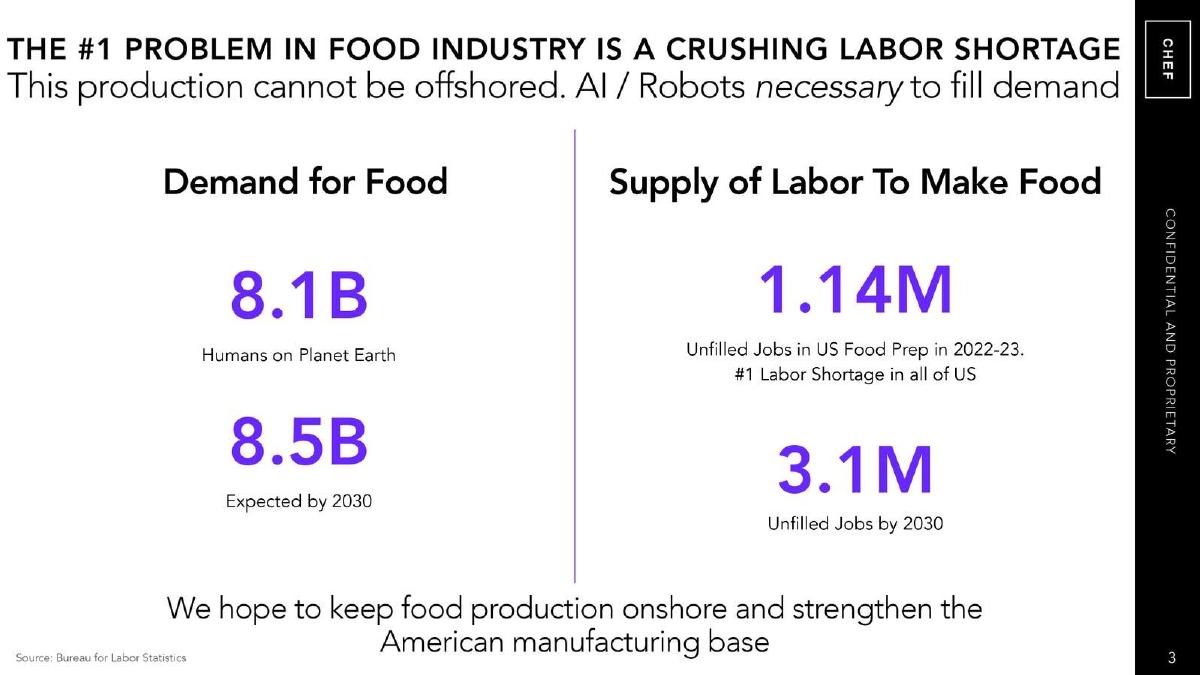
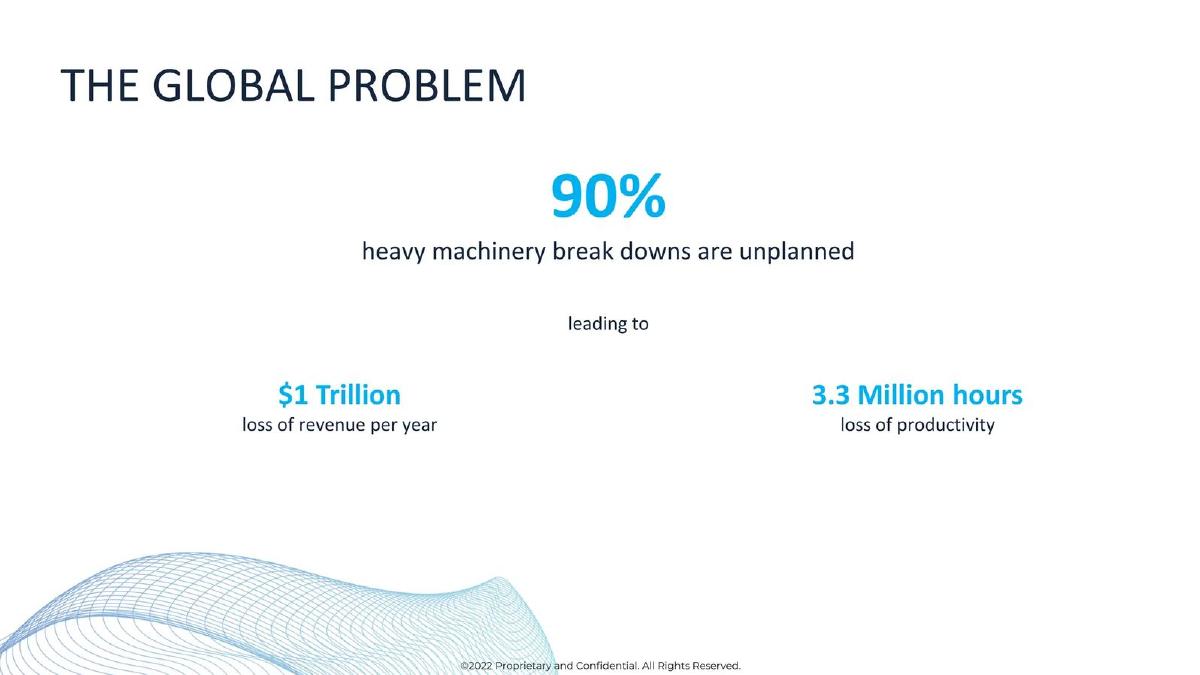
A manufacturing problem slide should name the job or machine that fails and measure the cost. Chef Robotics puts demand beside supply: "8.1B Humans on Planet Earth" and "8.5B Expected by 2030" against "1.14M Unfilled Jobs in US Food Prep in 2022-23" ("#1 Labor Shortage in all of US") and "3.1M Unfilled Jobs by 2030", sourced to the Bureau of Labor Statistics. Benvira leads with one figure: "90% heavy machinery break downs are unplanned", costing "$1 Trillion" in revenue per year. Fictiv's list of eight blockers ending "The list continues..." is the weaker pattern.
Manufacturing and robotics problem slides from real pitch decks
Each example shows the exact stored slide above its analysis and links to the full teardown. Claims are as shown on the slides; we have not verified them.
Chef Robotics problem slide — slide 3
Food-assembly robots. Demand and labour supply side by side.
Chef Robotics deck, slide 3. Exact stored slide matched to this analysis.
Our analysis: The strongest example here: one problem, a clear gap between demand and workers, and a named source.
Evidence and limitation: Four figures; labour figures sourced.
What a founder can adapt: Show the gap as two columns: what's needed and what's available.
Supporting analysis
What the deck claims: "The #1 problem in food industry is a crushing labor shortage." "This production cannot be offshored. AI / Robots necessary to fill demand." "Demand for Food": "8.1B Humans on Planet Earth", "8.5B Expected by 2030". "Supply of Labor To Make Food": "1.14M Unfilled Jobs in US Food Prep in 2022-23. #1 Labor Shortage in all of US", "3.1M Unfilled Jobs by 2030". "We hope to keep food production onshore and strengthen the American manufacturing base." Source: "Bureau of Labor Statistics."
Presentation choice: "Cannot be offshored" rules out the obvious alternative before an investor raises it.
When it does not fit: World population is context, not the problem; the US job numbers carry the slide.
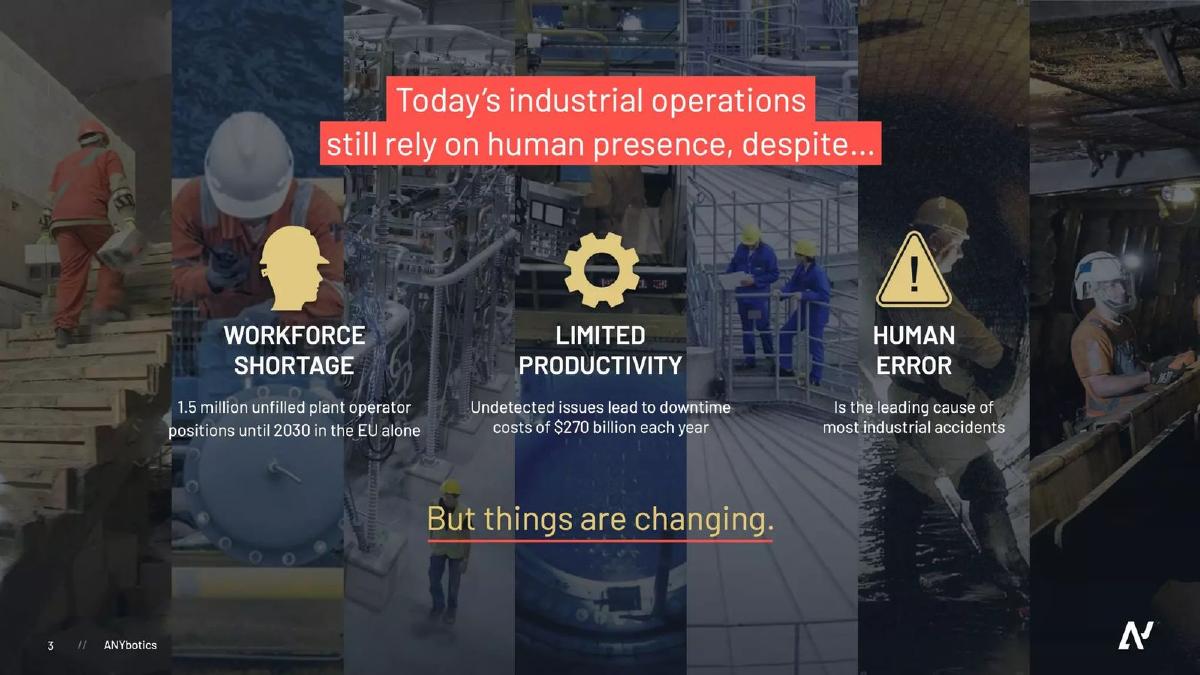
Inspection robots for industrial plants. Three icons over plant photos.
ANYbotics deck, slide 3. Exact stored slide matched to this analysis.
Our analysis: Three problems that share one cause (people must be on site), each measured or specific.
Evidence and limitation: Two figures; no source.
What a founder can adapt: If you list several problems, show what they have in common.
Supporting analysis
What the deck claims: "Today's industrial operations still rely on human presence, despite..." "Workforce Shortage: 1.5 million unfilled plant operator positions until 2030 in the EU alone." "Limited Productivity: Undetected issues lead to downtime costs of $270 billion each year." "Human Error: Is the leading cause of most industrial accidents." "But things are changing."
Presentation choice: Linking shortage, downtime and safety to one cause sets up one answer: a robot on patrol.
When it does not fit: Cite the $270 billion and 1.5 million figures.
Predicting factory shutdowns. Four lines beside a firefighter photo.
Limis deck, slide 2. Exact stored slide matched to this analysis.
Our analysis: One named problem, its cost, its human risk, and one word of hope ("avoidable").
Evidence and limitation: Two figures; no source.
What a founder can adapt: End the problem slide with why it can be fixed.
Supporting analysis
What the deck claims: "Problem: Unplanned Manufacturing Shutdowns." "Cost US Manufacturers $50 Billion per year." "Reduce Profits by 11%." "Often accompanied by threats to life and health toward employees and even the surrounding communities." "Frequently avoidable."
Presentation choice: "Frequently avoidable" hints at the solution without describing it.
When it does not fit: Say how often shutdowns are avoidable, with a source.
Predictive maintenance for heavy machinery. One figure leading to two more.
Benvira deck, slide 2. Exact stored slide matched to this analysis.
Our analysis: Very clear: one figure causes two costs.
Evidence and limitation: Three figures; no source.
What a founder can adapt: Lead with the rate, then show what it costs.
Supporting analysis
What the deck claims: "The Global Problem." "90% heavy machinery break downs are unplanned" leading to "$1 Trillion loss of revenue per year" and "3.3 Million hours loss of productivity."
Presentation choice: The layout reads as cause and effect.
When it does not fit: "Global" and "$1 Trillion" without a source invite doubt; name the machine owners you sell to.
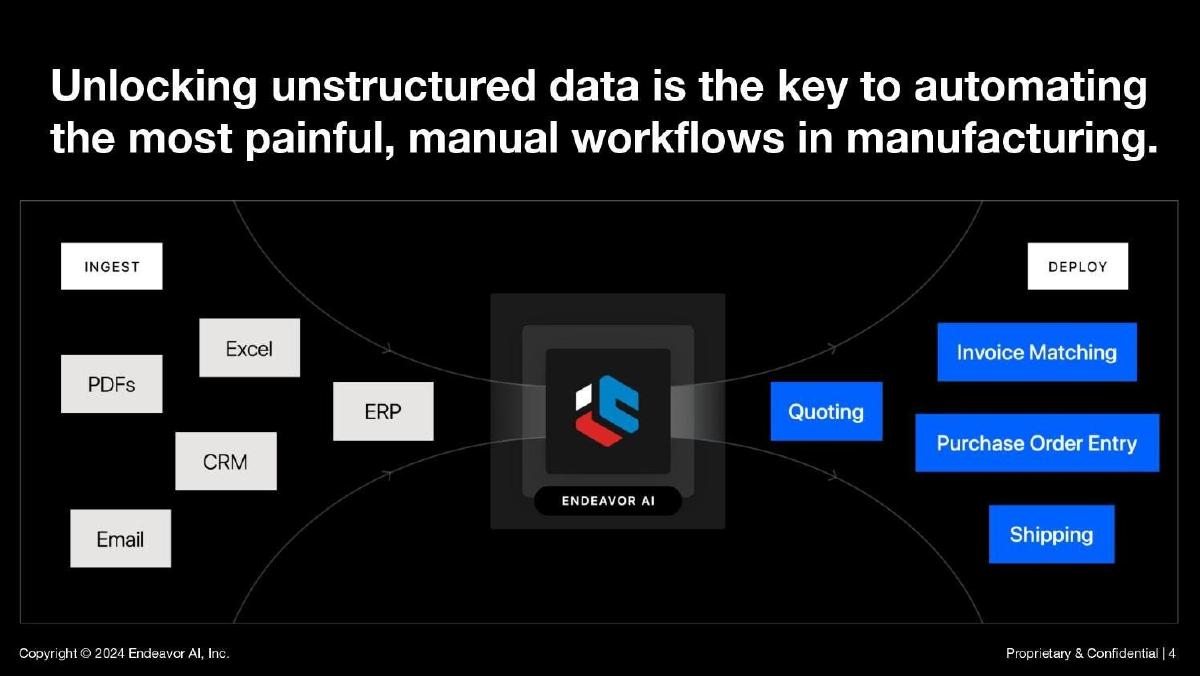
AI for manufacturers' back-office work. A flow from documents to tasks.
Endeavor AI deck, slide 4. Exact stored slide matched to this analysis.
Our analysis: Partial: it names the painful tasks precisely, but the slide is mostly the product flow.
Evidence and limitation: No figures.
What a founder can adapt: Give the hours each task takes today before showing the flow.
Supporting analysis
What the deck claims: "Unlocking unstructured data is the key to automating the most painful, manual workflows in manufacturing." Ingest: "PDFs", "Excel", "Email", "CRM", "ERP" → "Endeavor AI" → Deploy: "Invoice Matching", "Quoting", "Purchase Order Entry", "Shipping".
Presentation choice: Kept to show how naming exact tasks (quoting, purchase orders) makes an office problem concrete.
When it does not fit: Merging problem and solution on one slide.
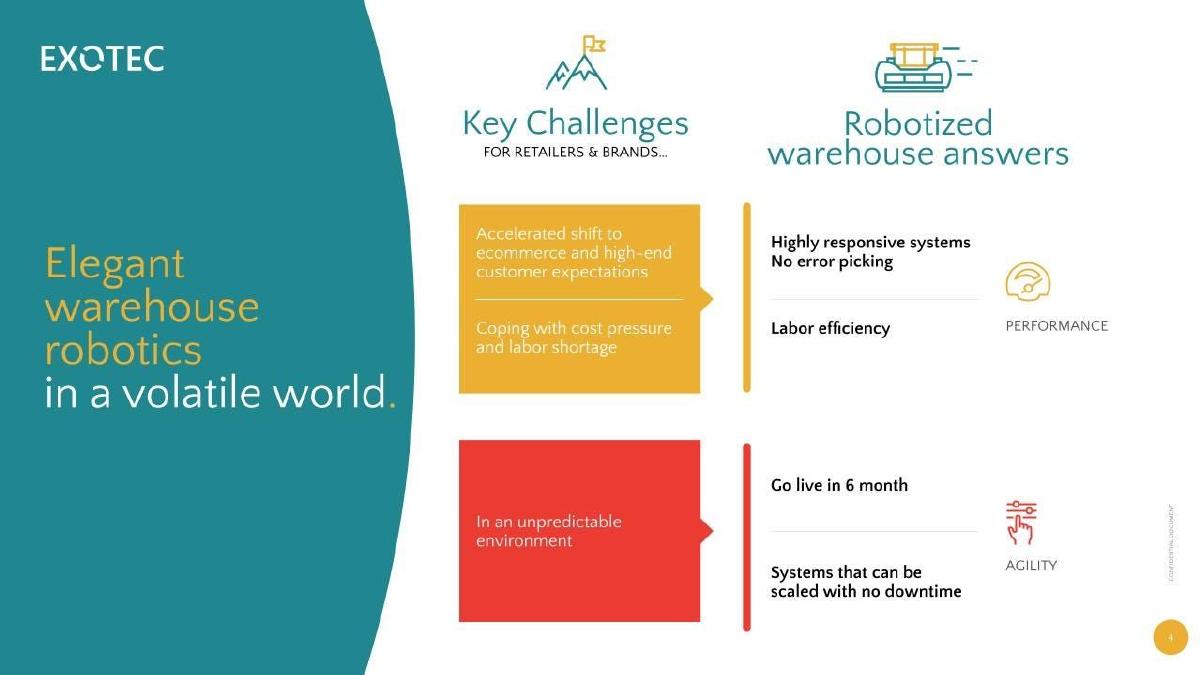
Warehouse robots. Challenges in one column, answers in the next.
Exotec deck, slide 5. Exact stored slide matched to this analysis.
Our analysis: Partial: a clear customer (retailers and brands), but the challenges are general and share the slide with the answer.
Evidence and limitation: One figure (6 months to go live).
What a founder can adapt: Give the challenges numbers, such as order growth or picking error rate.
Supporting analysis
What the deck claims: "Elegant warehouse robotics in a volatile world." "Key Challenges for Retailers & Brands...": "Accelerated shift to ecommerce and high-end customer expectations", "Coping with cost pressure and labor shortage", "In an unpredictable environment". "Robotized warehouse answers": "Highly responsive systems", "No error picking", "Labor efficiency", "Go live in 6 month", "Systems that can be scaled with no downtime".
Presentation choice: Kept to show the challenge-and-answer layout; the answers are more specific than the challenges.
When it does not fit: "Volatile" and "unpredictable" without a figure.
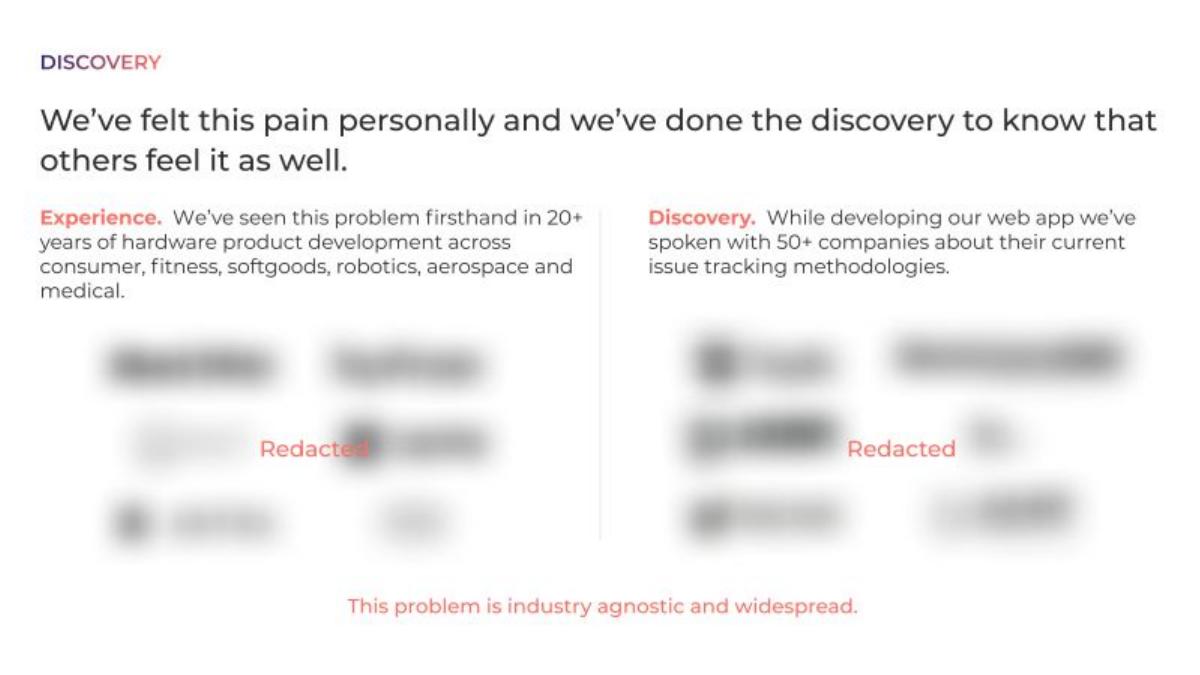
Issue tracking for hardware engineering teams. Two columns of evidence, with customer logos redacted in the stored copy.
Five Flute deck, slide 5. Exact stored slide matched to this analysis.
Our analysis: Partial: it proves the problem is real and shared, but never says what the problem is on this slide.
Evidence and limitation: 20+ years' experience; 50+ company interviews.
What a founder can adapt: Add what the 50 companies said: one quote or one common complaint.
Supporting analysis
What the deck claims: "Discovery: We've felt this pain personally and we've done the discovery to know that others feel it as well." "Experience. We've seen this problem firsthand in 20+ years of hardware product development across consumer, fitness, softgoods, robotics, aerospace and medical." "Discovery. While developing our web app we've spoken with 50+ companies about their current issue tracking methodologies." "This problem is industry agnostic and widespread."
Presentation choice: Kept to show a useful follow-up to a problem slide: evidence that others have it.
When it does not fit: Evidence of a problem without naming it.
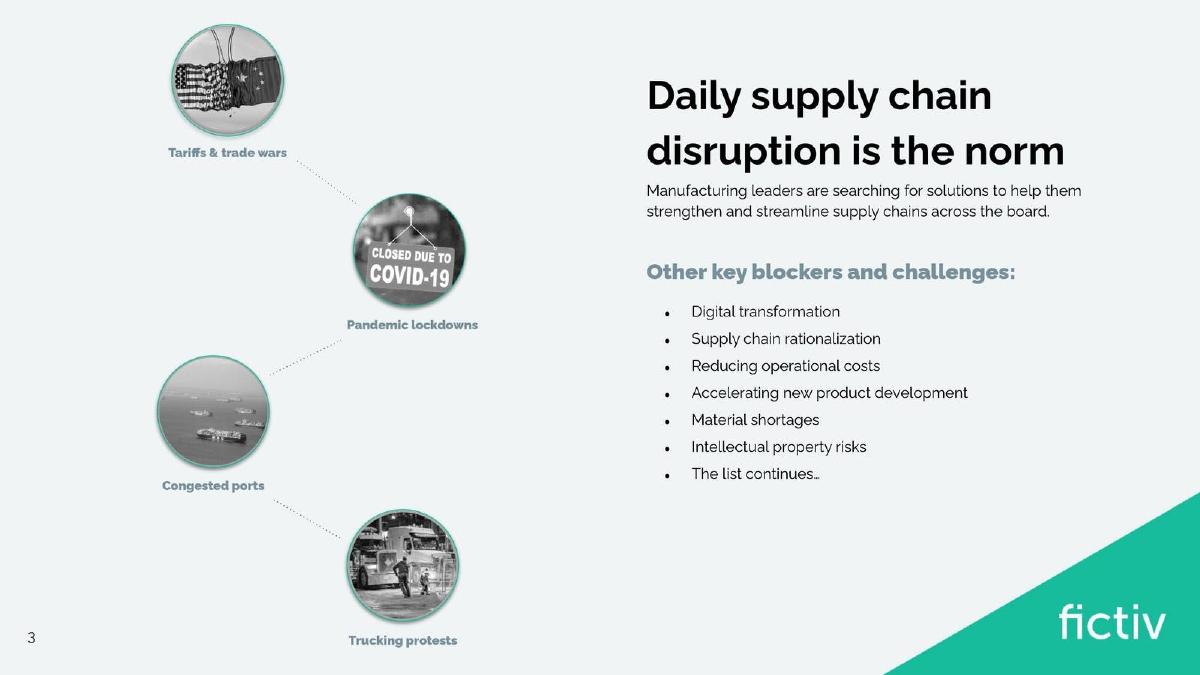
On-demand manufacturing platform. News photos and a bullet list.
Fictiv deck, slide 4. Exact stored slide matched to this analysis.
Our analysis: Weak on purpose: world events plus a list of general challenges; no customer, no measured cost, and no single problem Fictiv solves.
Evidence and limitation: No figures.
What a founder can adapt: Pick the one disruption your customers pay for most and measure it (weeks of delay, cost per late part).
Supporting analysis
What the deck claims: "Daily supply chain disruption is the norm." "Manufacturing leaders are searching for solutions to help them strengthen and streamline supply chains across the board." Photos: "Tariffs & trade wars", "Pandemic lockdowns", "Congested ports", "Trucking protests". "Other key blockers and challenges": "Digital transformation", "Supply chain rationalization", "Reducing operational costs", "Accelerating new product development", "Material shortages", "Intellectual property risks", "The list continues..."
Presentation choice: Kept as a contrast; compare Limis, which names one problem and its cost in four lines.
Before: Daily supply chain disruption is the norm. The list continues...
After: Hardware teams wait 6–8 weeks for custom machined parts; each week of delay pushes back a product launch. (Figures from our survey of 60 engineering managers.)
What improved: Our illustrative rewrite; the figures are invented for the example. It names who, what breaks and what it costs.
What this guide adds
No other guide in the library covers manufacturing or industrial robotics problems. The logistics guides cover delivery and warehousing networks; this guide is about plants, machines and factory work. None of these eight slides appears in another guide.
Most manufacturing problems fall into three kinds: not enough people (Chef Robotics, ANYbotics), machines that stop without warning (Limis, Benvira), and manual paperwork and supply disruption (Endeavor, Fictiv).
Three things a manufacturing problem slide proves
Where it breaks: "Unplanned Manufacturing Shutdowns" (Limis), "1.5 million unfilled plant operator positions" (ANYbotics), "Invoice Matching", "Quoting", "Purchase Order Entry" (Endeavor).
What it costs: "$50 Billion per year" and "Reduce Profits by 11%" (Limis); "costs of $270 billion each year" (ANYbotics); "3.3 Million hours loss of productivity" (Benvira).
A source: "Bureau of Labor Statistics" (Chef Robotics). Most other slides here give no source, the most common gap.
Common mistakes
A list of industry headaches. Pick the one you fix.
Unsourced trillion-dollar figures. Cite every number.
World events as the problem. Say what it costs your customer.
Evidence without the problem. Name it before proving it.
Product on the problem slide. Keep the robot for the next slide.
Diagnostic checklist
It names where the work breaks.
It gives one measured figure.
The figure has a source.
It focuses on one problem.
The solution waits for the next slide.
Frequently asked questions
How we chose these examples
Corpus: published pitch deck teardowns on StartupFundraising.com. Founder-uploaded private decks are excluded.
Selection (2026-09-25): we searched slides 2–5 for problem slides mentioning manufacturing, factories, machinery, robots, drones or supply chains. The drone delivery deck's slide 3 was left out because it already appears in the logistics problem guide. Endeavor AI, Exotec and Five Flute are marked partial; Fictiv is kept as a weaker contrast.
Overlap check: none of these eight slides appears in another guide. Other slides from the same decks do: Chef Robotics slide 5 (data moat guide), Fictiv slide 6 (customer slide guide), Limis slide 6 (go-to-market guide) and Five Flute slide 2 (SaaS team guide).
Review: all eight stored slide images were inspected on 2026-09-25 and matched to company, deck and slide number (editorial model review). Five Flute's stored slide has customer names redacted by the source. No person has yet completed an editorial review of this page.
Claims are as shown on the slides; we have not verified them. We make no claim that any slide caused a fundraising outcome.