The Nvidia × Arm acquisition deck is a masterclass in strategic narrative, positioning the merger as the foundational event for the 'Age of AI.' Across 15 slides, Nvidia argues that combining its GPU leadership with Arm's ubiquitous CPU ecosystem would create a 'premier computing company.' The deck emphasizes scale, noting Arm's 180 billion chips shipped and a combined reach of 15 million developers. Financially, the deal was structured as a $40 billion transaction involving $21.5 billion in stock and $12 billion in cash. While the deck focuses heavily on synergy and market expansion into a $…
Key takeaways
- The deal was valued at up to $40 billion, comprising $21.5B in shares and $12B in cash (Slide 14).
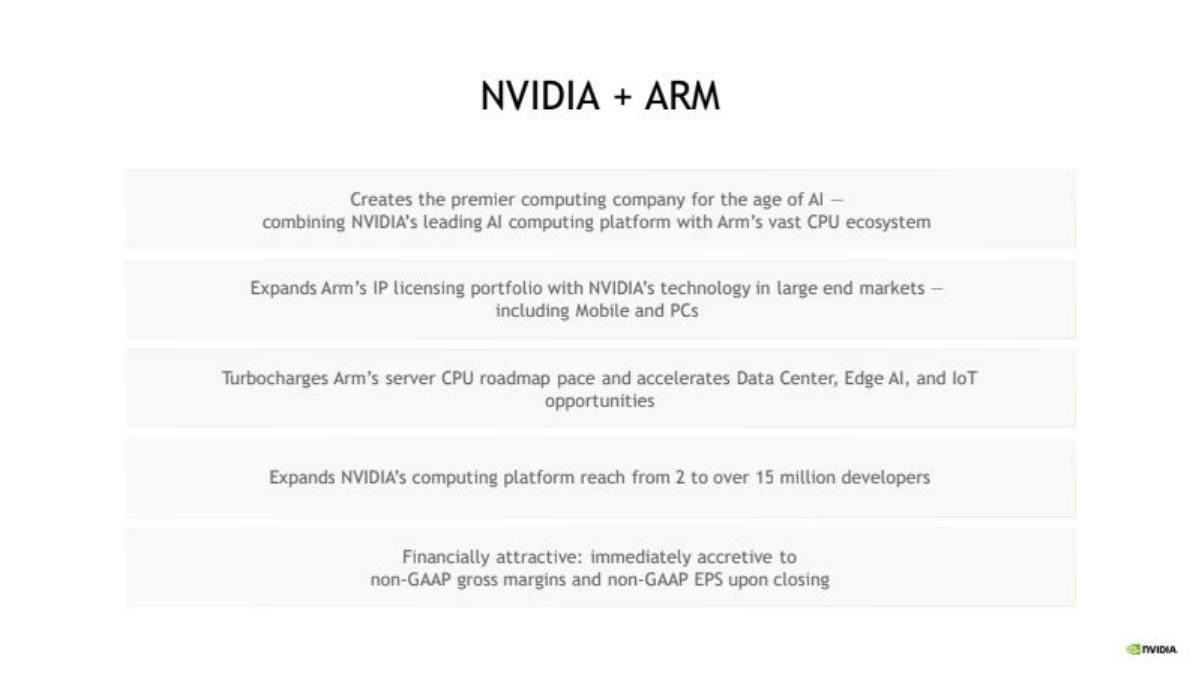
- Nvidia aimed to expand its developer reach from 2 million to over 15 million by absorbing Arm's ecosystem (Slide 5).
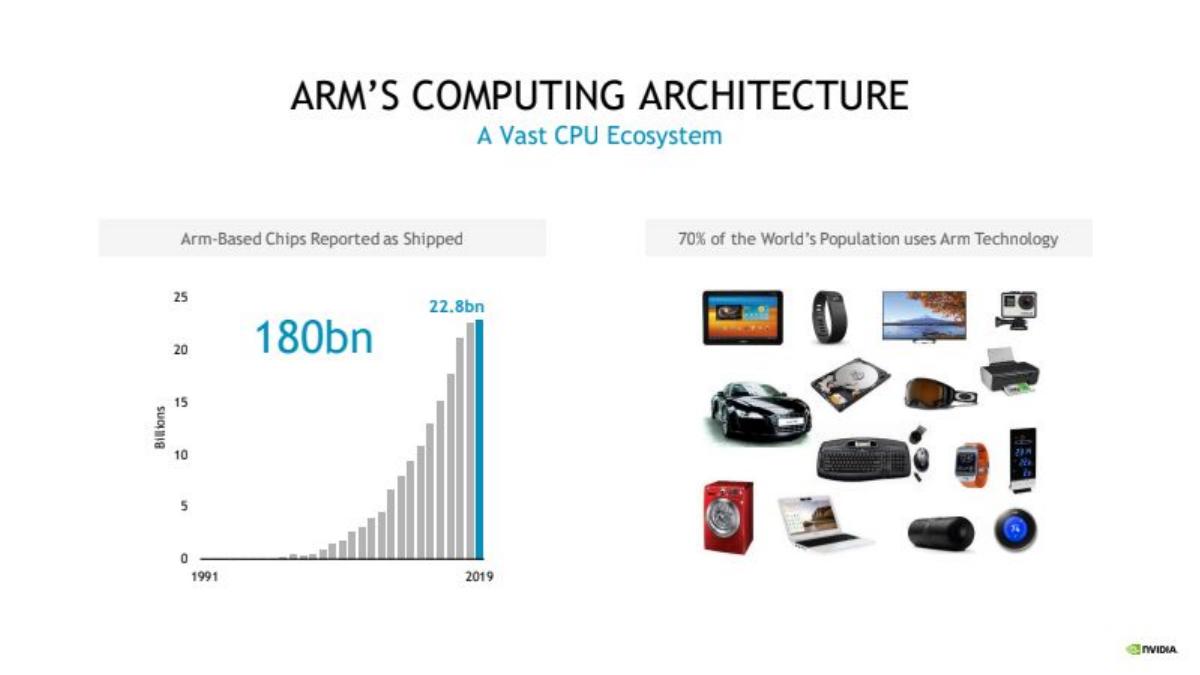
- Arm's massive market footprint is highlighted by the 180 billion chips shipped since 1991 (Slide 6).
- The combined entity targeted a $250 billion total addressable market by 2023 across devices, data centers, and IoT (Slide 12).
- Nvidia positioned itself as the R&D leader with 24% R&D intensity compared to Arm's significantly lower spend (Slide 9).
- The transaction was designed to be immediately accretive to non-GAAP gross margins and EPS (Slide 14).
- The deck outlines a 18-month expected closing timeline, which was ultimately halted by regulatory intervention (Slide 14).
- Arm's financial profile showed a high-quality business model with ~94% pro forma gross margins (Slide 13).
The Strategic Narrative of a Semiconductor Giant
The Nvidia × Arm acquisition deck is not a typical startup pitch; it is a corporate strategy document designed to sell a $40 billion vision to the public markets and regulators. It focuses on the concept of 'The Age of AI' and how the combination of two very different semiconductor powerhouses creates a vertical monopoly on innovation.
Slide 1: Title Slide
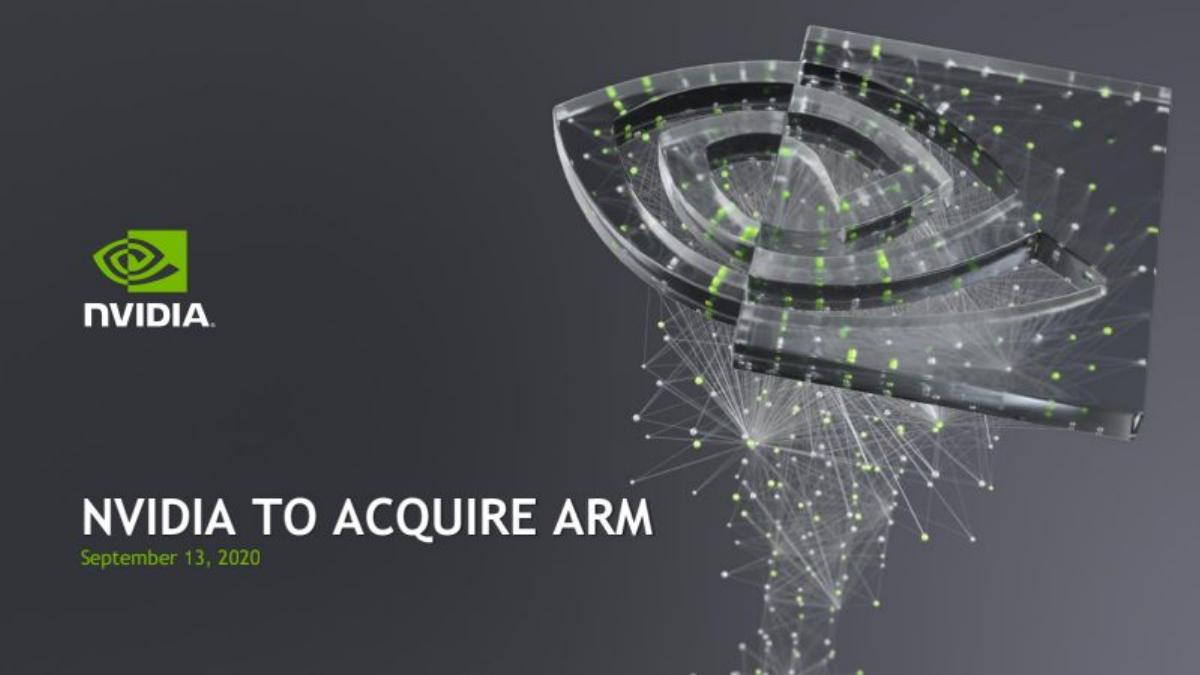
The deck opens with a clean, high-tech aesthetic featuring the Nvidia logo and the bold statement: NVIDIA TO ACQUIRE ARM . The date, September 13, 2020, marks a significant moment in tech history. The visual of a glass-like Nvidia logo suggests transparency and high-end engineering.
Slide 2: Forward Looking Statements
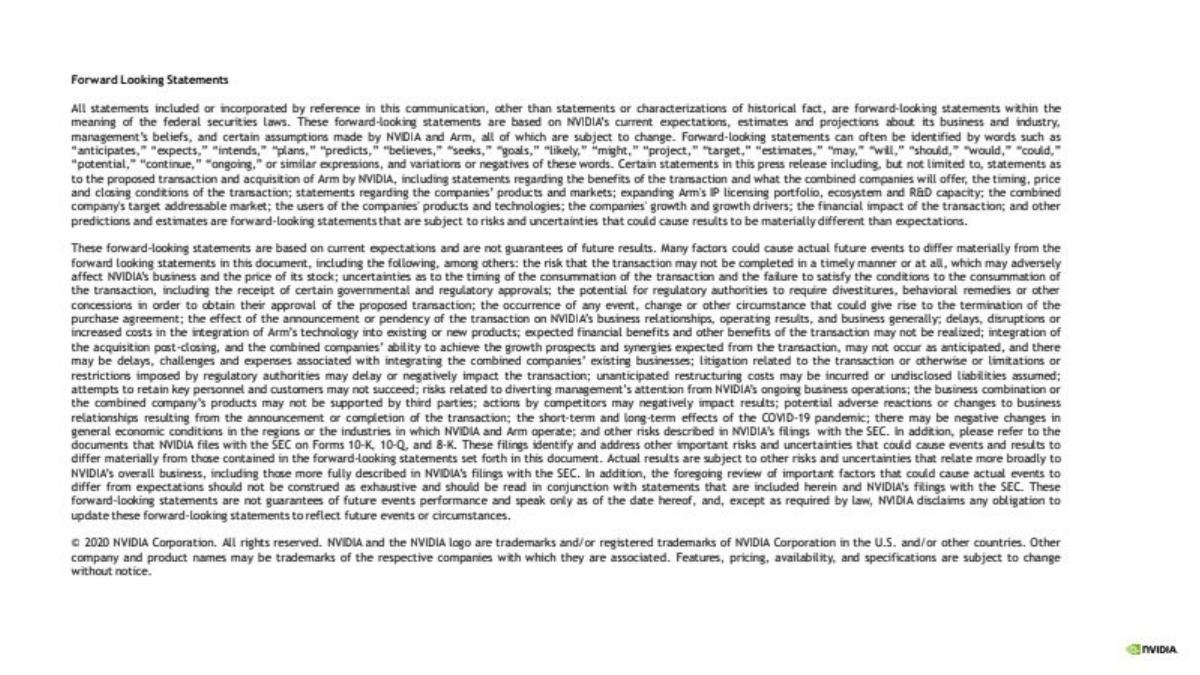
This is a standard but critical legal slide. It contains dense text outlining the risks and uncertainties of the deal. Notably, it mentions that 'regulatory authorities may require divestitures' or 'behavioral remedies,' which foreshadows the regulatory challenges that eventually killed the deal.
Slide 3: Full-Stack Computing for the Age of AI
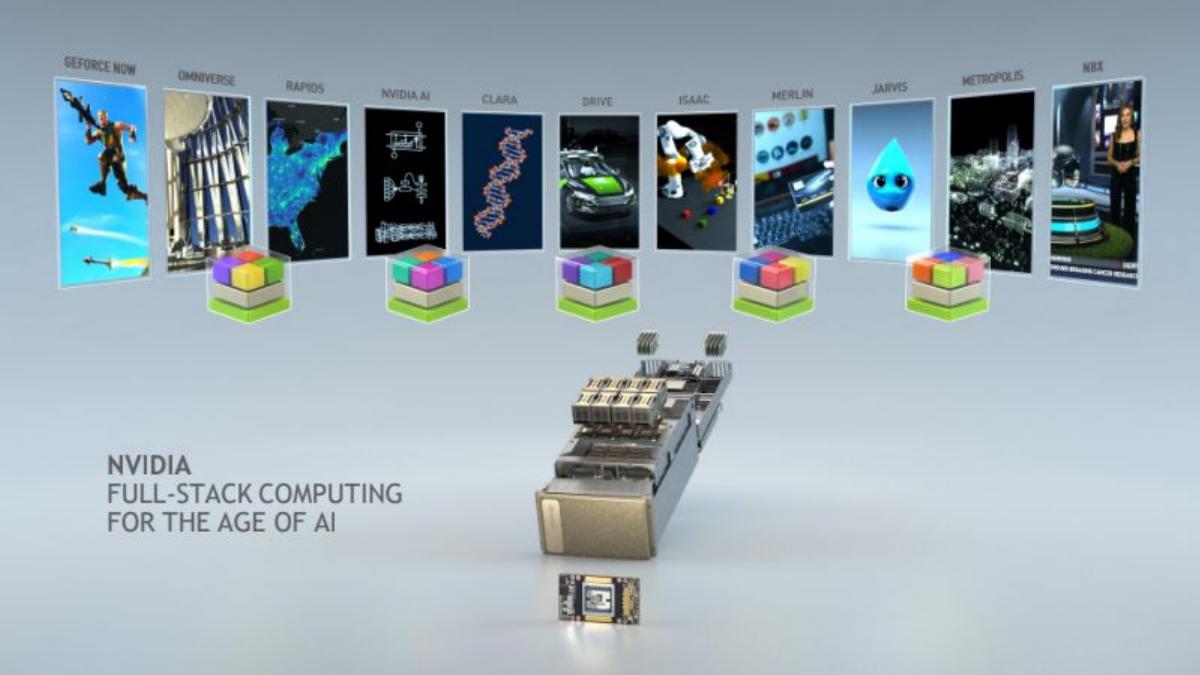
Nvidia establishes its current position. It showcases its various platforms—GeForce Now, Omniverse, Drive, Isaac, and Jarvis. The slide visualizes Nvidia as a 'full-stack' provider, moving from chips to systems to software. This sets the stage for why they need Arm: to complete the stack.
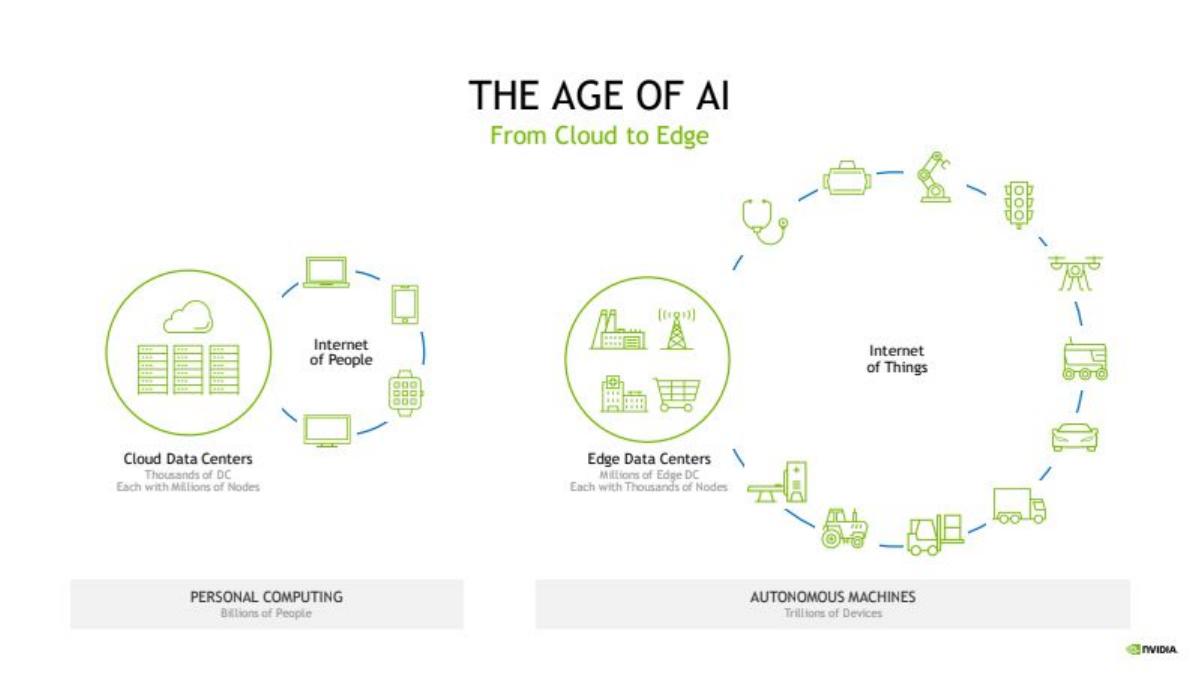
Slide 4: The Age of AI - From Cloud to Edge
This slide defines the market opportunity. It contrasts the 'Internet of People' (billions of people using personal computing) with the 'Internet of Things' (trillions of devices and autonomous machines). Nvidia's goal is to move from the 'Cloud Data Centers' on the left to the 'Edge Data Centers' and devices on the right.
Slide 5: NVIDIA + ARM - The Value Proposition
This slide summarizes the merger's benefits in five bullet points. It claims the deal creates the 'premier computing company for the age of AI.' Key metrics include expanding Nvidia’s reach from 2 million to over 15 million developers and ensuring the deal is 'immediately accretive' to financials.
Slide 6: Arm’s Computing Architecture
Nvidia highlights Arm's ubiquity. A bar chart shows exponential growth in Arm-based chips, totaling 180 billion shipped since 1991, with 22.8 billion in 2019 alone. The slide claims 70% of the world’s population uses Arm technology, illustrated by icons of cars, watches, and home appliances.
Slide 7: Expanding Arm’s IP Licensing Portfolio
This slide addresses the business model. It shows a flow chart of Arm's licensing model (Technology -> License Fee -> Per Chip Royalty). Nvidia proposes to 'turbocharge' this with its own IP, suggesting that Arm partners will now have access to Nvidia's GPU and AI capabilities.
Slide 8: Boosting the Ecosystem
This slide is a 'logo cloud' play. It shows Arm's vast ecosystem across Client, Infrastructure, AI/ML, IoT, and Automotive. By placing Nvidia's 'Accelerated Computing Platform' (CUDA, CUDA-X) alongside it, Nvidia argues that the merger will bring high-performance computing to every sector Arm touches.
Slide 9: Expanding R&D Capacity
Nvidia uses this slide to prove its commitment to innovation. A bar chart shows Nvidia leads the top 10 tech companies in 'R&D intensity' at 24% of revenue . It contrasts Nvidia’s $3.2B R&D spend with Arm’s ~$0.5B, implying that Nvidia’s resources will accelerate Arm’s roadmap.
Slide 10: Accelerating Data Center, Edge & IoT
This slide lists specific industry wins. It mentions Amazon’s Graviton2, Marvell’s ThunderX2 for Azure, and Fujitsu’s supercomputer. It reinforces the '13M+ Arm Developers + 2M NVIDIA Developers' stat, emphasizing the massive combined community.
Slide 11: Benefits to Customers
A simple, text-heavy slide intended to soothe customer fears. It promises access to Nvidia IP, a stronger server CPU roadmap, and fully optimized platforms for OEMs. It is a 'peace-of-mind' slide for the industry.
Slide 12: $250B Target Addressable Market
The 'Money Slide.' Nvidia breaks down the 2023 TAM into three buckets: Devices ($95B) , Data Center ($80B) , and Auto, Edge & IoT ($75B) . It clearly shows which parts of the market Nvidia currently owns and which parts Arm brings to the table.
Slide 13: Arm’s Financial Profile
Nvidia presents Arm as a high-quality asset. Key figures include ~$1.8B in pro forma revenues , a staggering ~94% pro forma gross margin , and a ~35% adjusted EBITDA margin. It highlights the 'contract-based, recurring revenues' from over 500 licensees.
Slide 14: Transaction Summary
The details of the $40B deal. It specifies $21.5B in Nvidia shares and $12B in cash . It also notes the approval by the boards of Nvidia, Arm, and SoftBank, and sets an expected closing timeline of 18 months.
Slide 15: Closing Slide
A repeat of the glass Nvidia logo, serving as a backdrop for Q&A or final remarks.
What Works in This Deck
Clear Strategic Fit: The deck does an excellent job of showing how Nvidia (GPU/Data Center) and Arm (CPU/Edge) are complementary rather than overlapping. · Scale Metrics: Using the '180 billion chips' and '15 million developers' figures provides an immediate sense of the deal's gravity. · Financial Transparency: Slide 13 and 14 provide the exact numbers investors need to model the deal's impact.
What Is Missing
Regulatory Mitigation: While the legal slide mentions risks, the deck lacks a proactive slide explaining how they will maintain Arm's neutrality—a key concern for regulators. · Integration Plan: There is very little detail on how the two organizations will actually merge their operations or cultures. · Competitive Response: The deck doesn't address how competitors (Intel, AMD, RISC-V) might react to this consolidation.
What a Founder Should Copy
The 'Turbocharge' Concept: If you are pitching an acquisition or a major partnership, use the logic from Slide 7. Show how your 'IP' plus their 'Scale' creates a 1+1=3 scenario. · TAM Segmentation: Slide 12 is a perfect example of how to break down a massive TAM into logical, digestible segments based on specific product lines. · R&D Intensity: If you are a technical founder, use a chart like Slide 9 to show that you out-invest your peers in innovation. It builds a 'moat' narrative.
Frequently asked questions
- What was the primary strategic goal of the Nvidia-Arm merger?
- The primary goal was to create the 'premier computing company for the age of AI.' By combining Nvidia's AI computing platform with Arm's CPU ecosystem, Nvidia intended to expand its reach into mobile, PCs, and the Internet of Things (IoT), effectively moving from the data center to the edge.
- How was the $40 billion purchase price structured?
- According to slide 14, the $40B price tag included $21.5 billion in Nvidia shares, $12 billion in cash (with $2B paid at signing), $1.5 billion in employee equity for retention, and a $5 billion performance-based earn-out.
- What were the projected financial benefits for Nvidia?
- Nvidia stated the deal would be immediately accretive to non-GAAP gross margins and non-GAAP earnings per share (EPS) upon closing. Arm brought a high-margin profile (~94% gross margin) and a recurring revenue model based on over 1,765 licenses.
- How did Nvidia plan to support Arm's existing customers?
- Nvidia committed to maintaining Arm's open-licensing model and neutrality. Slide 11 explicitly mentions offering Arm's customers access to Nvidia's AI and GPU IP, while slide 7 illustrates the 'turbocharged' IP licensing model intended to boost partner performance.
- Why did the acquisition fail despite this presentation?
- While the deck presents a strong business case, the 'Forward Looking Statements' on slide 2 hint at the risk of regulatory disapproval. The FTC and other global regulators eventually blocked the deal due to concerns over competition and Arm's role as a neutral supplier in the chip industry.