NVIS (Invisible Internet) positions itself as a specialized cybersecurity provider offering software-only Layer 2 encryption to secure private networks. The deck emphasizes technical differentiation, claiming protection against a wide array of protocol hacks by operating at the Data Link layer of the OSI model, rather than the more common Network or Application layers. With a heavy focus on its advisory board—including the inventor of SSL—and a legacy customer list dominated by U.S. military and national laboratory entities, the company presents a high-trust profile. However, the deck lacks c…
Key takeaways
- The technology operates at Layer 2 (Data Link) of the ISO/OSI model to encrypt all traffic, including source and destination data (Slide 9).
- NVIS claims to be the only software-based Layer 2 product obtaining FIPS certification (Slide 9).
- The advisory board features Dr. Taher Elgamal, recognized as the inventor of SSL (Slide 5).
- The Total Addressable Market is cited as $8.41 Billion in 2020, projected to reach $37.23 Billion by 2028 (Slide 17).
- Pricing is structured into Business Bundles ($6/node monthly) and Enterprise Bundles ($11/node monthly) (Slide 29).
- The competitive matrix places NVIS at the highest point for both simplicity and security compared to Cisco, VMware, and NordVPN (Slide 21).
- Legacy customers include high-security institutions such as Los Alamos National Laboratory, Sandia National Laboratories, and the U.S. Naval Academy (Slide 33).
- The deck provides no specific financial 'ask' or details on how investment capital will be deployed (Slide 25).
Executive Summary: The Invisible Network Play
NVIS, also referred to as Invisible Internet, presents a technical solution for network cloaking. The deck, labeled as version 6 from March 2022, is heavily weighted toward technical architecture and high-level credibility through its advisory board. It positions the company as a disruptor in the VPN and Software Defined Perimeter (SDP) space by moving security down to Layer 2 of the OSI model. While the technical value proposition is clear, the deck functions more as a product overview than a complete investment memorandum, as it lacks specific financial targets and a funding ask.
Slide 1: Title and Value Proposition
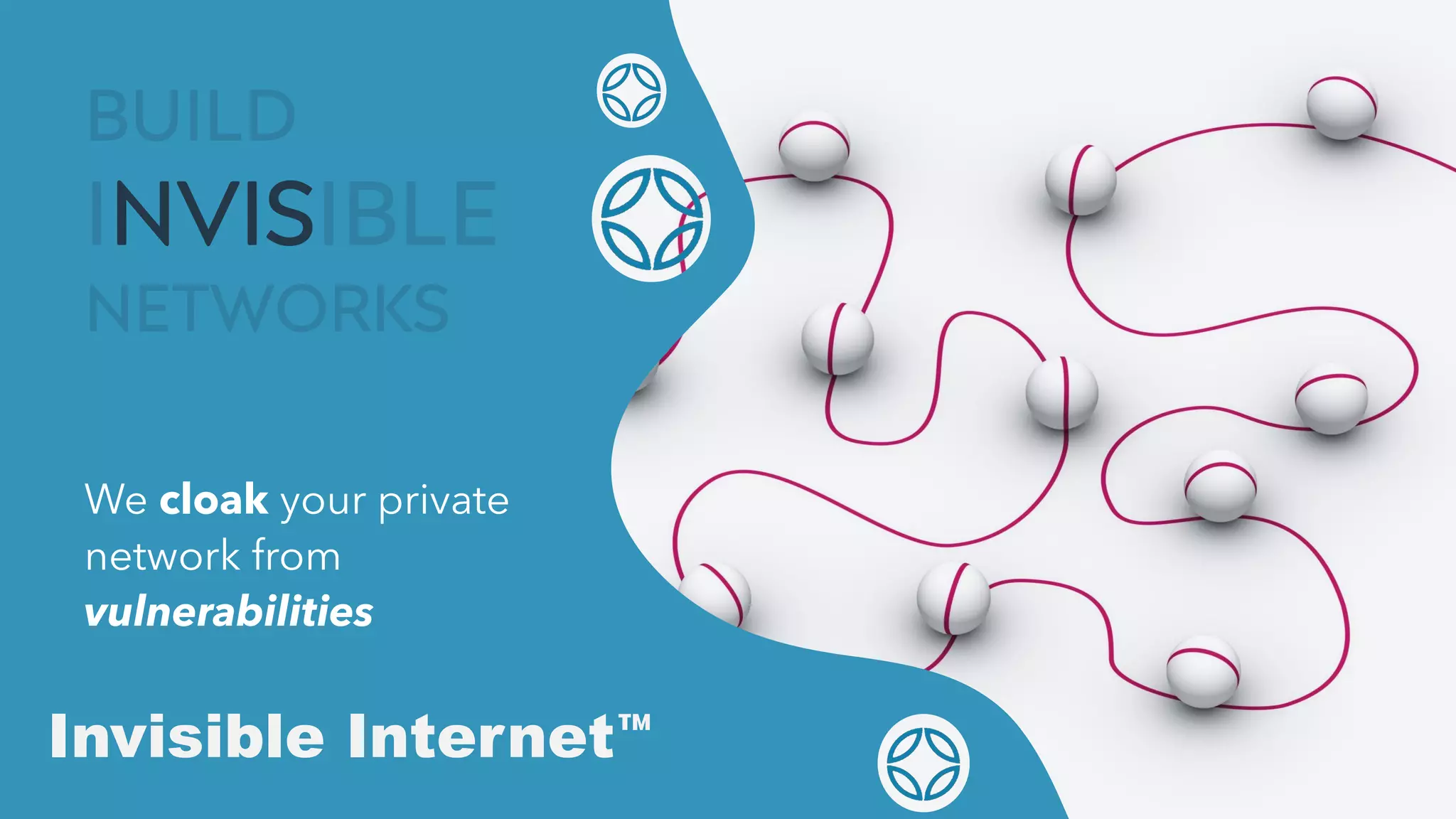
The cover slide introduces the brand "Invisible Internet" and the core mission: "Build Invisible Networks." The primary sub-headline states, "We cloak your private network from vulnerabilities." The visual language uses a connected node graphic, reinforcing the concept of a secure, private web of endpoints. The use of the trademark symbol on "Invisible Internet" suggests an emphasis on brand protection and proprietary positioning from the outset.
Slide 5: Our Advisors
NVIS leads with its advisory board, which is a common tactic for early-stage companies with complex technical products. The standout name is Dr. Taher Elgamal , identified as the inventor of SSL and current CTO of Security at Salesforce. His presence provides immediate technical validation. The slide also lists John Vigouroux (Chief Entrepreneur & Innovation Officer, Averett University), Manoj Bhatia (Partner Business Development, Verizon), and Gregory F. Ryan (President, Ryan Advisory Services). The bullet points for each advisor emphasize deep roots in cybersecurity, telecommunications, and management consulting, suggesting a well-rounded support system for the founder.
Slide 9: Innovation: Layer 2 Full Stack Security
This is the core technical slide of the deck. It explains the "Software-Only Architecture" and the benefits of Layer 2 encryption. By operating at the Data Link layer, NVIS claims to encrypt all traffic, including source and destination data, which supposedly secures the full stack. The slide includes a table of the ISO/OSI model to illustrate that while SSL/TLS operates at Layer 6 and IP/ICMP at Layer 3, NVIS sits at Layer 2. Key claims include:
No IP routing (hops) needed, which boosts performance. · Protection against MAC address spoofing, DDOS attacks, and ARP redirection. · Status as the only software-based Layer 2 product obtaining FIPS certification.
Slide 13: Admin Web UI
To counter the complexity of Layer 2 networking, slide 13 focuses on ease of use. It showcases three steps for network creation: adding a group, adding a member, and adding a new computer. The slide highlights "One click auto provisioning" and displays icons for Windows, Android, Linux, and Apple (noting "TODO" for the latter, indicating a development roadmap item). The tagline "Build a network as easy as 1-2-3" attempts to bridge the gap between high-level security and user-friendly administration.
Slide 17: The Market
NVIS uses a standard TAM/SAM/SOM funnel. The Total Addressable Market (TAM) is cited as $8.41 Billion in 2020, with a projected growth to $37.23 Billion by 2028 at a CAGR of 35.25%. The Service Addressable Market (SAM) is valued at $4 Billion, covering VPN users. The Service Obtainable Market (SOM) is narrowed to $1 Billion, specifically targeting the North America Site-to-Site and Remote Access Business Market. The figures are specific, though the source for the $8.41B valuation is not explicitly named on the slide.
Slide 21: Competitive Position
The competitive matrix plots "Simplicity" against "Security." NVIS places itself in the top-right quadrant, claiming superiority over legacy players like Cisco, VMware, and Juniper, as well as modern VPNs like NordVPN and ExpressVPN. A long list of 19 differentiators is provided, including "Invisible to any outside attack," "Private Static IPs over Internet," and "No Network Expertise Required." This slide is aggressive, positioning NVIS as a solution that requires no special hardware or OS while providing higher security than enterprise-grade incumbents.
Slide 25: Contact Information
This slide serves as the conclusion of the main narrative. It lists Phil Smith as the Founder of NVIS Inc., providing a direct email and phone number. The background image shows a professional setting with charts and a handshake, signaling a readiness for business. Notably, this slide does not include a summary of the investment opportunity, which is a missed chance to reiterate the "why now" for investors.
Slide 29: SaaS Subscription
The pricing model is transparently laid out in a table. NVIS offers two main categories:
Business Bundles: Priced at $6/node monthly. A 5-pack costs $30/month or $300/year. · Enterprise Bundles: Priced at $11/node monthly. A 50-pack costs $550/month or $6,000/year.
The definition of a node includes clients, endpoints, and gateways. The jump in price from Business to Enterprise ($6 to $11) is significant and likely reflects additional features or support levels not detailed on this specific slide.
Slide 33: Legacy Customers
The final slide is a logo wall of "Legacy Customers." This is a highly impressive list for a cybersecurity firm, featuring the U.S. Army Inspector General School , Sandia National Laboratories , Los Alamos National Laboratory , Lawrence Livermore National Laboratory , and the United States Naval Academy . International entities like Canada and the British Educational Communications and Technology Agency (Becta) are also included. This suggests the technology has already been vetted by some of the most demanding security environments in the world.
What NVIS Does Well
The deck excels at establishing technical authority. By leading with an advisor who invented SSL and concluding with a list of national laboratories as customers, NVIS bypasses the usual skepticism faced by new security protocols. The explanation of Layer 2 encryption (Slide 9) is clear enough for a technical reviewer to understand the fundamental difference between NVIS and a standard VPN. Furthermore, the pricing slide (Slide 29) shows a mature approach to monetization, moving away from vague "contact us" enterprise pricing toward a scalable SaaS model.
What Is Missing from the NVIS Deck
Despite the strong technical foundation, the deck has significant gaps regarding its current business state. There is no mention of current Annual Recurring Revenue (ARR), the number of active nodes currently deployed, or the growth rate since the "legacy" customers were acquired. The term "Legacy Customers" itself is ambiguous; it could imply that these were past contracts that are no longer active. Most critically, the deck lacks a Financial Ask . Investors need to know how much the company is raising, at what valuation, and what milestones (e.g., finishing the Apple "TODO" items) that capital will achieve. The absence of a full management team slide—listing the CEO, CTO, and Head of Sales—leaves the founder looking like a solo operator despite the high-profile advisors.
Founder's Guide: What to Copy and What to Avoid
Copy the technical positioning: NVIS does an excellent job of using the ISO/OSI model (Slide 9) to show exactly where they sit in the stack compared to competitors. If your product operates on a different logic than the industry standard, a visual comparison of the "layers" is highly effective.
Copy the transparent pricing: Including a clear SaaS pricing table (Slide 29) helps investors understand the unit economics and the target customer profile (SMB vs. Enterprise) immediately.
Avoid the 'Advisor-Heavy' trap: While Dr. Elgamal is a massive asset, advisors do not run the company. NVIS spends more time on advisors (Slide 5) than on the actual team executing the vision. Founders should ensure the people doing the daily work are highlighted as prominently as the names on the letterhead.
Avoid missing the 'Ask': Never end a pitch deck without a clear call to action. Even if the deck is for general circulation, a slide outlining the funding stage and the primary goals for the next 18 months is essential for converting interest into a meeting.
Frequently asked questions
- What is the core technical innovation claimed by NVIS?
- NVIS focuses on Layer 2 (Data Link) encryption. According to slide 9, this software-only architecture encrypts all traffic, including source and destination headers, which eliminates the need for IP routing (hops). The company claims this boosts performance by removing overhead and protects against specific threats like MAC address spoofing, ARP redirection, and man-in-the-middle attacks that often target higher layers of the OSI model.
- Who are the key people involved in the company?
- The deck highlights Phil Smith as the Founder (Slide 25). However, significant weight is given to the advisors on slide 5, most notably Dr. Taher Elgamal, the CTO of Security at Salesforce and inventor of SSL. Other advisors include John Vigouroux (former CEO of M86 Security), Manoj Bhatia (formerly of Verizon and Cisco), and Gregory F. Ryan (President of Ryan Advisory Services).
- How does NVIS plan to generate revenue?
- NVIS utilizes a tiered SaaS subscription model detailed on slide 29. Business Bundles start at $6 per node monthly for up to 25 nodes. Enterprise Bundles increase the price to $11 per node monthly for 50 to 250 nodes. They define a 'node' as clients, endpoints, or gateways. Annual pre-paid subscriptions offer a slight discount, such as $300/year for a 5-node business pack.
- What market segment is NVIS targeting?
- Slide 17 defines the Service Obtainable Market (SOM) as the $1 Billion North America Site-to-Site and Remote Access Business Market. The broader Service Addressable Market (SAM) of $4 Billion includes personal and corporate VPN users. The deck suggests a transition from 'Legacy Customers' in government and defense (Slide 33) toward a broader enterprise SaaS model.
- What information is missing from this pitch deck?
- The deck is missing several critical components for a fundraising round. There is no slide detailing current revenue, year-over-year growth, or active user counts. Most importantly, there is no 'Ask' slide specifying the amount of capital being raised, the valuation, or the intended use of funds. The 'Team' slide only lists the founder, leaving out other executive leadership or engineering staff.