MITO AI’s 18-slide deck successfully secured $4.5M in pre-seed funding by positioning the company as the 'orchestration layer' for the fragmented AI video landscape. Rather than competing directly with model providers like Runway or Kling, MITO focuses on the workflow—offering an infinite canvas, storyboarding tools, and collaborative features that mirror professional design software like Figma or Miro. The deck leans heavily on high-fidelity product visuals and a team with significant experience at European unicorns like Cabify and Factorial. While it lacks specific market sizing (TAM) and d…
Key takeaways
- MITO positions itself as an orchestration layer rather than a model provider, integrating with tools like Veo, Kling, and Runway (Slide 8).
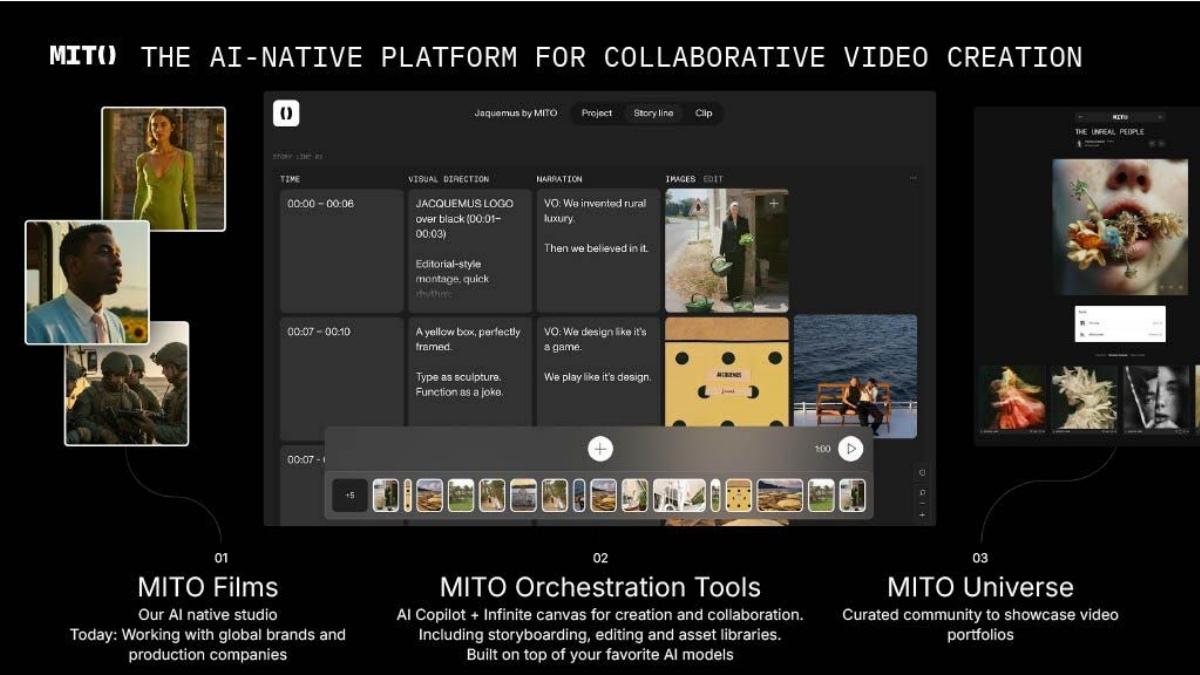
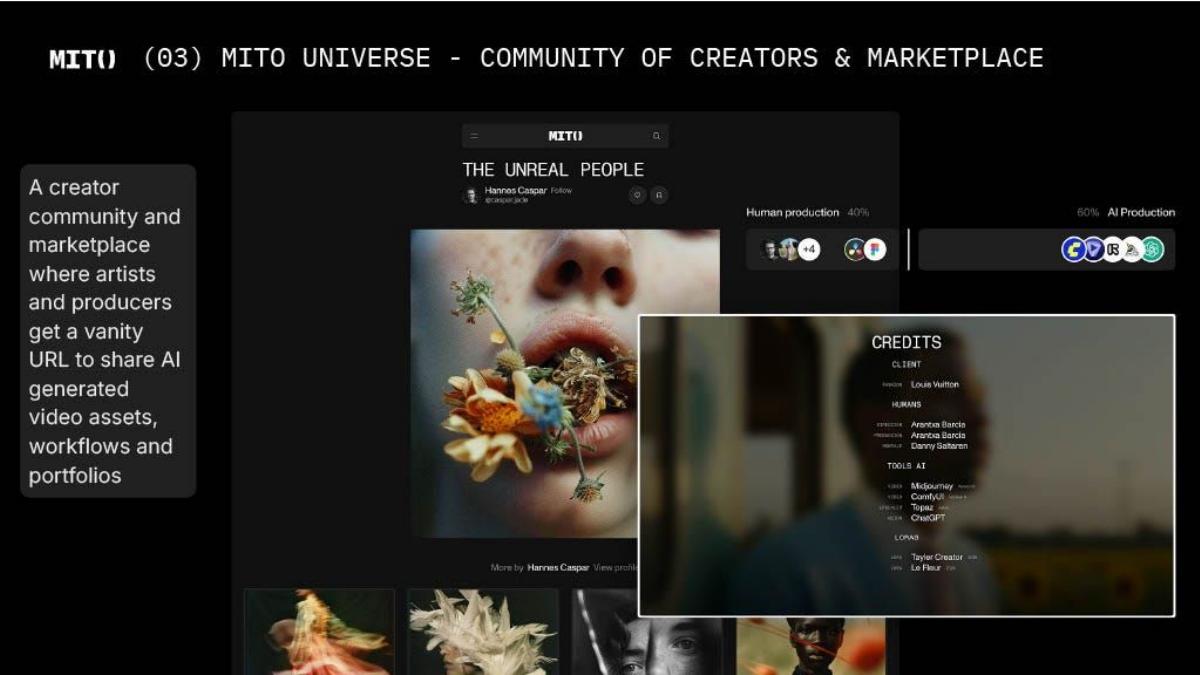
- The product is divided into three pillars: MITO Films (studio), MITO Orchestration Tools (SaaS), and MITO Universe (community) (Slide 4).
- The deck emphasizes 'multiplayer' collaboration, using an infinite canvas for non-linear visual exploration (Slide 6).
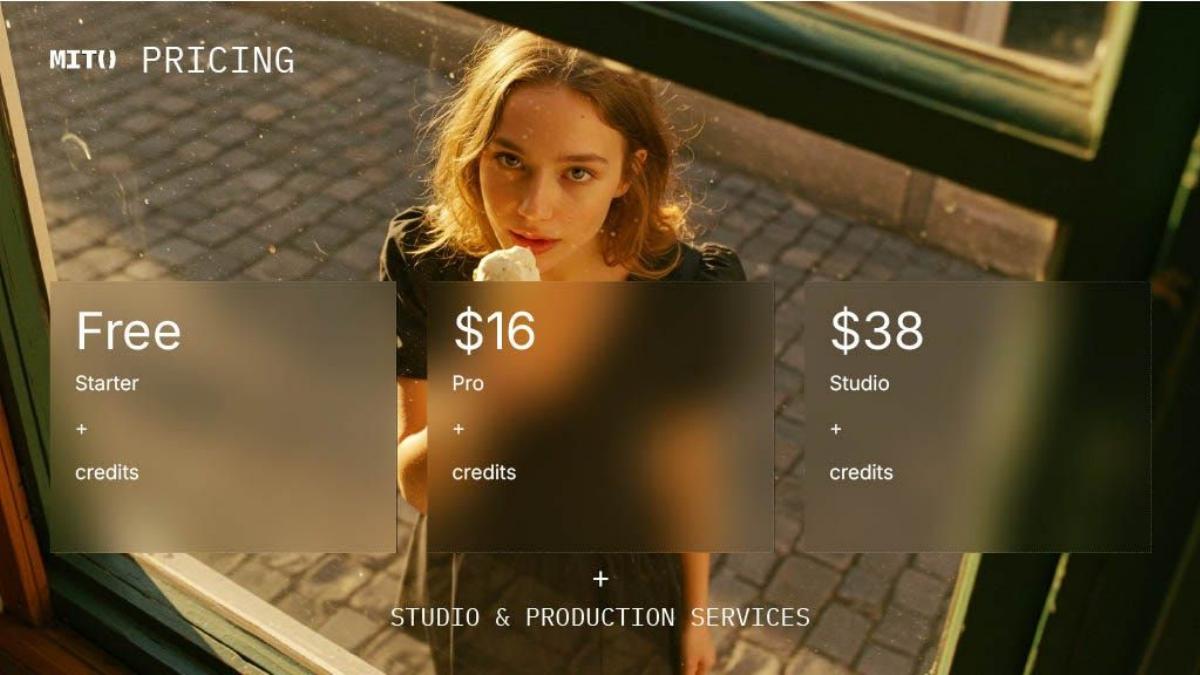
- Pricing is structured as a credit-based SaaS model with tiers at $16 (Pro) and $38 (Studio) per month (Slide 7).
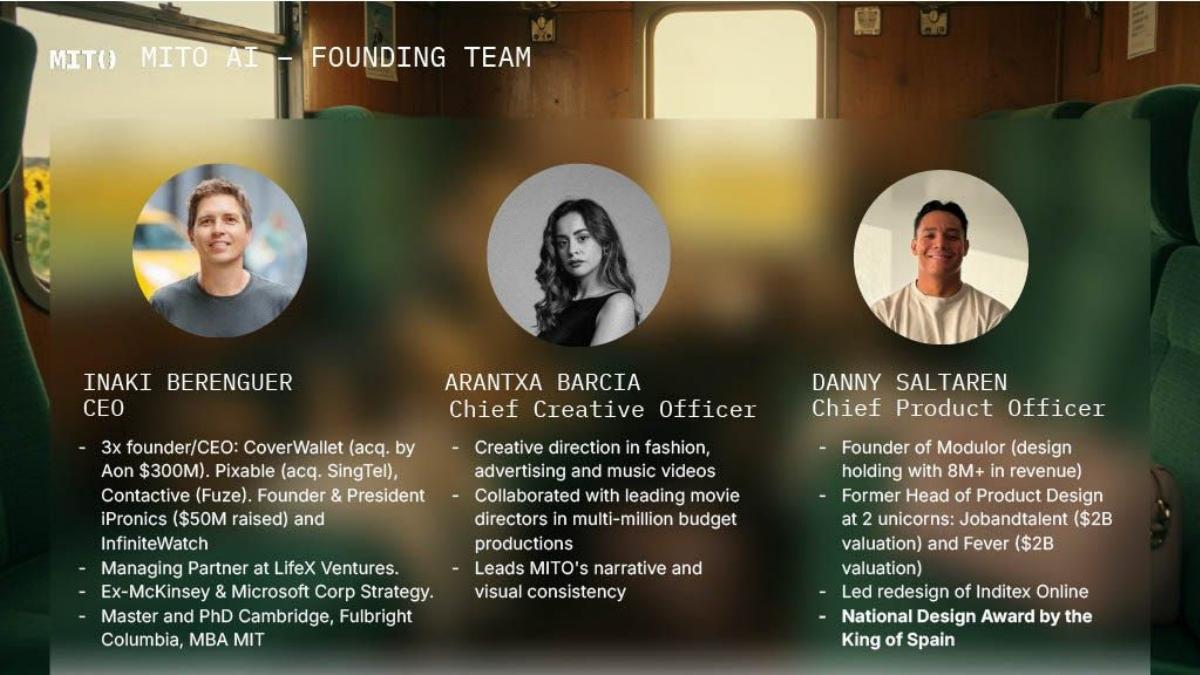
- The team slide highlights deep experience in scaling unicorns, including former leads from Cabify, Wise, and Factorial (Slide 3).
- MITO identifies a gap in the market where team workflows remain fragmented despite powerful AI models (Slide 8).
- The deck uses a competitive landscape slide to benchmark revenue milestones of other AI players like Synthesia ($150M) and Gamma ($100M) (Slide 9).
- There is no explicit 'Ask' slide detailing the specific use of the $4.5M raised, nor a traditional TAM/SAM/SOM breakdown.
The Orchestration Play: MITO AI’s $4.5M Pre-Seed Teardown
In the rapidly evolving AI video space, most startups are racing to build the best underlying model. MITO AI, as reported by Business Insider, took a different path, raising $4.5M in 2024 to build the workflow layer. Their 18-slide deck focuses on the 'multiplayer' aspect of creation, moving AI from a solitary prompting exercise to a professional collaborative environment.
Slide 1: Title and Vision
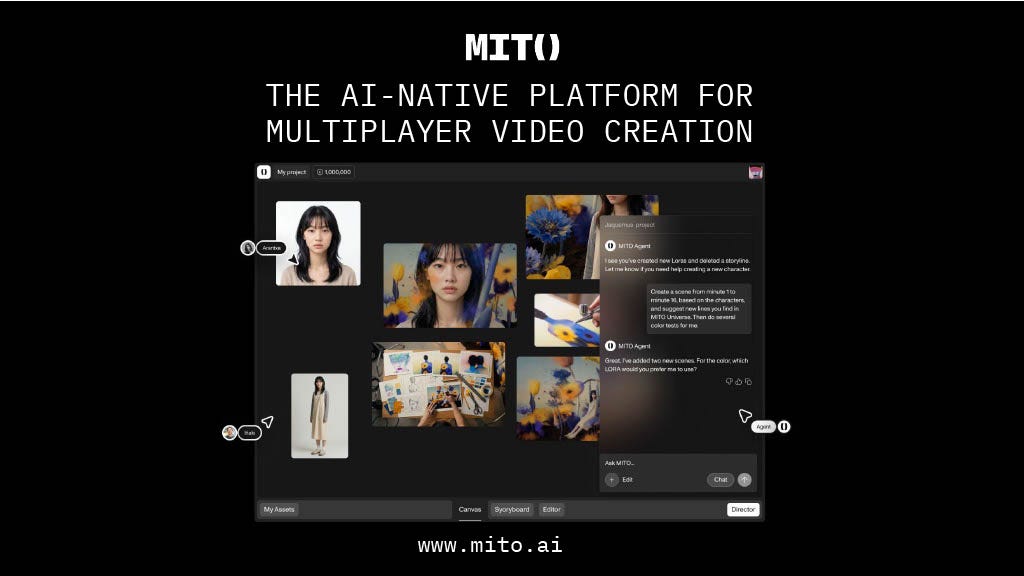
The deck opens with a high-contrast title slide: 'MITO: THE AI-NATIVE PLATFORM FOR MULTIPLAYER VIDEO CREATION.' The use of the word 'multiplayer' is a deliberate nod to Figma’s success in design, signaling that this is a tool for teams, not just individuals. The background image shows a complex UI with multiple assets, chat windows, and an 'AI Agent' interface, immediately establishing the product's technical depth.
Slide 2: Product Intro
Slide 2 is a minimalist video placeholder or demo slide. It features a portrait of a man with a UI overlay that says 'Change the background.' This reinforces the 'AI Director' concept—the idea that the user provides high-level creative direction while the AI handles the execution of specific tasks like rotoscoping or background replacement.
Slide 3: The Pedigree Slide
MITO places its 'Additional Team' slide early in the deck, which is a common tactic for pre-seed companies where the founders' track record is the primary de-risking factor. The slide is impressive, listing experience at unicorns like Cabify ($500M raised), Factorial ($200M raised), and Wise ($10B IPO). By highlighting 'Engineering Lead at Wise' and 'Product at Cabify,' the deck argues that this team knows how to build and scale complex, high-traffic platforms.
Slide 4: The Three Pillars
Slide 4 breaks the business down into three distinct segments: 01 MITO Films (an AI-native studio working with global brands), 02 MITO Orchestration Tools (the core SaaS product featuring an infinite canvas and storyboarding), and 03 MITO Universe (a community for showcasing portfolios). This structure shows investors that the company has an immediate revenue stream (the studio) while building toward a scalable software platform and a long-term moat (the community).
Slide 5: The Storyboard as Skeleton
This slide dives into the 'Orchestration and Collaboration Tools.' It defines the storyboard as the 'skeleton of a full AI video production.' The UI shown includes columns for Time, Narrative, References, and Video. This is a crucial distinction from simple 'text-to-video' tools; MITO is positioning itself as a tool for narrative construction, allowing users to break down scripts into shots, characters, and props.
Slide 6: The Infinite Canvas
Continuing the product deep-dive, Slide 6 focuses on the 'Infinite Canvas.' It describes a 'non-linear, visual collaboration space' for exploring ideas across images, video, audio, and text. The slide explicitly compares the experience to Miro, Figma, and Notion. This is a strategic move to align MITO with the 'Productivity 2.0' stack that investors already understand and value highly.
Slide 7: Monetization and Pricing
The pricing slide is straightforward, showing a credit-based SaaS model. The tiers are:
Free: Starter tier with basic credits. · $16: Pro tier for individual power users. · $38: Studio tier for professional teams.
The inclusion of 'Studio & Production Services' at the bottom suggests a hybrid model where high-touch enterprise contracts supplement the self-serve SaaS revenue.
Slide 8: The Market Opportunity
Slide 8 addresses the 'Why Now?' question. It identifies three tailwinds: the emergence of powerful models (Veo, Kling, Runway), the booming demand for video, and the fact that 'team workflows remain fragmented.' The core thesis is that while the engines (models) are being built, the steering wheel (orchestration layer) is missing. This is a classic 'picks and shovels' argument for the AI gold rush.
Slide 9: Competitive Benchmarking
The final slide in this selection is a 'New Powerful AI Video Models' chart. It lists competitors and their reported revenue milestones:
Higgsfield: $200M revenue in 9 months. · Synthesia: $150M revenue. · Gamma: $100M revenue with 50 people. · Runway: $200M revenue. · Kling AI: $130M revenue in 18 months.
By placing MITO at the top under 'Multi-Scene Narrative Videos,' the deck suggests that MITO is entering a category that is even larger and more complex than the ones these existing giants occupy.
What MITO AI Does Well
The deck excels at category positioning . By using terms like 'orchestration layer' and 'multiplayer,' MITO avoids being compared to the commodity 'prompt-to-video' apps that are currently flooding the market. They are selling a workflow, not just a feature. The visual design of the deck is also high-end, reflecting the aesthetic standards of the filmmaking industry they are targeting. Finally, the team slide is a masterclass in highlighting relevant 'unicorn' experience to build investor confidence in a pre-revenue or early-revenue stage.
What is Missing from the Deck
Despite its strengths, the deck has notable omissions. There is no TAM (Total Addressable Market) slide, which is usually a staple for a $4.5M round. While they mention 'booming demand,' they don't quantify the dollar value of the professional video production market they are disrupting. There is also a lack of Unit Economics ; while pricing is shown, there is no mention of the cost of compute or the margin profile of the 'credits' being sold. Finally, the Ask is missing from these slides—investors generally want to see exactly how the $4.5M will be allocated between engineering, GTM, and compute costs over the next 18-24 months.
Founder’s Guide: What to Copy
Founders should emulate MITO’s 'Three Pillars' strategy (Slide 4). By showing a studio, a tool, and a community, they demonstrate a path from service-based revenue to SaaS scalability to a platform moat. This is an excellent way to de-risk a startup in a nascent market. Additionally, the competitive benchmarking on Slide 9 is a clever way to use the success of others to validate your own potential, even if your product is in a slightly different sub-category. If you can show that 'Company X' reached $100M in revenue doing something simpler, it makes your more complex vision feel like a massive, untapped opportunity.
Frequently asked questions
- What is the core problem MITO AI is solving?
- According to Slide 8, while powerful AI models like Runway and Kling exist, the 'orchestration layer' is missing. Current team workflows for video production are fragmented, making it difficult for professional storytellers to collaborate on complex, multi-scene narrative projects using AI tools.
- How does MITO AI plan to make money?
- Slide 7 outlines a three-tier subscription model: a Free 'Starter' tier, a $16/month 'Pro' tier, and a $38/month 'Studio' tier. All tiers appear to be based on a 'credits' system. Additionally, they offer 'Studio & Production Services' for enterprise-level needs.
- Who are the key people behind MITO AI?
- The team (Slide 3) includes Nacho (Product, ex-Cabify/Factorial), Keyvan (Head of Engineering, ex-Wise/Cabify), and Rika (Strategic Ops, Harvard MBA, ex-McKinsey). The engineering and GTM teams also feature veterans from Genially and Inditex.
- What makes MITO different from other AI video generators?
- MITO focuses on the 'storyboard' as the skeleton of production (Slide 5). It allows for an 'infinite canvas' approach to prompting and asset management, enabling users to combine live-action footage with AI extensions rather than just generating isolated clips.
- What is 'MITO Universe'?
- As described on Slide 4, MITO Universe is a curated community designed to showcase video portfolios. This suggests a long-term strategy to build a network effect around the content created on the platform, similar to Behance or Dribbble for video.