How AI startups charge: share of results, pay per conversation, price per AI worker, credits, asset-based fees and tiers.
AI Business Model Slide: Outcome, Usage, Seat and Credit Pricing
AI products cost money every time they run, and often replace work people used to do. Both push AI startups toward pricing that isn't a flat software subscription: a share of results, a price per conversation, a price per AI "worker" or credits. This guide compares eight real AI business model slides, from a 10%-of-revenue-lift model with a free trial to a slide that says only "Solution as a service".
TL;DR
Say what the customer pays for, how much, and why that unit matches the value. Depict.ai offers a free two-week A/B test and then takes 10% of the revenue increase. Virtuoz shows a price per conversation for six named customers. Thoughtful AI prices by AI worker and shows the gross margin it expects. "Free to 300 €/month" or "everything included" doesn't tell an investor what a customer pays.
AI business model slides from real pitch decks
Each example shows the slide above its analysis and links to the full teardown. Slides with a clear unit and price come first. Claims are as shown on the slides; comments are ours.
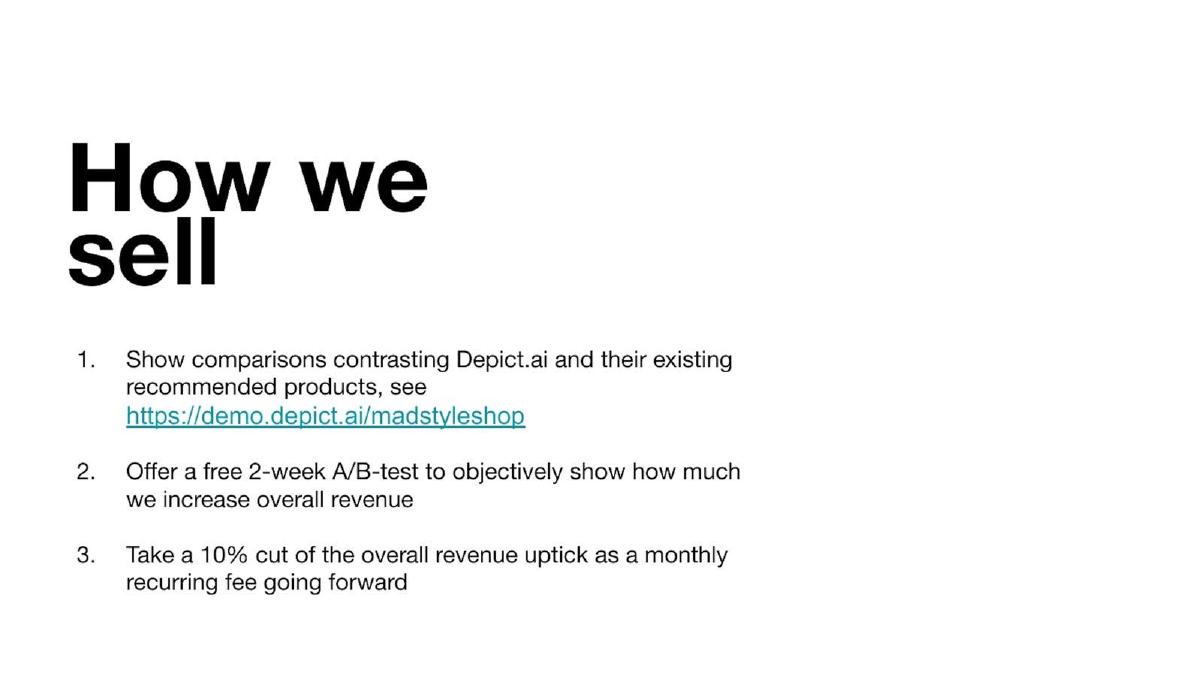
Depict.ai business model slide — slide 7
AI product recommendations for online stores.
Depict.ai deck, slide 7. Exact stored slide matched to this analysis.
Our analysis: Share of measured results.
Evidence and limitation: It names the unit (revenue increase), the price (10%) and how the increase is measured (an A/B test). It doesn't say how the uplift is measured after the test ends.
What a founder can adapt: "Free [N]-week test; then [X]% of [measured result], measured by [method]."
Supporting analysis
What the deck claims: "How we sell." "1. Show comparisons contrasting Depict.ai and their existing recommended products." "2. Offer a free 2-week A/B-test to objectively show how much we increase overall revenue." "3. Take a 10% cut of the overall revenue uptick as a monthly recurring fee going forward."
Presentation choice: The customer only pays when revenue rises, and the test proves it first.
When it does not fit: A results share with no way to measure the results.
AI chat assistants for customer support (early chatbot deck).
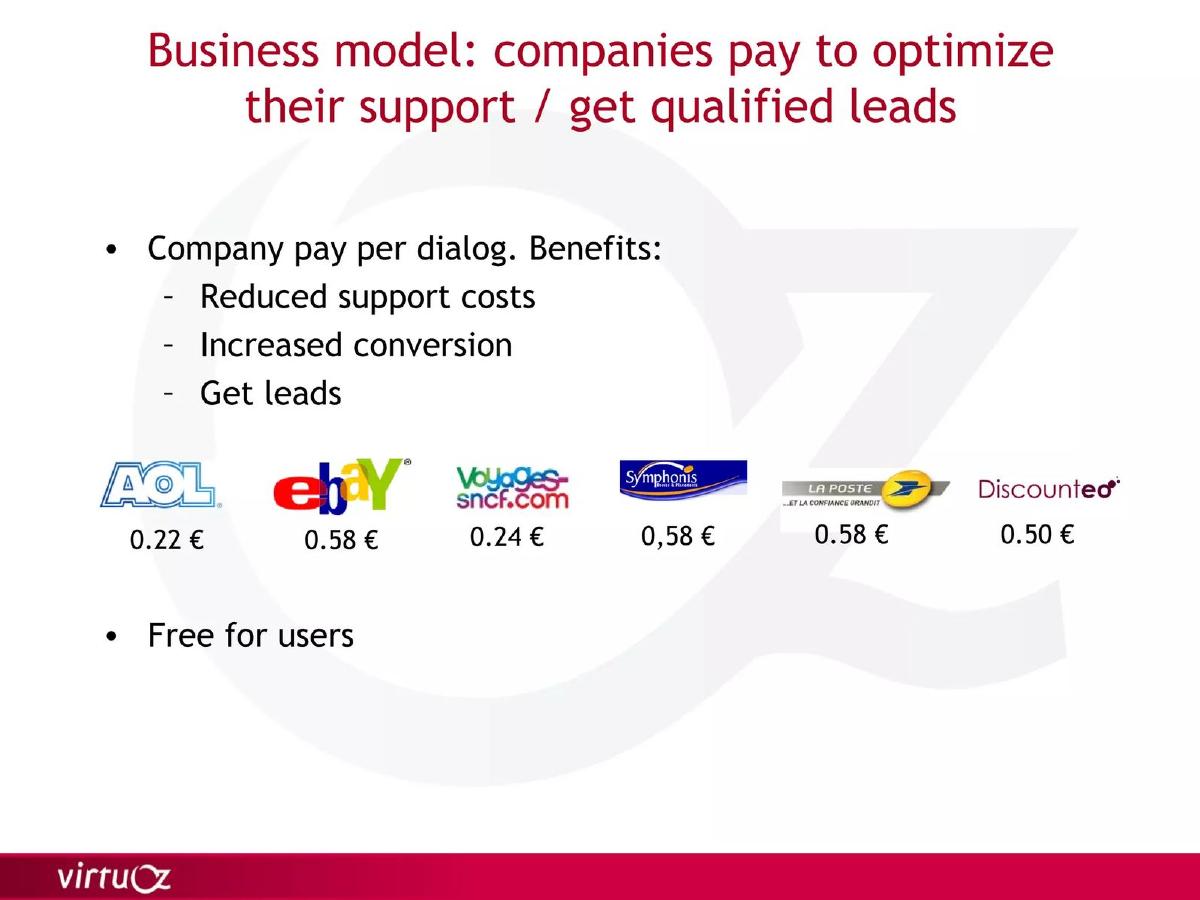
Virtuoz deck, slide 9. Exact stored slide matched to this analysis.
Our analysis: Usage price, named customers.
Evidence and limitation: A real price for each named customer, from 0.22 € to 0.58 € per conversation. It doesn't give volumes, so investors can't estimate revenue per customer.
What a founder can adapt: "[Price] per [unit]; [customer] runs [N] a month."
Supporting analysis
What the deck claims: "Business model: companies pay to optimize their support / get qualified leads." "Company pay per dialog. Benefits: Reduced support costs, Increased conversion, Get leads." Prices per dialog next to six logos: AOL 0.22 €, eBay 0.58 €, Voyages-sncf.com 0.24 €, Symphonis 0.58 €, La Poste 0.58 €, Discounteo 0.50 €. "Free for users."
Presentation choice: Per-conversation pricing tracks both the value and the running cost.
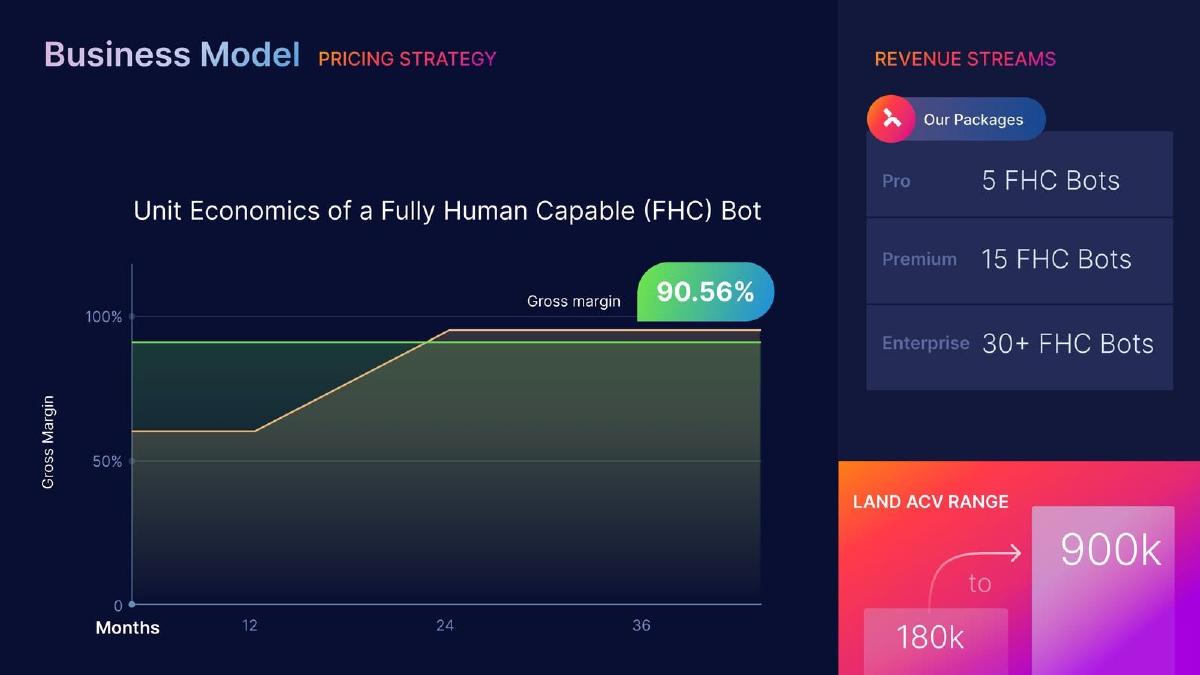
Thoughtful AI deck, slide 6. Exact stored slide matched to this analysis.
Our analysis: Priced per AI worker, with margin.
Evidence and limitation: It prices per AI worker, gives starting contract sizes and shows expected gross margin over time. It doesn't give the price per bot, and the slide doesn't say whether the margin curve is actual or projected.
What a founder can adapt: "$[X] per [AI worker] per year; gross margin [Y]% ([actual/projected])."
Supporting analysis
What the deck claims: "Business Model — Pricing Strategy." "Unit Economics of a Fully Human Capable (FHC) Bot" — a gross margin line rising over 36 months to "90.56%." Packages: "Pro 5 FHC Bots, Premium 15 FHC Bots, Enterprise 30+ FHC Bots." "Land ACV range 180k to 900k."
Presentation choice: Addresses the running-cost question directly.
When it does not fit: A margin curve without saying if it's real.
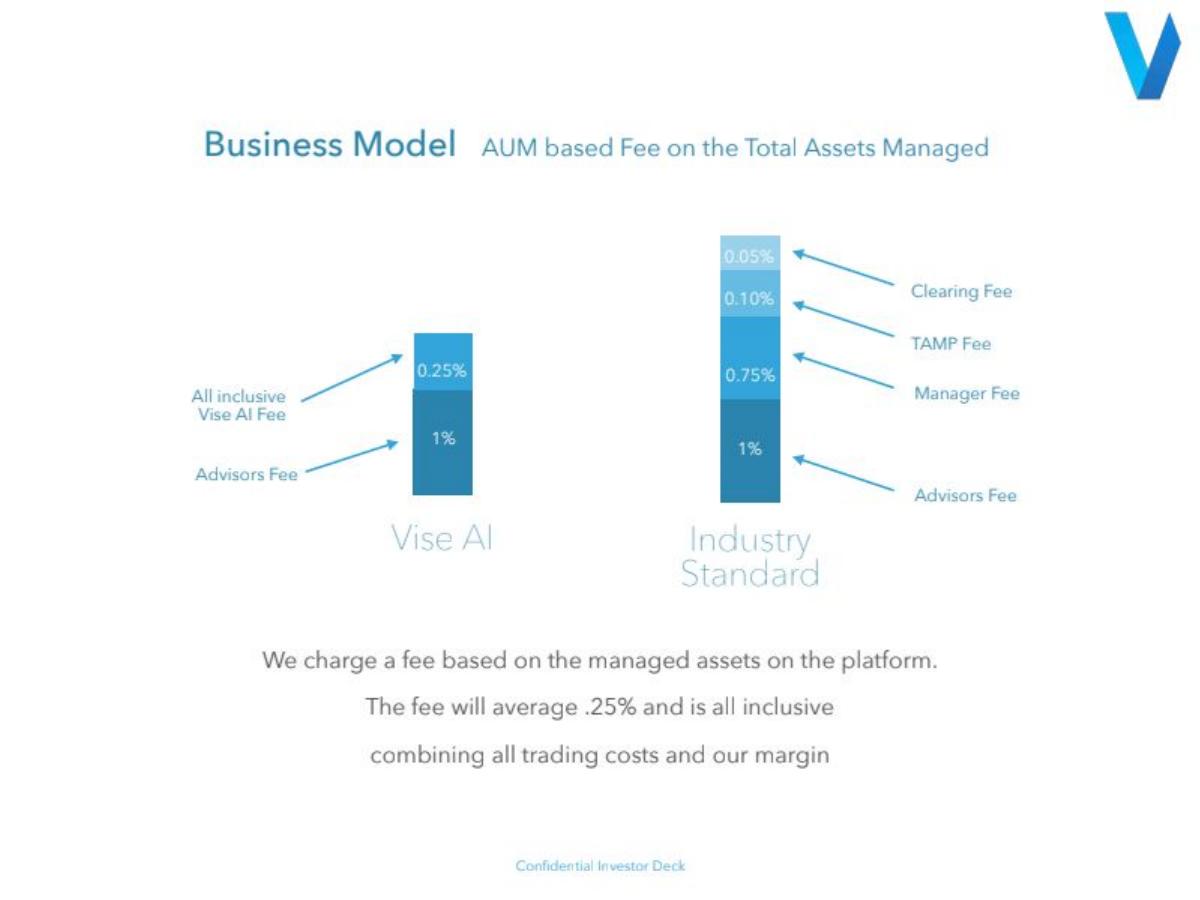
Vise AI deck, slide 8. Exact stored slide matched to this analysis.
Our analysis: Priced in the buyer's existing unit.
Evidence and limitation: It prices in the unit its buyers already use and shows the saving against their current fees. 'Industry standard' has no source.
What a founder can adapt: "[X]% of [unit buyers already pay on], vs [Y]% today ([source])."
Supporting analysis
What the deck claims: "Business Model: AUM based Fee on the Total Assets Managed." Bars compare "Vise AI" (1% advisors fee + 0.25% "all inclusive Vise AI fee") with "Industry Standard" (1% advisors fee, 0.75% manager fee, 0.10% TAMP fee, 0.05% clearing fee). "We charge a fee based on the managed assets on the platform. The fee will average .25% and is all inclusive combining all trading costs and our margin."
Presentation choice: Advisers can compare it with what they already pay.
When it does not fit: An unsourced 'industry standard'.
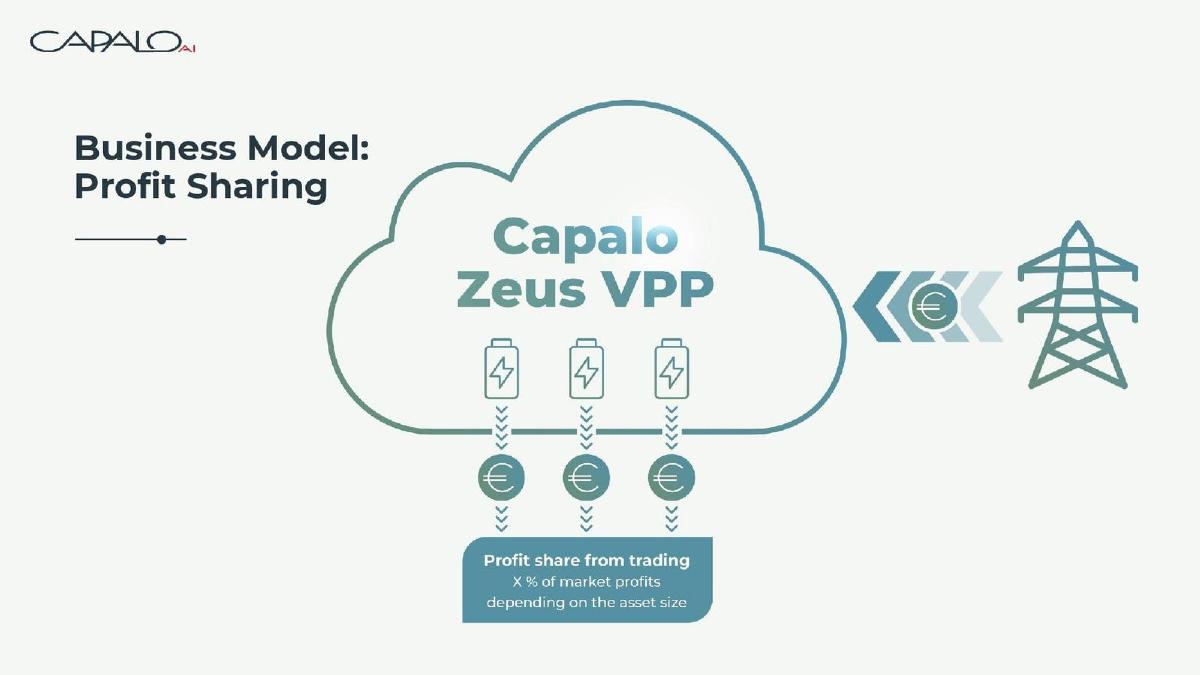
Capalo AI deck, slide 9. Exact stored slide matched to this analysis.
Our analysis: Share of results, percentage hidden.
Evidence and limitation: Paying a share of trading profit lines Capalo up with battery owners. The percentage is blanked as "X %", so investors can't size revenue per battery.
What a founder can adapt: "[X]–[Y]% of trading profit, by asset size ([MW] bands)."
Supporting analysis
What the deck claims: "Business Model: Profit Sharing." A diagram of batteries in the "Capalo Zeus VPP" trading with the grid. "Profit share from trading: X % of market profits depending on the asset size."
Presentation choice: Clear unit, but the number is the point.
When it does not fit: Blanking the one number the slide is about.
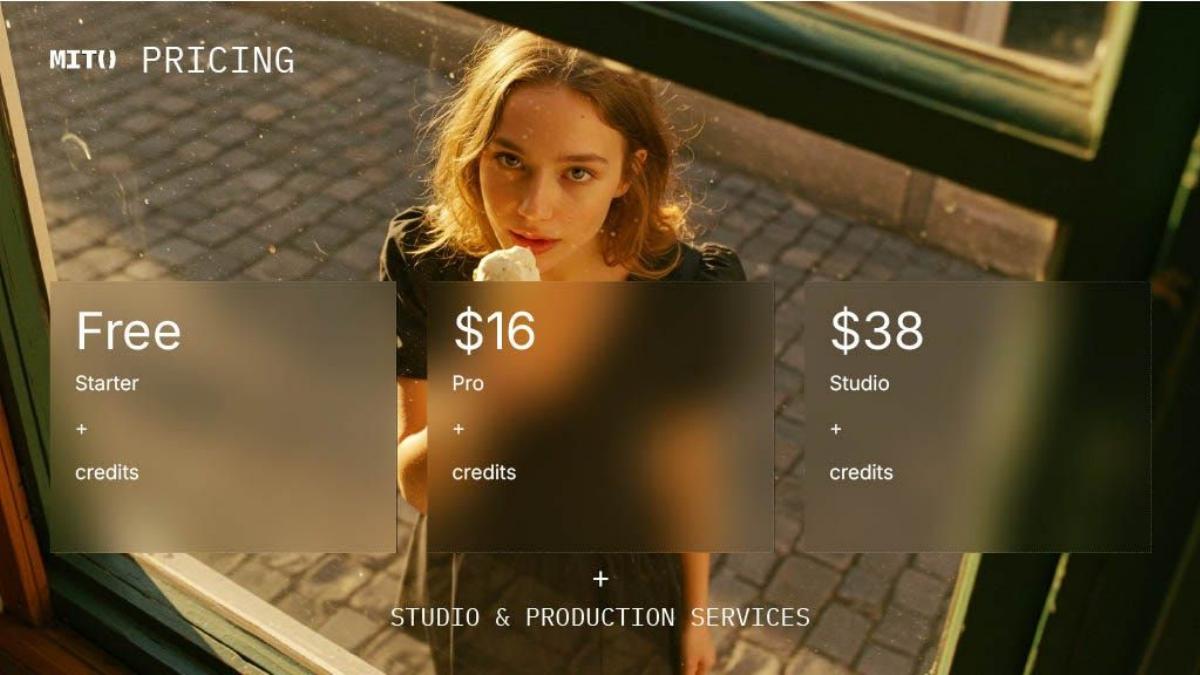
Mito deck, slide 13. Exact stored slide matched to this analysis.
Our analysis: Tiers plus credits, credits undefined.
Evidence and limitation: It gives tier prices and credits, a common way to cover AI running costs. It doesn't say what a credit buys, whether prices are monthly, or how studio services are priced.
What a founder can adapt: "$[X]/month includes [N] credits; 1 credit = [output]."
Supporting analysis
What the deck claims: "Pricing." "Free Starter + credits." "$16 Pro + credits." "$38 Studio + credits." "+ Studio & production services."
Presentation choice: Credits link price to usage, if investors know what one buys.
When it does not fit: Credits without saying what they buy.
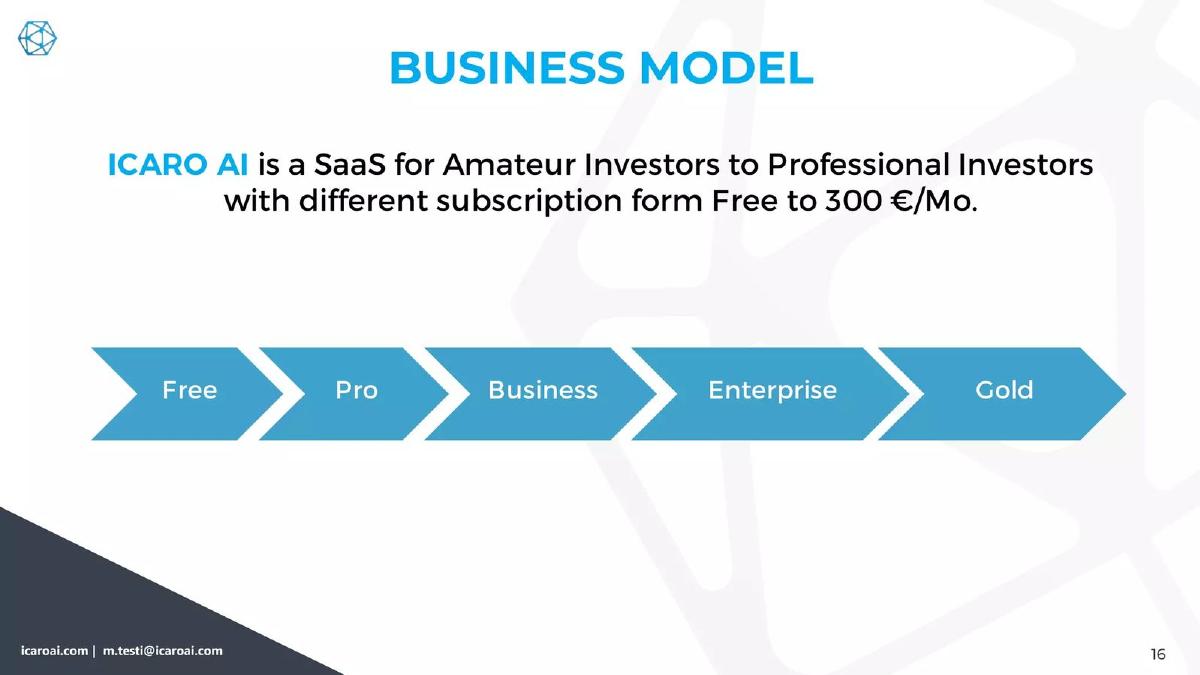
Icaro AI deck, slide 16. Exact stored slide matched to this analysis.
Our analysis: Tier names only.
Evidence and limitation: Weaker example. It gives a price range but no price or features per tier.
What a founder can adapt: "[Tier]: €[X]/month for [features]; most customers on [tier]."
Supporting analysis
What the deck claims: "Icaro AI is a SaaS for Amateur Investors to Professional Investors with different subscription form Free to 300 €/Mo." Five tiers: Free, Pro, Business, Enterprise, Gold.
Presentation choice: Investors can't tell what most customers will pay.
When it does not fit: Five tier names with one price range.
Which kind of AI business model slide answers which question.
Approach
Example
Answers
Leaves open
Share of measured results
Depict.ai
What customers pay and why
Ongoing measurement
Price per use
Virtuoz
Price per conversation
Volumes
Price per AI worker
Thoughtful AI
Deal size and margin
Price per bot
Buyer's existing unit
Vise AI
Saving vs today
Source for benchmark
Profit share, hidden
Capalo AI
Unit
Percentage
Tiers plus credits
Mito
Entry prices
What a credit buys
Tier names / label
Icaro AI, Teton.ai
Little
Unit and price
Key Takeaways
Name the unit the customer pays for.
Put a price or percentage on it.
Show why the unit tracks customer value.
Address the cost of running the AI.
Tier names alone aren't a model.
Write your AI business model slide
Answer these before you design tiers.
Unit. What does the customer pay for: a result, a use, an AI worker, a seat?
Price. How much, and per what period?
Value link. Why does that unit rise with the value the customer gets?
Running cost. What does it cost you to serve one unit, and what margin is left?
Copyable framework: Customers pay [price] per [unit], because [value link]. Serving one [unit] costs [cost]; gross margin [X]% ([actual/projected]).
Illustrative example 1 — written by us
Before: "Solution as a service. Everything included."
After: "$[X] per [bed] per month, including [hardware, software, support]; [N]-year contracts."
What improved: Our illustrative rewrite of Teton.ai's slide; bracketed text is a placeholder, not company fact.
What's different about AI business models
Each AI request has a running cost, so heavy use can shrink margin under a flat fee. AI that does a task end to end can also be priced against the labour or result it replaces rather than per user. Investors want to see which unit you chose, and whether gross margin holds as usage grows.
What investors check
Whether a price is stated. Whether the unit (result, conversation, AI worker, credit) rises with the value the customer gets. Whether a share-of-results model says how results are measured. Whether gross margin is shown or at least addressed.
How we read each slide
We quote the text on the slide images. We have not checked any price, margin or customer. None of these pages was in our stored image set, so we rendered each from the original deck file in our library.
Common mistakes
No price. State at least one real price or percentage.
Undefined credits. Say what one credit buys.
Unmeasured results share. Say how results are measured.
Ignoring running costs. Show or address gross margin.
Tier names only. Give price and contents per tier.
Diagnostic checklist
Unit named.
Price or percentage stated.
Link to customer value explained.
Gross margin shown or addressed.
Frequently asked questions
How should an AI startup price its product on a pitch deck?
Name the unit and the price, and show why it tracks value. Depict.ai takes 10% of the revenue increase after a free A/B test; Virtuoz shows 0.22–0.58 € per conversation for named customers.
Should an AI startup show gross margin on its business model slide?
It helps, because AI has running costs per use. Thoughtful AI shows a gross margin curve reaching 90.56% for its AI worker; say whether a curve like that is actual or projected.
How we chose these examples
Corpus: published pitch deck teardowns on StartupFundraising.com. Founder-uploaded private decks are excluded.
Selection (2026-09-26): we searched AI teardowns for business model, pricing and monetisation headings, rendered ten candidate decks with neighbouring pages, and kept eight.
Excluded: Heidi Health (its page describes growth, not pricing) and Deep Render (no business model page in the pages checked).
None of the chosen pages was in our stored image set; we rendered them from the original deck PDFs and stored them with the existing slide-image workflow. All eight decks were confirmed as published teardowns on 2026-09-26.
Prices, percentages and margins are quoted from the slides and not independently verified.
Review: slide images were checked on 2026-09-26 and matched to company, deck and page (editorial model review). No person has yet completed an editorial review of this page. We make no claim that any slide caused a fundraising outcome.