Capalo AI’s 12-slide deck serves as a masterclass in identifying a specific, high-value bottleneck in the green energy transition: grid volatility. By positioning their 'Zeus VPP' platform as the intelligence layer between energy storage owners and complex wholesale markets, they present a clear value proposition. The deck highlights a staggering 70% CAGR in battery storage capacity additions and uses data from Fingrid to show the rising cost of grid stabilization. While the deck is visually clean and professionally structured, it leans heavily on market macro-trends and team composition, lea…
Key takeaways
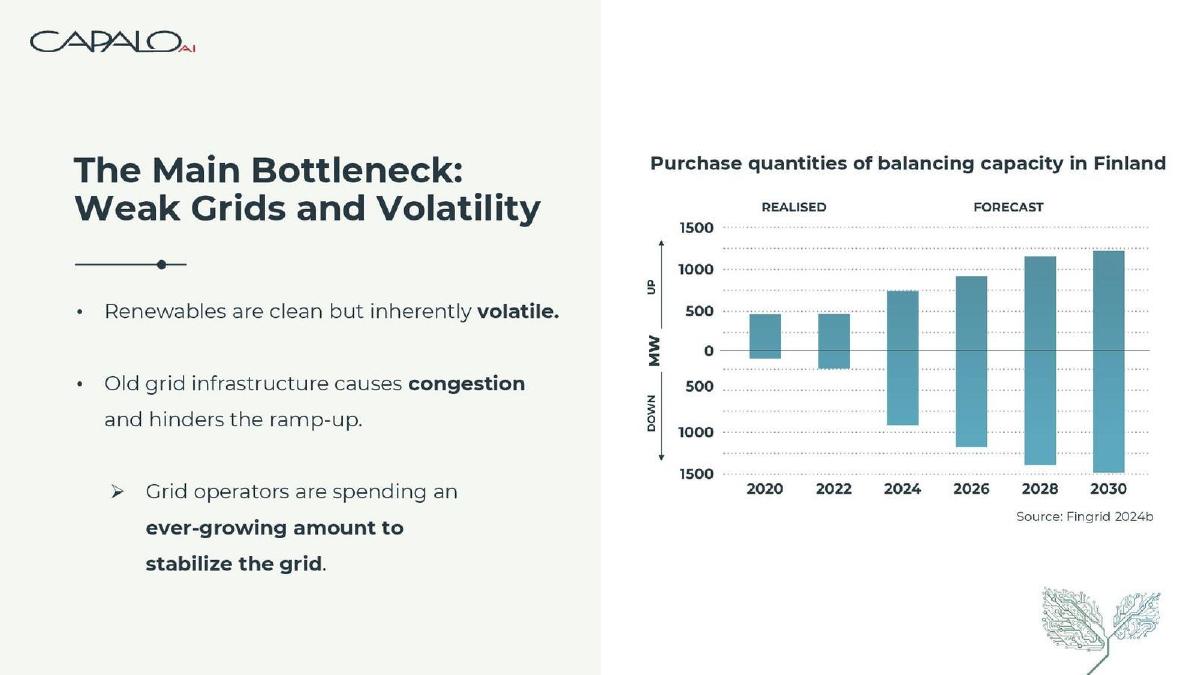
- The deck identifies grid congestion and renewable volatility as the primary 'bottlenecks' for energy storage (Slide 2).
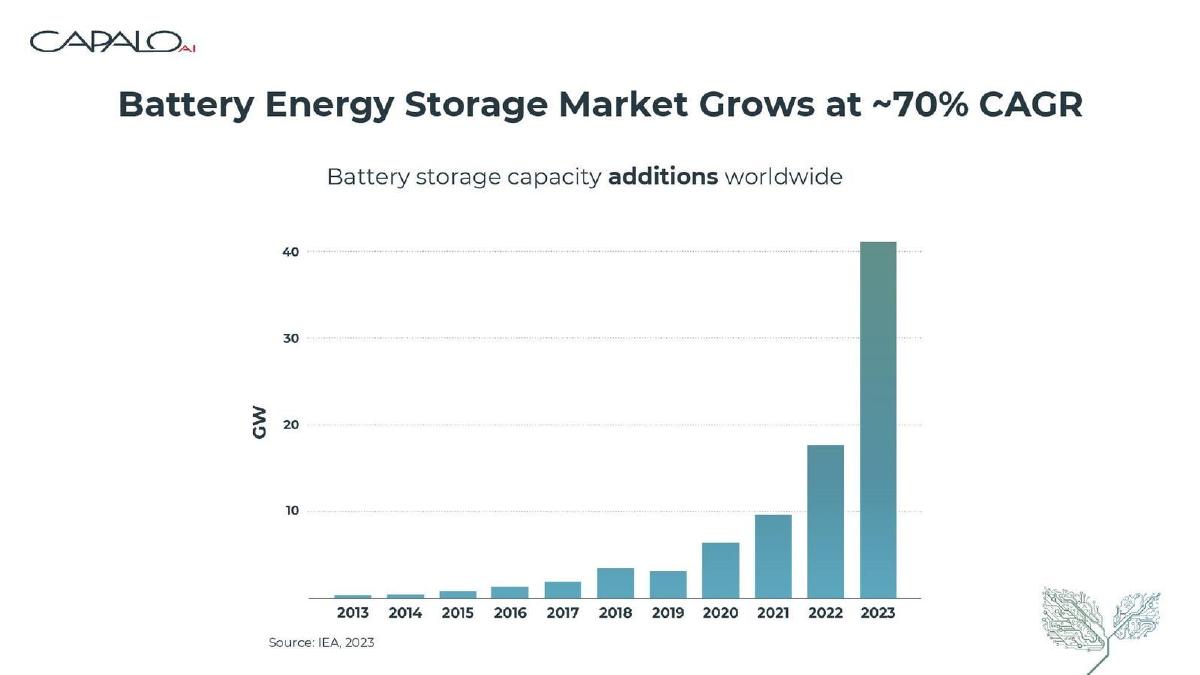
- Global battery storage capacity additions are growing at a ~70% CAGR, according to IEA data (Slide 3).
- The product, Zeus VPP, automates the decision of when, where, and how much energy to bid into wholesale and ancillary markets (Slide 4).
- Capalo AI utilizes a profit-sharing business model where they take 'X % of market profits' based on asset size (Slide 5).
- The team is exceptionally large for a Seed stage startup, featuring 24 individuals across engineering, data science, and trading (Slide 6).
- Grid operators in Finland are forecasted to significantly increase purchase quantities of balancing capacity through 2030 (Slide 2).
- The deck omits a specific 'Ask' slide, though publisher reports indicate a $4.1M raise (Fact).
- There is no explicit slide detailing the competitive landscape or direct rivals in the VPP optimization space (Slide 1-12).
The Macro Thesis: Why Energy Storage Needs Intelligence
Capalo AI enters the market at a pivotal moment for the European energy transition. As the continent shifts toward renewables, the inherent volatility of wind and solar power creates a massive technical and financial challenge for grid operators. The Capalo AI pitch deck, used to secure a $4.1M Seed round, focuses heavily on this macro-economic shift. Rather than just selling 'AI,' they are selling a solution to a physical infrastructure bottleneck.
Slide 1: Title and Vision
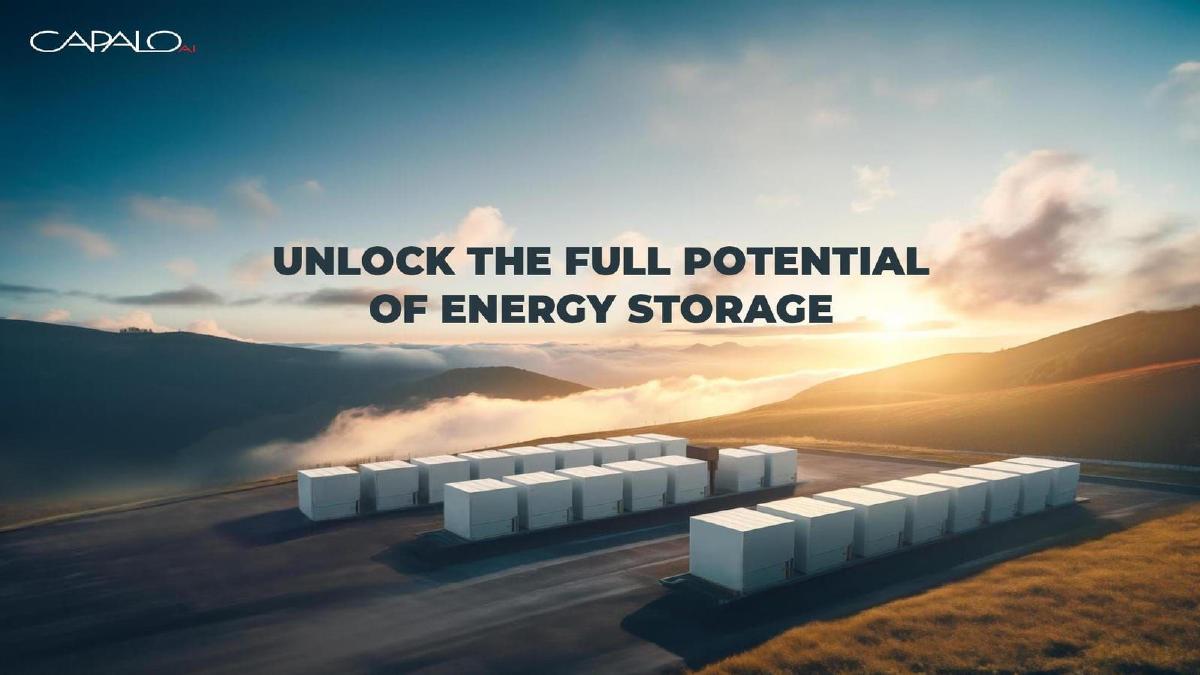
The opening slide is minimalist, featuring a high-quality rendering of a battery storage site in a natural landscape. The tagline, "UNLOCK THE FULL POTENTIAL OF ENERGY STORAGE," sets the stage. It immediately identifies the target asset class (energy storage) and implies that current assets are underperforming or underutilized. This is a classic 'value-unlock' narrative that appeals to investors looking for infrastructure-adjacent software plays.
Slide 2: The Bottleneck - Weak Grids and Volatility
Slide 2 defines the problem space. It explicitly labels "Weak Grids and Volatility" as the main bottleneck. The slide makes two key points: renewables are inherently volatile, and old grid infrastructure causes congestion. The visual evidence provided is a bar chart showing the "Purchase quantities of balancing capacity in Finland." It compares 'Realised' data from 2020-2022 against 'Forecast' data through 2030. The forecast shows a dramatic increase in the MW required to balance the grid, signaling a massive and growing market for stabilization services. Citing "Fingrid 2024b" adds significant credibility to these projections.
Slide 3: Market Growth - The 70% CAGR
To prove the scale of the opportunity, Slide 3 focuses on the "Battery Energy Storage Market." It cites a "~70% CAGR" and provides a chart of "Battery storage capacity additions worldwide" from 2013 to 2023. The data, sourced from the IEA (2023) , shows an exponential hockey-stick growth curve, with 2023 seeing a massive spike to over 40 GW. This slide serves to convince investors that even if Capalo AI only captures a small slice of this market, the total addressable market (TAM) is expanding so rapidly that the upside is enormous.
Slide 4: The Solution - Capalo Zeus VPP
Slide 4 introduces the product: "Capalo Zeus VPP." It uses a three-circle Venn-style diagram to explain the ecosystem. On one side is the "Energy Storage Owner" who wants to maximize asset value. On the other are the "Markets" (wholesale and ancillary) that balance the national grid. In the center is the Zeus VPP, described as "Fully automatic AI-powered trading that pools together the whole battery portfolio." The core value proposition is automated decision-making: "When to bid, which market to bid, and how much energy to allocate." This positions the software as the essential 'brain' of the battery.
Slide 5: Business Model - Profit Sharing
The business model is refreshingly simple. Slide 5, titled "Business Model: Profit Sharing," uses a cloud-based diagram to show energy assets feeding into the Zeus VPP, which then interacts with the grid to generate revenue. The company earns a "Profit share from trading," defined as "X % of market profits depending on the asset size." This model is highly attractive to customers because it aligns the startup's incentives with the asset owner's success—Capalo AI only makes money if the customer makes money. For investors, this suggests high margins and a scalable revenue stream tied to market performance.
Slide 6: The Team - Technical Depth
The final slide provided is the team slide. It is notable for its size. For a Seed round, a 24-person team is unusually large. The roster includes a CEO (Henri Taskinen) , CSO (Riku Kukkonen) , CTO (Eerik Jauhiainen) , and COO (Teemu Lappalainen) . The rest of the team is heavily weighted toward technical and operational roles, including Cloud Solution Architects, ML Engineers, VPP Data Scientists, and Day-ahead Trading Leads. This composition signals to investors that the company has already moved past the 'two founders in a garage' phase and has built a robust engineering and trading organization capable of handling complex energy markets.
What Works in the Capalo AI Deck
1. Strong Data Backing: The use of third-party data from Fingrid and the IEA (Slides 2 and 3) grounds the pitch in reality. It moves the conversation from "we think this is a problem" to "the authorities in this space say this is a massive, growing problem."
2. Clear Incentive Alignment: The profit-sharing model (Slide 5) is a powerful sales and fundraising tool. It reduces the perceived risk for the customer and demonstrates the founders' confidence in their AI's ability to outperform manual trading or simpler algorithms.
3. Specificity of the Problem: By focusing on "balancing capacity" and "ancillary markets," Capalo AI avoids being a generic 'green energy' company. They are targeting a very specific, high-value niche within the energy sector that requires deep technical expertise.
What Is Missing from the Capalo AI Deck
1. Competitive Landscape: The deck does not mention other VPP (Virtual Power Plant) operators or optimization platforms. In a crowded field with players like Tesla (Autobidder) or Fluence, investors would want to know how Capalo AI’s algorithms specifically differ or provide a superior edge.
2. Unit Economics and Traction: While the business model is clear, the deck lacks specific performance data. There are no case studies showing how much Zeus VPP increased profits for a specific pilot project or existing customer. Investors usually look for 'before and after' metrics in a Seed deck.
3. The Ask and Use of Funds: The deck ends without a clear call to action or a breakdown of how the $4.1M will be spent. While this information is often shared in a separate document or a follow-up meeting, its absence in the main deck leaves the narrative somewhat unfinished.
Founders: What to Copy from Capalo AI
Focus on the 'Bottleneck': If you are building in a complex industry, don't just describe your product. Describe the specific bottleneck that is preventing the industry from growing. Capalo AI does this perfectly on Slide 2. By framing their solution as the key to unlocking a multi-billion dollar infrastructure shift, they make their software feel essential rather than optional.
Visualizing the Ecosystem: Slide 4 is an excellent example of how to explain a complex B2B2C or B2B-Marketplace product. By showing the three entities (Owner, Platform, Market) and the flow of information/value between them, they make a sophisticated AI trading platform easy to understand for a generalist investor.
Professionalism Over Hype: The deck uses a clean, muted color palette and professional imagery. There are no hyperbolic claims about 'changing the world.' Instead, the focus is on market CAGR, purchase quantities, and profit sharing. This 'industrial' tone is often more effective for B2B infrastructure startups than the high-energy hype typical of consumer tech decks.
Frequently asked questions
- What is the core problem Capalo AI is solving?
- Capalo AI addresses the 'Main Bottleneck' of weak grids and volatility. As renewable energy use grows, old grid infrastructure causes congestion. Grid operators must spend increasing amounts to stabilize these fluctuations. Capalo AI uses AI to manage battery storage assets to help balance the grid while maximizing profits for the asset owners.
- How does Capalo AI make money?
- The company employs a profit-sharing business model. According to Slide 5, they take a percentage of the market profits generated from trading energy. This percentage is variable, depending on the size of the energy storage asset being managed by their Zeus VPP platform.
- What is the 'Zeus VPP' mentioned in the deck?
- Zeus VPP is Capalo AI's core product. It is a fully automatic, AI-powered trading platform that pools together battery portfolios. It makes real-time decisions on when to bid, which market to bid in (wholesale vs. ancillary), and how much energy to allocate to maximize asset value.
- Who is the target customer for this platform?
- The primary customers are Energy Storage Owners. These are entities that own large-scale battery assets and want to maximize the financial return on those assets by participating in complex energy markets that balance the national grid.
- Is there a specific funding ask in the deck?
- No, the provided 12-slide deck does not include a specific 'Ask' slide detailing the amount of capital sought or the intended use of funds. However, external reports confirm the company successfully raised $4.1M in a Seed round in 2024.