Caracal FR's pitch deck focuses on the French healthcare market, specifically targeting the 12 million people suffering from hypertension. The solution relies on a 'virtuous circle' involving connected IoT devices (scales, blood pressure monitors, wearables) that feed data into a secure cloud for doctors to analyze. A notable differentiator is the inclusion of a loyalty program intended to incentivize patient engagement and provide a new revenue stream for pharmacists. However, the deck is critically incomplete from a venture capital perspective: it lacks a team slide, financial projections,…
Key takeaways
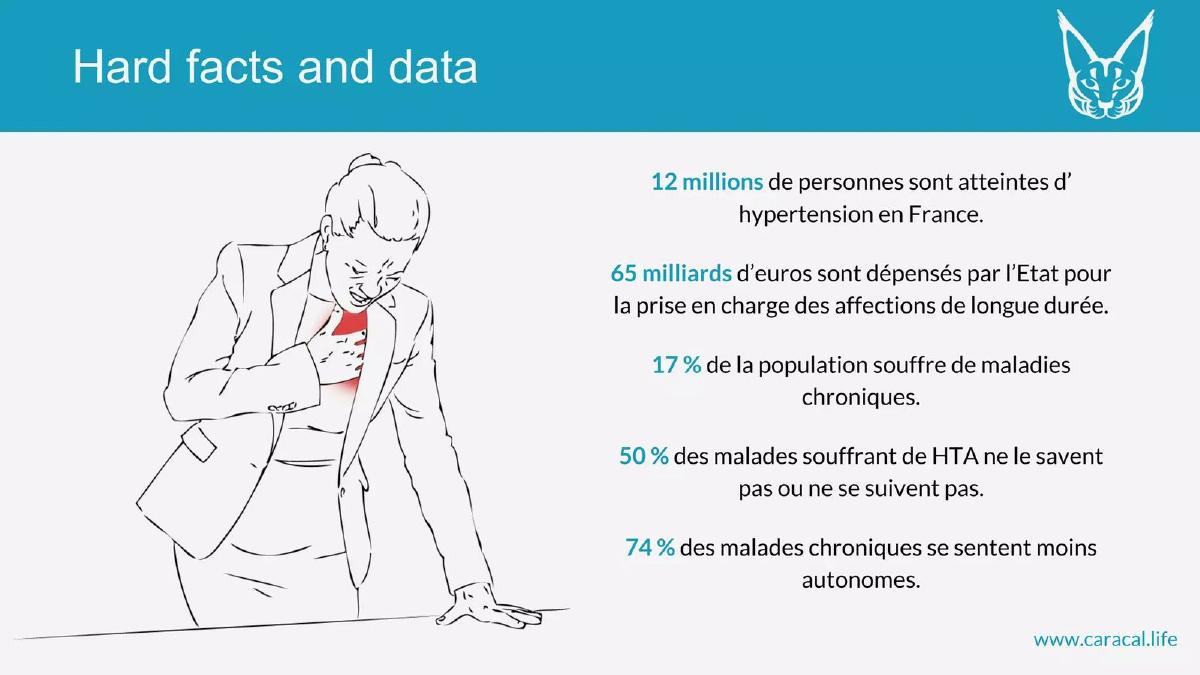
- The French market opportunity is defined by 12 million people with hypertension and 65 billion euros spent by the state on long-term conditions (Slide 2).
- A significant problem identified is that 50% of HTA (hypertension) patients are unaware of their condition or do not follow up (Slide 2).
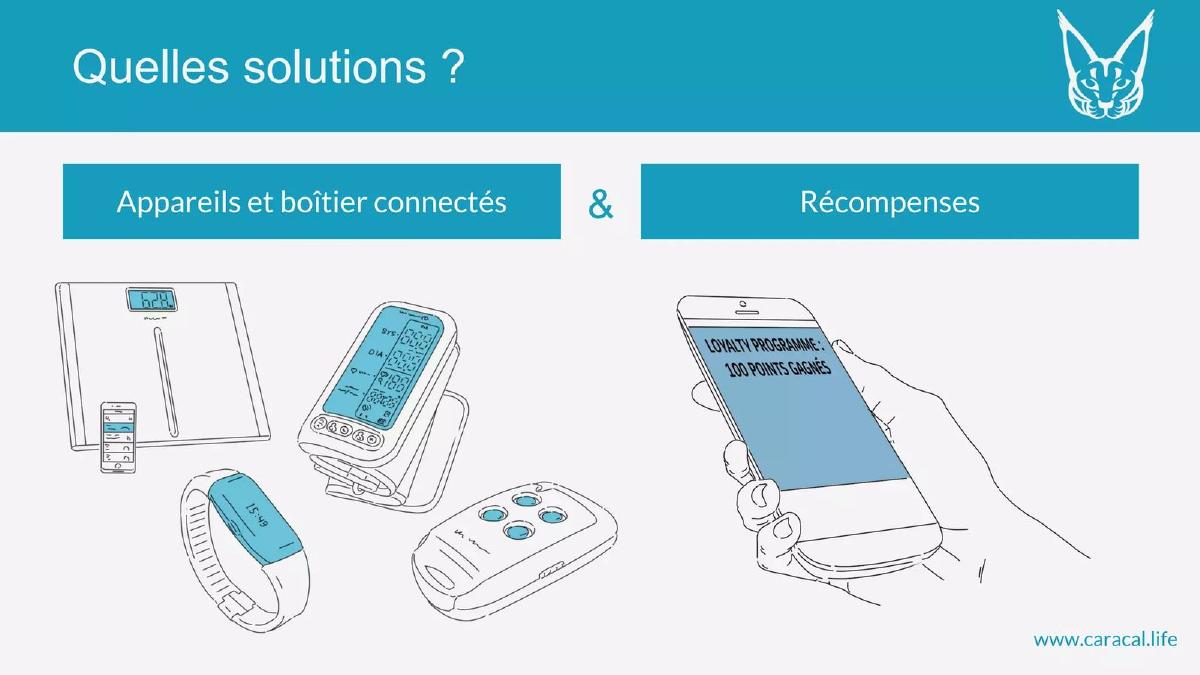
- The solution combines hardware (connected scales and monitors) with a digital loyalty program to drive engagement (Slide 4).
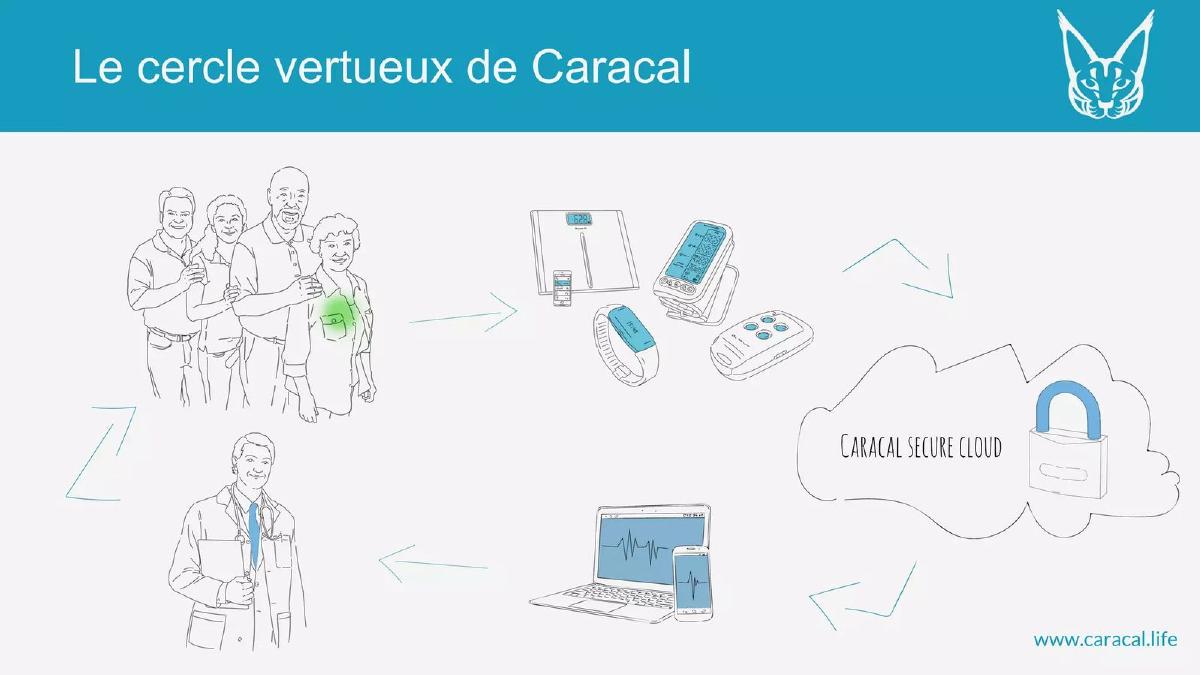
- Data flow is centralized through the 'Caracal Secure Cloud,' which connects patients to their practitioners (Slide 5).
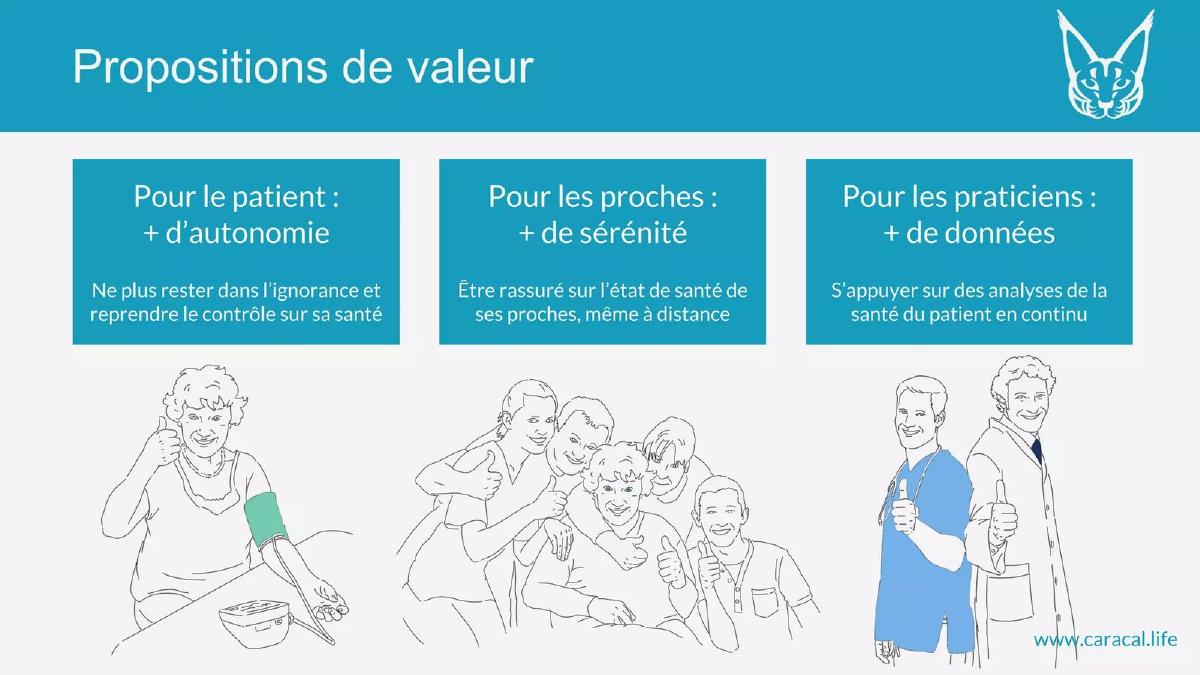
- Value propositions are segmented into three groups: autonomy for patients, serenity for families, and data for practitioners (Slide 6).
- Pharmacists are identified as a key distribution channel, with benefits including catalog diversification and patient loyalty (Slide 7).
- The deck completely omits the founding team, business model details, and the amount of capital being raised.
- There is no mention of regulatory compliance (such as CE marking or GDPR) despite the focus on medical data and the French market.
Caracal FR: The Ecosystem Approach to Chronic Care
The Caracal FR pitch deck is a concise, 7-slide presentation that outlines a vision for a connected healthcare ecosystem in France. The deck uses a clean, consistent visual style with line-art illustrations to explain how IoT devices can improve the lives of chronic disease patients. While the problem and solution are clearly defined, the deck leaves significant questions unanswered regarding the business's viability and the team's ability to execute.
Slide 1: Title Slide
The deck opens with the Caracal logo—a stylized blue lynx head—and the tagline "Care Health Serenity." The branding is professional and clinical, establishing a tone of reliability. No specific date or versioning is provided on the cover, though the URL www.caracal.life is present throughout the deck.
Slide 2: Hard Facts and Data
This slide establishes the market need with specific figures. It states that 12 million people in France suffer from hypertension. It also notes that the French state spends 65 billion euros on long-term conditions (ALD). Crucially, it highlights a behavioral gap: 50% of patients with hypertension (HTA) are unaware of their condition or do not follow up, and 74% of chronic patients feel a loss of autonomy. This slide successfully uses pain points to justify the need for a new solution.
Slide 3: Un Problème Non Résolu (An Unresolved Problem)
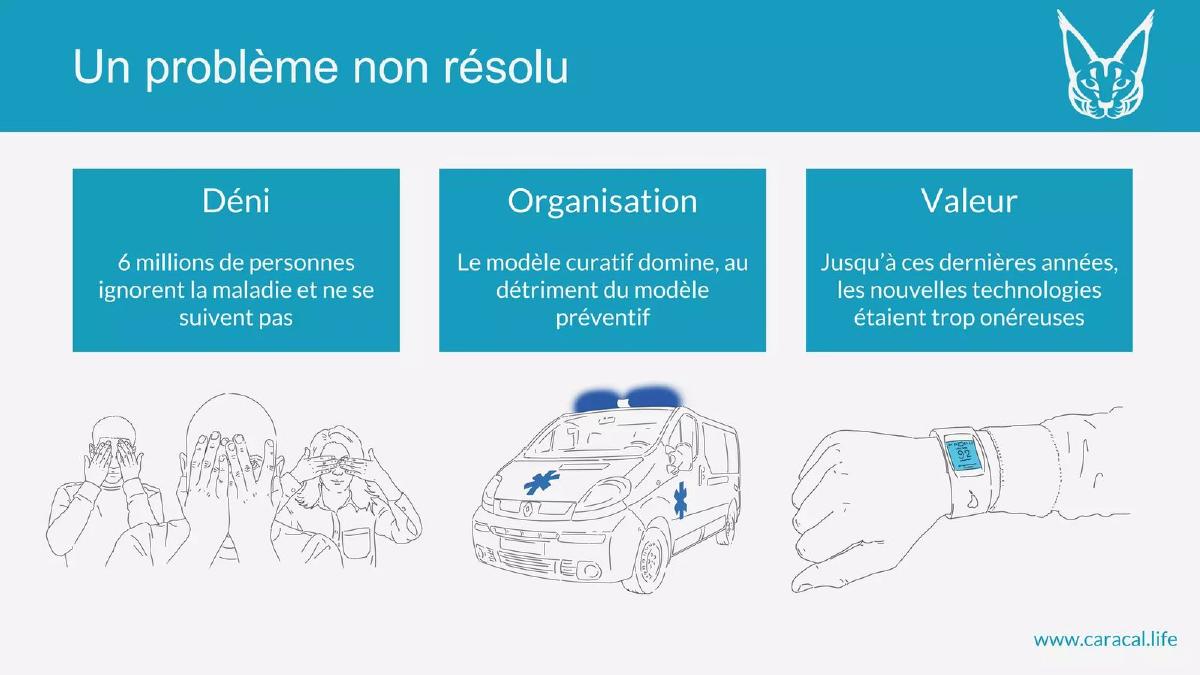
Caracal categorizes the market failure into three pillars: Déni (Denial), Organisation , and Valeur . It claims 6 million people ignore their illness. It critiques the current medical system for prioritizing curative care over prevention. Finally, it notes that technological costs have historically been a barrier to entry, implying that Caracal is entering the market as these costs are decreasing.
Slide 4: Quelles Solutions? (What Solutions?)
The solution is presented as a two-part strategy: Appareils et boîtier connectés (Connected devices and hubs) and Récompenses (Rewards). The slide features illustrations of a connected scale, a blood pressure monitor, a wearable band, and a smartphone app showing a loyalty program with "100 points gagnés." This indicates a hybrid hardware-software play that uses gamification to ensure patient compliance.
Slide 5: Le Cercle Vertueux de Caracal (The Virtuous Circle)
This slide acts as the system architecture diagram. It shows the flow of data from the patient and their devices into the Caracal Secure Cloud . From there, the data is shared with practitioners (doctors) who can monitor the patient remotely. The loop closes with the doctor providing better care back to the patient. This visualizes the "ecosystem" nature of the product, emphasizing that it is not just a gadget but a communication tool.
Slide 6: Propositions de Valeur (Value Propositions)
For the patient: More autonomy and regaining control over their health. · For relatives: Serenity and reassurance regarding the health of loved ones, even at a distance. · For practitioners: More data and continuous health analysis to support medical decisions.
This segmentation is a strong way to show that the product solves different problems for different stakeholders simultaneously.
Slide 7: Quels Intérêts pour les Pharmaciens? (What Interest for Pharmacists?)
The final slide addresses the distribution channel. It positions the pharmacist as a key partner who can sell connected objects to better know and retain their customers. The three benefits listed are: 1) Diversification of catalog and revenue growth , 2) Patient loyalty via the rewards program, and 3) Better patient knowledge through health data access. This is a clear B2B2C strategy, though the legalities of pharmacists accessing patient health data are not addressed.
What Works in This Deck
Stakeholder Mapping: The deck does an excellent job of explaining why every person in the healthcare chain should care about the product. By addressing patients, families, doctors, and pharmacists, Caracal shows a holistic understanding of the French healthcare landscape.
Clarity of Vision: The "virtuous circle" diagram on Slide 5 is a very effective way to explain a complex data-sharing ecosystem in a single glance. It moves the conversation away from "we sell a scale" to "we provide a data loop."
Market Sizing through Pain: Instead of just showing a generic TAM/SAM/SOM, Slide 2 uses specific statistics about patient behavior and state spending. This makes the problem feel urgent and economically significant.
What is Missing
The Team: This is the most glaring omission. In early-stage fundraising, the team is often more important than the idea. There is no information on who is building this, their medical background, or their technical expertise.
Business Model and Unit Economics: While the deck mentions selling devices through pharmacists, it doesn't explain the revenue split. Is there a subscription for the cloud? Does the pharmacist take a margin? How much does the hardware cost to produce versus its retail price?
Regulatory and Privacy: Handling medical data in France requires specific certifications (like HDS - Hébergeur de Données de Santé) and compliance with GDPR. Given that the "Secure Cloud" is a central feature, the lack of mention of these standards is a red flag for sophisticated investors.
Competition: The digital health space is crowded with giants (Withings, Apple, Fitbit) and specialized startups. Caracal does not explain how its devices or its loyalty program will compete with established players.
The Ask: A pitch deck should end with a request. There is no mention of how much money is being raised, what the milestones are, or how the funds will be allocated.
Founder's Takeaway
If you are building a healthcare startup, the Caracal deck provides a good template for visualizing an ecosystem . Using simple illustrations instead of dense text makes the product easy to understand. However, a founder should treat this as a "teaser" deck rather than a full pitch. To make this investment-ready, you must include a team slide that proves you can handle the regulatory hurdles of MedTech and a clear financial plan that explains how the loyalty program translates into a sustainable business model.
Frequently asked questions
- What is the primary problem Caracal FR is trying to solve?
- According to Slide 3, the company addresses three main issues: 'Déni' (denial), where 6 million people ignore their illness; 'Organisation,' where curative models dominate over preventive ones; and 'Valeur,' noting that until recently, new technologies were too expensive for widespread adoption.
- How does the loyalty program work within a medical context?
- Slide 4 introduces 'Récompenses' (Rewards) alongside connected devices. Slide 7 further clarifies that this 'loyalty programme' is intended to help pharmacists retain patients. While the exact mechanism isn't detailed, it suggests that patients earn points (shown as '100 points gagnés' on a smartphone) for engaging with their health monitoring.
- Who are the target stakeholders in the Caracal ecosystem?
- The deck identifies four key stakeholders: the patient, their 'proches' (relatives), 'praticiens' (medical practitioners), and 'pharmaciens' (pharmacists). Each group has a specific value proposition, ranging from increased autonomy for patients to increased revenue and data for pharmacists (Slides 6 and 7).
- What hardware is required for the Caracal solution?
- Slide 4 illustrates several connected devices: a digital scale, a blood pressure cuff, a wearable wristband, and a small remote-like device. These devices are meant to be sold through pharmacies to provide continuous health data (Slide 7).
- Is this a complete investment deck?
- No. With only 7 slides, it lacks essential sections such as the Team, Competition, Business Model (pricing/margins), Go-to-Market strategy, and the Ask. It serves as a conceptual introduction to the product ecosystem rather than a full business case for investors.