Carbon Block's November 2020 pitch deck presents a solution to the high cost and manual nature of carbon offset verification. By utilizing a 'Carbon Oracle' to ingest data from GPS, grid, and solar sources, the company proposes to automate the creation of offsets on a distributed ledger. The deck is notable for its specific financial ask—$650,000 for 16.25% equity—and a team that claims the #1 market share in the Manitoba solar sector. While the revenue projections are extremely aggressive, jumping from $37.6 million in Year 4 to $312 million in Year 5, the technical foundation is supported b…
Key takeaways
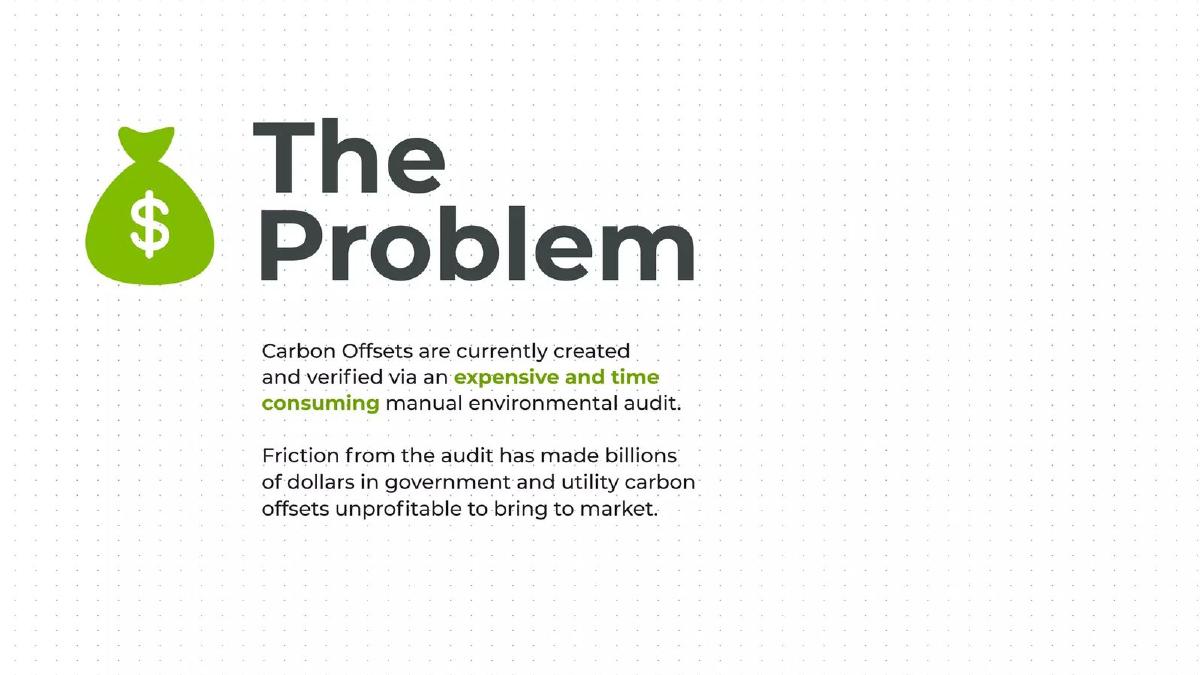
- The core problem identified is that manual environmental audits make billions in carbon offsets unprofitable to bring to market (Slide 2).
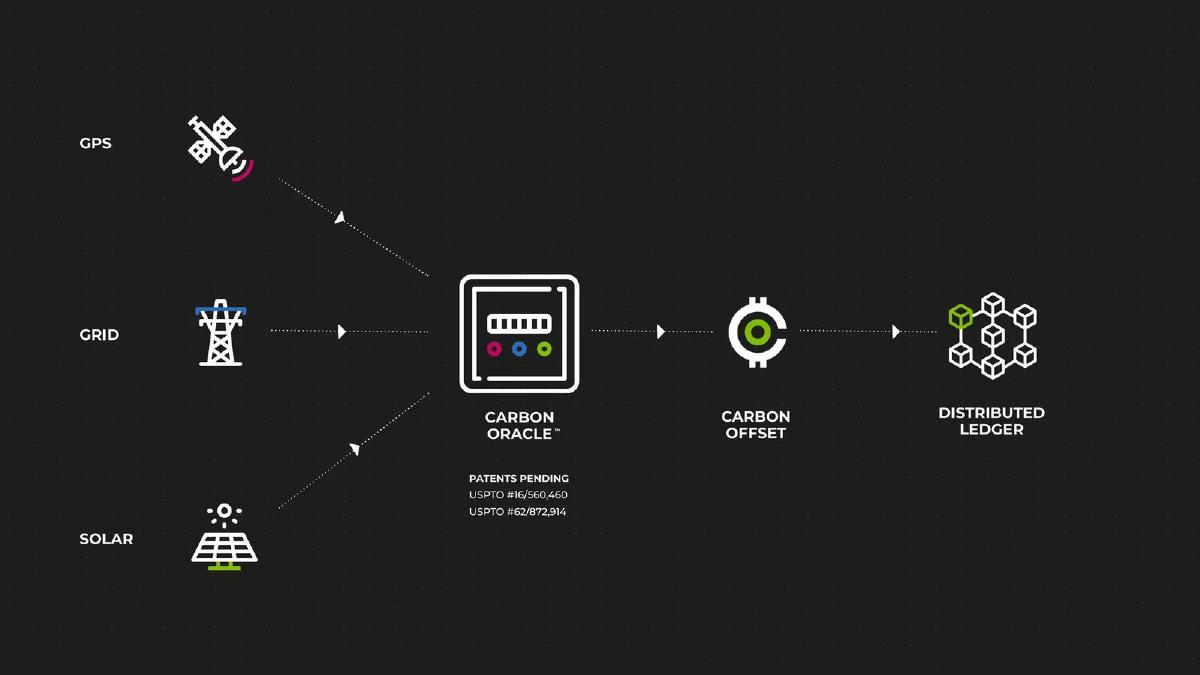
- The technical solution relies on a 'Carbon Oracle' that integrates GPS, Grid, and Solar data into a distributed ledger (Slide 3).
- The company holds two pending patents: USPTO #16/560,460 and #62/872,914 (Slide 3).
- The founding team has significant regional traction, including $20MM+ in sales and over 200 projects totaling 8MW+ in the solar sector (Slide 4).
- The business model is based on taking a transaction fee from the tokenization and sale of carbon offsets (Slide 5).
- Revenue projections show a steep hockey-stick curve, targeting $312,000,000 by Year 5 (Slide 6).
- The fundraising ask is $650,000 for 16.25% equity at a $4,000,000 post-money valuation (Slide 7).
- Capital sources are diversified, with 42% of the $1.11M total budget coming from government grants like IRAP, SR&ED, and SDTC (Slide 7).
Carbon Block: Automating Environmental Audits
Carbon Block’s pitch deck, dated November 2020, addresses a significant bottleneck in the green economy: the manual, expensive, and time-consuming process of verifying carbon offsets. The deck presents a technical solution that leverages blockchain and IoT-style data ingestion to turn carbon reduction into a liquid asset class. With a team rooted in the Canadian solar industry, the company attempts to bridge the gap between physical renewable energy projects and digital carbon markets.
Slide 1: Title Slide
The deck opens with a clear value proposition: "Simple Profitable Decarbonization." It identifies Alex Stuart as the President and Founder and dates the opportunity to November 2020. The branding is minimalist, using a dark background with high-contrast green text, establishing a professional and modern aesthetic typical of the 'CleanTech' and 'ClimateTech' sectors.
Slide 2: The Problem
Slide 2 identifies the friction in the current carbon market. It states that carbon offsets are currently created and verified via manual environmental audits. The slide claims that this friction has made "billions of dollars in government and utility carbon offsets unprofitable to bring to market." By framing the problem in terms of lost profitability rather than just environmental impact, Carbon Block appeals directly to the economic interests of potential investors.
Slide 3: The Solution (Carbon Oracle)
This slide provides a high-level architectural view of the product. The "Carbon Oracle" is the central component, shown receiving inputs from GPS, the Grid, and Solar sources. This data is transformed into a "Carbon Offset" and then recorded on a "Distributed Ledger." Crucially, the slide lists two pending patents (USPTO #16/560,460 and #62/872,914), which provides a layer of defensibility to their technical claims.
Slide 4: Meet Our Team
The team slide is heavy on regional traction and industry accolades. The highlights include achieving the #1 market share in the Manitoba solar sector and generating $20MM+ in sales across 200 projects. The founders, Alex Stuart and Justin Phillips, are described as serial entrepreneurial partners. The inclusion of CFO Peter Moreira, a CPA/MBA, suggests a focus on financial rigor. The slide also mentions participation in Season Six of CBC’s Dragons’ Den and graduation from the Creative Destruction Labs (CDL) Blockchain Stream, which serves as external validation of the business concept.
Slide 5: Business Model
The business model is depicted as a circular ecosystem. Carbon Block takes a transaction fee from the tokenization and sale of offsets. The participants in this cycle are "Offset Holders" (governments like SaskPower or green tech companies like EnerPure) and "Corporations" (seeking offsets for regulatory compliance). This is a classic marketplace model where the platform provides the infrastructure for trust and exchange.
Slide 6: Revenue Projections
Slide 6 presents a five-year growth forecast. The numbers start modestly at $50,625 in Year 1 (POC) and grow to $3,177,600 in Year 3 as they enter the Alberta market. However, the projections become extremely aggressive in the final two years, jumping from $37.6 million in Year 4 (California) to $312,000,000 in Year 5 (Global). The slide also maps these milestones to financing stages: Seed, Pre-A/SDTC, and Series A.
Slide 7: The Ask
This is one of the most transparent "Ask" slides in recent teardowns. It explicitly requests $650,000 for 16.25% equity at a $4,000,000 post-money valuation. It also breaks down the total capital sources ($1,110,000), showing that 42% of their funding comes from non-dilutive government grants (IRAP, SR&ED, and SDTC). The use of funds is clearly listed: obtaining national accreditation, completing pilots, achieving revenue, and prototyping hardware.
Slide 8: The Moon Shot Goals
The penultimate slide outlines the long-term vision. The boldest claim is that "Carbon Block is to the carbon market what VISA is to retail." The goals include establishing carbon as an asset class and enabling cap-and-trade regulations. They also list future market expansions into electric vehicle switching, methane gas capture, and carbon sequestration, showing that their "Oracle" model is intended to be sector-agnostic within the climate space.
Slide 9: Closing Slide
The deck concludes with a final call to action: "Profit from Global Decarbonization now, Invest in Carbon Block." It repeats the contact information for Alex Stuart, maintaining the consistent branding established on the title slide.
What Carbon Block Does Well
Clarity of the Ask: Many founders are vague about valuation and equity. Carbon Block is refreshingly direct, providing the exact percentage and valuation they are targeting. This allows an investor to immediately determine if the deal fits their mandate.
Leveraging Non-Dilutive Funding: The breakdown of grant funding (IRAP, SR&ED, SDTC) is a strong signal. It shows that the company has already passed the technical due diligence required by government agencies and that the investor's dollar will be stretched further by these matching funds.
Regional Traction as a Proxy: By highlighting their #1 market share in Manitoba, the founders prove they can execute within a specific geographic and regulatory framework before asking for capital to scale globally.
What is Missing from the Deck
Unit Economics: While the business model mentions a "transaction fee," there is no detail on what that fee is (e.g., 2% vs 20%) or what the cost of customer acquisition (CAC) looks like. Without these details, the $312M revenue target in Year 5 feels like an arbitrary number.
Competitive Landscape: The deck does not mention other carbon credit platforms or traditional auditing firms. Investors need to know why a corporation would choose Carbon Block over established registries like Verra or Gold Standard, or other emerging blockchain competitors.
Technical Depth on the 'Oracle': The deck mentions hardware prototyping in the 'Use of Funds' but doesn't explain what the hardware is. If the 'Carbon Oracle' is a physical device that must be installed on-site, the scaling challenges are significantly different than if it is a pure software integration.
Founder Takeaways
Patent Transparency: If you have patents pending, list the numbers. It adds immediate credibility to your 'Solution' slide and shows you are serious about protecting your IP.
The 'VISA' Analogy: Using a well-known company as a benchmark for your business model (e.g., "The VISA of X") is a double-edged sword. It helps investors understand your role in the ecosystem quickly, but it also sets a very high bar for infrastructure and reliability that you must be prepared to defend.
Staged Geographic Expansion: Carbon Block’s roadmap (Manitoba -> Alberta -> California -> Global) is a logical way to present a scaling plan. It shows an understanding that regulatory environments differ and that 'Global' is a destination, not a starting point.
Frequently asked questions
- What is the specific technology Carbon Block uses to verify offsets?
- According to Slide 3, the company uses a proprietary 'Carbon Oracle' that acts as a gateway. It ingests data from three primary sources: GPS, the electrical grid, and solar installations. This data is then converted into a 'Carbon Offset' and recorded on a distributed ledger (blockchain), which automates the verification process that is traditionally done manually by environmental auditors.
- How does Carbon Block plan to generate revenue?
- Slide 5 outlines a transaction-based business model. Carbon Block sits between 'Offset Holders' (like governments or green tech companies) and 'Corporations' seeking to buy offsets for compliance or sustainability goals. The company generates revenue by taking a transaction fee every time a carbon offset is tokenized and sold through their platform.
- What is the team's background in the energy sector?
- The team, led by Alex Stuart and Justin Phillips, claims over 25 years of combined renewable energy experience. Slide 4 notes they achieved the #1 market share in the Manitoba, Canada solar sector and have managed over 200 projects. CFO Peter Moreira adds 15+ years of financial management and controllership experience to the leadership group.
- What are the details of the investment round offered in the deck?
- Slide 7 specifies an ask of $650,000 in exchange for 16.25% equity, valuing the company at $4,000,000 post-money. At the time of the deck's creation in November 2020, $100,000 of the round was already committed. The slide also mentions that this cash is part of a larger $1,110,000 capital pool supplemented by Canadian government grants.
- Does the deck provide a clear roadmap for geographic expansion?
- Yes, Slide 6 maps revenue projections to specific milestones and locations. Year 1 focuses on a Proof of Concept (POC), Year 2 on a full build-out, Year 3 targets the Alberta market, Year 4 expands to California, and Year 5 aims for global scale. This indicates a strategy of starting in highly regulated regional carbon markets before attempting international expansion.