Myflexbox, an Austrian startup, successfully raised $79M in 2023 to expand its open smart-locker network across Europe. The deck highlights a critical shift in the logistics industry: moving from closed, carrier-specific locker systems to an open API-driven platform that serves multiple couriers and retailers simultaneously. By positioning itself as the largest open network in Austria with established partnerships with DPD, DHL Express, UPS, and GLS, the company demonstrated a proven model for reducing last-mile delivery failures and CO2 emissions. The deck effectively balances the hardware r…
Key takeaways
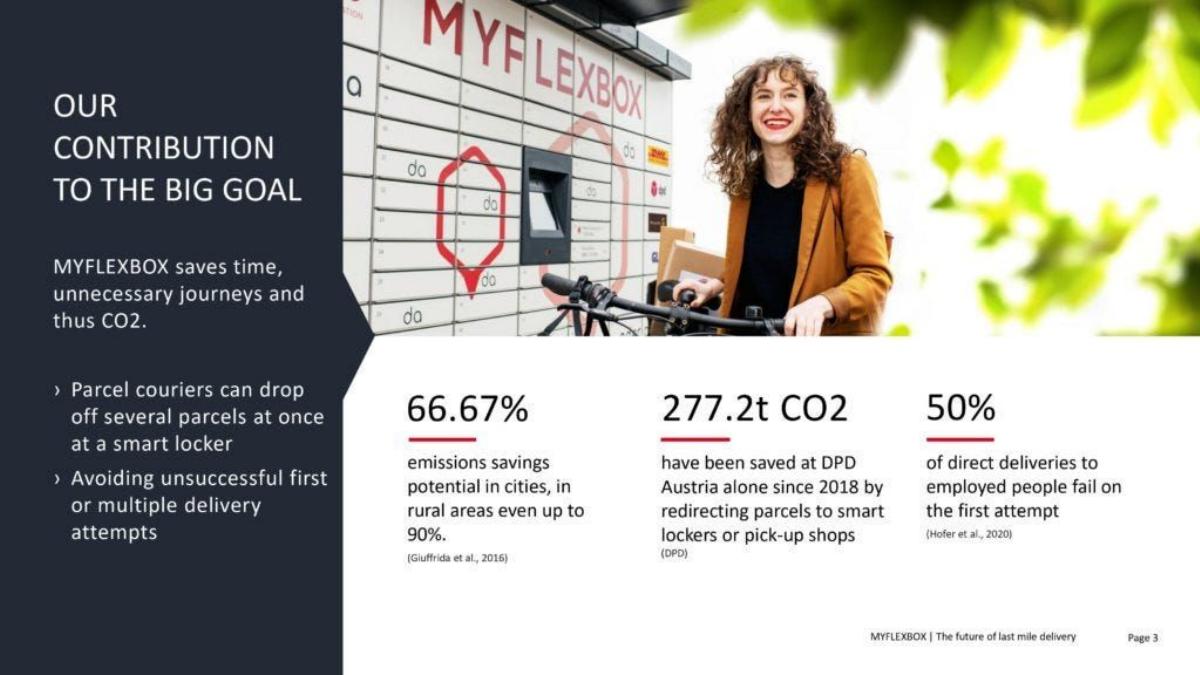
- The company claims a 66.67% emission savings potential in cities and up to 90% in rural areas on Slide 3.
- Slide 5 identifies the core problem as B2C parcel volume growing faster than Courier, Express, and Parcel (CEP) providers can expand infrastructure.
- Myflexbox positions its open API approach as a key differentiator, allowing integration for local retailers and multiple CEP providers on Slide 9.
- The market slide (Slide 11) notes that 70% of CEP providers do not operate their own smart-locker network, representing a significant white-space opportunity.
- Slide 15 reveals the company originated as a winning project of Salzburg AG's innovation program before its planned spin-off in July 2022.
- The deck highlights that 50% of direct deliveries to employed people fail on the first attempt, citing Hofer et al., 2020 on Slide 3.
- Competitive positioning on Slide 11 places Myflexbox in the 'Open Network' quadrant against closed networks like Amazon and DHL.
- The deck omits specific financial figures for revenue and unit economics, using 'XY' placeholders for location and parcel counts in the milestone history on Slide 15.
Slide-by-Slide Teardown
Slide 1: Title Slide
The cover slide features the Myflexbox logo and a high-quality photograph of a user interacting with a smart locker. The tagline 'The future of last mile delivery' clearly establishes the sector. It specifically notes this is for a 'Series A Funding Round,' signaling the stage of the company at the time of the presentation.
Slide 2: The Vision
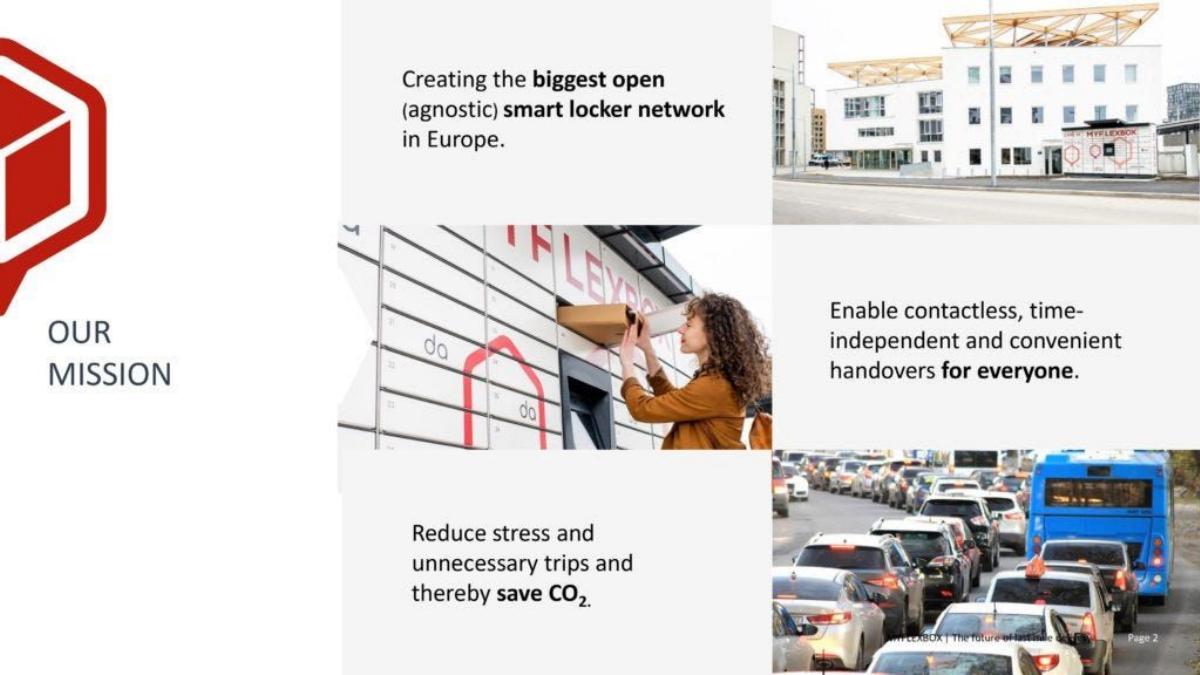
Slide 2 states the primary objective: 'Creating the biggest open smart locker network in Europe.' This slide sets the scale of ambition, moving beyond their home market of Austria to a continental play.
Slide 3: Environmental and Operational Impact
This slide provides the 'Why' behind the business. It lists three key metrics: 66.67% emission savings potential in cities (up to 90% in rural areas), 277.2 tons of CO2 saved at DPD Austria since 2018, and a 50% failure rate for direct deliveries to employed people on the first attempt. By citing sources like Giuffrida et al. (2016) and Hofer et al. (2020), the company builds credibility for its impact claims.
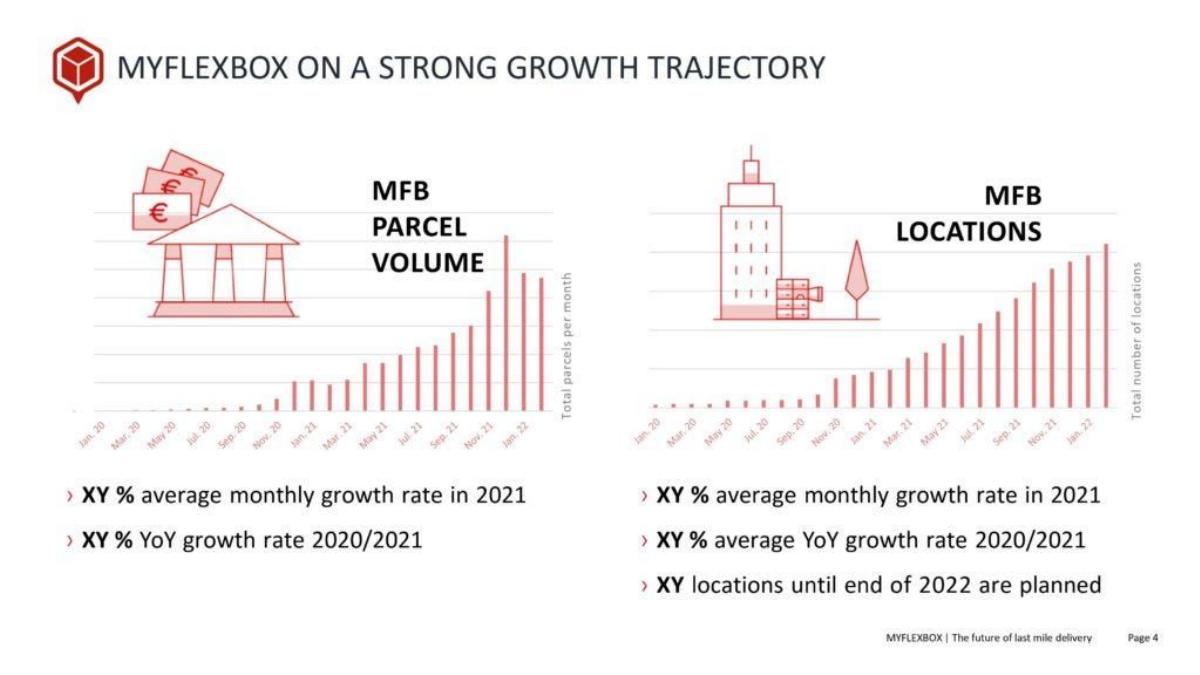
Slide 4: Growth Trajectory
This is a transition slide titled 'Strong growth trajectory.' While the text is minimal, it serves to pivot the deck from the problem/impact phase into the performance and market phase.
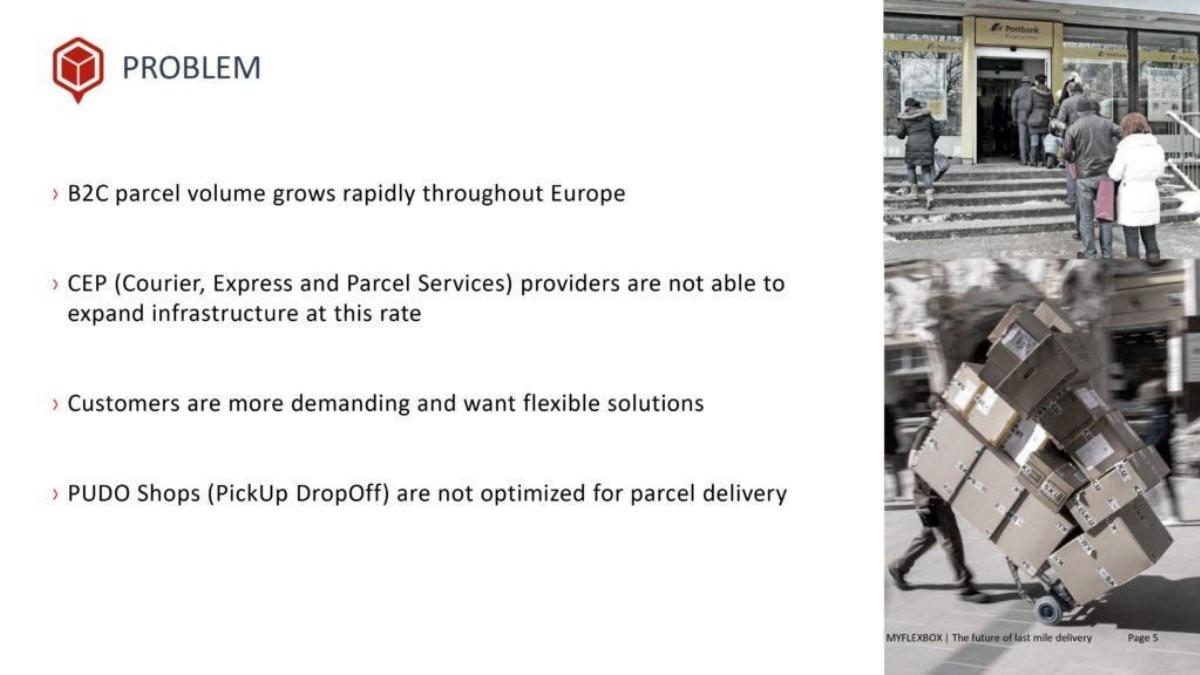
Slide 5: The Problem
The problem is framed through four bullet points: rapid growth in B2C parcel volume, the inability of CEP (Courier, Express, and Parcel) providers to expand infrastructure at the same rate, increasing customer demand for flexibility, and the fact that PUDO (PickUp DropOff) shops—typically local convenience stores—are not optimized for parcel delivery. The imagery shows crowded delivery points and strained couriers to visualize the bottleneck.
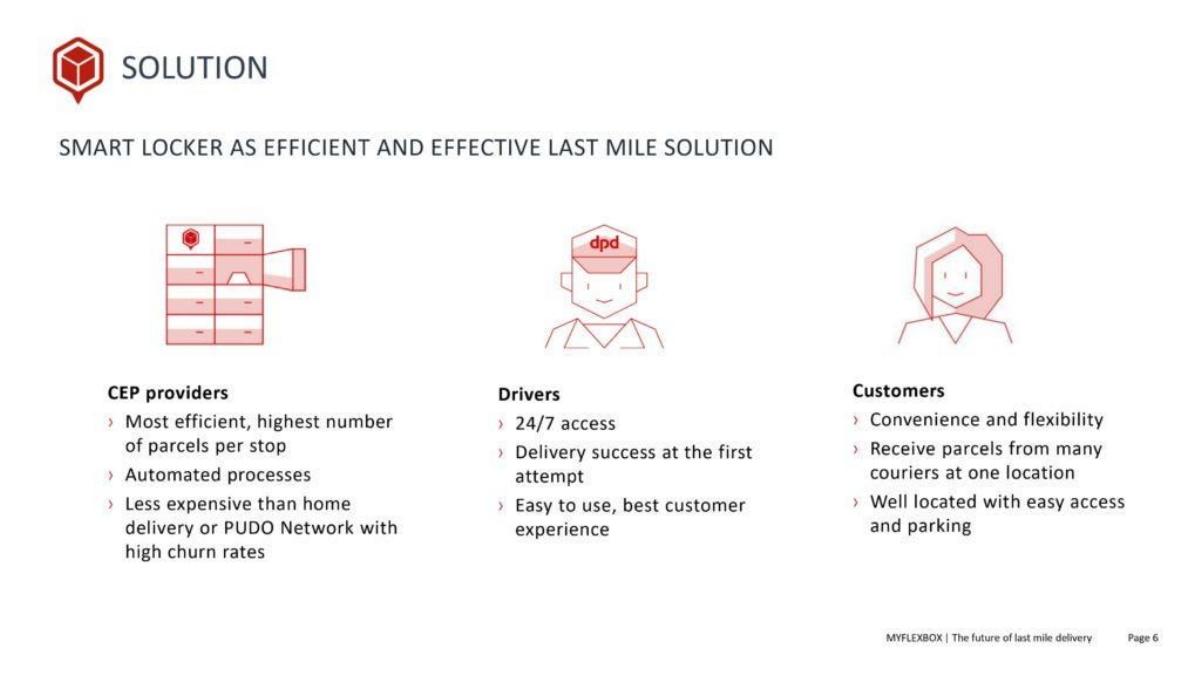
Slide 6: The Solution
Slide 6 introduces smart lockers as the 'efficient and effective last mile solution.' It highlights the benefits of 24/7 availability, reduced traffic, and a better user experience compared to traditional home delivery or shop-based pickup.
Slide 7: Unique Selling Proposition (USP)
Myflexbox defines its USP through three pillars: being 'Open for everyone' (serving CEPs, retailers, and C2C), having 'Access to the best locations' (benefiting residents and site partners), and a 'Scalable cloud-based platform.' The slide emphasizes that they are already the largest open network in Austria with existing partnerships with leading European CEP providers.
Slide 8: Foundations for Expansion
This slide serves as a summary of their current standing, emphasizing that the 'foundations'—meaning the technology, partnerships, and initial network density—are ready to be exported to new markets.
Slide 9: Software as Centerpiece
This is a critical technical slide. It explains that the software was developed in-house from scratch. The diagram shows the 'MYFLEXBOX CLOUD' connecting via Open API to CEP providers and e-commerce players. It also mentions a 'Service portal' for local retailers and a 'Customer app' currently in development. The bottom of the slide lists various modules: Click & Collect, Service marketplace, Refrigerated lockers, Cargo bikes, Micro depots, and Mobility hubs, suggesting the lockers are part of a broader smart-city infrastructure.
Slide 10: Business Model
The deck notes a 'Robust business model through various use cases.' While specific pricing is not detailed on this slide, it implies revenue streams from multiple sources: couriers paying for drops, retailers paying for Click & Collect, and potentially C2C transaction fees.
Slide 11: Market and Competition
This slide quantifies the opportunity. It cites a 10 Billion B2C parcel market in Europe (as of 2020), with 40-50% being B2C parcels. Crucially, it states that 70% of CEP providers do not operate their own locker network. The competitive matrix plots 'Closed vs. Open' against 'Small vs. Large' networks. Myflexbox places itself as the leader of the 'Open' category, with a target to move into the 'Large Network' quadrant by 2025.
Slide 12: Growth Plan
This slide outlines the intent to implement a growth plan with a 'financially strong investor.' It sets the stage for the 'Ask' by connecting the market opportunity to the need for capital.
Slide 13: Business Plan Assumptions
Slide 13 shows two bar charts: one for 'Locations' and one for 'Parcel Volume.' Both show aggressive upward trends. However, the Y-axis lacks specific numbers, and the bullet points at the bottom are empty in this version of the deck, likely to protect sensitive projections in a public-facing or early-stage version of the file.
Slide 14: Management Team
The deck includes a dedicated slide for the management team. While the names and bios are not detailed in the provided text, the presence of the slide indicates the importance of the leadership's experience in logistics and technology.
Slide 15: Milestones and Funding History
This timeline is highly informative. It shows the company started operations in 2020 with the first 5 lockers. By 2021, they had integrated DHL Express and UPS. In 2022, they added GLS and planned the spin-off from Salzburg AG. The timeline also notes a market entry into Germany in September 2022 and plans for a 'third market' and other European countries in 2023 and beyond. Note that location and parcel counts are marked as 'XY,' indicating these were likely redacted or meant to be filled in for specific investor meetings.
Slide 16: Questions
Slide 17: Disclaimer
A comprehensive legal disclaimer noting that the presentation is based on preliminary information from Salzburg AG and contains forward-looking statements.
What Myflexbox Does Well
Clear Categorization: The deck does an excellent job of defining the 'Open vs. Closed' network distinction. By positioning themselves as the 'Open' alternative to giants like Amazon and DHL, they turn a competitive threat into a market opportunity. They aren't just another locker company; they are the infrastructure that the 70% of couriers without lockers need to use.
Validation through Partnerships: Listing DPD, DHL Express, UPS, and GLS as partners (Slide 15) provides immediate institutional credibility. For a hardware-heavy business, showing that the major players in the industry are already integrated with your API is the strongest possible signal of product-market fit.
Sustainability as a Core Driver: Instead of treating CO2 savings as a footnote, Myflexbox leads with it (Slide 3). In the European regulatory and investment climate of 2023, the 'Green' angle of reducing failed deliveries is a powerful secondary hook for growth-stage investors.
What is Missing from the Deck
Unit Economics: While the deck mentions a 'robust business model,' it lacks the specific unit economics that growth investors typically require. There is no mention of the cost to manufacture/install a locker, the average revenue per locker (ARPL), or the payback period. For a $79M raise, these figures are usually central to the argument.
Specific Financials: Slide 13 and Slide 15 use 'XY' placeholders for locations, parcel volumes, and financial assumptions. While this is common in 'teaser' decks, the lack of even a range of revenue makes it difficult to assess the actual scale of the business at the time of the pitch.
Real Estate Strategy: Smart lockers live and die by their locations. The deck mentions 'Access to the best locations' but doesn't explain the strategy for securing them. Are they partnering with supermarkets, gas stations, or municipalities? The 'how' of the land-grab is missing.
What Other Founders Can Copy
The 'White Space' Argument: Slide 11 is a masterclass in market sizing. By pointing out that 70% of CEP providers lack their own network, Myflexbox identifies a massive, underserved customer base. Founders should look for similar 'infrastructure gaps' where the incumbents are underserved by existing closed-loop solutions.
Visualizing the Ecosystem: The 'Software as Centerpiece' slide (Slide 9) is very effective. It moves the conversation away from 'boxes on a sidewalk' and toward 'cloud-based multi-tenant platform.' If your business has a physical component, always include a slide that highlights the digital 'brain' that makes it scalable.
Strategic Timeline: The milestone slide (Slide 15) is exceptionally clear. It shows a logical progression from a corporate project to a multi-partner national leader to an international contender. It gives investors a clear sense of the company's momentum and the logical 'next steps' that their capital will fund.
Frequently asked questions
- What is the primary value proposition of Myflexbox?
- Myflexbox offers an 'open' smart-locker network. Unlike closed systems owned by specific couriers (like Amazon or DHL), Myflexbox allows any courier, local retailer, or C2C user to utilize their lockers via an open API. This increases locker utilization rates and provides a more convenient, single point of contact for consumers receiving parcels from multiple different delivery services.
- How does the company address environmental concerns?
- Sustainability is a core pillar of the pitch. Slide 3 cites that the network saves time, journeys, and CO2. Specifically, it mentions 277.2 tons of CO2 saved at DPD Austria alone since 2018. By consolidating deliveries into lockers, they eliminate the 'failed first attempt' rate, which they claim is as high as 50% for employed individuals.
- What is the significance of the 'Open API' mentioned in the deck?
- The Open API (Slide 9) is the technical backbone that enables scalability. It allows Myflexbox to function as a multi-tenant platform. This means they can integrate with various CEP providers, e-commerce players, and even local retailers who want to offer 'Click & Collect' services without building their own physical or digital infrastructure.
- Who are the main competitors identified in the deck?
- Slide 11 categorizes competitors into two groups: Closed Networks (Amazon, DHL, InPost, Post) and Open Networks. Myflexbox positions itself as the leader in the Open Network space, competing with smaller players like Smartmile and DB. Their goal is to move from a 'Small Network' to a 'Large Network' by 2025 while remaining open.
- What was the origin of Myflexbox?
- According to Slide 15, Myflexbox was not a standalone startup from day one. It was a 'winning project of Salzburg AG’s (SAG) innovation program.' The deck was used to facilitate a spin-off from the parent corporate entity in July 2022, transitioning the project into a venture-backed growth company.