Mycroft’s 2015 Seed deck is a lean, highly visual presentation that relies on the 'Linux for X' narrative. In an era where Amazon, Google, and Apple were locking users into proprietary ecosystems, Mycroft pitched an open-source alternative. The deck is notable for its lack of text-heavy slides, instead using evocative imagery—like a Blue Origin rocket and a Google self-driving car—to signal the massive markets they intended to disrupt. While it lacks traditional financial projections or a detailed business model, it leans heavily on community traction, showcasing a growth chart from 1,000 to…
Key takeaways
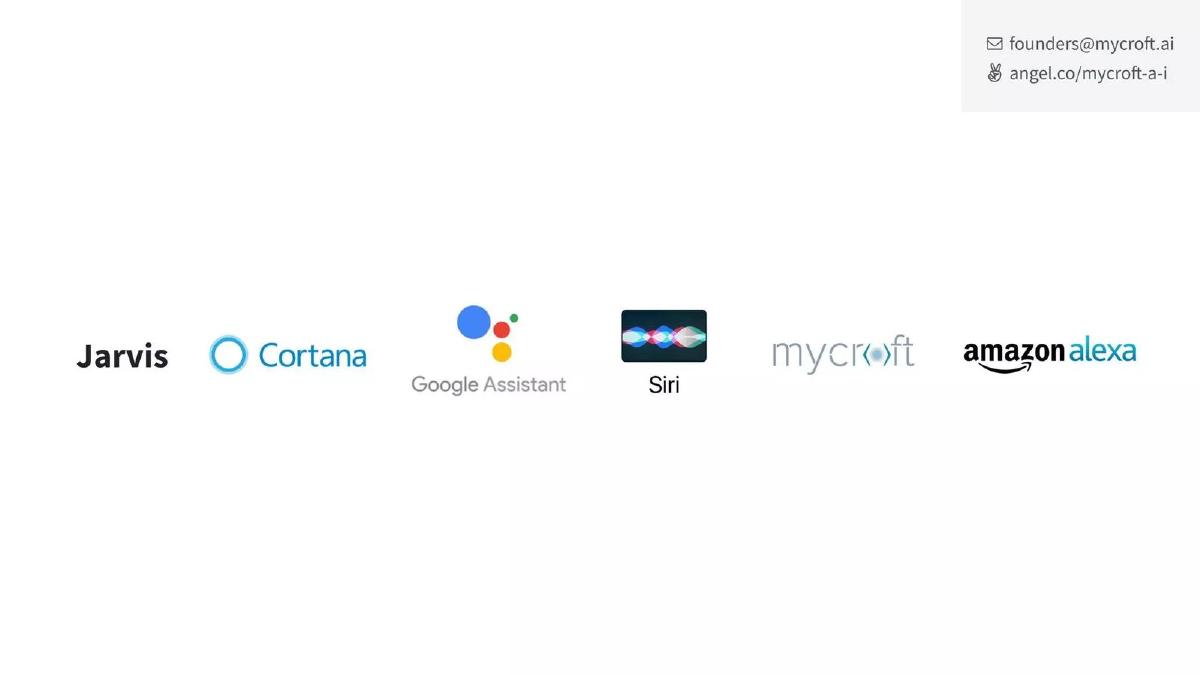
- The deck uses a 'David vs. Goliath' strategy by placing the Mycroft logo alongside Siri, Alexa, and Google Assistant on slide 2.
- Market opportunity is framed through the lens of open-source success stories, citing a '34B' figure for Linux on slide 9.
- The product is positioned as a horizontal platform applicable to Retail, Cars, and Payments (slide 8).
- Traction is demonstrated through a growth chart showing a climb from 1,000 to nearly 5,000 units/users over a six-month period (slide 11).
- The 'Open Source' advantage is quantified by a community of '1000+ Developers' shown in a mosaic on slide 14.
- The team slide (13) highlights a mix of military leadership, enterprise experience (Autodesk), and academic expertise.
- The deck omits a specific 'Ask' slide, failing to detail exactly how much capital was being raised or the intended use of funds.
- Visual metaphors are used extensively, such as the 'Mycroft Baked In' cake on slide 10 to represent OS integration.
The Vision: AI for Everyone
Slides 1-2: Positioning Against Giants
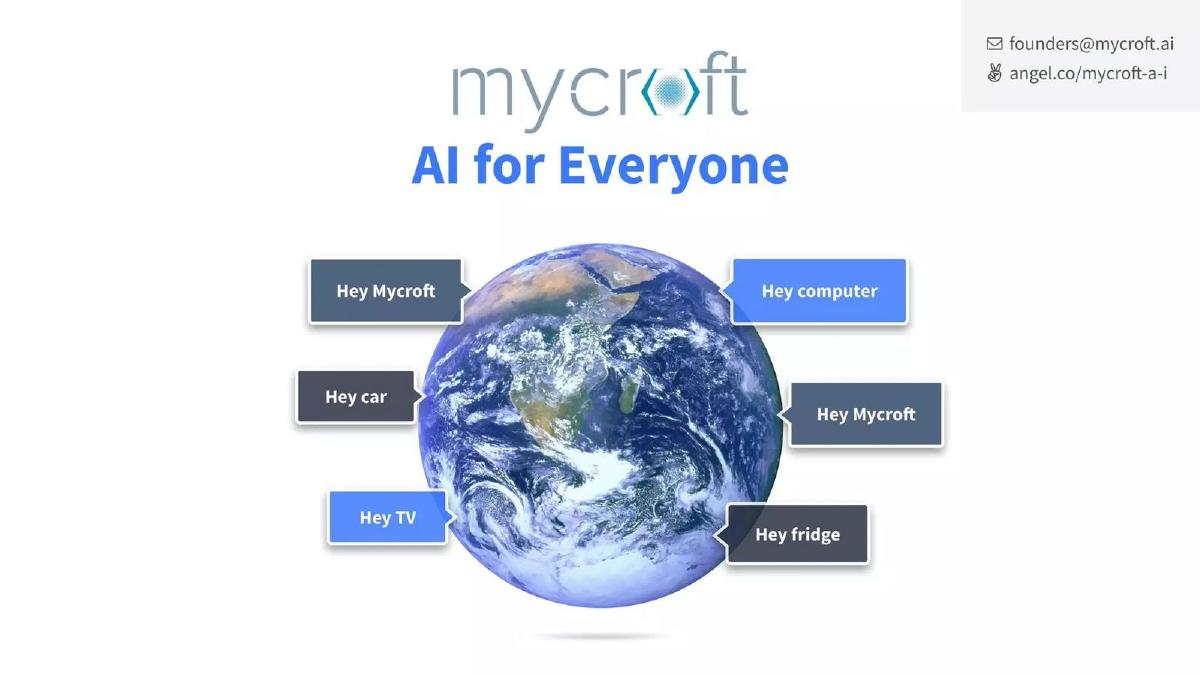
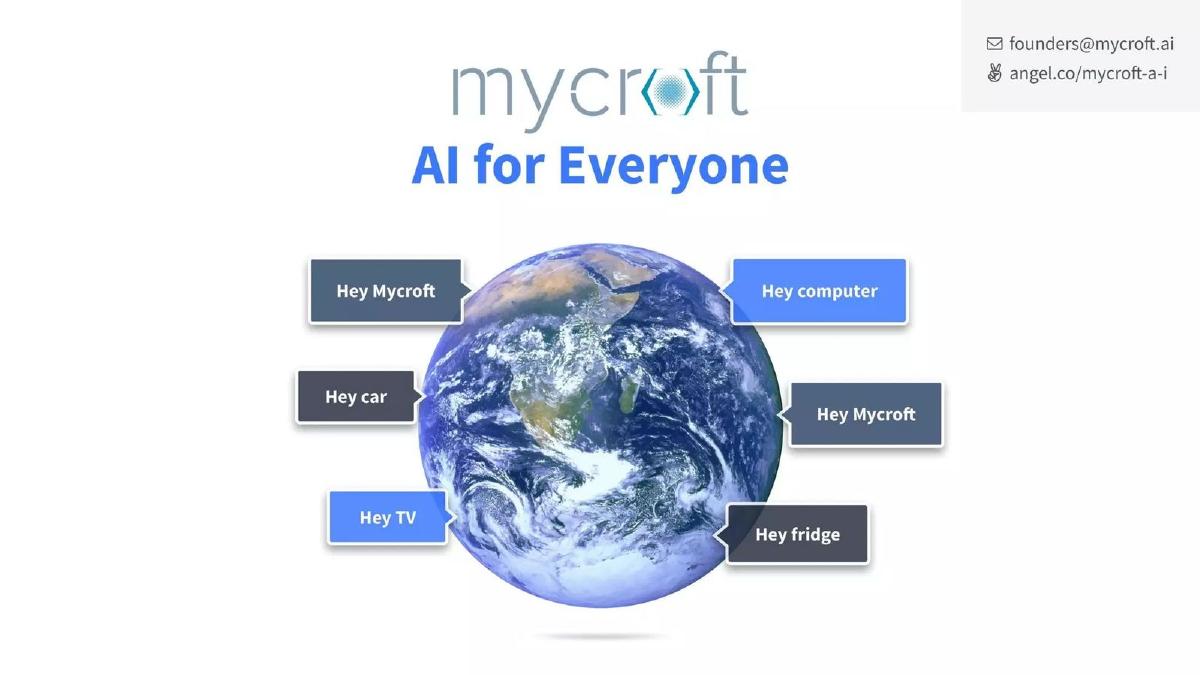
The deck opens with a bold title slide: "mycroft: AI for Everyone" (Slide 1). The imagery of a globe surrounded by voice prompts like "Hey car," "Hey TV," and "Hey fridge" immediately establishes the company's ambition as a ubiquitous, cross-device platform. This is a classic 'Land and Expand' vision slide.
Slide 2 is perhaps the most critical for investor psychology. It places the Mycroft logo in a lineup with Jarvis, Cortana, Google Assistant, Siri, and Amazon Alexa . By simply existing in this row, Mycroft is framing itself as the only independent alternative to the 'Big Tech' walled gardens. It doesn't need to explain the problem; the logos of the competitors do the work of reminding investors about data privacy and platform lock-in.
The Market Context: Big Tech and Big Infrastructure
Slides 3-6: The Silent Narrative
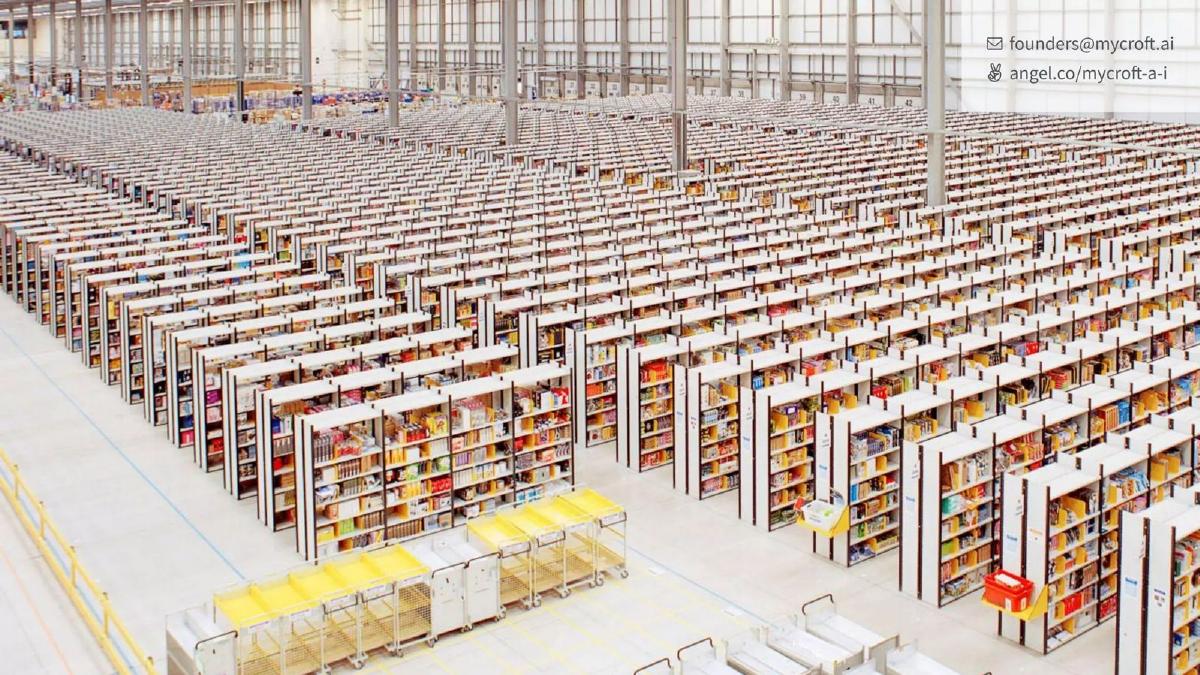
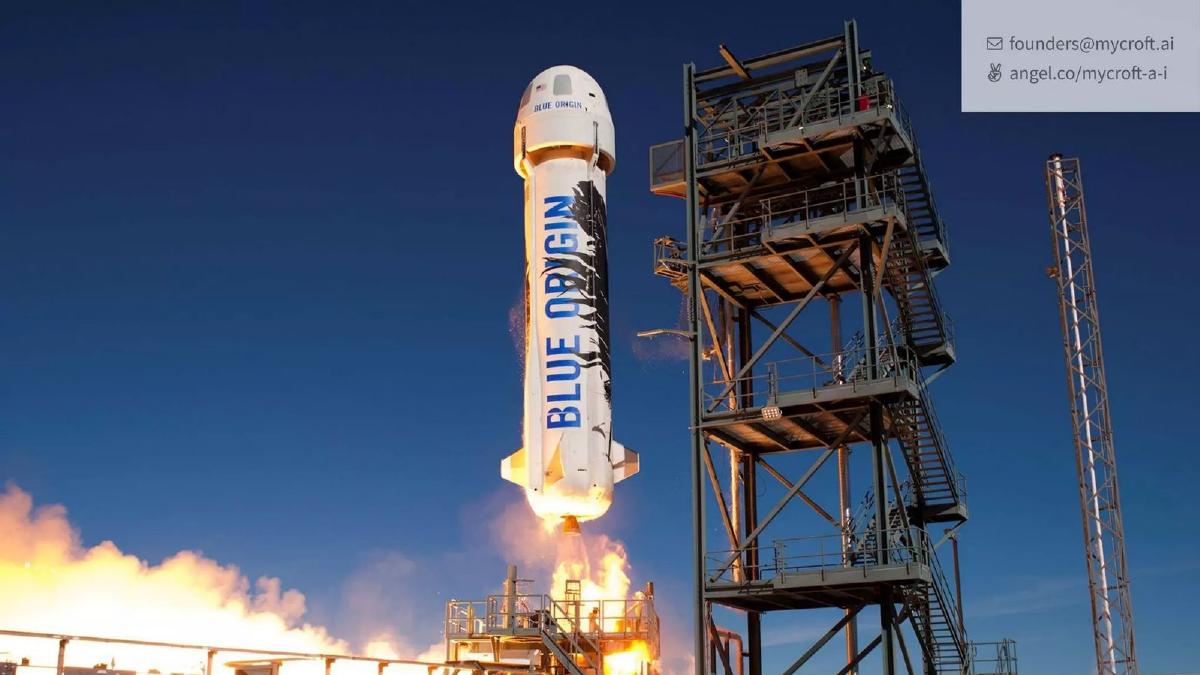
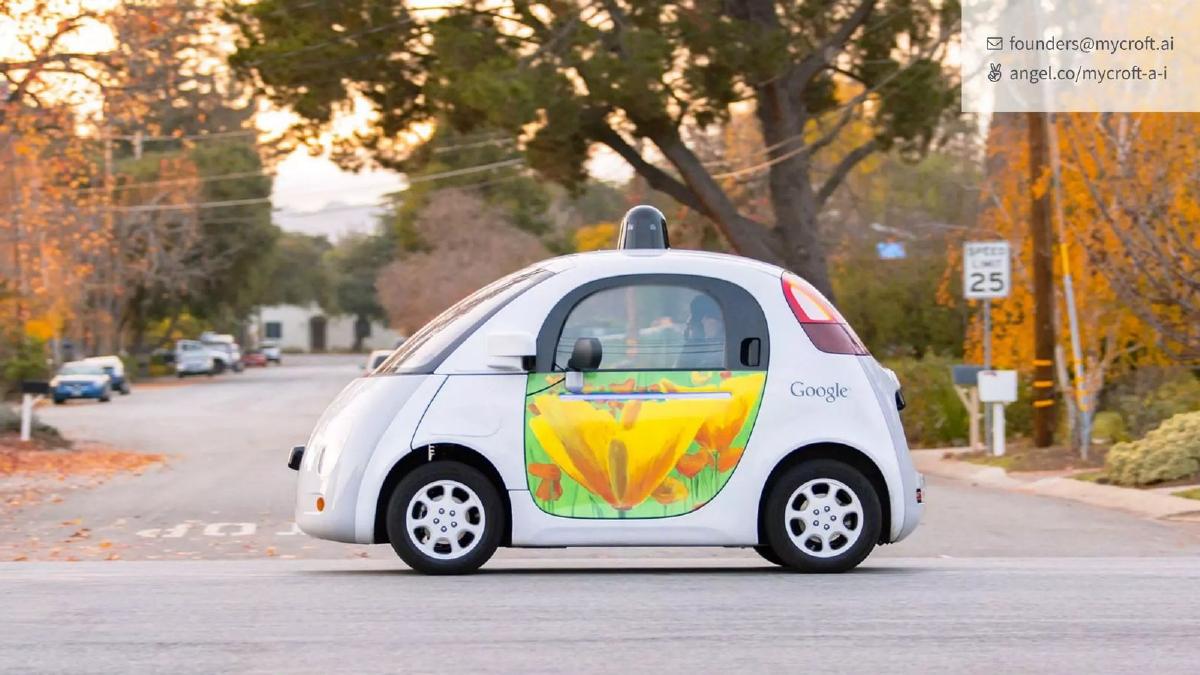
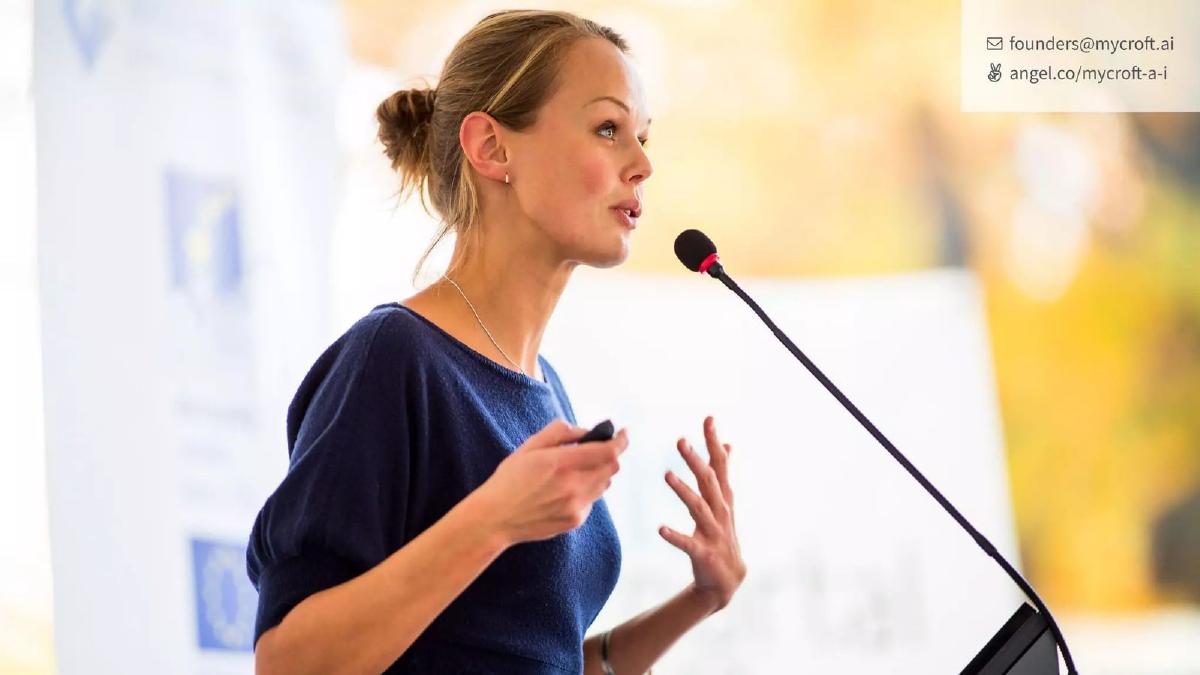
Slides 3, 4, 5, and 6 are purely visual and contain no text other than the contact footer. This is a high-risk, high-reward strategy usually reserved for live pitches where the founder is speaking over the slides. Slide 3 shows a massive Amazon-style fulfillment center. Slide 4 shows a Blue Origin rocket launch. Slide 5 shows a Google self-driving car. Slide 6 shows a woman speaking at a podium.
The intended takeaway here is the scale of the industries Mycroft intends to touch: Logistics, Aerospace, Automotive, and Public Discourse. By showing Blue Origin and Google, they are signaling that they are playing in the same league as the world's most ambitious companies.
The Solution: The Open Voice Assistant
Slides 7-8: Product and Verticals
Slide 7 introduces the core product identity: "The Open Voice Assistant." The slide features a montage of hardware—a tablet, a laptop, a car dashboard (Jaguar), a smart speaker, and a smartwatch. This reinforces the 'horizontal' nature of the software; it is not a device, but the intelligence inside the devices.
Slide 8 narrows the focus to three commercial pillars: Retail, Cars, and Payments . This is the first hint of a business strategy, suggesting that Mycroft intends to provide the voice interface for transactions and transportation, two of the highest-value data segments in the economy.
The 'Linux' Precedent
Slides 9-10: The Open Source Business Case
Because open-source companies can be difficult to value, Mycroft uses Slide 9 to anchor the investor's mind to a massive number: "34B" next to the Linux penguin. This likely refers to the estimated market value or economic impact of Linux at the time. Next to it is a "$25B" figure with a chat bubble icon, likely representing the voice/conversational AI market size.
Slide 10 uses a literal metaphor: a cake with the Linux penguin on top and the Mycroft logo "Baked In." The message is clear: Mycroft is the natural extension of the open-source stack into the AI era. If you believe in the power of open-source infrastructure, you must believe in Mycroft.
Traction and Validation
Slides 11-12: Growth and Partnerships
Slide 11 provides the deck's only hard data chart. It shows a steady upward trend from October 2016 (at 1,000) to March 2017 (approaching 5,000) . While the Y-axis is unlabeled, in the context of the next slides, this likely represents active developers or community members. The steepening of the curve in early 2017 suggests a 'hockey stick' moment.
Slide 12 is a 'proof of life' photo. It shows the founders standing with a Jaguar and a 500 Startups shirt. This serves two purposes: it validates their automotive vertical (Slide 8) and signals their participation in a top-tier accelerator program.
The Team and Community
Slides 13-14: Human Capital
The team slide (Slide 13) is strong, featuring six key members with clear roles. Joshua Montgomery (CEO) is noted as an Air Force Officer and experienced leader. Steve Penrod (CTO) brings enterprise credibility from Autodesk . The inclusion of an AI Lead (Karl Fezer) and a Community Manager (Arron Atchison) highlights the two most important parts of an open-source AI company: the tech and the people who build on it.
Slide 14 doubles down on the community aspect with a mosaic of faces and the text "1000+ Developers." For a seed-stage company, a thousand unpaid developers building on your platform is a more powerful signal of product-market fit than early revenue.
Conclusion and Contact
Slide 15: The Final Call
The deck ends on Slide 15 with a simple call to action, providing the website and email. It also includes logos for CrunchBase and AngelList , encouraging investors to perform their own due diligence on the company's public profile.
What Works
The 'Linux' Analogy: By tethering their success to the history of Linux, they bypass the need to explain why open-source is a viable business model. It’s a shorthand for 'we will be the industry standard.' · Visual Dominance: The deck is not cluttered. It uses high-quality imagery to evoke a sense of scale and professionalism that matches the 'Big Tech' competitors they are challenging. · Clear Vertical Focus: Identifying Retail, Cars, and Payments gives investors a concrete idea of where the first dollars will come from, even without a detailed revenue slide. · Community as Traction: Showing 1,000+ developers is the ultimate 'moat' for an open-source startup. It proves that there is a demand for a non-proprietary alternative.
What Is Missing
The Ask: There is no slide detailing how much money is being raised, the valuation, or what the milestones are for the next 18 months. · Business Model: While they identify verticals, they don't explain how they make money. Is it licensing? Support? A marketplace for 'skills'? Investors are left to guess. · Technical Architecture: For a developer-centric platform, there is very little information on the actual NLP (Natural Language Processing) stack or how they handle privacy/security. · Unit Economics: There is no mention of the cost to acquire a developer or the lifetime value of a commercial partnership.
What a Founder Should Copy
The Competitor Lineup: Slide 2 is a perfect example of how to position yourself against giants. Don't use a complex 2x2 matrix; just put your logo next to theirs and let the investor's brain fill in the 'open vs. closed' gap. · The 'Baked In' Metaphor: Using a simple visual (the cake) to explain a complex integration strategy is highly effective for a generalist VC who may not understand OS kernels. · The Proof of Life Photo: Slide 12, showing the founders with a physical product and a partner's car, makes the 'vision' feel real and attainable. · The Developer Mosaic: If you are building a platform, your users are your best marketing. Showing a thousand faces is much more emotive than a bar chart.
Frequently asked questions
- How much did Mycroft raise with this deck?
- According to the catalogue data, Mycroft raised $5,100,000 in 2015 at the Seed stage. The deck itself does not specify the amount raised or the terms of the round, which is common in decks designed for stage presentations rather than cold emails.
- What is Mycroft's primary competitive advantage according to the slides?
- The primary advantage is being 'The Open Voice Assistant' (slide 7). By referencing Linux (slide 9) and showing a community of 1,000+ developers (slide 14), Mycroft argues that an open-source model can achieve scale and neutrality that proprietary systems from Google or Amazon cannot.
- Which industries does Mycroft target?
- Slide 8 explicitly identifies three key verticals: Retail, Cars, and Payments. This is reinforced by slide 12, which shows the founders with a Jaguar F-Type, suggesting a focus on automotive integration.
- Does the deck include a business model or revenue projections?
- No. The deck is entirely devoid of unit economics, revenue figures, or a specific monetization strategy. It focuses on the 'platform play' and the growth of the developer ecosystem rather than immediate cash flow.
- What is the significance of the Linux references in the deck?
- Mycroft uses Linux as a 'proven' precedent for their business model. By showing the '34B' figure on slide 9 and the 'Mycroft Baked In' cake on slide 10, they are telling investors that they intend to become the standard, invisible operating layer for voice, just as Linux did for servers and mobile (via Android).