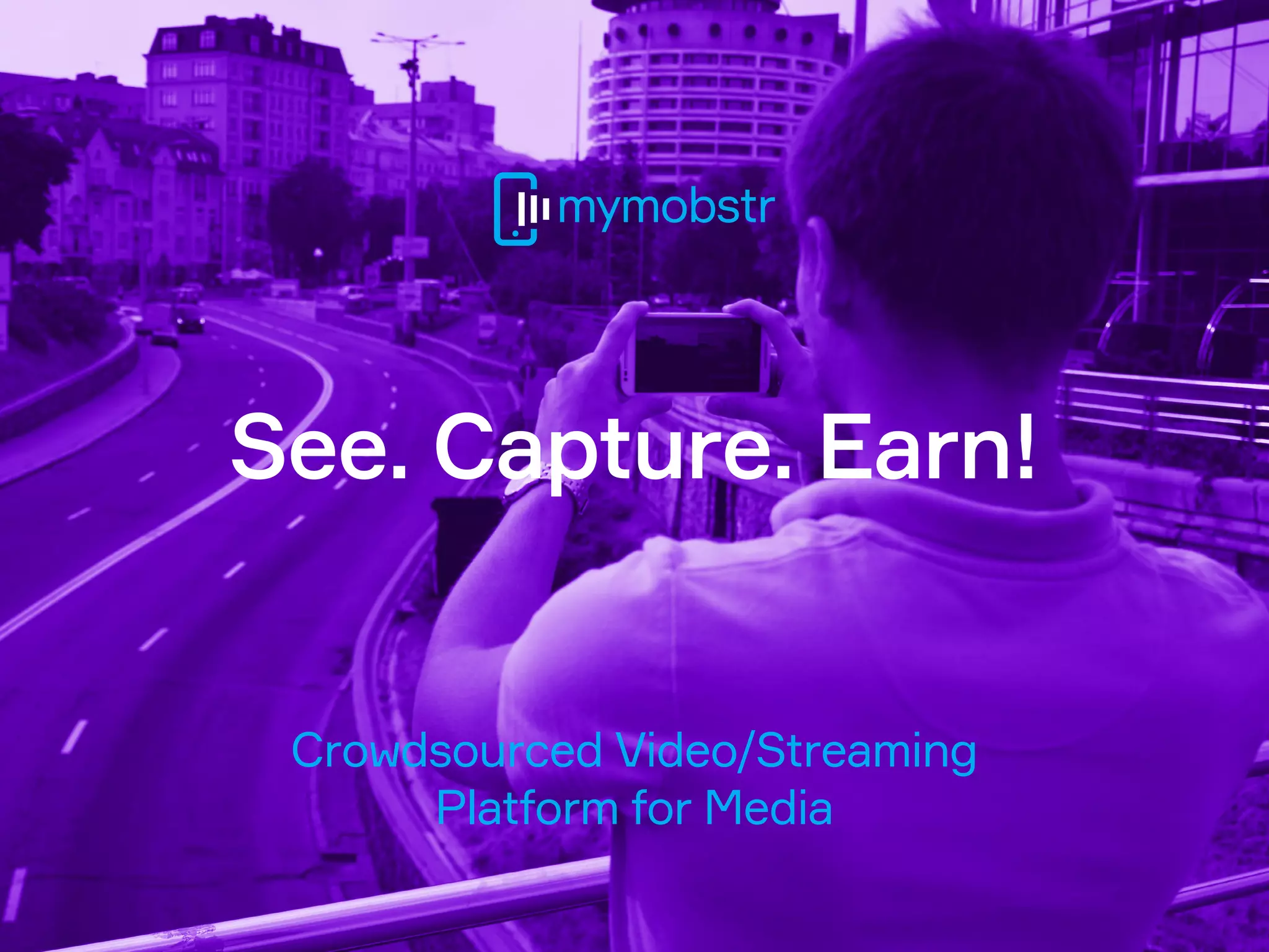
Mymobstr is a crowdsourced video and streaming platform targeting the media industry. The deck identifies two primary pain points: the slow delivery of content to media companies and the loss of valuable user-generated content (UGC) in the 'black hole' of generic hosting sites like YouTube. Their solution involves a location-based request system where media outlets can solicit authentic, unedited footage directly from users on the ground. The business model relies on a dual B2B and B2C approach, targeting TV channels and real estate agencies while acquiring users through social media and opin…
Key takeaways
- The platform positions itself as a 'turnkey solution' for content generation, focusing on authentic, unedited footage (Slide 5, 11).
- Mymobstr identifies a local market of 1.7 million people interested in news via smartphones, based on a 2015 1+1 media report (Slide 9).
- The team consists of three members covering project management, lead development, operations, UI-UX, and full-stack engineering (Slide 7).
- User acquisition is split between B2B partnerships (TV channels, real estate) and B2C direct acquisition (SEO, SMM, opinion leaders) (Slide 13).
- The solution emphasizes metadata, providing information on the time and author of the footage to ensure authenticity (Slide 5).
- The deck highlights 'comparable exits' and a 'scalable business model' as primary value drivers for investors (Slide 15).
- There is a notable absence of a specific financial 'ask' or a slide detailing how much capital is being raised in this version of the deck.
- The product interface shown in the mockup includes a bounty system, displaying rewards like '200 GRN' for specific footage requests (Slide 5).
Slide-by-Slide Analysis
Slide 1: Title Slide
The cover slide introduces Mymobstr with the tagline "See. Capture. Earn!" and defines the business as a "Crowdsourced Video/Streaming Platform for Media." The background image features a user holding a smartphone to record a city scene, which effectively communicates the mobile-first nature of the product. The branding uses a purple and cyan color palette that remains consistent throughout the deck.
Slide 3: Problem
This slide identifies two pain points. First, "Late content delivery to media companies," suggesting that traditional news gathering is too slow for the digital age. Second, "User Generated Content lost in the black hole of video hostings (e.g. YouTube)." This positions the problem not just as a lack of content, but as a discovery and distribution failure for high-value, timely footage.
Slide 5: Solution
The solution slide highlights "Location-based requests for Footage" and the provision of "Authentic, not edited footage (video, photo, live stream) from place with information of time, author." A smartphone mockup shows a list of "Pending Requests," one of which offers "200 GRN" (Ukrainian Hryvnia) for specific video of an incident on a bridge. This slide is critical as it explains the marketplace mechanics: media outlets request, users fulfill, and authenticity is baked into the metadata.
Slide 7: Mymobstr Team
The team slide features three individuals: Andrii Bulavinov (PM, Lead Developer), Evgen Tytov (Operations, UI-UX), and Dmytro Bezkorovainyi (Front-End, Back-End). The team appears to be heavily weighted toward product and engineering, with all three members having technical or operational roles. There is no mention of previous exits, specific industry experience, or advisors on this slide.
Slide 9: Local Market
Mymobstr quantifies its initial target market as "1.7M interested in news on smartphones," citing a "1+1 media internet-audience survey report (2015)." A circular diagram illustrates the flow of "Ads/Money" and "Content" between users and "TV / Media" outlets. This slide suggests the company is starting with a focus on the Ukrainian market, given the source of the data and the currency used in the earlier mockup.
Slide 11: Competitive Advantages
The company lists three pillars of differentiation: "Content Generation turnkey solution," "Location-based request for Footage," and "Ease of use." While these are clear, the slide lacks a comparison against direct competitors or existing alternatives like Stringr or Fresco News, which operated in similar spaces during the same era.
Slide 13: Users Acquisition
The acquisition strategy is bifurcated. For B2B, they focus on "Sales & Partnership" with TV channels and real estate agencies. For B2C, they list "Direct user acquisition" via opinion leaders, SMM (Social Media Marketing), context advertising, and SEO. This shows a dual-sided marketplace approach, though it does not detail the projected cost per acquisition (CAC).
Slide 15: Value Drivers
The final content slide lists four drivers: "Growth of the UGC market," "Scalable business model," "Comparable exits," and "Recurring revenues (B2B market)." This is a high-level summary intended to appeal to investor interests in scalability and liquidity, though it lacks specific data points to back up these claims.
What Works
Clear Value Proposition: The deck does an excellent job of explaining exactly what the product does within the first five slides. The "See. Capture. Earn!" tagline is simple and effectively summarizes the user journey.
Visual Mockups: Including a screenshot of the app (Slide 5) with a real-world use case (a request for footage of a car accident) helps investors visualize the transaction flow and the incentive structure for users.
Niche Targeting: By specifically mentioning real estate agencies and TV channels (Slide 13), the founders show they have thought about specific verticals where high-quality, verified, location-specific footage is a recurring need, rather than just chasing general 'news.'
What Is Missing
The Ask: The most significant omission in this set of slides is a clear funding request. There is no mention of how much money is being raised, the valuation, or how the funds will be allocated (e.g., 50% engineering, 30% marketing).
Unit Economics: While the deck mentions "Recurring revenues" and "Ads/Money," it provides no information on the take rate (the percentage Mymobstr keeps from each transaction) or the Lifetime Value (LTV) of a B2B client.
Traction Metrics: There are no slides showing current progress. It is unclear if the platform has any active users, signed partnerships with TV channels, or completed transactions. Without traction data, the deck feels like a pre-seed concept pitch rather than a growth-stage presentation.
Competitive Landscape: The "Competitive Advantages" slide is generic. A standard 2x2 matrix or a feature comparison table against established players would have strengthened the argument for why Mymobstr is a better choice for media companies.
Founder Takeaways
Standardize the Problem-Solution Fit: Mymobstr follows the classic pitch deck structure by identifying a specific inefficiency (slow news gathering) and offering a specific technical fix (location-based mobile requests). Founders should emulate this directness.
Use Local Data to Prove a Micro-Market: Citing a specific 2015 media report for their local market (Slide 9) shows that the founders have done their homework. Even if the global market is the ultimate goal, proving the concept in a defined local geography is a common and effective strategy for marketplaces.
Define Roles Clearly: The team slide (Slide 7) clearly delineates who is responsible for what. In early-stage startups, investors want to see that the core competencies (product, ops, dev) are covered by the founding team.
Address Authenticity: In an era of increasing misinformation, Mymobstr’s focus on "authentic, not edited" footage with verified metadata (Slide 5) is a strong selling point that founders in the content space should emphasize.
Frequently asked questions
- What is the core problem Mymobstr aims to solve?
- According to slide 3, the company addresses two main issues: the 'late content delivery' to media companies who need breaking news footage immediately, and the fact that valuable user-generated content often gets lost on massive platforms like YouTube where it cannot be easily discovered or monetized by professional media outlets.
- How does the Mymobstr platform actually work for a user?
- As shown on slide 5, the platform uses location-based requests. A media company can request footage from a specific area, and users in that location receive a notification. The app allows them to capture and upload authentic, unedited video, photos, or live streams, which include verified time and author data.
- Who is the target audience for this platform?
- The deck identifies two distinct groups on slide 13. The B2B side targets TV channels, real estate agencies, and remote services. The B2C side targets the general smartphone-using public, specifically the 1.7 million people identified in their local market research on slide 9.
- What are the primary competitive advantages claimed by the company?
- Slide 11 lists three main advantages: providing a 'turnkey solution' for content generation, the specific 'location-based request' functionality for footage, and general 'ease of use' for both the content creators and the media buyers.
- Does the deck provide information on the company's financial health?
- No. The provided slides do not include revenue figures, burn rate, or specific financial projections. Slide 15 mentions 'recurring revenues' in the B2B market as a value driver, but no actual dollar amounts or growth percentages are listed in the available slides.