MyFavorito’s 14-slide deck is a classic example of a 'problem-solution' narrative built around a high-profile pilot. The company addresses a specific pain point: large brands like Coca-Cola and Nestle spending billions on marketing while seeing declining revenues. The deck positions MyFavorito as a 'CRM-tech' alternative to traditional 'Ad-tech,' claiming to offer 20x more customer relationships than Facebook for their pilot partner, McDonald's. While the deck excels at establishing founder credibility—citing 15+ years of experience and $30 million in previously generated revenue—it is notabl…
Key takeaways
- The deck identifies a $100 billion marketing waste problem among top-tier global brands on slide 2.
- Slide 6 uses a quote from Noah Kagan to argue that social media 'likes' do not translate to sales, positioning the product against Facebook and Instagram.
- The company leverages a pilot with McDonald's to claim a 6.3% increase in store visits and sales on slide 10.
- MyFavorito claims to provide 20x more customer relationships than Facebook for the same marketing spend on slide 10.
- Traction is highlighted on slide 12 with 100 customers, 300,000 users, and $500,000 in revenue.
- The founders, Dirk and Mark Schlenzig, cite a track record of generating $30 million in revenue and 3.5 million daily active users in previous ventures on slide 13.
- The deck completely omits a formal investment 'Ask' or a breakdown of how the $270,000 raised would be allocated.
- There is no slide dedicated to unit economics, customer acquisition costs (CAC), or lifetime value (LTV).
The Narrative: From Waste to Relationship
The MyFavorito pitch deck, produced in 2015, follows a classic narrative arc designed to unsettle the investor before offering a proprietary cure. It begins by attacking the status quo of the advertising industry, specifically targeting the 'waste' generated by Fortune 500 brands. By framing the problem as a systemic failure of 'Ad-tech' to drive revenue, the founders carve out a niche for their 'CRM-tech' solution. The deck is heavily reliant on social proof, using the McDonald's pilot as the primary evidence of product-market fit.
Slides 1-5: The Billion-Dollar Problem
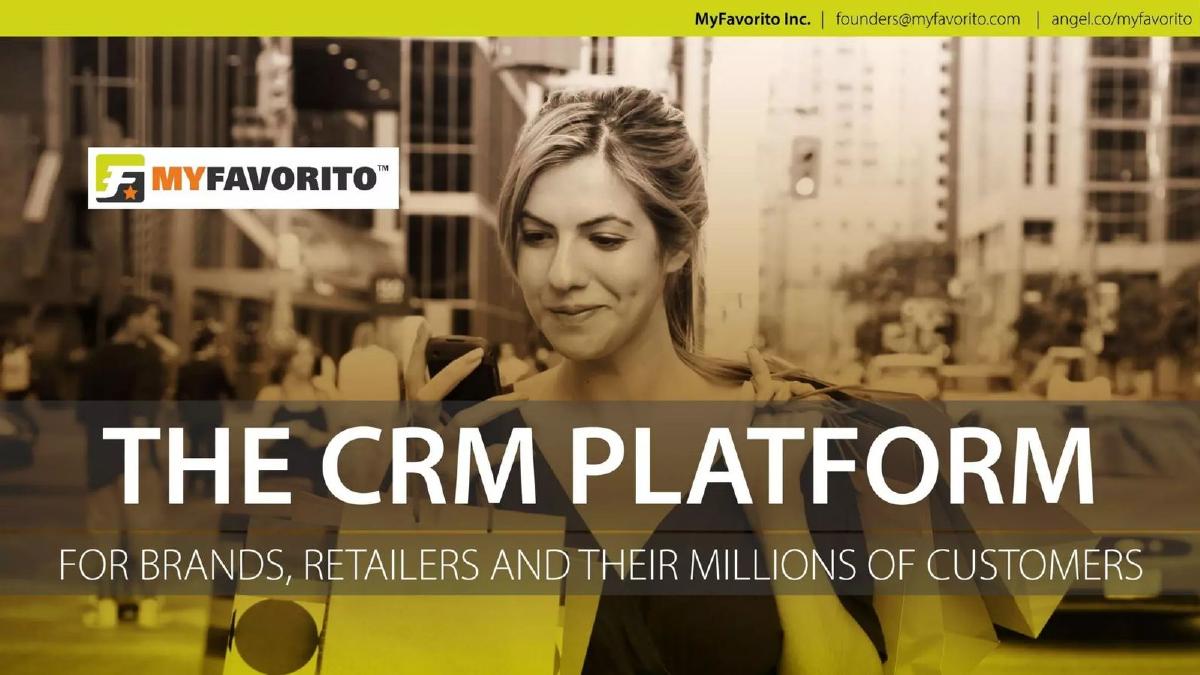
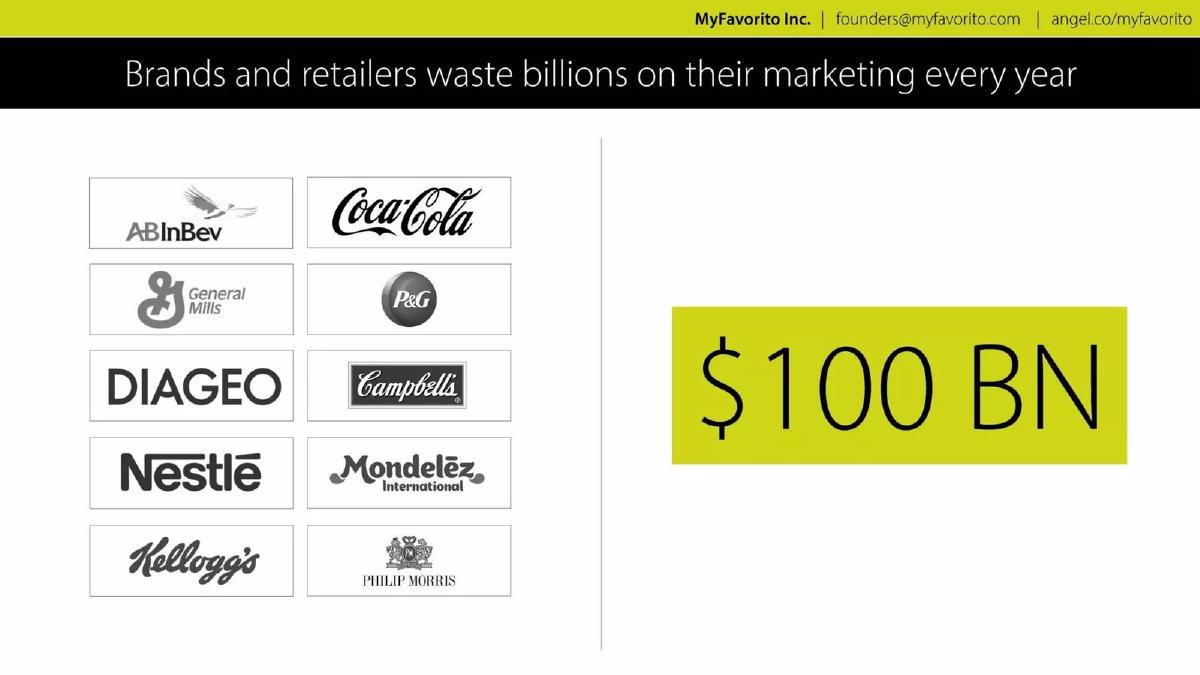
Slide 1 introduces the company as 'The CRM Platform for brands, retailers and their millions of customers.' The contact information includes an AngelList URL, signaling the deck's purpose for early-stage fundraising. Slide 2 immediately goes for the 'shock and awe' metric, stating that brands and retailers waste '$100 BN' on marketing every year, accompanied by logos of global giants like P&G, Nestle, and Coca-Cola.
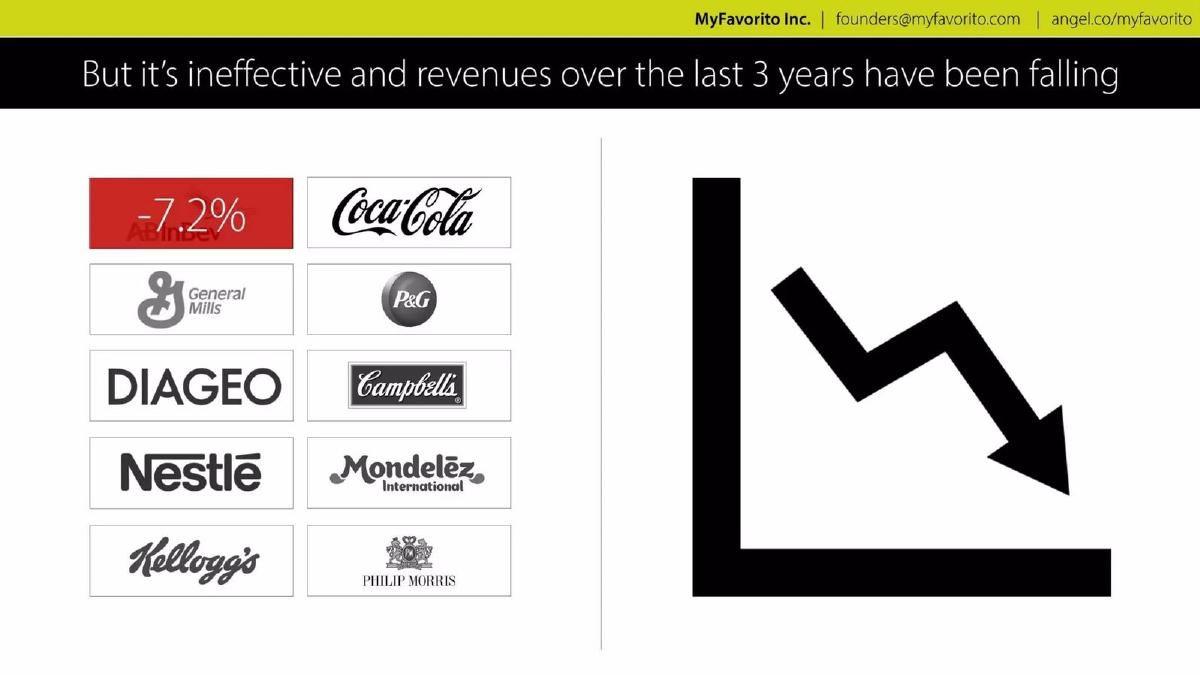
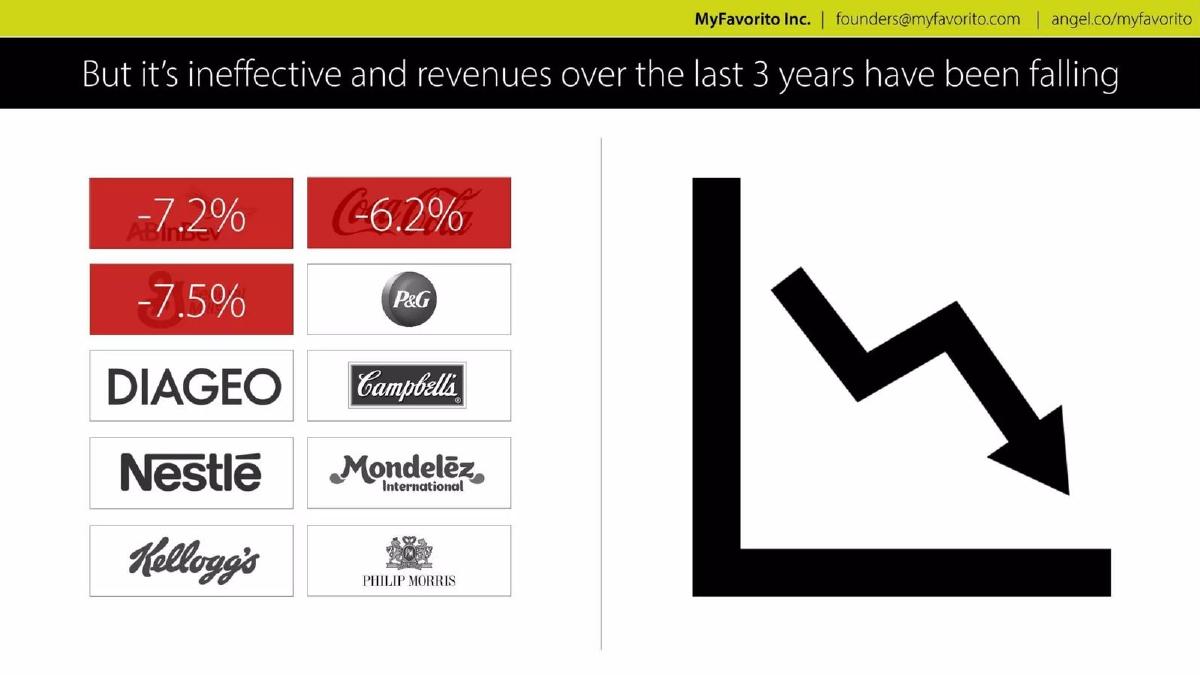
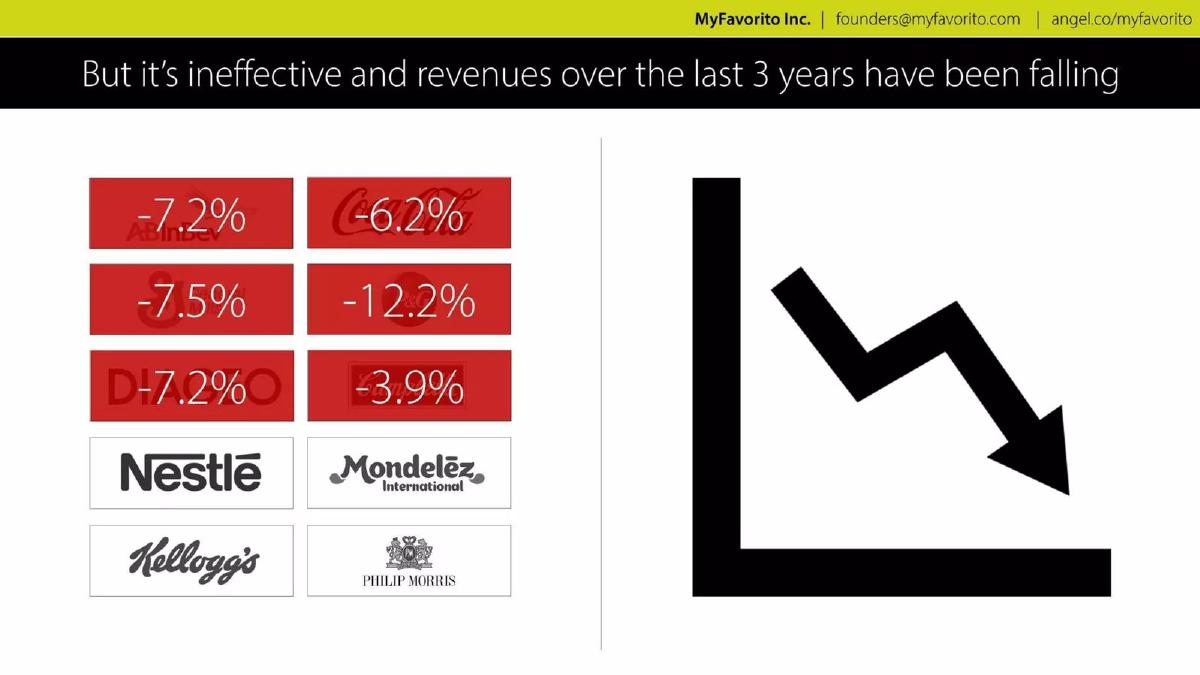
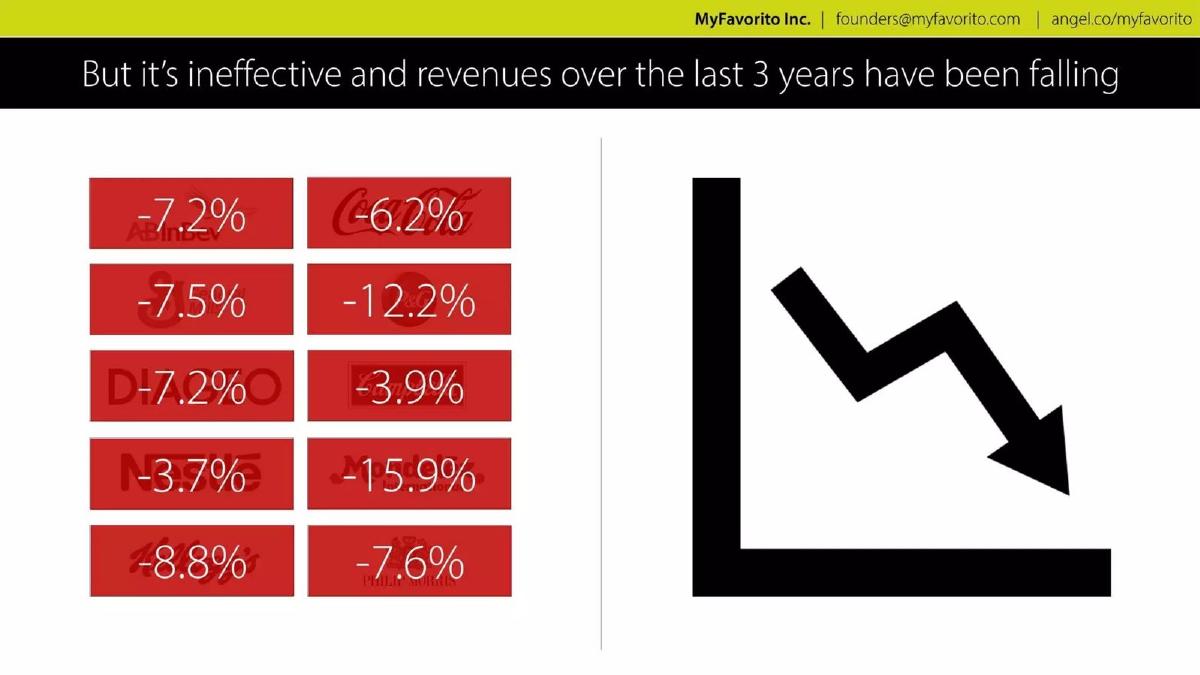
Slides 3, 4, and 5 function as a progressive reveal of industry decline. The headline 'But it’s ineffective and revenues over the last 3 years have been falling' is supported by a series of red overlays on the brand logos. The deck cites specific revenue drops: AB InBev at -7.2%, Coca-Cola at -6.2%, General Mills at -7.5%, Diageo at -7.2%, Campbell's at -3.9%, Nestle at -3.7%, Mondelez at -15.9%, Kellogg's at -8.8%, and Philip Morris at -7.6%. This sequence is designed to prove that the current marketing paradigm is not just inefficient, but failing to protect the top line of the world's largest companies.
Slides 6-8: The Solution Shift
Slide 6 pivots to the 'Why.' It lists Facebook Ads, Google Adwords, Snapchat Stories, and Instagram Ads, followed by a blunt 'No.' It features a quote from Noah Kagan: '"LIKES" DO NOT PAY THE BILLS. SALES DO.' This is a direct challenge to the social media metrics that were dominant in 2015. Slide 7 defines the '#1 growth technology' as 'Personal relationships with millions of customers.' The visual shows a central building (the brand) connected directly to various individuals via smartphone icons, bypassing traditional media intermediaries.
Slide 8 reinforces this by showing the MyFavorito logo as the bridge between the brand and the consumer, emphasizing a direct-to-mobile connection.
Slides 9-11: The McDonald's Case Study and Product Definition
Slide 9 provides the most tangible evidence in the deck: 'MyFavorito's first customer was McDonald's.' It shows photos of a McDonald's employee holding a 'Stars of America' promotional box featuring a MyFavorito QR code, and a smartphone scanning that code. This demonstrates the offline-to-online bridge the platform facilitates.
Slide 10 quantifies the success of this pilot. It claims '+6.3% More store visits and sales,' '5X Less marketing costs,' and '20X More customer relationships than facebook.' These are bold claims, particularly the 20x multiplier against Facebook, though the deck does not define exactly how a 'customer relationship' is measured compared to a Facebook 'like' or 'follow.'
Slide 11 finally defines the product components. It breaks the platform into three parts: 'Irresistible ENGAGEMENT TOOLS,' '360-degree-view CUSTOMER DATABASE,' and 'AI-driven, 24-7 AUTOMATED SALES TEAMS.' The slide promises that these tools lead to increased store visits, loyalty, referrals, and sales.
Slides 12-14: Traction, Team, and Conclusion
Slide 12 presents the company's growth trajectory. It claims 100 customers, 300,000 users, $500,000 in total revenue, and $20,000 in MRR. A map shows a global presence, and a 'Microsoft loves us' logo is prominently displayed, though the nature of the Microsoft relationship is not explained. The chart shows a steep upward curve from 2016 to 2018, suggesting these are projections rather than historical data, given the deck is from 2015.
Slide 13 introduces the founders, Dirk and Mark Schlenzig. The slide establishes significant 'founder-market fit,' noting 15+ years of experience in CRM and a history of generating $30 million in revenue. They list previous enterprise customers including Microsoft, Coca-Cola, BP, and Telekom Malaysia, which helps mitigate the risk of two founders tackling such a large market. Slide 14 concludes with the tagline 'The future of marketing is one-to-one' and contact information, noting the company is 'Built with passion... in California and Germany.'
What Works
Strong Problem Identification: By using specific revenue decline percentages for well-known brands, the deck creates a sense of urgency. It doesn't just say marketing is 'bad'; it says it is failing to prevent a -15.9% revenue drop for companies like Mondelez. High-Value Social Proof: Leading with McDonald's as the first customer is a powerful validator. Showing the physical product (the QR code on the box) makes the abstract concept of 'CRM-tech' feel real and operational. Founder Credibility: The 'Team' slide is exceptionally strong. Citing $30 million in previously generated revenue and 3.5 million daily active users provides investors with confidence that the founders have scaled products before.
What is Missing
The 'Ask': There is no slide indicating how much money the company is looking to raise or the terms of the round. While the catalogue facts state $270,000 was raised, the deck itself leaves the investor guessing. Business Model and Pricing: The deck never explains how MyFavorito makes money. Is it a SaaS fee per store? A commission on sales? A fee per customer relationship? This is a significant omission for a 'sales engine.' Competitive Landscape: While the deck dismisses Facebook and Google, it ignores other CRM competitors like Salesforce, HubSpot, or retail-specific loyalty platforms. Financial Projections: Aside from a vague growth arrow on the traction slide, there are no detailed projections for future revenue, expenses, or profitability.
What a Founder Should Copy
The 'Red Overlay' Technique: Slides 3-5 are a masterclass in visual storytelling. By taking a familiar set of logos and gradually 'bleeding' them with red negative percentages, the founders visually communicate a market crisis without needing a wall of text. The 'Ad-tech vs. CRM-tech' Positioning: Founders should copy the way MyFavorito defines what it is by contrasting it with what it is not. By explicitly stating 'CRM-tech, not Ad-tech,' they distance themselves from the volatility and 'waste' associated with the advertising industry. Tangible Pilot Results: If you have a pilot with a major brand, dedicate a slide to showing the product in the wild. The photo of the McDonald's box is worth more than ten slides of feature lists.
Frequently asked questions
- What is the core problem MyFavorito aims to solve?
- According to slides 2 through 6, MyFavorito targets the inefficiency of traditional marketing spend. It highlights that major brands like AB InBev, Coca-Cola, and P&G are wasting billions while seeing revenue declines (ranging from -3.7% to -15.9%). The deck argues that social media engagement, such as 'likes,' fails to drive actual sales, creating a need for a direct CRM-based relationship between brands and consumers.
- How does the product differ from traditional advertising?
- Slide 11 explicitly states, 'MyFavorito is CRM-tech, not Ad-tech.' Unlike advertising platforms that charge for impressions or clicks, MyFavorito provides a cloud-based platform featuring engagement tools (like QR codes on packaging, shown on slide 9), a 360-degree customer database, and AI-driven automated sales engines to facilitate one-to-one communication with customers.
- What specific traction did the company demonstrate in the deck?
- On slide 12, the company reports having 100 customers and 300,000 users. Financial milestones include $500,000 in total revenue and $20,000 in Monthly Recurring Revenue (MRR). The slide also features logos of major retail partners including McDonald's, Diageo, GameStop, Subway, and Zalando, alongside a 'Microsoft loves us' badge.
- Who are the founders and what is their background?
- Slide 13 introduces Dirk Schlenzig (CEO) and Mark Schlenzig (CTO). They are described as brothers and CRM experts with over 15 years of experience in cloud CRM products. They claim to have previously generated $30 million in revenue and managed 3.5 million daily active users, serving enterprise clients like BP, Telekom Malaysia, and Coca-Cola.
- What critical information is missing from this pitch deck?
- The deck lacks several standard components: a specific funding ask, a 'Use of Funds' breakdown, a detailed competitor matrix, and financial projections. It also fails to explain the pricing model or unit economics. While it mentions 'AI-driven' sales teams, it does not provide technical depth on how the platform's automation works or how it integrates with existing retail POS systems.