Riogrande's 2022 pitch deck serves as a blueprint for the e-commerce aggregator model tailored to emerging markets. By focusing on the Latin American middle class, the company positioned itself to capture a +$100B market growing at 13.4% CAGR, significantly faster than the US. The deck highlights a 40x revenue growth since July 2021 and a target of $250M in run-rate revenue by 2023. While the deck is strong on team pedigree and market opportunity, it is notably light on specific unit economics and the exact terms of the $12M Seed round. The presentation relies heavily on the 'proven' nature o…
Key takeaways
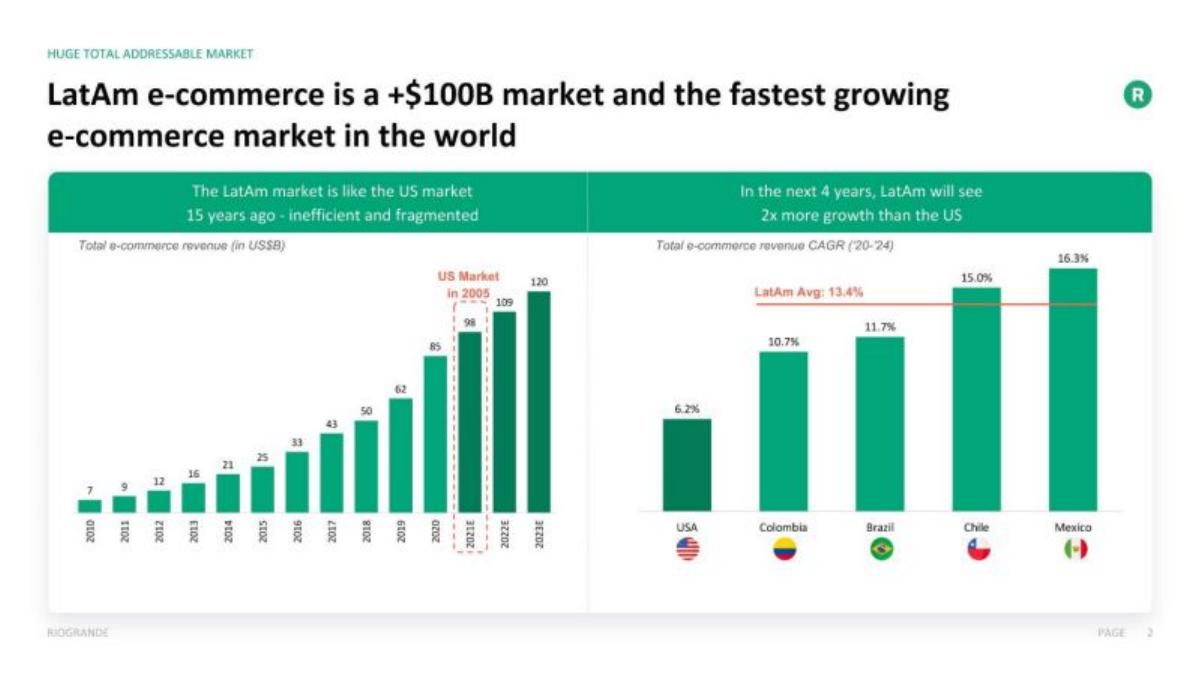
- The Latin American e-commerce market is valued at +$100B and is described as being in a state similar to the US market 15 years ago (Slide 2).
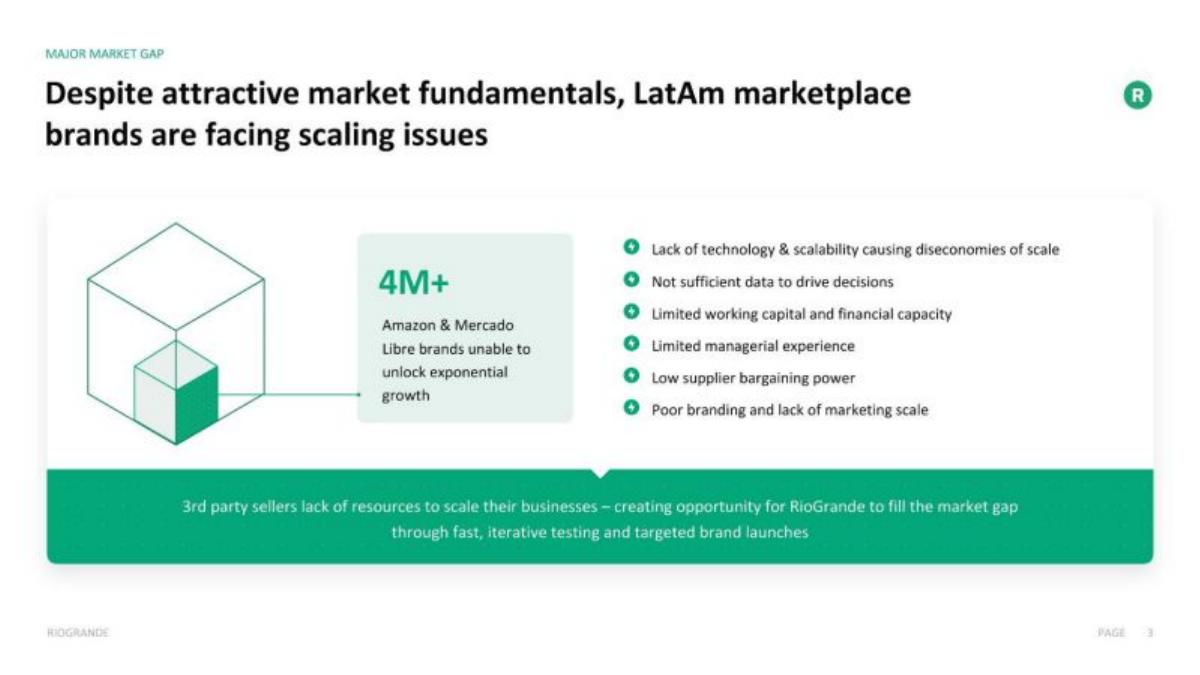
- Riogrande identifies a gap of 4M+ Amazon and Mercado Libre brands that lack the technology and capital to scale (Slide 3).
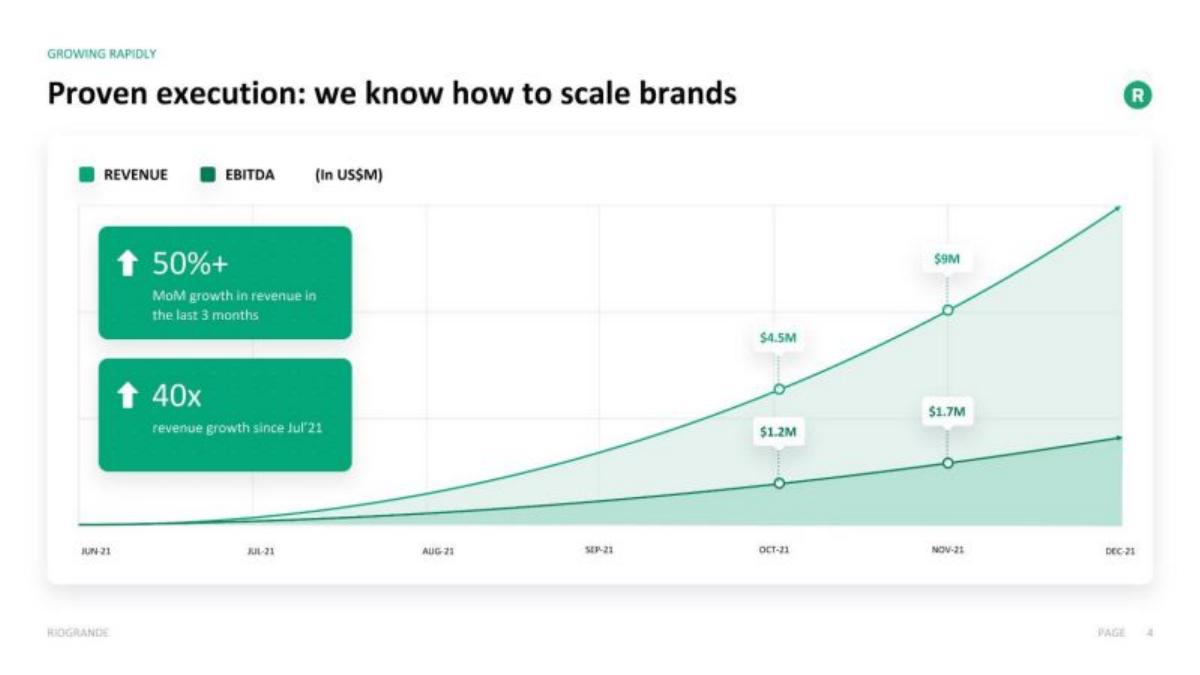
- The company reported 40x revenue growth between July 2021 and December 2021, reaching a $9M run rate (Slide 4).
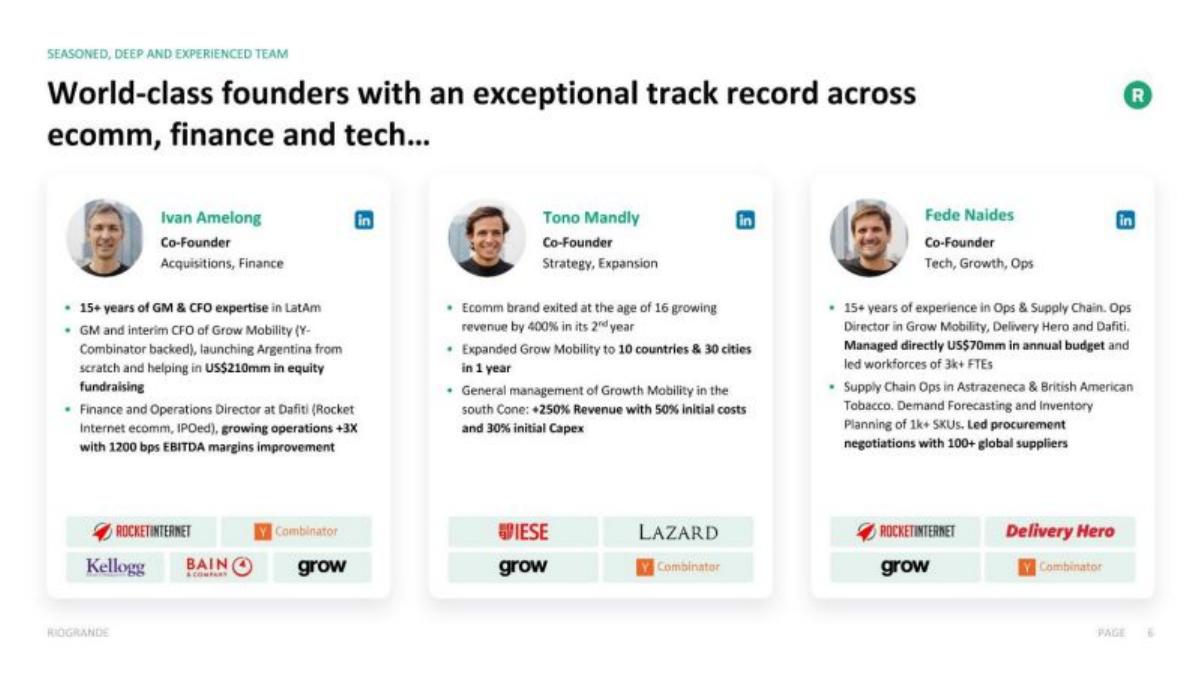
- The founding team possesses significant experience from Y-Combinator, Rocket Internet, and major regional players like Grow Mobility and Dafiti (Slide 6).
- Riogrande uses a 'buy and build' strategy, acquiring brands in categories like Shapeware, Sexual Wellness, and Nutrition (Slide 9).
- The proprietary tech stack integrates data from Mercado Libre, Amazon, and Shopify to automate inventory and sales (Slide 10).
- The roadmap outlines a three-phase expansion from Mexico into Chile, Colombia, Brazil, and Argentina (Slide 11).
- The deck sets an ambitious goal of reaching $250M in run-rate revenue by the end of 2023 (Slide 12).
Executive Summary: The Aggregator Play in Emerging Markets
Riogrande’s pitch deck is a masterclass in the 'proven model, new geography' pitch. By 2022, the e-commerce aggregator model (pioneered by companies like Thrasio) was well-understood by investors. Riogrande’s task was not to prove that aggregation works, but to prove that they were the right team to execute it in Latin America. The deck uses a clean, professional aesthetic to communicate rapid scaling and operational sophistication.
Slide 1: Title and Positioning
The cover slide is minimalist, featuring the Riogrande logo and the tagline 'SCALING E-COMMERCE IN LATAM.' Notably, it features the Y Combinator logo prominently. For a Seed round, this badge of honor serves as immediate social proof, signaling to investors that the founders have already passed a rigorous vetting process. The date is listed as February 2022.
Slide 2: The Macro Opportunity
Riogrande frames the Latin American market as a time-machine opportunity. Slide 2 states that the 'LatAm market is like the US market 15 years ago - inefficient and fragmented.' This is a classic narrative technique used to suggest that the outcome is inevitable, and the only variable is timing. The slide provides a bar chart showing total e-commerce revenue growing from $7B in 2010 to an estimated $120B in 2023. It also highlights that LatAm will see '2x more growth than the US' over the next four years, with a regional average CAGR of 13.4%.
Slide 3: The Problem – Scaling Issues for 3rd Party Sellers
This slide identifies the 'Major Market Gap.' It claims there are '4M+ Amazon & Mercado Libre brands unable to unlock exponential growth.' The deck lists six specific pain points: lack of technology, insufficient data, limited working capital, limited managerial experience, low supplier bargaining power, and poor branding. By listing these, Riogrande defines its own value proposition: it will provide the resources these 4 million sellers lack.
Slide 4: Traction and Revenue Growth
Traction is the heart of this deck. Slide 4 shows a revenue and EBITDA curve from June 2021 to December 2021. The headline claims '40x revenue growth since Jul’21' and '50%+ MoM growth in revenue in the last 3 months.' The chart shows revenue hitting a $9M run rate in November 2021, with EBITDA reaching $1.7M . This demonstrates that the company is not just acquiring brands, but doing so profitably and at high speed.
Slide 5: Competitive Advantage and Value Creation
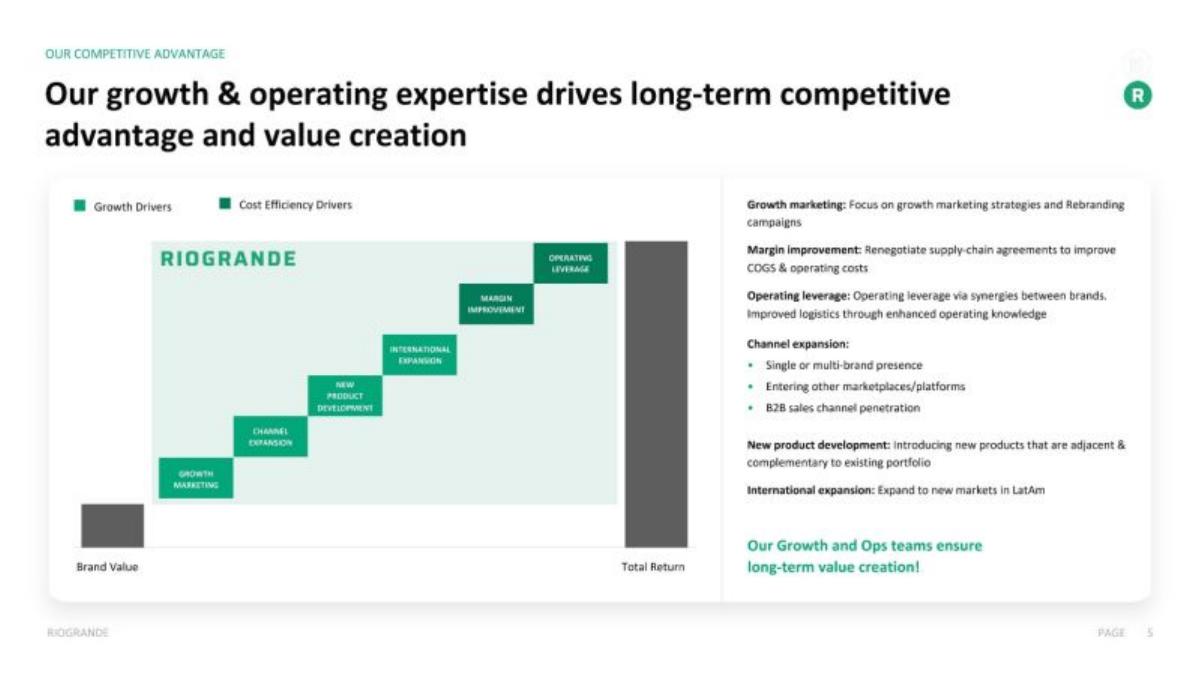
Riogrande breaks down its 'Growth & Operating Expertise' into a staircase of value drivers. These include growth marketing, channel expansion, new product development, international expansion, margin improvement, and operating leverage. The slide argues that these interventions take a brand from its initial 'Brand Value' to a much higher 'Total Return.' This slide is critical for explaining how the aggregator actually makes money beyond simple financial engineering.
Slide 6 & 7: The 'World-Class' Team
The team section spans two slides, emphasizing the 'deep and experienced' nature of the staff. Slide 6 profiles the three co-founders: Ivan Amelong, Tono Mandly, and Fede Naides. Their resumes are packed with high-signal names: Rocket Internet, Y Combinator, Bain & Company, Lazard, and Delivery Hero. Specific achievements, like managing a $70M annual budget or growing operations 3x with 1200 bps EBITDA improvement, are highlighted in bold. Slide 7 extends this to the broader leadership team, covering M&A, Growth, New Business, and Tech, featuring logos from Goldman Sachs, Amazon, and Rappi.
Slide 8: Investor Base
Social proof continues on Slide 8 , which lists their 'top-tier' backers. The slide is split between Latin American investors (Mercado Libre, Rappi, Kavak) and US investors (Y Combinator, Harvard Management Company, JAM Fund). This mix suggests that the company has both local market support and access to deep-pocketed US venture capital.
Slide 9: The Portfolio Strategy
Slide 9 validates the business model by showing their current brands alongside 'proven brands outside of LatAm.' For example, in the 'Shapeware' category, they list their brand 'I love shape' next to Spanx ($1B company) and Shapermint ($150M sales). In 'Nutrition,' they compare their brand 'HUMAN+' to Goli (+$700M sales). This 'X for Y' comparison helps investors visualize the ceiling for each individual brand in the Riogrande portfolio.
Slide 10: Proprietary Tech Stack
To differentiate themselves from a simple private equity firm, Riogrande showcases its 'Tech Platform' on Slide 10. The diagram illustrates how they ingest 'thousands of data points' from marketplaces like Mercado Libre, Amazon, and Shopify. This data flows through a proprietary API and data processing layer to manage inventory (WMS) and enterprise resources (ERP). The implication is that their scale is driven by automation, not just headcount.
Slide 11: The Roadmap (GTM Strategy)
The Go-To-Market strategy is presented in three phases. Phase 1 (2021-2022) focused on Mexico and validating the model. Phase 2 (2022) involves expanding into Chile and Colombia and transforming into an omni-channel business. Phase 3 (2023+) targets leadership across LatAm, including Brazil and Argentina, with a goal of reaching 30+ brands and utilizing ML-powered automation.
Slide 12: The Vision
The final content slide sets a bold target: '$250M in run rate revenue by 2023.' It reiterates that the strategy is 'proven, consistent and repeatable' and yields 'exceptional FCF (Free Cash Flow) generation.' This is a strong closing note, focusing on the financial outcome for investors.
What Riogrande Does Well
The deck excels at Team Credibility. In the aggregator space, execution is everything. By showcasing a team that has already scaled major LatAm unicorns (like Rappi and Kavak), they mitigate the perceived risk of operating in a complex emerging market. The use of comparative benchmarking (Slide 9) is also highly effective; it allows investors to use successful US companies as a proxy for Riogrande’s potential brand exits.
Furthermore, the traction slide is exceptionally clear. Many startups obfuscate their revenue with 'Gross Merchandise Volume' (GMV) or other vanity metrics. Riogrande explicitly labels their revenue and EBITDA, showing a clear path to profitability even at the Seed stage.
What is Missing
The most glaring omission is the Ask Slide. While the catalogue listing mentions a $12M Seed round, the deck itself does not state how much they are raising, at what valuation, or how the funds will be allocated between brand acquisitions and technology development. This information is usually vital for a pitch deck.
Additionally, there is a lack of Competitive Landscape analysis. The aggregator model became highly competitive in 2021 and 2022. The deck does not mention other regional players or how Riogrande plans to win bidding wars for the best brands. There is also no mention of Unit Economics at the brand level—investors would typically want to see the average acquisition multiple they are paying and the post-acquisition growth rates of specific brands they have already bought.
Founder Takeaways: What to Copy
Use 'Time Machine' Logic: If you are building in an emerging market, compare your region to a more developed one to show the 'inevitable' growth path (Slide 2). · Quantify Team Impact: Don't just list where you worked; list the specific dollar amounts you managed and the percentage growth you achieved (Slide 6). · Benchmark Your Portfolio: If you have multiple products or brands, compare them to well-known billion-dollar companies to give investors a sense of the 'Total Addressable Market' for each segment (Slide 9). · Visual Tech Stacks: Even for non-SaaS companies, showing a diagram of how data flows through your business helps prove that your operations are scalable and not just manual labor (Slide 10).
Frequently asked questions
- What is Riogrande's core business model?
- Riogrande operates as an e-commerce aggregator. According to the catalogue listing and Slide 9, they acquire and incubate local digital brands in Latin America. They focus on high-growth categories like personal care, nutrition, and home goods, applying professional management, technology, and capital to scale these brands across multiple regional marketplaces.
- How does the deck justify the market opportunity in Latin America?
- Slide 2 compares the current LatAm market to the US market in 2005, highlighting that it is 'inefficient and fragmented.' It notes a 13.4% average CAGR for the region, with Mexico leading at 16.3%, which is more than double the projected growth rate of the US market.
- What traction did Riogrande show at the time of the Seed round?
- Slide 4 shows significant early traction, claiming 50%+ Month-over-Month revenue growth in the three months leading up to December 2021. The chart indicates they grew from a negligible base in July 2021 to an $9M revenue run rate by December 2021, with EBITDA also showing a positive upward trend.
- Who are the key people behind the company?
- The team is a major focal point of the deck. Co-founders Ivan Amelong, Tono Mandly, and Fede Naides bring experience from Rocket Internet, Bain & Company, and Lazard. Slide 6 and 7 highlight their history of managing $70M+ budgets and scaling operations across 10 countries, providing the 'operating expertise' necessary for an aggregator.
- What is missing from this pitch deck?
- The deck lacks a clear 'Ask' slide, which usually specifies the amount being raised and the intended allocation of capital. It also omits detailed unit economics, such as Customer Acquisition Cost (CAC) or Lifetime Value (LTV) for the individual brands, and does not provide a list of current competitors in the LatAm aggregator space.