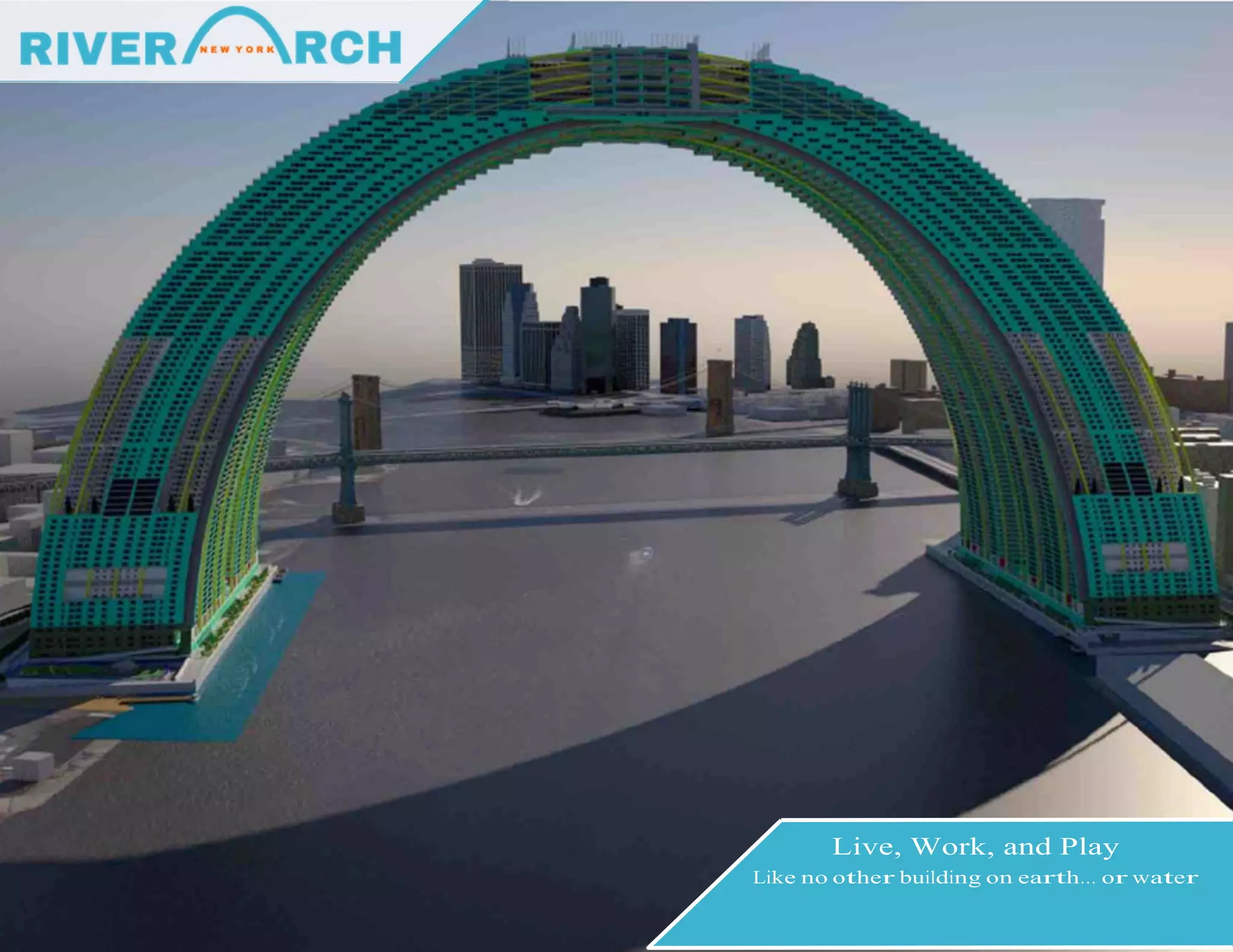
The RiverArch deck presents a vision for what it claims would be the largest building in the world by floor area, spanning the East River in New York City. The project seeks $5 million in 'Stage 0' funding to navigate the initial NYC planning and zoning hurdles. The total development cost is estimated at a staggering $21,594,479,280, with a projected profit of approximately $9.14 billion over a 68-month timeline. The deck is heavy on architectural inspiration and granular financial projections for secondary income streams, such as observation deck fees and even a 'stairwell run.' However, it…
Key takeaways
- The project estimates a total development cost of $21,594,479,280 (Slide 5).
- The building is designed to span the East River, connecting Manhattan and Brooklyn with a footprint of 400,000 square feet (Slide 5).
- The current 'Stage 0' ask is $5 million for 1% equity in RiverArch profit to reach the Pre-Application Statement (PAS) milestone (Slide 8).
- Scott Baker is identified as the Chair, CEO, and Lead Designer, holding 100% stake in RiverArch Ventures (Slide 8).
- Revenue projections include $150 million annually from an observation deck and $575 million in total combined annual income (Slide 6).
- The deck admits the project currently lacks site control and requires a Zoning Text Amendment to build over the river (Slide 7).
- Construction costs are estimated at $600 per square foot, totaling over $15 billion for the direct building costs (Slide 5).
- The proposal includes a 'sunset clause' where investors receive remaining funds if the PAS goal is not achieved within one year (Slide 8).
Slide 1: Title Slide
The opening slide introduces the 'RiverArch' brand with a high-resolution 3D rendering of a massive, green-tinted arch structure spanning the East River. The Manhattan skyline, including the Brooklyn and Manhattan Bridges, is visible in the background, providing scale. The tagline reads: 'Live, Work, and Play Like no other building on earth... or water.' The visual establishes the project as a landmark architectural undertaking.
Slide 2: Identifying the Problems
This slide lists eleven pain points that the project aims to address. These include macro-urban issues such as 'Too Little, or Unaffordable Housing,' 'Too Much Displacement & Gentrification,' and 'Too Vulnerable to Flooding & Sea Level Rise.' It also touches on infrastructure needs like 'Too few Transportation Options' and 'Too Dependent on Unreliable Grid & Fossil Fuels.' The slide serves to position a single massive building as a multi-purpose solution to New York City's systemic urban challenges.
Slide 3: Items Completed
RiverArch lists its progress to date to demonstrate momentum. Key achievements include a full building model in Sketch-Up, an entry into the 2021 NYSERDA Buildings of Excellence, and the formation of RiverArch Ventures LLC. Notably, the slide mentions they have 'Received Legal Opinion' regarding the need for a Zoning Text Amendment and state/federal permits. They also claim to have met with the Department of City Planning (DCP) three times, as well as the Mayor’s Office and Borough President offices. The slide also notes an independent energy analysis resulting in a '100 SEDI Score.'
Slide 4: Similar Inspirations
This slide uses a collage of existing and conceptual buildings to provide architectural context. It features Zaha Hadid’s CECEP headquarters, the Sheraton Huzhou Hot Spring Resort (the 'Horseshoe Hotel'), and 'The Via' at 57 West in Manhattan. By showing these completed or planned 'O' and 'U' shaped buildings, the deck attempts to normalize the radical design of the RiverArch. It explicitly states that while these are inspirations, the RiverArch is unique because it is a 'major river-span' providing thousands of residential units.
Slide 5: Total Development Cost
This is a data-heavy slide featuring a detailed spreadsheet. The 'Total Development Cost' is stated as $21,594,479,280. The breakdown includes $15.1 billion for building construction (estimated at $600 per square foot) and $1.27 billion for retail/commercial tenant improvements. Land acquisition is estimated at a relatively low $81.7 million, with a footnote explaining that land costs are expected to be low due to the need for brownfield remediation and lack of competitive bids for piers. The project assumes a 60/40 debt/equity split and a 68-month development timeline.
Slide 6: Additional Income Streams
This slide details how the project will generate cash flow beyond apartment sales. It compares the RiverArch observation deck to the Empire State Building, projecting 3 million visitors a year at $35-$70 per ticket, totaling $150 million in average annual revenue. Other granular income sources include a 'Dog Center' ($2.28 million), a 'Senior Center' ($2.47 million), and even $60,000 from an annual stairwell run. The total combined annual revenue for the Condominium and RiverArch Corporation is projected at $575,816,610.
Slide 7: City Decision Chart
This slide outlines the New York City planning process (ULURP). It maps out five steps from 'Find out what's allowed' to 'Public Review or Agency Approval.' The deck notes that the goal of 'Stage 0' financing is simply to be allowed to submit the Pre-Application Statement (PAS). It identifies key stakeholders like Con Edison (which currently owns the Brooklyn site) and the EDC. A critical footnote admits that 'Legal and community opposition is not included in timeline, but may be significant.'
Slide 8: The Deal
The final slide in this set outlines the investment structure for 'Stage 0.' It seeks $5 million from Angel Investors for a 1% equity stake in 'RiverArch Profit.' Scott Baker is listed as the 100% owner of the Ventures entity. The deal includes a 'Sunset clause' after one year if the PAS goal is not achieved. If the goal is met, the project moves to 'Stage 1,' which involves forming a Joint Venture with a senior developer and seeking additional funding. The estimated total profit is cited as ~$9.14 billion, though it notes this is dependent on bank rates and future JV equity splits.
What Works in This Deck
The deck is exceptionally transparent about the scale of the challenge. Unlike many visionary projects that gloss over regulatory hurdles, Slide 7 and Slide 3 explicitly name the specific NYC agencies and legal amendments required to make the project a reality. This suggests the founders have done significant homework on the 'how' of NYC real estate development, even if the 'what' remains fantastical.
The financial modeling on Slide 5 and Slide 6 is granular. By breaking down costs to the 'per square foot' level and comparing observation deck revenues to the Empire State Building, the founders provide a logical framework for their multi-billion dollar projections. The inclusion of a 'sunset clause' in the deal terms (Slide 8) is a sophisticated way to mitigate risk for early angel investors, acknowledging that the project could easily be killed by the city within the first year.
What Is Missing from This Deck
The most glaring omission is a dedicated 'Team' slide with professional biographies. While Scott Baker and Emory Brooks are mentioned, there is no information regarding their track record in developing large-scale infrastructure or high-rise real estate. For a $21 billion project, the pedigree of the development team is usually the first thing an investor looks for.
There is also a lack of technical engineering detail regarding the 'river-span' itself. Building a habitable structure over a navigable waterway like the East River involves immense structural and maritime engineering challenges that are not addressed in these slides. Furthermore, while 'site control' is mentioned as a missing piece, there is no clear strategy for how the team intends to acquire the land from Con Edison or the EDC beyond 'meeting with them.'
Founder Takeaways
Be upfront about regulatory 'deal-breakers': RiverArch correctly identifies that a Zoning Text Amendment is their biggest hurdle. Founders in highly regulated industries should follow this lead by naming the specific permits or laws that stand in their way. · Use 'Stage 0' to bridge the gap: Asking for $5 million to reach a specific paperwork milestone (the PAS) is more realistic than asking for the full $21 billion upfront. Breaking a massive project into 'stages' with clear exit or sunset clauses makes a moonshot more palatable to investors. · Quantify secondary revenue: The deck does a great job of showing that the building isn't just a residential play. By modeling observation decks, laundry rooms, and dog centers, they show a diversified income stream that supports the overall valuation. · Scale requires a massive team: If you are pitching a project that would be the 'largest building in the world,' your deck must feature a team that looks capable of managing that scale. The absence of a deep bench of engineers, architects, and lobbyists is a significant weakness here.
Frequently asked questions
- What is the primary goal of the current funding round?
- The project is seeking $5 million in 'Stage 0' funding. The specific objective is to achieve the submission of a Pre-Application Statement (PAS) to the New York City Department of City Planning. This is a preliminary step in the long regulatory process required for a project of this scale, which currently lacks site control and necessary zoning permissions.
- How does RiverArch plan to generate revenue?
- Revenue is split between the RiverArch Corporation and a Condominium Corporation. Major streams include $150 million from observation deck fees, $144 million from apartment common charges, and smaller niche streams like a $60,000 annual 'RiverArch Run' through the stairwells. The total projected annual income across all entities is $575,816,610.
- What are the biggest risks identified in the deck?
- The deck explicitly mentions the need for a Zoning Text Amendment, as well as State and Federal permits. Slide 7 notes that legal and community opposition is not included in the timeline but 'may be significant.' Furthermore, the project does not yet have site control, which is a prerequisite for moving past the initial planning stages.
- Who is leading the project?
- Scott Baker is the central figure, listed as the Chair, CEO, and Lead Designer. He currently holds 100% of the stake in RiverArch Ventures. The deck also mentions Emory Brooks as a board member and notes that the initial team has been formed, though specific bios for other team members are not provided in the reviewed slides.
- What is the proposed timeline for the project?
- The financial projections are based on a 68-month timeline. The immediate goal is a one-year window to hit the 'Stage 0' milestone (PAS submission). If that goal is not met, a sunset clause is triggered to dissolve the company and return remaining funds to investors.