VO/D’s 12-slide Series A deck presents a structured alternative to the often-haphazard world of celebrity endorsements. Instead of simple licensing, VO/D positions itself as a venture studio that funds and operates brands internally before leveraging talent for amplification. The deck relies heavily on social proof, leading with its backing by CPG-focused PE firm KarpReilly and a detailed case study of 1UP Candy, which claims over $10M in trailing twelve-month revenue. By outlining a clear two-stage investment model—testing with $50K-$250K before scaling with up to $1.5M—VO/D demonstrates a d…
Key takeaways
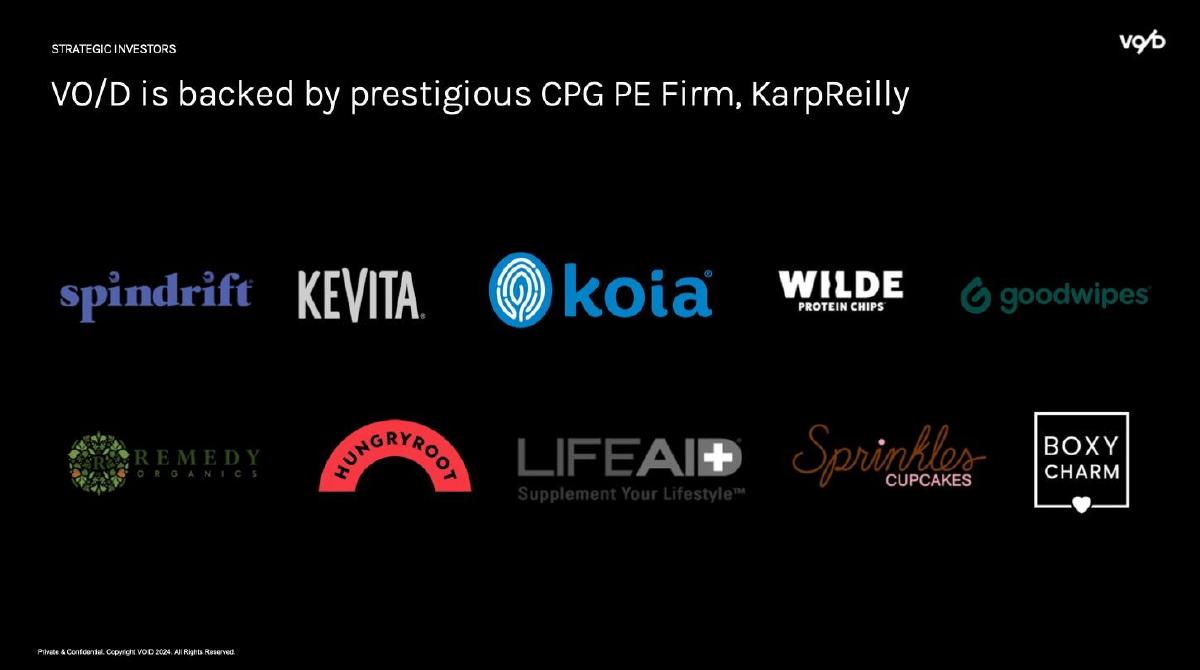
- The deck leads with institutional credibility, highlighting backing from KarpReilly and their portfolio of successful CPG brands like Spindrift and Kevita on Slide 3.
- VO/D utilizes a two-tier 'Test' and 'Scale' model, requiring 40%+ gross margins and low MOQs for initial validation as shown on Slide 5.
- Initial testing is 100% funded by VO/D with $50K to $250K, while scaling involves outside capital between $500K and $1.5M per Slide 5.
- The 8-step pre-launch process on Slide 7 emphasizes 'negotiating marketing commitment' early to ensure talent is fully invested.
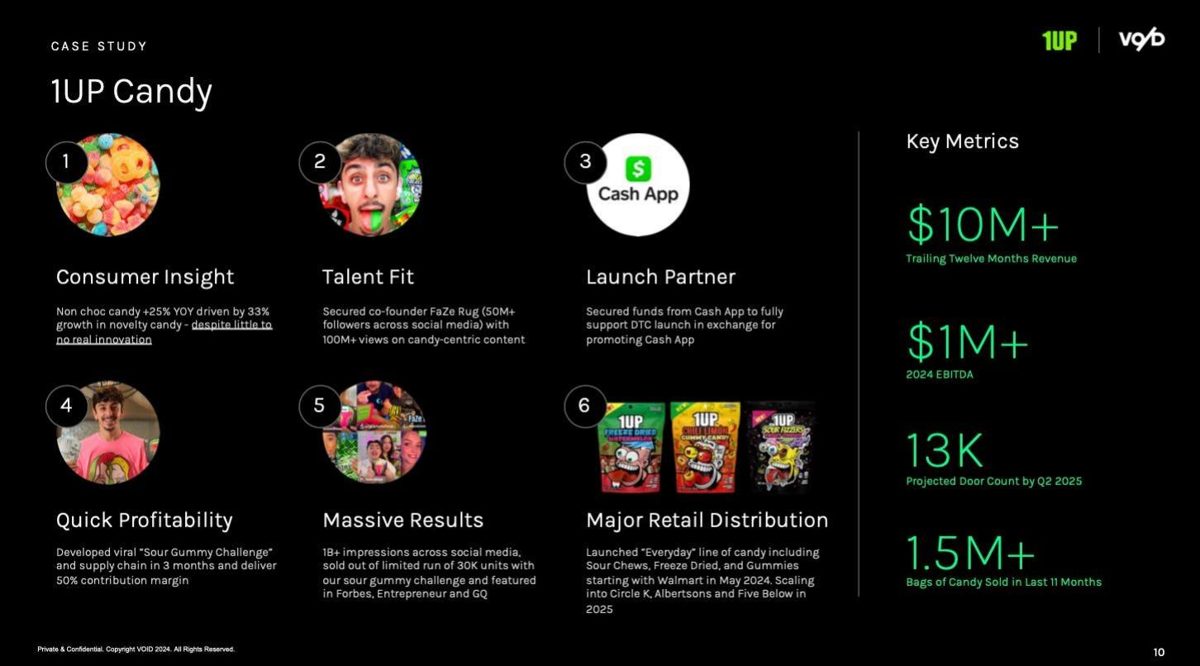
- A primary case study, 1UP Candy, reports $10M+ in TTM revenue and $1M+ in 2024 EBITDA on Slide 10.
- 1UP Candy achieved a 50% contribution margin and sold 1.5M+ bags in 11 months, according to Slide 10.
- Retail distribution is a core pillar, with 1UP Candy projected to reach 13,000 doors by Q2 2025 as stated on Slide 10.
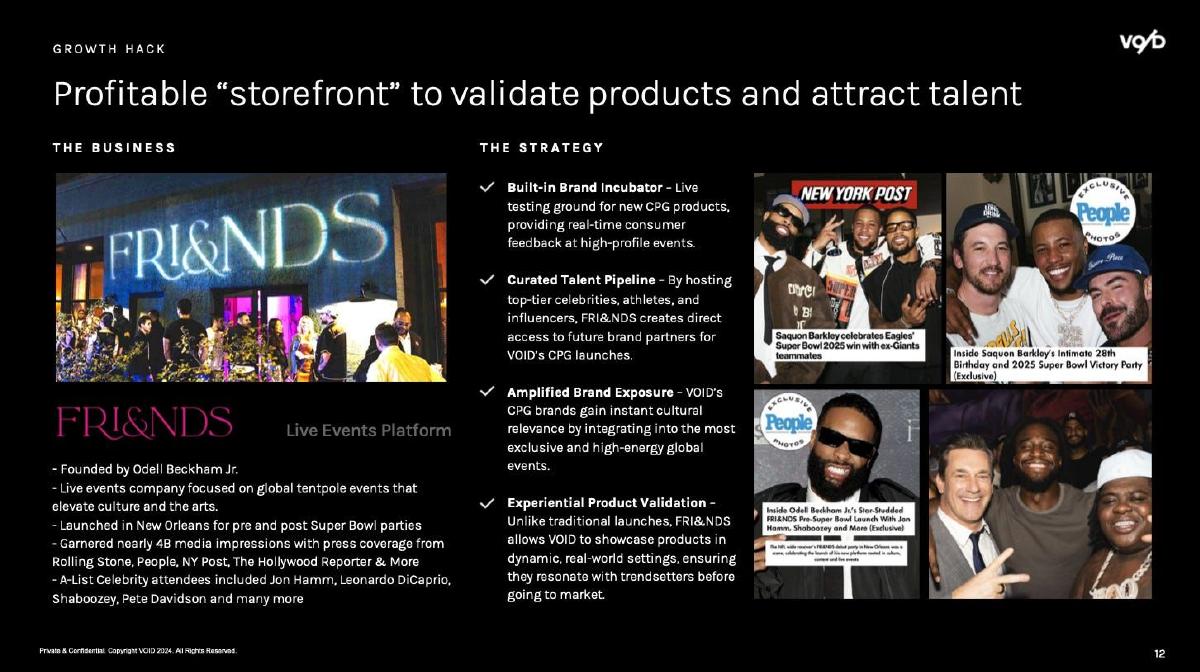
- The company uses a 'storefront' strategy via FRI&NDS, a live events platform that has generated 4B media impressions, to attract talent (Slide 11).
VO/D Pitch Deck Teardown: The Systematic Approach to Celebrity CPG
Celebrity brands are often viewed by investors as high-volatility bets that rely too heavily on the whims of a single individual. VO/D’s $5M Series A deck attempts to flip this narrative by presenting a venture studio model that treats celebrity involvement as a distribution multiplier rather than the sole foundation of the business. By focusing on unit economics and systematic validation first, VO/D positions itself as a disciplined operator in a crowded consumer market.
Slide 1-2: The Vision and Positioning
The deck opens with a minimalist aesthetic, using a black-and-white color palette that suggests a premium, 'behind-the-scenes' operator. Slide 2 defines the mission: "pioneering, funding and operating tomorrow's celebrity-led ventures." The use of the word 'operating' is critical here; it signals to investors that VO/D is not just a middleman or a talent agency, but a firm that handles the heavy lifting of supply chain, logistics, and retail distribution.
Slide 3: Institutional Validation
Slide 3 is a heavy-hitter for credibility. It states that VO/D is backed by KarpReilly, a private equity firm well-known in the CPG space. By displaying logos for Spindrift, KeVita, Koia, and Sprinkles, VO/D aligns itself with some of the most successful consumer exits and brands of the last decade. This slide serves to answer the 'Why you?' question by proxy—if a top-tier CPG investor trusts them, other Series A investors should pay attention.
Slide 4-5: The Systematic Solution
Slide 4 argues that the future of consumer brands is celebrity-owned. Slide 5 then breaks down how VO/D captures this opportunity through a two-stage 'Test and Scale' framework. This is one of the most important slides in the deck because it quantifies their risk management strategy. The 'Test' phase requires 40%+ gross margins and is 100% funded by VO/D ($50K-$250K). The 'Scale' phase moves into larger checks ($500K-$1.5M) and brings in outside capital. This clear delineation shows a disciplined approach to capital allocation, ensuring they don't over-invest in unproven concepts.
Slide 6-8: The Rigorous Process
Slides 6 and 7 detail the 8-step pre-launch process. The emphasis is on 'identifying' the category and 'validating' the fit before the 'launch.' Step 2, "Negotiate Marketing Commitment," is a subtle but vital point—it suggests that VO/D protects its investment by ensuring the celebrity partner is contractually obligated to provide specific promotional support. Slide 8 mentions a "trusted partner network," though it does not name specific vendors, focusing instead on the 'high quality of execution' as a value prop.
Slide 9-10: The 1UP Candy Case Study
Slide 9 and 10 provide the 'meat' of the deck through the 1UP Candy case study. Partnering with FaZe Rug (50M+ followers), VO/D demonstrates the efficacy of their model. The metrics on Slide 10 are impressive for a Series A deck: $10M+ in TTM revenue and $1M+ in 2024 EBITDA. The mention of a 50% contribution margin and 1.5M+ bags sold provides the unit economic proof that investors crave. Furthermore, the projection of 13,000 retail doors by Q2 2025 shows that this isn't just a DTC (Direct-to-Consumer) play, but a brand with genuine omnichannel potential.
Slide 11: The Growth Hack
Slide 11 introduces 'FRI&NDS,' a live events platform founded by Odell Beckham Jr. VO/D calls this a "profitable storefront." The strategy here is twofold: it acts as a real-world testing ground for new products and serves as a high-end funnel for recruiting new talent. By hosting A-list celebrities like Leonardo DiCaprio and Jon Hamm, VO/D creates an environment where potential brand partners can experience their products organically. This is a sophisticated way to handle 'Business Development' without it looking like a sales pitch.
Slide 12: The Close
The deck concludes with a standard contact slide. Notably, the deck is short (12 slides) and moves quickly from high-level vision to hard data. It relies on the strength of the 1UP Candy case study to carry the weight of the entire studio's potential.
What Works in the VO/D Deck
1. The 'Test and Scale' Framework: Investors love frameworks because they suggest a repeatable process. By putting hard numbers on what constitutes a 'Test' (40% margins, $50K-$250K investment), VO/D removes the mystery of how they spend money. It shows they are not just throwing celebrity names at a wall to see what sticks.
2. Hard Financial Metrics: Many venture studio decks are purely theoretical. VO/D includes EBITDA, TTM revenue, and contribution margins for their lead brand. Claiming $1M in EBITDA for a single brand within the studio is a powerful signal that the model can actually generate cash, not just 'impressions.'
3. Strategic Investor Alignment: Leading with the KarpReilly connection immediately solves the 'retail credibility' problem. In CPG, knowing how to get on shelves is half the battle, and the KarpReilly portfolio proves VO/D has the right mentors or backers to navigate that landscape.
What is Missing from the VO/D Deck
1. The Team Slide: This is a glaring omission. In a venture studio, the 'who' is just as important as the 'how.' Who are the operators? Who is running the supply chain? Who is the creative director? Without a team slide, the deck feels slightly anonymous, relying entirely on the celebrity partners and the PE firm for identity.
2. The 'Studio' Economics: While the deck explains how individual brands are funded, it doesn't explain how the VO/D parent company makes money or how the $5M Series A will be split between corporate overhead and brand equity. Investors usually want to see the 'cap table' logic of a studio—how much equity does the celebrity get vs. the studio?
3. Competitive Landscape: There are other celebrity brand builders (like Hello Sunshine or various talent agency-led incubators). VO/D doesn't explicitly state why their 'systematic approach' is superior to others, other than the implication that they are more data-driven.
What a Founder Should Copy
1. The Case Study Format: Slide 10 is a masterclass in how to present a case study. It combines consumer insights, talent fit, launch partners, and four distinct financial/growth metrics. If you have one 'hero' product or client, give it a full slide with dense, verifiable data.
2. The 'Growth Hack' Concept: If your business has a non-obvious way of acquiring customers or partners (like the FRI&NDS events), highlight it as a 'Growth Hack.' It makes your business seem more clever and less reliant on expensive traditional marketing.
3. Visual Hierarchy: The deck uses a very consistent visual language. The use of dark backgrounds with high-contrast green and white text makes the data points pop. It feels like a modern consumer brand deck, which is appropriate for the industry they are in.
Final Thoughts
VO/D’s deck is a high-signal, low-noise presentation. It successfully argues that celebrity brands can be built with the same rigor as any other CPG startup. By leading with institutional backing and following up with a profitable, high-growth case study, they make the $5M Series A feel like a safe bet on a proven system rather than a speculative gamble on fame.
Frequently asked questions
- What is VO/D's core business model?
- VO/D acts as a venture studio for celebrity-led consumer brands. Unlike traditional agencies, they fund, develop, and operate the businesses internally. They use a systematic 'Test and Scale' approach where they first validate a product's market fit and margins before bringing on a celebrity partner to amplify growth through their existing audience.
- How does VO/D validate a new brand idea?
- According to Slide 7, the company follows an 8-step process: reviewing opportunities, negotiating marketing commitments, meeting the team, concept testing (quant/qual), creative exploration, creative testing, market testing, and finally, product testing. This ensures the talent is 'all-in' and the product resonates with consumers before a full-scale launch.
- What are the financial requirements for a VO/D brand?
- Slide 5 specifies that for a brand to enter the 'Test' phase, it must have 40%+ gross margins and low minimum order quantities (MOQs). The initial investment is between $50,000 and $250,000. To move to the 'Scale' phase, the concept must be validated, warranting an investment of $500,000 to $1.5 million.
- What success metrics does the deck provide?
- The deck focuses on 1UP Candy as its primary proof of concept. Slide 10 reports over $10 million in trailing twelve-month revenue, $1 million in 2024 EBITDA, and over 1.5 million bags sold. It also highlights a 50% contribution margin and a projected retail footprint of 13,000 doors by mid-2025.
- What is the purpose of the FRI&NDS platform mentioned in the deck?
- Slide 11 describes FRI&NDS as a 'growth hack.' It is a live events platform founded by Odell Beckham Jr. that hosts high-profile parties (e.g., at the Super Bowl). VO/D uses these events as a 'storefront' to test products with trendsetters and build relationships with A-list celebrities who may become future brand partners.