Vitable Health’s 2020 Seed deck is a lean, 9-slide presentation that successfully raised $8.8 million by identifying a specific, underserved niche: the 65 million American workers earning under $15/hour. The deck avoids the typical 'all-in-one' healthcare trap, instead positioning itself as a 'Kaiser for primary and urgent care.' It leverages a founder’s personal narrative to establish immediate credibility and uses clear, punchy metrics to illustrate the failure of the current insurance model for small businesses. While it lacks a formal team slide or detailed financial projections, its stre…
Key takeaways
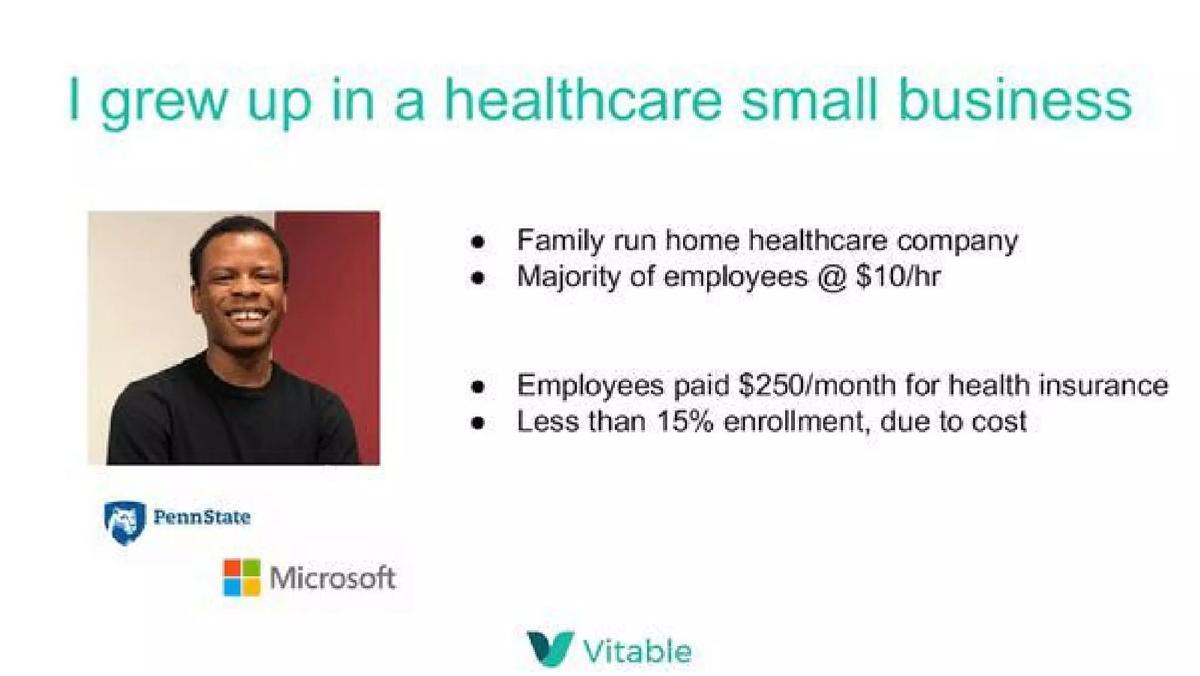
- The founder establishes immediate founder-market fit on Slide 2 by citing his upbringing in a family-run home healthcare business where less than 15% of employees enrolled in insurance due to cost.
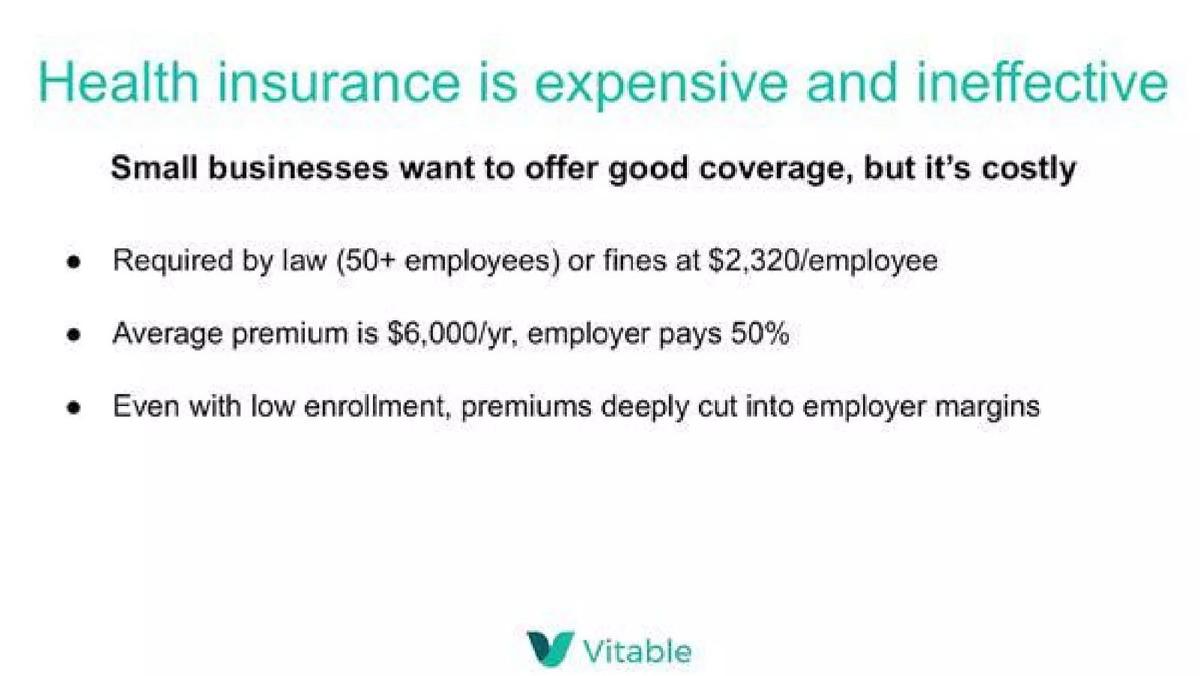
- Vitable identifies a specific regulatory pain point on Slide 3: businesses with 50+ employees face fines of $2,320 per employee if they do not offer coverage.
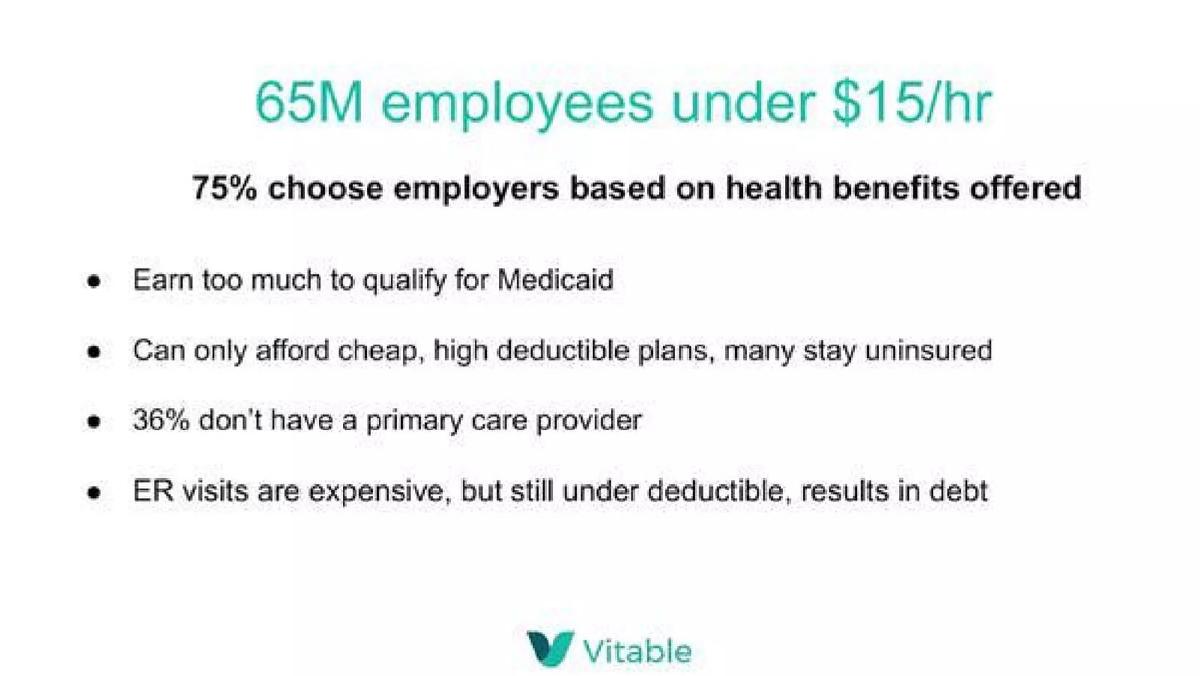
- The deck targets a massive, underserved demographic of 65 million employees earning under $15/hour who earn too much for Medicaid but cannot afford high-deductible plans (Slide 4).
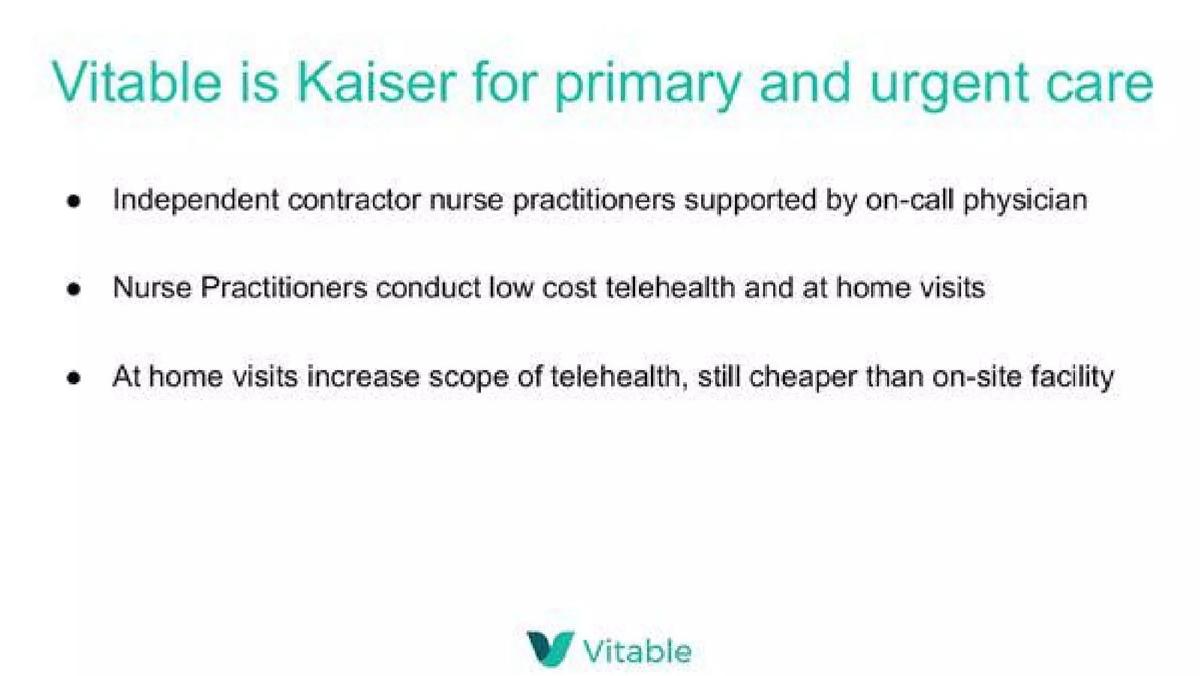
- The business model relies on independent contractor nurse practitioners supported by on-call physicians to keep costs lower than on-site facilities (Slide 5).
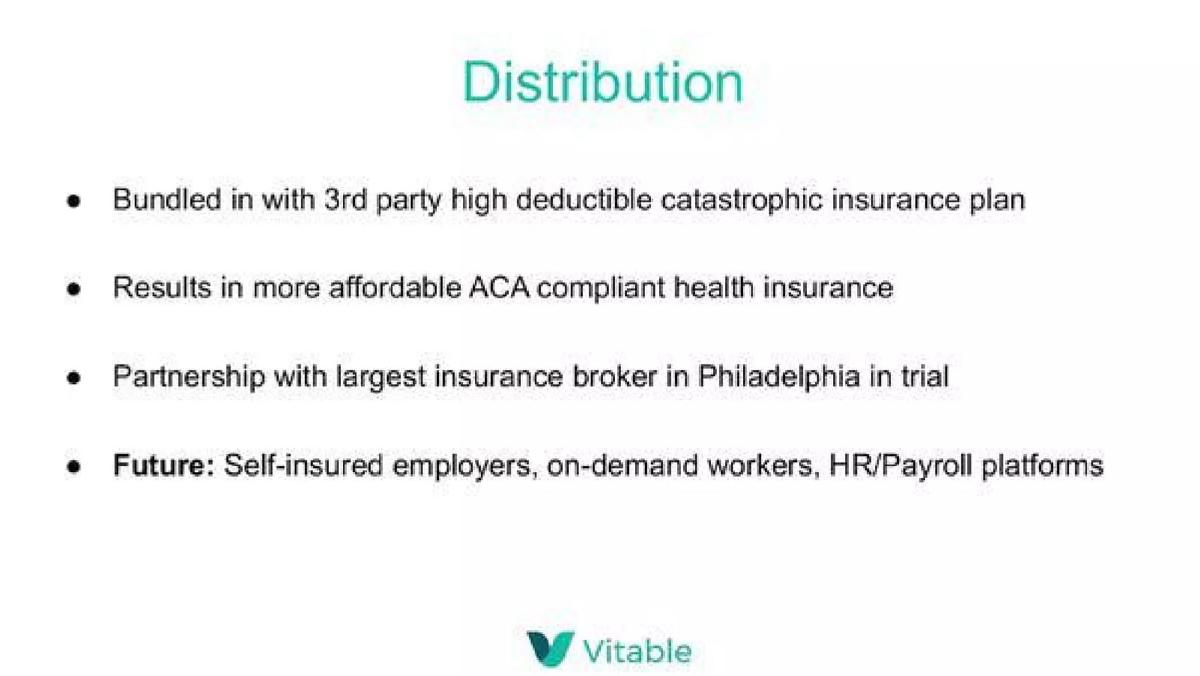
- Distribution is solved by bundling Vitable with 3rd party high-deductible catastrophic plans to create ACA-compliant coverage (Slide 6).
- The company prices its service at $50/month, leading to a calculated TAM of $39 billion based on 65 million living-wage workers (Slide 7).
- The long-term vision is to transition from a primary care provider to an end-to-end virtual telehealth-driven health plan (Slide 8).
- The deck omits a traditional team slide, a specific funding 'ask,' and detailed historical traction metrics, relying instead on the strength of the market opportunity and business model.
The Power of a Narrow Focus
Vitable Health’s pitch deck is a refreshing departure from the over-designed, 25-slide behemoths often seen in the health-tech space. At just 9 slides, it is a masterclass in identifying a specific problem for a specific audience and offering a specific solution. The deck doesn't try to fix the entire US healthcare system; it tries to fix primary care for the 65 million people making less than $15 an hour. This teardown examines how they used this narrow focus to raise a substantial $8.8 million seed round.
Slide 1: The Vision Statement
The cover slide is minimalist, featuring the Vitable logo and a clear value proposition: "Affordable health coverage for SMBs and their living-wage employees." This immediately sets the stage. By using the term "living-wage employees," Vitable signals that they understand the socio-economic segment they are targeting. They aren't going after tech startups with high-paid engineers; they are going after the backbone of the service and home-care economy.
Slide 2: Founder-Market Fit
Slide 2 is titled "I grew up in a healthcare small business." This is a powerful narrative move. Instead of a standard resume slide, the founder uses a personal photo and a story to establish credibility. He notes that in his family's home healthcare company, the majority of employees earned $10/hr and faced insurance premiums of $250/month. The result was less than 15% enrollment due to cost. This slide accomplishes two things: it proves the founder has seen the problem firsthand, and it provides a data point that illustrates the failure of the current system.
Slide 3: The Employer’s Pain Point
Vitable shifts from the employee's struggle to the employer's regulatory burden on Slide 3. Titled "Health insurance is expensive and ineffective," it lists the hard numbers. Employers with 50+ employees are required by law to offer coverage or face fines of "$2,320/employee." With average premiums at $6,000/year and employers typically paying 50%, the cost is prohibitive. This slide establishes the 'Why Now'—the legal and financial pressure on SMBs is reaching a breaking point.
Slide 4: The 65M Employee Gap
Slide 4 quantifies the market opportunity: "65M employees under $15/hr." It highlights a critical gap in the American safety net: these workers earn too much for Medicaid but cannot afford the high-deductible plans available to them. A key stat here is that "36% don't have a primary care provider." This lack of primary care leads to expensive ER visits that result in debt, creating a cycle of financial and physical instability. Vitable positions itself as the intervention in this cycle.
Slide 5: The Solution - "Kaiser for Primary and Urgent Care"
This is the 'How it Works' slide. Vitable uses a recognizable comparison—Kaiser Permanente—to explain their model. They use "Independent contractor nurse practitioners supported by on-call physician" to deliver care via telehealth and at-home visits. The core innovation is the removal of the "expense of physical locations," which allows them to offer services at a lower cost than on-site facilities. It is a lean, decentralized approach to healthcare delivery.
Slide 6: Distribution and Compliance
One of the biggest hurdles for any health-tech startup is distribution. Slide 6, "Distribution," explains how they bypass the traditional sales slog. They bundle Vitable with "3rd party high deductible catastrophic insurance plans." This allows the employer to offer an ACA-compliant plan that actually provides day-to-day value (through Vitable) while covering major emergencies (through the catastrophic plan). They also mention a trial partnership with the "largest insurance broker in Philadelphia," providing a hint of early traction.
Slide 7: The $39B TAM
The market size slide is straightforward. Vitable prices their coverage at "$50/month." Multiplying this by the 65 million living-wage workers in the U.S. results in a "$39 Billion market." They also localize this by noting a "$1 Billion in Philadelphia area alone." This helps investors visualize the path from a local pilot to a national powerhouse.
Slide 8: The Long-Term Vision
Slide 8, "Build relationship, expand service offering," outlines the roadmap. Vitable doesn't intend to stay just a primary care provider. They aim to "capture more of member healthcare spend (Chronic care)" and eventually become an "end-end virtual telehealth-driven health plan." This is the 'billion-dollar' slide that shows the potential for Vitable to evolve from a service into a full-scale insurance alternative.
Slide 9: Savings for Members
The final slide is a pie chart titled "Savings for our members." It breaks down the types of care they provide: Urgent Care (45%), Preventative Care (29%), Non-urgent Acute Care (16%), and Chronic Care (10%). The message is clear: by focusing on primary care, they are "preventing unnecessary ER visits." It’s a closing argument on the efficiency of their model.
What Works in This Deck
The Narrative Arc: The deck follows a perfect logical flow: I know this problem (Slide 2) -> The problem is expensive for employers (Slide 3) -> The problem is devastating for employees (Slide 4) -> Here is the lean solution (Slide 5) -> Here is how we sell it (Slide 6) -> Here is how big it can get (Slide 7-8).
The Comparison: Calling themselves "Kaiser for primary care" is a brilliant shorthand. It tells an investor exactly what the business model is (integrated provider and payer) without needing a complex diagram.
The Specificity of the Target: Most healthcare decks try to be for everyone. Vitable’s insistence on the "living-wage worker" makes the unit economics of a $50/month plan make sense. It defines the constraints of the product, which actually makes the solution more believable.
What Is Missing
A Traditional Team Slide: While the founder is introduced early, there is no mention of a CTO, a Chief Medical Officer, or any advisors. For a healthcare company, the lack of medical credentials on the core team slide is a notable omission that likely required significant explanation during the pitch meetings.
Traction Data: The deck is very light on actual performance. It mentions a "trial" with a broker, but doesn't list current member counts, revenue, or patient satisfaction scores. This suggests the $8.8M was raised largely on the strength of the vision and the founder's background rather than existing scale.
The Competition: There is no mention of other telehealth providers (Teladoc, etc.) or other primary care startups (One Medical, Cityblock Health). Investors would naturally want to know how Vitable defends its niche against these better-funded giants.
The Ask: There is no slide stating how much they are raising or what the milestones for the next 18 months are. While we know they raised $8.8M, the deck itself doesn't make the request.
What a Founder Should Copy
The Problem/Solution Simplicity: If you can't explain your business in 9 slides, you might not understand it well enough. Vitable proves that you don't need 20 slides to raise millions if your core insight is strong enough.
The Regulatory Hook: Slide 3 is a great example of using "the law" as a tailwind. If your business helps people avoid a specific, mandated fine, that is a very powerful sales lever that investors love to see.
The Distribution Strategy: Don't just say "we will use direct sales." Vitable’s idea of bundling with catastrophic plans is a specific, clever way to enter a regulated market. Founders should always aim for this level of specificity in their 'Go-to-Market' slides.
Frequently asked questions
- How much did Vitable Health raise with this deck?
- According to the catalogue facts, Vitable Health raised $8,800,000 in a Seed round in 2020. This is a significant amount for a Seed round, especially considering the deck is only 9 slides long and lacks many traditional elements like a full team page or a detailed use-of-funds slide.
- What is Vitable's core product offering?
- Vitable offers affordable primary and urgent care specifically for small businesses and living-wage employees. As described on Slide 5, they utilize nurse practitioners to provide telehealth and at-home visits, covering everything from sick visits to blood draws and X-rays without copays, effectively acting as a 'Kaiser for primary care.'
- How does Vitable handle insurance regulations?
- Vitable is not a full insurance plan on its own. Slide 6 explains that their distribution strategy involves bundling their service with 3rd party high-deductible catastrophic insurance plans. This combination results in a more affordable, ACA-compliant health insurance package for small business employers.
- Who is the target customer for Vitable?
- The deck identifies two primary targets: Small and Medium Businesses (SMBs) that are required by law to provide coverage or face fines, and 'living-wage' employees—specifically the 65 million Americans earning under $15/hour who currently fall into the gap between Medicaid eligibility and affordable private insurance.
- What is missing from the Vitable pitch deck?
- The deck is notably missing a dedicated team slide (though the founder is introduced on Slide 2), a competition slide, a detailed financial breakdown, and a specific 'Ask' slide detailing how the $8.8 million would be spent. It also lacks a slide showing current revenue or user growth numbers.