Vitriol is an automated machine learning (AutoML) platform designed to bridge the gap between business data needs and the high cost of data science talent. The deck focuses heavily on the technical underpinnings of the product, specifically citing 'Meta-Learning' and 'Transfer Learning' as the basis for its efficiency. By utilizing a web-based interface, Vitriol aims to make complex model selection and data visualization accessible without extensive training. The presentation highlights features such as 2D/3D data distribution visualization and an automated model selection process that includ…
Key takeaways
- The company positions itself as a solution for businesses that find creating a machine learning team too costly (Slide 2).
- The core technology is based on meta-learning, utilizing hundreds of thousands of learning episodes to improve progressively (Slide 3).
- The platform uses more than 20 features to describe datasets during the analysis phase (Slide 4).
- The solution is delivered as a web application to ensure global accessibility and ease of updates (Slide 5).
- Visualization features include 2D and 3D data distribution plots and analysis results (Slide 6).
- The user interface allows for automated model creation by selecting specific table columns to define 'modal tags' (Slide 7).
- The deck identifies a dual pain point: the business cost of talent and the time-consuming nature of model experimentation for scientists (Slide 2).
- The technical process includes automated imputation methods and the tuning of model parameters (Slide 4).
Vitriol: Technical Product Walkthrough vs. Investment Pitch
The Vitriol deck is a highly technical presentation that focuses on the 'how' of automated machine learning. While it identifies a clear pain point—the scarcity and cost of data science talent—it leans heavily into the mechanics of meta-learning rather than the mechanics of a scalable business. For an engineering-heavy audience, the deck provides a clear roadmap of the product's logic, but for a venture capital audience, it leaves significant questions unanswered regarding market capture and monetization.
Slide 1: Title Slide
The cover slide introduces Vitriol with the subtitle "Automated Machine Learning Solutions." The branding features a geometric, hexagonal logo containing a fractal tree, which visually reinforces the concepts of growth and algorithmic complexity mentioned later in the deck. The design is clean and minimalist, setting a professional tone for a software-as-a-service (SaaS) product.
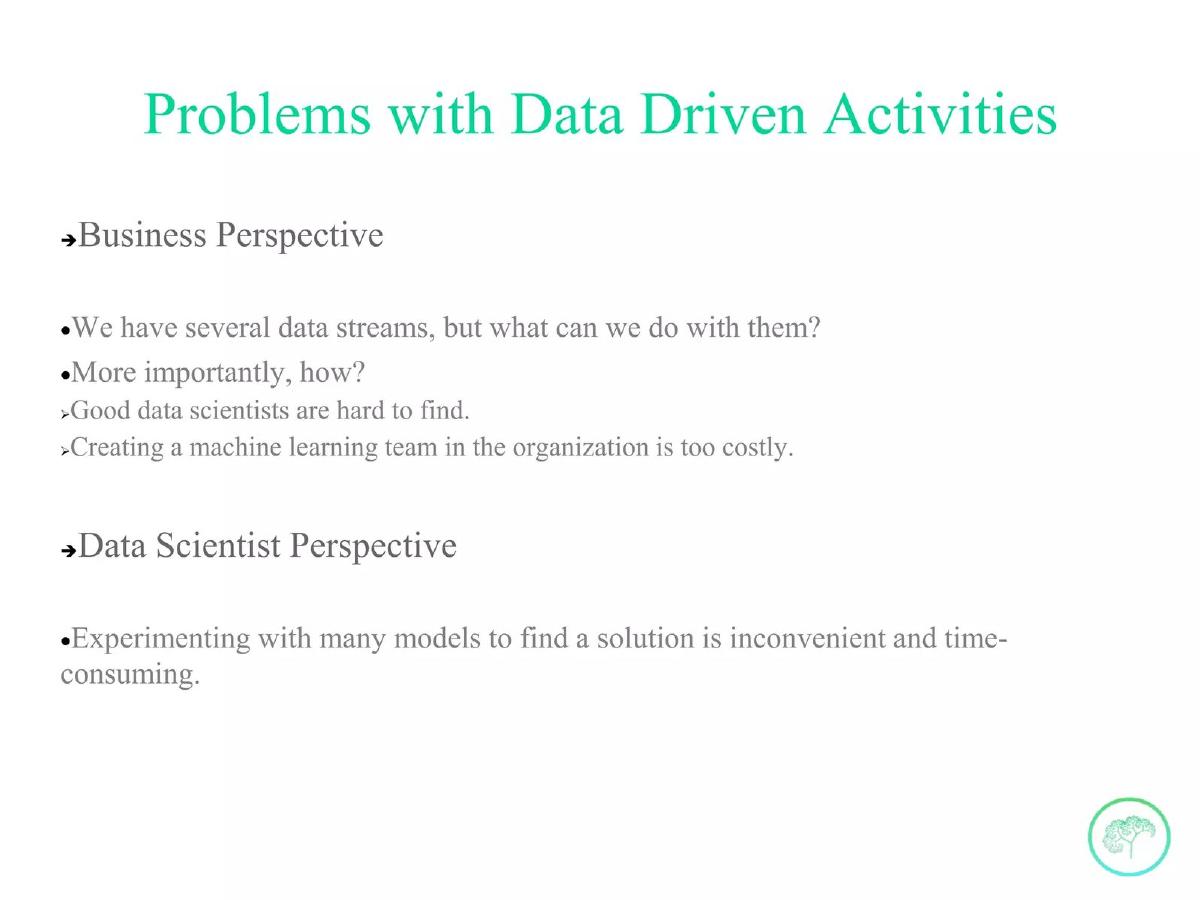
Slide 2: Problems with Data Driven Activities
This slide bifurcates the problem into two categories: Business and Data Scientist perspectives. Business Perspective: The deck notes that while organizations have data streams, they lack the knowledge of how to use them. It explicitly states that "Good data scientists are hard to find" and "Creating a machine learning team in the organization is too costly." Data Scientist Perspective: The slide identifies that "Experimenting with many models to find a solution is inconvenient and time-consuming." This establishes the value proposition: Vitriol is intended to automate the tedious parts of the data science workflow, potentially allowing less specialized staff to achieve results or making existing scientists more efficient.
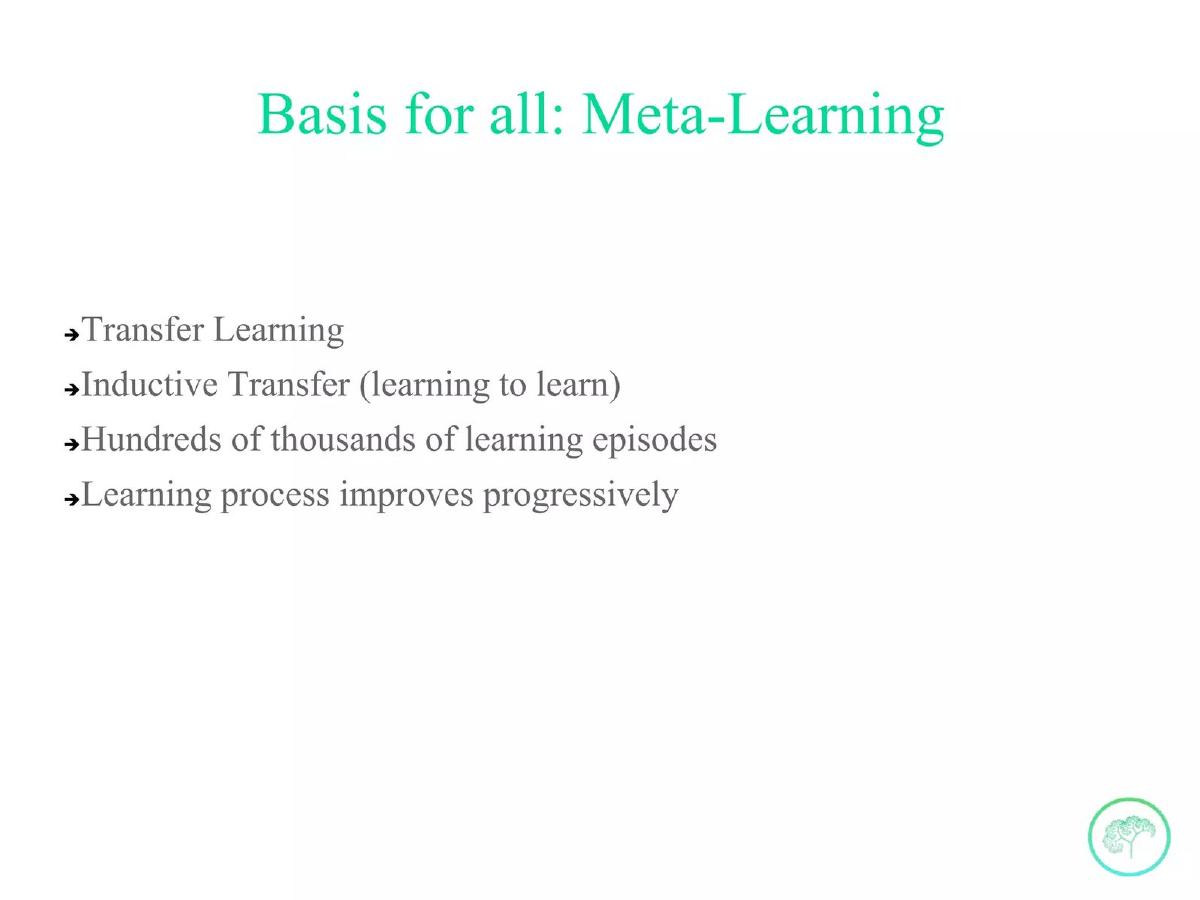
Slide 3: Basis for all: Meta-Learning
Vitriol introduces its core technological differentiator here. The slide lists "Transfer Learning" and "Inductive Transfer (learning to learn)" as the foundation of the platform. It claims the system is built on "Hundreds of thousands of learning episodes" and that the "Learning process improves progressively." This is a classic 'flywheel' argument—the more the system is used, the better it becomes at predicting which models will work for new datasets. However, the slide does not explain where these hundreds of thousands of episodes originated (e.g., open-source data or proprietary training).
Slide 4: Meta-Learner Mechanics
This slide goes deeper into the technical execution. It describes a "rich set of meta-data" used to represent information from previous tasks. The process involves:
Analysis of the problem: Using more than 20 features to describe the dataset. · Selected ML model: Automating the choice of imputation methods, model algorithms, and tunable parameters. · Evaluation results: Measuring success via multiple metrics such as R2 and accuracy for regression, or WeightedFMeasure for classification.
This level of detail is useful for proving the product isn't just a simple wrapper around basic libraries, but a sophisticated decision engine.
Slide 5: Why Web Application
The deck pivots to the delivery model. Vitriol justifies its existence as a web application by citing five factors: ease of use, no need for training, global accessibility, no space limitations, and ease of updates. While these are standard benefits of SaaS, the point about "not needing training to learn" is a bold claim for a machine learning tool, suggesting a high level of UI/UX abstraction from the underlying math.
Slide 6: Visualization
Visualization is presented as a key feature for both data and models. The slide mentions 2D and 3D data distribution views and analysis results. It also highlights visualization for classification and clustering. The slide includes two graphics: a bar chart showing data over time (April 10th to April 25th) and a 3D scatter plot. These visuals demonstrate that the platform provides the necessary interpretability for users to trust the automated results.
Slide 7: Vitriol in Action 2: Model Selection
This slide provides a functional walkthrough of the user interface. It outlines a four-step workflow: I. Selecting the data table. II. Choosing between pre-processing or model creation. III. Selecting pre-processing options ("clean and complete"). IV. Choosing the target column to define the "modal tag." The screenshots provided are somewhat low-resolution but show a standard sidebar-driven dashboard typical of modern enterprise software. This slide is crucial for proving that a functional prototype or product exists.
What Works in the Vitriol Deck
The deck excels at defining the technical "secret sauce." By focusing on meta-learning and transfer learning, Vitriol positions itself above basic automation tools. The clear distinction between the business problem (cost) and the practitioner problem (time) shows a sophisticated understanding of the market's pain points. Furthermore, the inclusion of a workflow slide (Slide 7) helps ground the abstract concepts of machine learning into a tangible software experience.
What is Missing from the Vitriol Deck
As a fundraising document, this deck is incomplete. The following critical elements are missing: 1. Team: There is no slide introducing the founders or their technical credentials. In AI/ML startups, the pedigree of the engineering team is often the primary driver of valuation. 2. Market Size: There is no mention of the Total Addressable Market (TAM). Investors need to know if this is a niche tool for small businesses or an enterprise-grade platform. 3. Business Model: The deck does not explain how Vitriol makes money. Is it a per-seat license, a consumption-based model based on compute, or a flat monthly subscription? 4. Competition: The AutoML space is crowded (e.g., DataRobot, H2O.ai, Google Cloud AutoML). Vitriol fails to mention how it differentiates itself from these established giants. 5. The Ask: There is no slide detailing how much capital is being raised, the valuation, or the milestones the company intends to hit with the funding.
Founder Takeaways
Founders should look at the Vitriol deck as a model for explaining complex technical processes simply. The use of bullet points to break down the "Meta-Learner" logic (Slide 4) is effective. However, founders must avoid the "product-only" trap. A pitch deck is a business plan, not a user manual. To make this a viable investment pitch, the technical slides should be condensed, and at least five to six slides regarding market opportunity, competitive advantage, and financial projections must be added. The omission of a team slide is particularly detrimental, as investors in this space are buying the expertise of the people who built the meta-learning engine as much as the engine itself.
Frequently asked questions
- What is the primary problem Vitriol is trying to solve?
- Vitriol addresses two main issues identified on Slide 2. From a business perspective, it targets the high cost and difficulty of finding good data scientists. From a technical perspective, it aims to solve the 'inconvenient and time-consuming' nature of experimenting with many models to find a solution, which typically slows down data-driven activities.
- How does Vitriol's 'Meta-Learning' approach work?
- According to Slide 3 and Slide 4, the system uses 'Inductive Transfer' (learning to learn) based on hundreds of thousands of previous learning episodes. It analyzes new problems by extracting over 20 features from a dataset and comparing them against a rich set of meta-data from previous tasks to select the best imputation methods, algorithms, and parameters.
- What are the key features of the Vitriol web application?
- Slide 5 and Slide 6 highlight that the web application is designed for ease of use without training. Key features include global accessibility, 2D and 3D dataset visualization, and automated model visualization for classification and clustering tasks. It removes local space limitations and allows for seamless software updates.
- What does the user workflow look like in the Vitriol platform?
- Slide 7 outlines a four-step process: 1) User selects a data table; 2) User chooses between pre-processing or model creation; 3) For pre-processing, the user selects 'clean' or 'complete' options; 4) To create a model, the user selects the specific column that defines the target variable or 'modal tag'.
- What essential investor information is missing from this deck?
- The deck is missing almost all standard financial and strategic slides. There is no mention of the founding team's expertise, no market size (TAM/SAM/SOM) analysis, no competitive landscape, no business model or pricing strategy, and no specific funding ask or use of proceeds. It functions primarily as a technical product walkthrough.