api.video raised $12M in a 2024 Series A round to expand its European lead in video infrastructure. The deck focuses heavily on the macro shift from 'one-to-many' broadcasting (Netflix/YouTube) to 'many-to-few' social interactions (TikTok), positioning their API as the essential bridge for developers. By highlighting a 14% average month-over-month growth rate and a 172% increase in ARPU, the company demonstrated strong land-and-expand mechanics. The deck successfully maps out a transition from serving startups in their seed round to targeting scale-ups for the Series A. While the public versi…
Key takeaways
- The deck identifies a massive market gap, stating that 17,000,000 hours of video are produced every minute, yet 97% stay offline (Slide 5).
- A clear evolution of customer segments is shown, moving from 'Startups' in the Seed round to 'Scaleups' for the Series A (Slide 5).
- The company reports a strong 14% average month-over-month ARR growth (Slide 6).
- Unit economics are trending upward, with a reported 172% increase in ARPU in 2021 (Slide 6).
- The product is positioned as a 'Platform of Platforms,' targeting CTOs and Product Managers rather than just end-users (Slide 5).
- The 'Problem' slide focuses on developer friction, citing weeks of work to aggregate tools and multiple billing systems as key pain points (Slide 4).
- The growth plan introduces a new 'Data Revenue' stream to complement core video revenue (Slide 7).
- The $12M ask is explicitly tied to four strategic pillars, including US infrastructure deployment and enterprise offers (Slide 8).
The Developer-First Infrastructure Play
api.video’s Series A deck is a clinical example of how to pitch a technical 'plumbing' product by connecting it to massive consumer trends. The company, headquartered in Europe, raised $12M in 2024 to solve a specific developer pain point: the sheer difficulty of integrating high-quality video into non-video-native applications. By focusing on the 'product builder' rather than the 'content creator,' api.video carves out a niche in the crowded cloud infrastructure space.
Slide 1: Title and Positioning
The deck opens with a minimalist title slide: "The video infrastructure for product builders." This immediately identifies the target customer (developers and product teams) and the product category (infrastructure). The branding is consistent, using a deep purple gradient that suggests a modern, cloud-native enterprise tool. There are no distractions here; the focus is entirely on the value proposition of providing the 'pipes' for video.
Slide 2: The Macro Environment
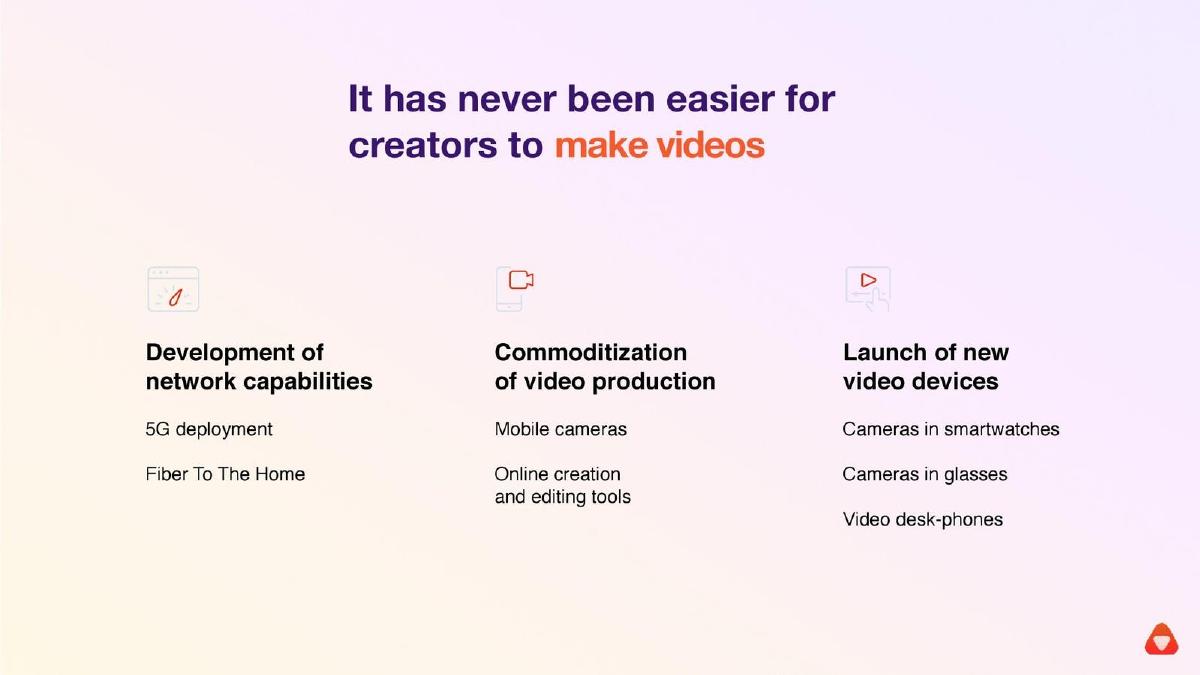
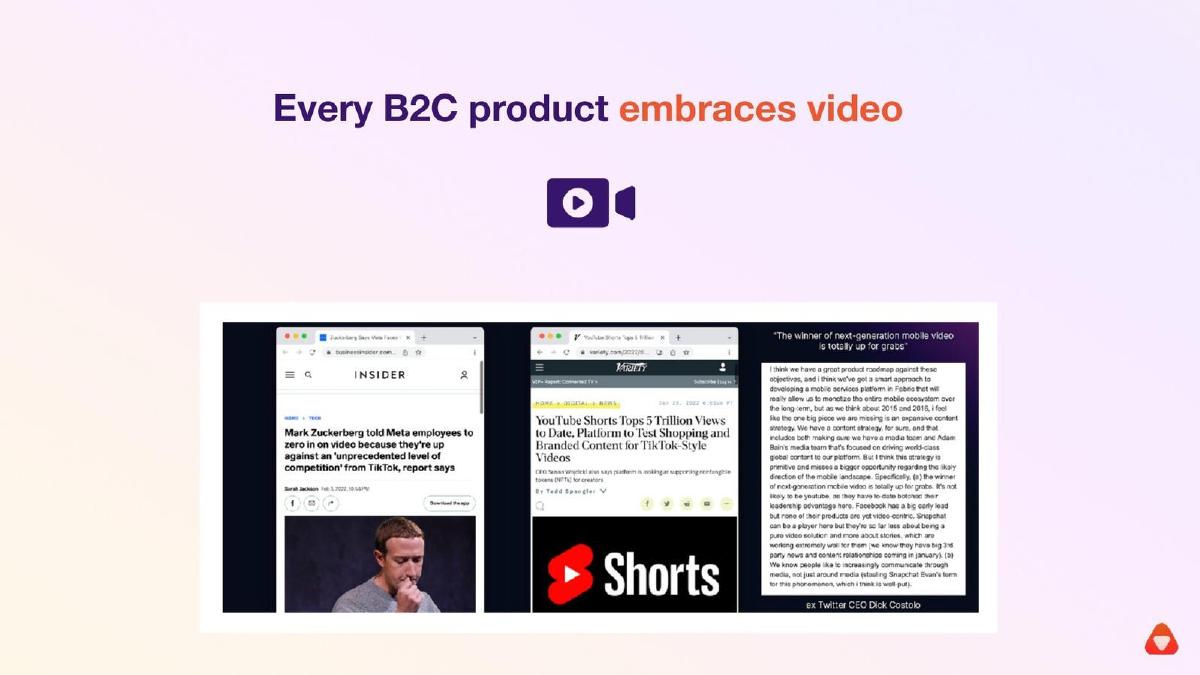
Slide 2 sets the stage by claiming, "It has never been easier for creators to make videos." It breaks this down into three catalysts: the development of network capabilities (5G and Fiber), the commoditization of production (mobile cameras and online editing tools), and the launch of new devices (smartwatches, glasses, and desk-phones). This slide establishes the 'Why Now' by showing that the supply side of video is exploding due to hardware and connectivity improvements.
Slide 3: The Shift in Consumption Patterns
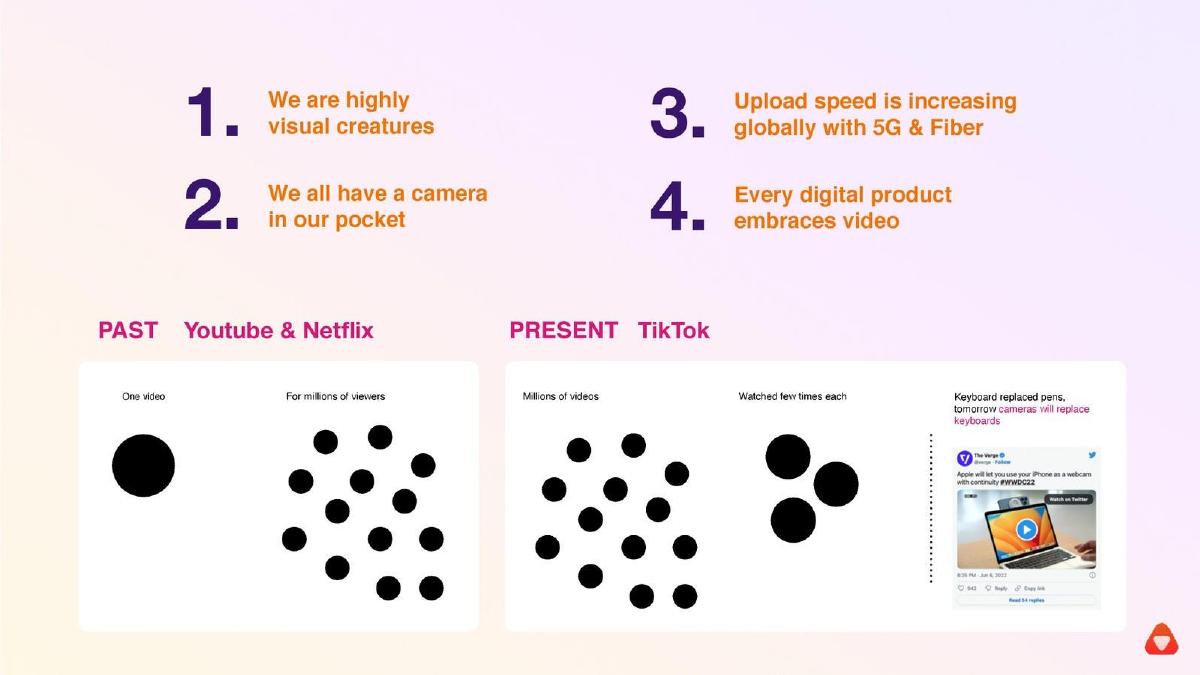
This slide provides a sophisticated look at market evolution. It contrasts the 'Past' (YouTube & Netflix), characterized by "One video for millions of viewers," with the 'Present' (TikTok), characterized by "Millions of videos watched few times each." This is a critical distinction. It suggests that the future of video is fragmented, social, and embedded in every digital product, rather than centralized on a few giant platforms. The slide notes that "Every digital product embraces video" and "tomorrow cameras will replace keyboards."
Slide 4: The Developer Friction (The Problem)
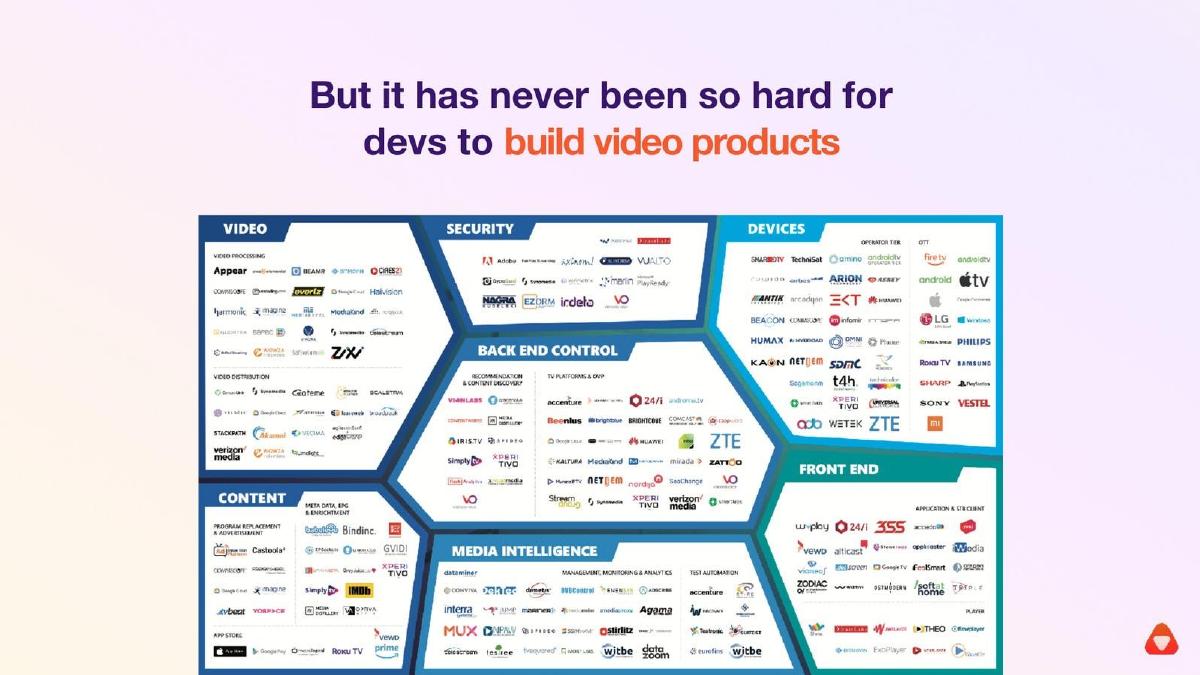
Having established the opportunity, Slide 4 pivots to the pain. It states, "But it has never been so hard for devs to build video products." The slide lists four specific barriers:
Weeks to aggregate a dozen of tools, services and platforms · Hours of work to maintain every week · Multiple billing systems · Struggle to scale
This slide is effective because it speaks directly to the operational headaches of a CTO or Lead Engineer, which are the primary personas api.video needs to win over.
Slide 5: The Opportunity and Market Mapping
Slide 5 is the 'meat' of the strategic narrative. It leads with a staggering statistic: "17,000,000 hours of video are produced every minute, 97% stay offline." This quantifies the untapped market. Below this, the company maps its trajectory. It shows a 'Seed round' focus on "Startups" (verified with a green checkmark) and a 'Serie A' focus on "Scaleups." It lists impressive logos like Strava, Brainly, Leboncoin, and Airbnb . The slide also defines the 'Positioning' as a "Platform of Platforms," targeting CTOs and Product Managers across categories like Event Orgs, SMBs, and Teachers.
Slide 6: Traction and Unit Economics
Slide 6 focuses on growth. The headline is "We’ve started to land and expand." It features a bar chart showing consistent ARR growth with a "14% AVG MoM GROWTH." While the specific ARR at the end of April 2022 is redacted as "$-M ARR," the secondary metrics are telling: a "+172% ARPU IN 2021." This indicates that once a customer integrates the API, they use it significantly more over time, which is the hallmark of a successful infrastructure business.
Slide 7: The Product-Led Growth (PLG) Roadmap
Slide 7 outlines the 2022-2023 roadmap to reach a specific (redacted) ARR target. It breaks the strategy into Growth, Targets, Land & Expand, NDR (Net Dollar Retention), and Revenue. Notable entries include moving from targeting "Digital Agencies" in S2 2022 to "Scale-Ups" in S1 2023. It also introduces "Data Revenue" as a new stream, planning to monetize analytics, logs, and monitoring alongside core video delivery. This shows investors that the company has multiple levers for expansion beyond just bandwidth usage.
Slide 8: The Ask and Future Milestones
The final slide in the provided sequence is the 'Ask.' It states, "We are raising $12M to be the European leader." The funds are allocated to four clear objectives:
Keep investing in the bottom-up strategy · Launch Data plans · Launch Enterprise offers · Deploy US infrastructure
This slide provides a clear bridge between the capital raised and the next phase of company maturity, specifically the expansion into the US market and the move upmarket into Enterprise sales.
What Works in the api.video Deck
The deck excels at segmentation and persona targeting . By explicitly listing CTOs and Product Managers as the target personas on Slide 5, the founders demonstrate they understand their sales cycle. The distinction between 'Startups' for the Seed round and 'Scaleups' for the Series A shows a logical progression of market capture that de-risks the investment.
The market thesis presented on Slide 3 is also a highlight. Many founders simply say 'video is growing.' api.video explains how it is changing—from broadcasting to narrowcasting—which justifies why a new, flexible API is needed rather than just using existing solutions like YouTube embeds.
Finally, the unit economics focus on Slide 6 is strong. A 172% increase in ARPU is a powerful signal of 'stickiness.' In infrastructure, the hardest part is the initial integration; once that is done, the revenue should grow naturally with the customer's own success. This slide proves that the 'land and expand' model is working.
What is Missing
The most glaring omission in the provided slides is a Team Slide . For a Series A infrastructure play, the technical pedigree of the founders and the engineering team is paramount. Investors want to know if the team has the chops to build a global, low-latency video network that can compete with incumbents.
There is also no Competition Slide . The video API space is not empty; companies like Mux, Twilio, and AWS Elemental are significant players. The deck mentions being a 'European leader,' but it doesn't explicitly detail how its feature set or pricing model differentiates it from US-based giants, other than perhaps data sovereignty or local support.
Lastly, the Unit Economics could be deeper. While ARPU growth is great, there is no mention of Churn or LTV/CAC ratios. For a PLG (Product-Led Growth) company, showing the efficiency of the self-serve funnel is usually a requirement for a Series A teardown.
Founder Takeaways
Focus on the 'Why Now': api.video doesn't just say video is big; they point to 5G, mobile camera commoditization, and the shift to 'many-to-few' consumption. If you are building in a crowded space, you must identify the specific technological or behavioral shift that makes your solution necessary today.
Show the Evolution of Your Customer: Slide 5 is a masterclass in showing progress. By checking off 'Startups' and pointing toward 'Scaleups,' the founders show they have conquered one segment and have a clear plan for the next. This prevents the company from looking like it's stuck in the 'small business' trap.
Monetize the 'Sidecars': The introduction of 'Data Revenue' on Slide 7 is a smart move. It shows that the product generates value (and revenue) beyond its primary function. If your product generates data, logs, or analytics, show how those can become high-margin revenue streams in the future.
Use a 'Platform of Platforms' Narrative: If you are an API company, you aren't just selling to one company; you are selling to their entire user base. api.video uses this to justify a massive TAM, even if their direct customer list is relatively short. They are 'empowering apps... to meet creators' expectations,' which makes them a force multiplier.
Frequently asked questions
- What is the core value proposition of api.video?
- As stated on Slide 1, api.video positions itself as 'The video infrastructure for product builders.' It aims to solve the complexity of building video products by replacing a dozen fragmented tools and services with a single API, reducing the weeks of development time typically required to launch video features.
- How does api.video justify the market opportunity?
- Slide 5 claims that 17 million hours of video are produced every minute, but 97% of that content remains offline. They argue that while video production has been commoditized by mobile cameras and 5G, the infrastructure to embed that video into native apps remains a significant hurdle for developers.
- What are the key growth metrics shared in the deck?
- The company highlights three primary metrics on Slide 6: a 14% average month-over-month growth rate, a 172% increase in Average Revenue Per User (ARPU) during 2021, and a consistent upward trend in ARR, though the specific dollar amounts are redacted in this version.
- Who is the target audience for this product?
- According to Slide 5, the primary personas are CTOs, Product Managers, and Front-end Engineers. The company targets segments ranging from startups and digital agencies to large scale-ups like Strava, Brainly, and Airbnb, positioning itself as a 'Platform of Platforms.'
- What is the planned use of the $12M Series A funds?
- Slide 8 outlines four specific goals: investing in their bottom-up (product-led) growth strategy, launching new Data plans, introducing Enterprise-grade offers, and deploying infrastructure in the United States to expand beyond their European base.