Scedule’s pitch deck is a high-level product overview that identifies a specific pain point in the 'meeting-driven day' of knowledge workers. The deck excels at articulating a vision where scheduling is not just about calendar slots, but about integrating external services like catering, travel, and facilities. However, as a fundraising tool, it is incomplete. It omits the team slide, business model, market sizing, and any mention of current traction or a specific capital ask. The presentation functions more as a product teaser or a 'short' version of a deck intended to secure a first meeting…
Key takeaways
- The deck identifies the 'established tool to schedule a meeting-driven day' as insufficient on slide 2.
- Scedule proposes 'Smart Availability Matching' to find meaningful slots rather than just technical openings (slide 3).
- The product aims to bridge boundaries by integrating external users via email or text with pre-qualified options (slide 3).
- The vision involves connecting a meeting ecosystem including facilities (Regus, WeWork), catering (Lemoncat, Zesty), and travel (Lufthansa, Booking.com) as shown on slide 5.
- The platform claims compatibility with existing calendars (iOS, Android) rather than replacing them (slide 4).
- Occasion-specific workflows are highlighted, allowing for different arrangements for lunches, workshops, or quick calls (slide 3).
- The deck completely omits a team slide, providing no information on the founders' backgrounds or expertise.
- There is no mention of a business model, pricing strategy, or revenue generation plan in the 6-slide presentation.
Scedule Pitch Deck Analysis
The Scedule pitch deck is a concise, 6-slide presentation that focuses heavily on product vision and the user experience of scheduling. Labeled as a 'short' deck in its source listing, it functions as a high-level introduction to a software-as-a-service (SaaS) productivity tool. The deck is dated February 2017 (02/2017) on the cover slide, placing it in a period where mobile-first productivity tools were seeing significant venture interest.
Slide 1: Title and Value Proposition
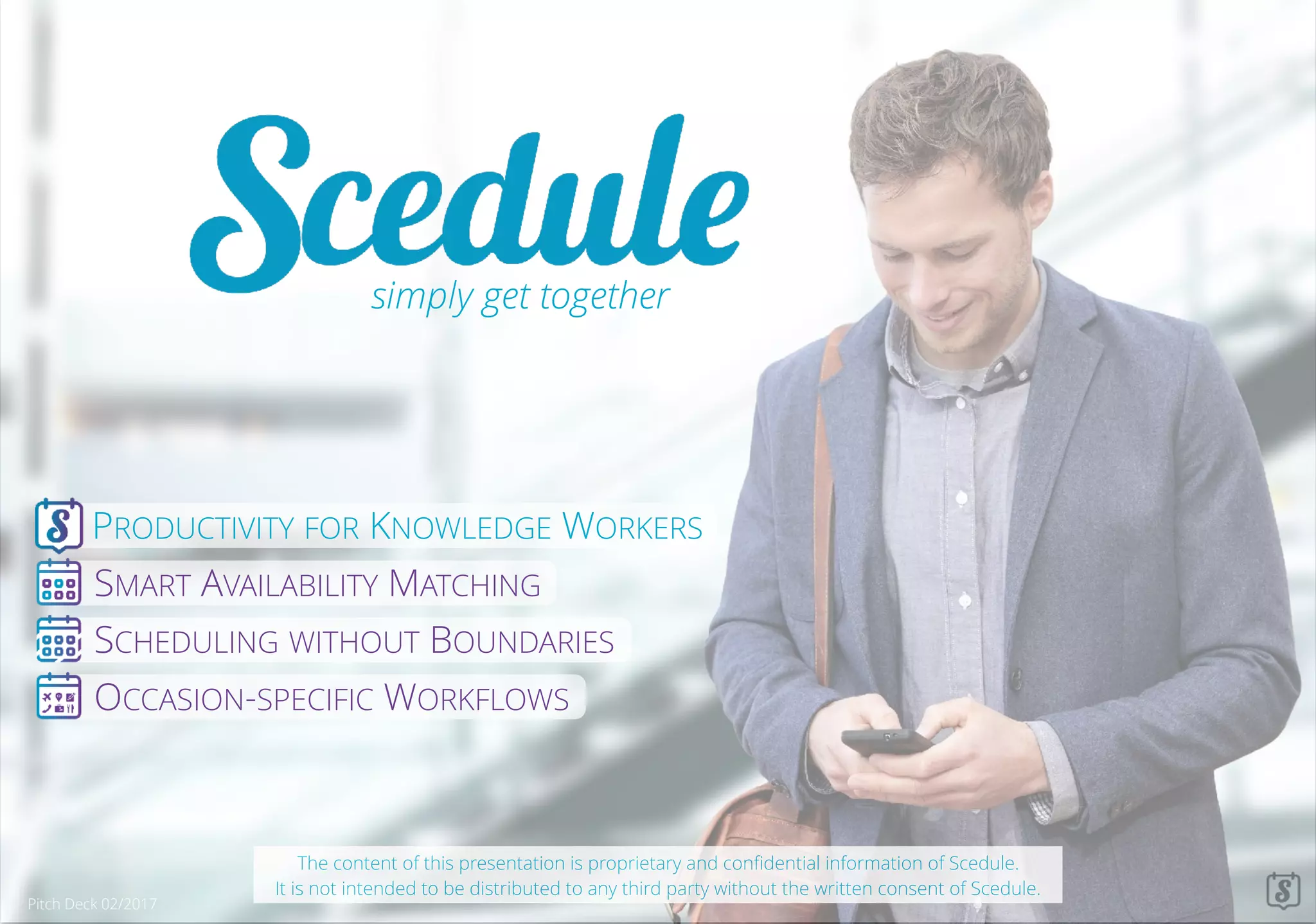
The cover slide introduces the brand 'Scedule' with the tagline 'simply get together.' It immediately establishes four pillars of the product: Productivity for Knowledge Workers, Smart Availability Matching, Scheduling Without Boundaries, and Occasion-Specific Workflows. The imagery of a professional using a smartphone reinforces the mobile-centric, professional nature of the application. A confidentiality notice is included at the bottom, which is standard for early-stage fundraising materials.
Slide 2: The Problem
Slide 2 defines the problem space. It uses a screenshot of a standard mobile calendar and a desktop Outlook-style interface to represent the 'established tool.' The text asserts that these tools are 'insufficient' for a 'meeting-driven day.' The core critique is that current tools do not reflect the 'dynamic business environment' and lack 'meaningful scheduling or organization.' By showing a cluttered calendar, the slide visually communicates the 'typical day' chaos that the founders intend to solve.
Slide 3: Product Differentiators
This slide attempts to answer 'What makes Scedule unique?' through three columns: 1. Smart Availability Matching: It uses a visual metaphor of colored dots to show how the software matches 'technical' availabilities and applies an algorithm to find 'meaningful' slots. 2. Scheduling W/O Boundaries: This is a key feature, showing that the tool works for users in the same company and external users. It highlights the ability to reach external participants via email or text with real-time options. 3. Occasion-Specific Workflows: This shows a mobile interface where users can select categories like 'Quick Call,' 'Coffee Chat,' 'Lunch,' or 'Workshop.' The slide notes that Scedule offers relevant services like meeting rooms within these workflows.
Slide 4: Product Features and Compatibility
Slide 4 provides a more detailed breakdown of the feature set. It reiterates the matching and boundary-less scheduling but adds new information regarding 'Private & Business Calendars.' It claims the tool can consider both without sharing private details. Crucially, it mentions 'Compatibility,' stating that Scedule is a cross-platform solution (iOS, Android) that references existing calendars rather than replacing them. It also mentions 'Enterprise Integration,' suggesting an ability to access existing corporate infrastructure and resources.
Slide 5: The Vision and Ecosystem
This is the most ambitious slide in the deck. It moves beyond simple scheduling to the 'meeting ecosystem.' Scedule positions itself at the center of four categories: Facilities, Catering, Travel, and Miscellaneous. It displays logos of major companies like WeWork, Regus, Booking.com, Lufthansa, and Eventbrite. The text states that 'all services related to meetings are connected manually' today, and Scedule intends to automate this connection because 'it all starts with connecting people.'
Slide 6: Benefits
The final slide summarizes the value proposition for the user or the enterprise. It lists four points: reducing administrative effort, increasing productivity, focusing on results, and 'enabling the future of work.' The slide uses a faded background image of a team in a meeting, reinforcing the collaborative nature of the product. Notably, this slide serves as the conclusion, but it lacks a call to action or contact information.
What Scedule Does Well
The deck is visually clean and maintains a consistent brand identity. The use of icons and simple diagrams to explain 'Smart Availability Matching' (Slide 3) is effective at communicating a technical concept without getting bogged down in jargon. The problem statement is relatable to any knowledge worker, and the 'Vision' slide (Slide 5) successfully paints a picture of a much larger market opportunity than just a calendar app. By showing how scheduling is the entry point for travel, catering, and facilities, the founders suggest a significant platform play.
What is Missing from the Scedule Deck
As a 'short' deck, the omissions are substantial and would prevent an investor from making an informed decision without further documentation:
Team Slide: There is no mention of who is building this. Investors at the early stage (which this appears to be) prioritize the founders' pedigree and execution capability above all else. · Business Model: The deck does not explain how Scedule makes money. Is it a per-user SaaS fee, a commission on the ecosystem services (travel/catering), or a freemium model? · Market Size (TAM/SAM/SOM): While the vision slide hints at a large market, there are no figures to quantify the opportunity. · Traction: There is no mention of user numbers, pilot programs, or partnerships with the companies listed on Slide 5. It is unclear if the product is a prototype or a live application. · Competition: The deck ignores the competitive landscape. In 2017, companies like Calendly and X.ai were already active in this space. · The Ask: The deck does not state how much money is being raised, the valuation, or what the milestones for the next 18 months are.
Lessons for Founders
Founders can learn two distinct lessons from this teardown. First, the 'Ecosystem' approach (Slide 5) is a powerful way to turn a 'feature' (scheduling) into a 'platform' (meeting management). If you are building a tool that feels like a feature, you must show how it acts as a gateway to a larger spend. Second, a 'short' deck must still contain the essential pillars of a business. Even in a teaser deck, omitting the team and the business model can make the project look like a product in search of a business rather than a startup ready for investment. If you use a 6-slide format, at least one slide should be dedicated to why your team is the right one to win the market.
Frequently asked questions
- What is the primary problem Scedule is trying to solve?
- According to slide 2, Scedule addresses the fact that current scheduling tools are insufficient for a 'meeting-driven day.' The company argues that existing tools do not reflect the dynamic nature of modern business and fail to offer 'meaningful scheduling or organization,' particularly when dealing with complex, multi-participant environments.
- How does Scedule handle users who are not on their platform?
- Slide 3 explains that Scedule 'integrates external users by e-mail or text.' Instead of requiring everyone to be on the same platform, it provides these external participants with 'pre-qualified, real-time options,' effectively extending the scheduling logic beyond the boundaries of a single organization.
- What third-party services does Scedule plan to integrate?
- Slide 5 outlines a broad 'meeting ecosystem.' This includes facilities (Regus, WeWork, Cisco Webex), catering (Bookatable, Zesty, Lemoncat), travel (Skyscanner, Priceline, Expedia/Egencia), and miscellaneous services like LinkedIn, Eventbrite, and Diligent. The goal is to connect all services related to meetings in one workflow.
- Is Scedule a new calendar app or an integration layer?
- Slide 4 clarifies that Scedule is a 'cross-platform solution' that references preferred calendars 'instead of replacing' them. While it offers a 'Smart Calendar App' for iOS and Android, its primary value lies in its ability to access resources and entities within existing infrastructure and enterprise integrations.
- What are the stated benefits of using Scedule?
- Slide 6 lists four high-level benefits: reducing effort for administrative tasks, increasing productivity and satisfaction, allowing users to focus on 'topics and results,' and enabling the 'future of work.' These are qualitative benefits intended to appeal to enterprise efficiency.