SciSparc's 2022 corporate presentation serves as a progress report for a publicly traded biotech company (Nasdaq: SPRC) transitioning under new leadership. The deck emphasizes a diversified clinical pipeline targeting high-value indications including Alzheimer’s Disease, Status Epilepticus, and chronic pain. With a reported $17 million in equity raised and no debt as of early 2022, the company positions itself as a lean, IP-heavy entity with nine patent families. The presentation focuses heavily on clinical trial design, specifically the Phase IIA study for Alzheimer’s agitation and the pre-c…
Key takeaways
- The company is publicly traded on the Nasdaq under the ticker SPRC, as noted on slide 1.
- New leadership took over in August 2020, subsequently raising $17M in equity with zero debt (slide 4).
- The market cap was approximately $16.3M as of February 14, 2022 (slide 4).
- SciSparc targets five major unmet needs: Tourette Syndrome, Status Epilepticus, Alzheimer's, ASD, and Pain/Inflammation (slide 7).
- The SCI-110 program for Alzheimer's is in Phase IIA, testing a daily dose of up to 12.5mg THC + 800mg PEA (slide 13).
- The SCI-160 program for pain utilizes a proprietary CB2 Receptor agonist synthesized by Professor Raphael Mechoulam (slide 16).
- The company's IP portfolio consists of 9 patent families and 8 granted patents, 5 of which are in the U.S. (slide 19).
- A key 2022 milestone included the goal of having three clinical studies running simultaneously by year-end (slide 22).
SciSparc Corporate Presentation: A Deep Dive into Cannabinoid Biotech
The SciSparc 2022 Investor Deck is a technical, milestone-oriented presentation designed for a public market audience. As a Nasdaq-listed company (SPRC), the narrative shifts away from the 'problem-solution' hook typical of early-stage startups and focuses instead on clinical validation, regulatory pathways, and intellectual property strength. The deck serves to justify a $16.3M market cap by highlighting a diversified pipeline and a clean balance sheet.
Slide 1: Title and Identity
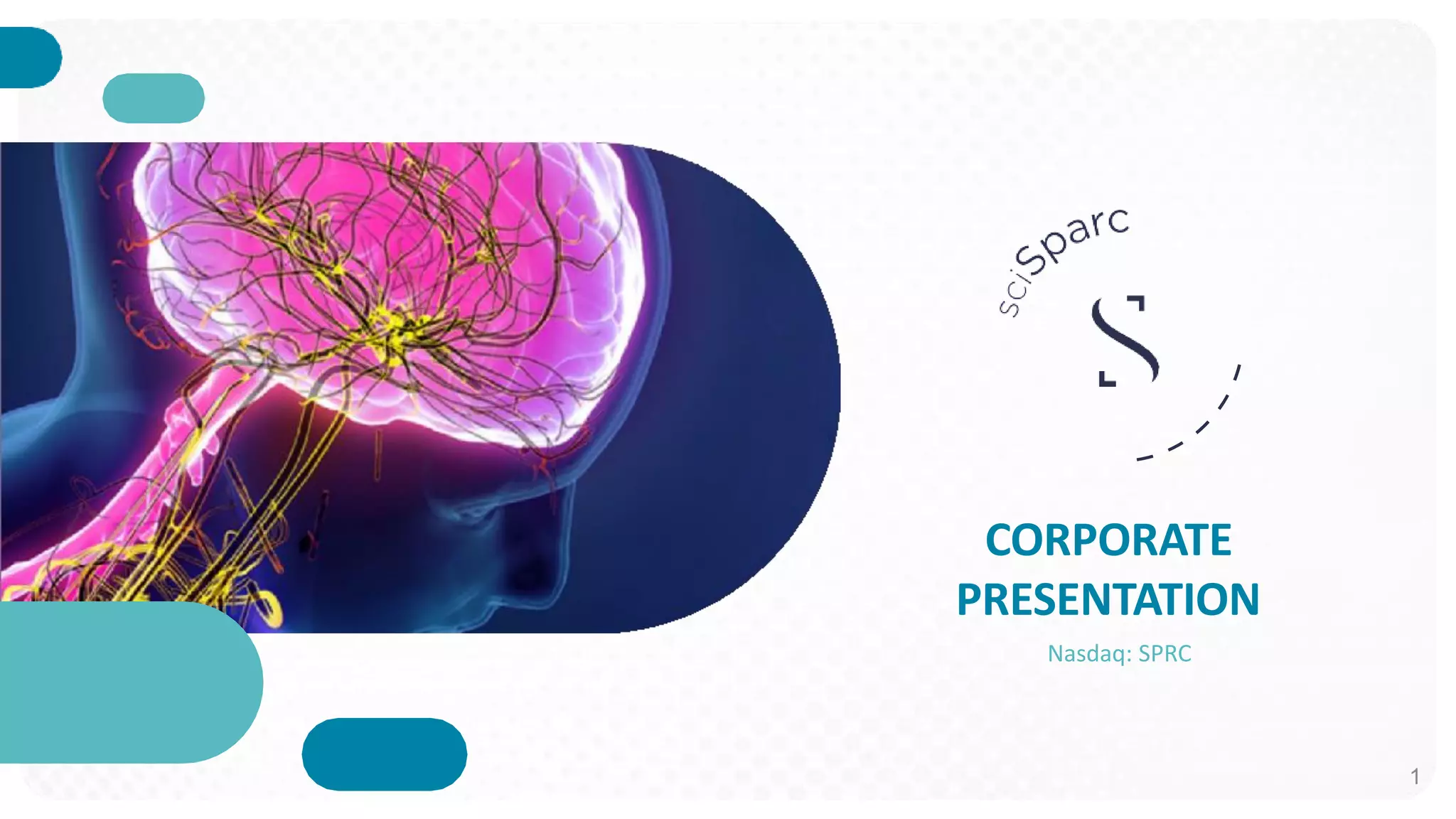
The cover slide establishes the company's identity as a life sciences firm focused on neurology, evidenced by the anatomical graphic of a human brain and nervous system. It clearly displays the Nasdaq ticker 'SPRC,' immediately signaling to the viewer that this is a publicly traded entity rather than a private startup seeking seed funding. The branding is clinical and minimalist.
Slide 4: Recent Achievements and Leadership Transition
This slide functions as a 'traction' slide for a post-IPO company. It highlights a pivot or restart under 'NEW LEADERSHIP' in place since August 2020. The key metrics provided are financial and regulatory: $17M raised in equity , a debt-free status , and a market cap of ~$16.3M as of February 14, 2022. The slide also notes the acceleration of R&D and the strengthening of the IP portfolio with new patents in the U.S., Japan, and Australia. The mention of the 'CannAmide' trademark suggests a move toward commercializing specific proprietary formulations.
Slide 7: Market Opportunity
SciSparc identifies five distinct therapeutic areas with 'unmet needs.' The slide provides specific market valuations and growth projections for each:
Tourette Syndrome (TS): $80M in 2019, growing to $98.7M by 2023. · Status Epilepticus: Part of a global epilepsy market growing from $8.8B (2018) to $9.5B (2023). · Alzheimer’s Disease (AD): Projected to reach $13.6B by 2027. · Autism Spectrum Disorder (ASD): Expected to reach $4.6B by 2026. · Pain and Inflammation: The largest segment, valued at $77.8B in 2019.
This slide effectively demonstrates the 'multi-shot on goal' strategy, showing that the company's core technology can be applied to both niche orphan diseases and massive global health burdens.
Slide 10: Programs in Detail
This is a section divider that transitions the deck from high-level corporate strategy to specific clinical data. The imagery reinforces the medical and laboratory focus of the company.
Slide 13: SCI-110 for Alzheimer’s Disease and Agitation
This slide details a specific Phase IIA clinical trial. It defines the objective (safety, tolerability, and efficacy) and the clinical site (Sophie & Abraham Stuchynski Israeli Alzheimer's Medical Center). Technical specifics are provided: 20 patients are being treated with a daily dose of up to 12.5mg THC + 800mg PEA . The use of the Cohen Mansfield Agitation Inventory (CMAI) as a primary efficacy trend indicator shows a standardized approach to clinical validation. This level of detail is crucial for biotech investors who need to assess trial design risk.
Slide 16: SCI-160 for Pain
The SCI-160 program is presented as an 'innovative and proprietary CB2 Receptor (CB2R) agonist.' A major credibility marker here is the mention of Professor Raphael Mechoulam, Ph.D. , who synthesized the formulation. The slide emphasizes that this treatment does not cause 'cannabis psycho-activity,' a key selling point for medical applications. The program is moving from successful animal models toward an FDA IND Phase I study , indicating the next major regulatory hurdle for the company.
Slide 19: Intellectual Property
For a biotech company, the IP slide is often the most important. SciSparc quantifies its moat with:
9 patent families · 8 granted patents (5 in the U.S.) · Pending applications in Europe, China, and Japan.
The use of icons makes this data easily digestible, reinforcing the message that the company's value is protected globally.
Slide 22: Why Invest in Us?
The closing argument summarizes the value proposition: proprietary technology, 'attractive valuation,' and strategic partnerships. It lists three concrete milestones for 2022: three active clinical studies, IND application progress for the pain program, and top-line results for the Status Epilepticus study. This slide sets the yardstick by which investors will measure management's performance over the following twelve months.
What SciSparc Does Well
The deck is exceptionally clear about its clinical stages. Unlike many biotech decks that obfuscate their progress with overly dense scientific jargon, SciSparc uses bullet points to define trial sizes, dosages, and specific medical centers. The inclusion of Professor Mechoulam provides an 'authority' bias that is highly effective in the cannabinoid space. Furthermore, the financial clarity on slide 4—specifically the 'no debts' claim—is a strong signal of fiscal responsibility in a sector known for high burn rates.
What is Missing from the Deck
The most significant omission in these slides is a detailed 'Team' slide. While 'New Leadership' is mentioned, the specific names, backgrounds, and previous exits of the executive team are not shown in this selection. In biotech, the pedigree of the C-suite is often as important as the science. Additionally, there is no 'Ask' slide. While the company is public, a corporate presentation usually includes a slide detailing the intended use of proceeds from recent or upcoming capital raises. Finally, there is a lack of competitive landscape analysis; the deck assumes the 'unmet need' is enough to justify the investment without addressing other firms developing cannabinoid or traditional therapies for the same indications.
Founder Takeaways: Copy the Clarity, Not the Omissions
Quantify your IP: Don't just say you have patents. Follow SciSparc's lead on slide 19 by breaking them down by 'families,' 'granted,' and 'pending,' and specify the jurisdictions (U.S. vs. International). This builds immediate professional credibility.
Define your 'Multi-Shot' Strategy: If your technology is a platform, show how it applies to different markets with varying sizes (Slide 7). This helps investors understand that the failure of one clinical trial doesn't necessarily mean the end of the company.
Use Authority Markers: If a world-renowned expert (like Mechoulam) is involved in your research, their name should be prominent. It acts as a shorthand for scientific validity that pages of data cannot replicate.
Be Specific About Trials: If you are in clinical stages, provide the N-number (patient count), the dosage, and the primary endpoints (Slide 13). Vague descriptions of 'testing' are a red flag; specific trial parameters suggest a professional regulatory strategy.
Frequently asked questions
- What is the primary focus of SciSparc's drug development?
- SciSparc focuses on creating proprietary cannabinoid-based combinations to treat central nervous system disorders and chronic pain. Their technology aims to enhance the efficacy of cannabinoids while reducing side effects. Key programs include SCI-110 for Alzheimer's and Tourette Syndrome, and SCI-160, a non-psychoactive CB2 receptor agonist for pain management, as detailed on slides 13 and 16.
- What is the current clinical status of their Alzheimer's treatment?
- According to slide 13, the SCI-110 program for Alzheimer's Disease and Agitation is in Phase IIA. The study is being conducted at the Sophie & Abraham Stuchynski Israeli Alzheimer's Medical Center. It involves 20 patients and focuses on safety, tolerability, and the ability to ameliorate agitation using the Cohen Mansfield Agitation Inventory (CMAI) as a measurement tool.
- How does SciSparc protect its technology?
- SciSparc relies on a robust intellectual property strategy. Slide 19 indicates they own nine patent families and have eight granted patents, with five of those in the United States. They also have pending applications in major global markets including Europe, China, and Japan. Additionally, they have secured trademarks like CannAmide for their proprietary formulations (slide 4).
- Who are the key scientific figures associated with the company?
- The deck highlights the involvement of Professor Raphael Mechoulam, Ph.D., who is credited with synthesizing the specific CB2R agonist used in the SCI-160 program for pain (slide 16). Mechoulam is widely regarded as a pioneer in cannabinoid research, providing significant scientific credibility to the company's proprietary formulations and clinical approach.
- What were the company's stated financial goals for 2022?
- Slide 22 outlines several value-driving milestones for 2022, including having three clinical studies active by the end of the year. They also aimed to reach the late stages of preparation for an Investigational New Drug (IND) application for their pain program and expected to release top-line results for their Status Epilepticus study.