Scope3’s Series B pitch deck is a focused narrative on category creation within the intersection of ESG and advertising technology. The deck avoids the typical 'problem-solution' tropes, instead leading with a high-pedigree team and immediate market validation. By showcasing 40+ industry-leading partners and a case study demonstrating a 30% improvement in core performance KPIs alongside carbon reduction, the company proves that sustainability is not a tax on efficiency. The deck is notably transparent about its business model, detailing specific CPM-based pricing and revenue share structures.…
Key takeaways
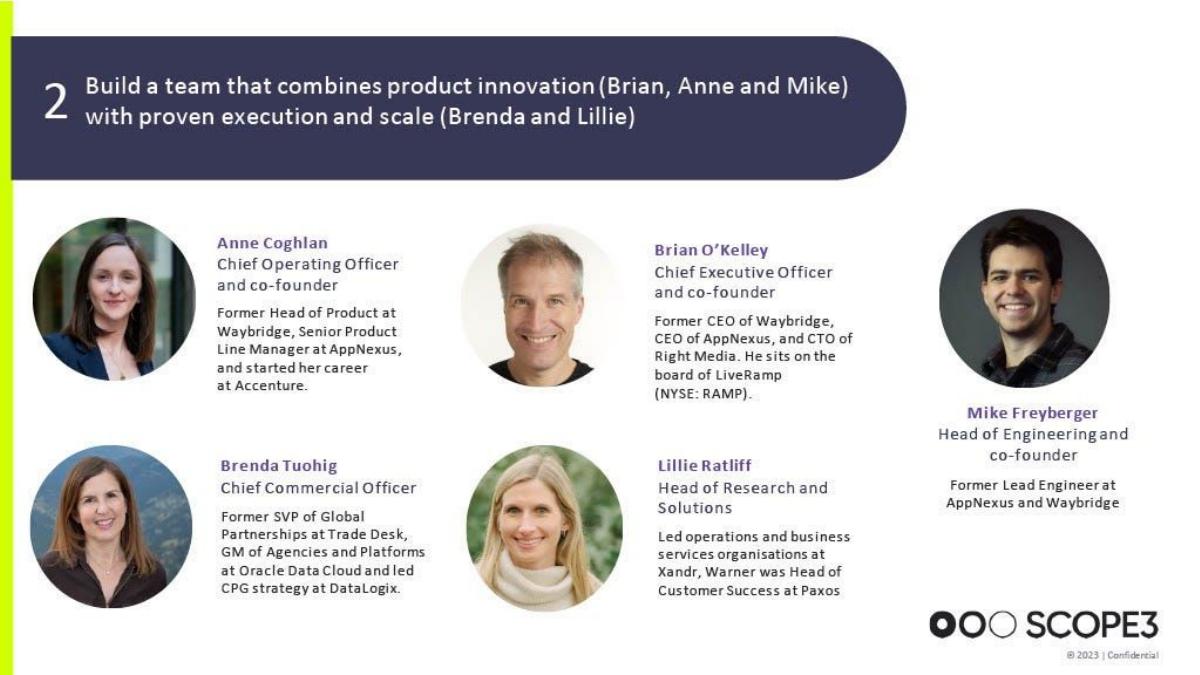
- The team slide (Slide 3) emphasizes deep domain expertise, citing former roles at AppNexus, The Trade Desk, and Oracle to establish immediate credibility.
- Market validation is presented through a 'land grab' strategy, listing 40+ partners including Microsoft, Vox Media, and Magnite on Slide 4.
- A detailed case study on Slide 6 quantifies impact, showing a reduction from 670g to 414g of CO2e per 1,000 impressions.
- The deck claims a 30% outperformance of core KPIs in carbon-optimized campaigns, refuting the idea that 'green' media is less effective (Slide 6).
- Revenue models are explicitly stated on Slide 7, including a $0.10 CPM via DSPs and a 50/50 revenue share model.
- Traction metrics are aggressive, reporting over 300% ARR growth in the first half of 2023 (Slide 8).
- The product roadmap (Slide 5) links specific trends like AI content propagation and privacy to their long-term 'Scope3 Index' strategy.
- Investment priorities (Slide 9) focus on geographic expansion into Europe and Japan and moving corporate functions from part-time to full-time.
Introduction: The Decarbonization of Digital Supply Chains
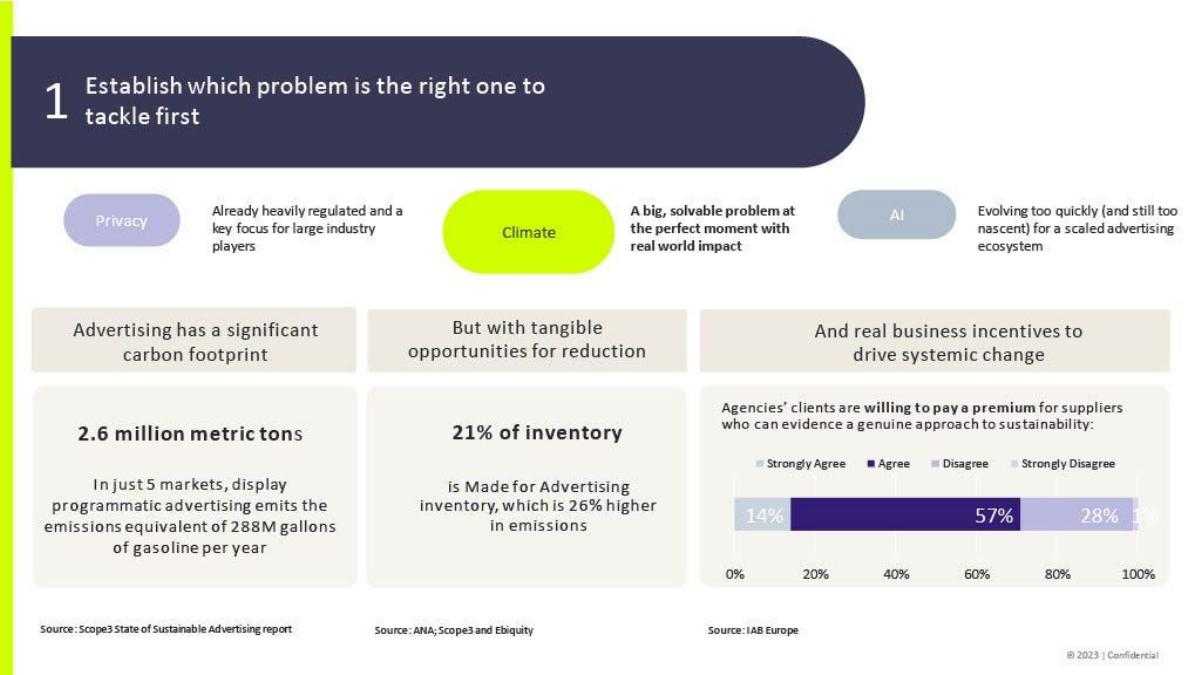
Scope3’s Series B deck represents a shift in how climate-tech companies approach traditional industries. Rather than pitching sustainability as a moral imperative, the deck frames carbon reduction as a lever for operational efficiency and media quality. Reported by Business Insider to have raised $20M in 2024, the company focuses on the 'Scope 3' emissions—indirect emissions that occur in a company’s value chain—specifically within the energy-intensive world of programmatic advertising.
Slide 1-2: The Vision and the Paradigm Shift
The deck opens with a stark, atmospheric image of smoke, titled 'Decarbonizing Media and Advertising.' Slide 2 poses a rhetorical question: 'Where do you start if you want to build a generational ad tech company without getting stuck in the current paradigm?' This sets the stage for a 'category-defining' pitch. It suggests that the current state of ad tech is flawed and that a new generation of companies must be built on a different foundation—in this case, carbon accountability.
Slide 3: The Pedigree Slide
In high-stakes Series B rounds, the team is often the strongest signal of success. Slide 3 is a masterclass in establishing authority. Brian O’Kelley (CEO) is credited as the former CEO of AppNexus and CTO of Right Media, essentially identifying him as one of the architects of modern programmatic advertising. The inclusion of Brenda Tuohig (former SVP at The Trade Desk) and Anne Coghlan (former AppNexus) reinforces that this isn't a group of environmentalists trying to learn ad tech, but ad tech veterans solving a new problem. This slide justifies the 'generational company' ambition mentioned previously.
Slide 4: Market Validation and the 'Land Grab'
Slide 4 is a 'logo cloud' that carries more weight than most. It claims 40+ industry-leading companies are already using Scope3 data. The logos include heavyweights like Microsoft, Vox Media, Magnite, and IAS. The slide uses the phrase 'land grab it,' signaling to investors that the company is in a high-growth phase where capturing market share is the primary objective. By showing both buy-side and sell-side partners, Scope3 demonstrates that they are becoming the standard 'currency' for carbon in the industry.
Slide 5: Product Strategy and Market Trends
This slide maps Scope3’s products against current industry trends. It identifies four key drivers: consumer/regulatory demand, AI-driven content propagation, privacy-driven inventory shifts, and the continued flow of dollars toward quality. The product matrix shows how 'Climate Shield' and 'Green Media Products' address these trends. Notably, it mentions the 'Scope3 Index,' suggesting a long-term play to become the definitive rating system for the entire advertising ecosystem.
Slide 6: The Proof Point (Case Study)
One of the most effective slides in the deck, Slide 6, provides a concrete case study with mpb.com and EssenceMediacom. It quantifies the value proposition: reducing carbon emissions from 670g to 414g of CO2e per 1,000 impressions. Crucially, it notes that the carbon-optimized campaign 'exceeded the core performance KPI by 30%.' This is the 'holy grail' of ESG investing—proving that the sustainable choice is also the more profitable/performant choice. It also translates the data into layman's terms: 11.4 tons of CO2e avoided is equivalent to 200,000 passenger air miles.
Slide 7: The Business Model
Transparency in the business model is often missing in early-stage decks, but Scope3 is explicit. Slide 7 breaks down two revenue streams: Campaign Measurement & Optimization and Media Platform . They disclose a $0.10 CPM via DSPs with a 50/50 revenue share and a $0.02 CPM for other channels. The Media Platform is sold as a SaaS product to ad tech platforms and publishers. This level of detail gives investors confidence in the unit economics and the scalability of the revenue engine.
Slide 8: Traction and Pipeline
Slide 8 provides the 'up and to the right' metrics required for a Series B. It reports that the number of sell-side customers grew by 'almost 140% in the first half of 2023' and ARR revenue grew 'over 300%' in the same period. The right side of the slide outlines the 'Where we are Heading' roadmap, targeting SSPs, DSPs, and new verticals like Retail Media and DOOH (Digital Out of Home). Some specific partner names are redacted, but the momentum is clear.
Slide 9: Investment Priorities
The final slide in the provided set outlines how the capital will be used. Instead of a simple pie chart, it lists strategic 'Focus Areas.' These include geographic expansion (Europe and Japan), subsidizing the buy-side to drive adoption, and maturing the organization by moving corporate functions (HR, Legal) from part-time to full-time. It also emphasizes creating 'space for R&D,' suggesting that while they have a product-market fit now, they are looking toward future innovations.
What Works in This Deck
The 'Performance Plus' Narrative: The deck successfully argues that carbon reduction isn't just a compliance box to check; it’s a way to find better media. By linking carbon to 'waste' and 'quality,' they align their mission with the CFO’s goals, not just the Chief Sustainability Officer’s goals.
Extreme Credibility: The team slide is arguably the strongest in the industry. When the person who helped build the current ecosystem says it needs to change, investors listen. The 40+ partner logos further validate that the industry is listening too.
Pricing Transparency: By including specific CPM rates and revenue share percentages, Scope3 avoids the 'black box' problem many data startups face. Investors can easily model the potential upside based on total programmatic ad spend.
What Is Missing
Competitive Landscape: The deck does not include a traditional competitor matrix. While Scope3 likely views itself as a first-mover in a new category, there are other carbon measurement firms (like Good-Loop or Cedara). Omitting them suggests a position of market dominance, but investors would likely ask about defensibility against incumbents like DoubleVerify or IAS building similar features.
The 'Ask' Slide: While the investment priorities are listed, the actual dollar amount and terms of the round are not on these slides. This is common in 'teaser' or 'follow-up' versions of decks, but a complete pitch usually includes a specific funding target.
Unit Economics Deep Dive: While they provide pricing, they don't show the cost of data acquisition or the margins on their SaaS vs. CPM revenue. At Series B, investors typically look for a more granular view of the LTV/CAC ratio.
Founder Takeaways
Lead with your 'Why Now': Scope3 perfectly times their pitch with the convergence of AI content explosions and tightening ESG regulations. Founders should always anchor their product in macro trends that make their solution inevitable. · Quantify the 'Green Premium': If you are building in climate-tech, you must prove that your solution doesn't hurt the bottom line. Scope3’s 30% KPI improvement metric is the most important data point in the deck. · Use 'Industry Currency' for Pricing: By pricing in CPM (Cost Per Mille), Scope3 speaks the language of their customers. Don't force a new billing paradigm on an industry if you can fit into their existing flow of funds. · Show, Don't Just Tell, Your Network: The logo slide (Slide 4) is powerful because it shows integration, not just interest. Listing '40+ companies standing up unique solutions' is much stronger than saying 'we have a large pipeline.'
Frequently asked questions
- How does Scope3 make money according to the deck?
- Scope3 utilizes a multi-pronged revenue model detailed on Slide 7. For campaign measurement and optimization, they charge $0.10 CPM via DSPs (usually with a 50/50 revenue share) or $0.02 CPM via other channels. They also offer a SaaS-based model for their Media Platform, sold directly to ad tech platforms and publishers.
- What is the 'Climate Shield' mentioned in the product slides?
- The Climate Shield is a core product feature designed to 'block digital waste.' According to Slide 7, it allows advertisers to block climate-risk inventory on all campaigns 'at the click of a button,' effectively automating the exclusion of high-emission or low-quality media placements.
- Does the deck address the performance trade-offs of green advertising?
- Yes, Slide 6 explicitly addresses this by highlighting a case study with mpb.com where a carbon-optimized campaign actually exceeded core performance KPIs by 30%. This suggests that reducing carbon often involves removing 'waste' inventory, which improves overall campaign efficiency.
- Who are the key people behind Scope3?
- The leadership team is highly experienced in ad tech. CEO Brian O’Kelley was the former CEO of AppNexus and CTO of Right Media. COO Anne Coghlan and Head of Engineering Mike Freyberger both have backgrounds at AppNexus and Waybridge, while CCO Brenda Tuohig comes from The Trade Desk and Oracle (Slide 3).
- What are the primary growth targets for the new funding?
- As per Slide 9, the investment priorities include expanding operations in Europe and Japan, subsidizing the buy-side to accelerate market 'land grab,' and scaling the product and engineering teams to allow more room for R&D.