Scrintal's $1M seed deck presents a compelling case for a visual knowledge base that integrates thinking, developing, and sharing into a single platform. The deck effectively uses a persona-driven problem statement, citing that 74% of time is spent on non-value-added tasks (Slide 3). It showcases strong organic growth with a waitlist of over XX,000 users and a referral-driven acquisition model (Slide 8). The strategy focuses on 'gatekeeper' power users—strategists and consultants—who control tool budgets in 75% of cases (Slide 11). While the deck is visually clean and data-rich, it uses place…
Key takeaways
- Scrintal positions itself as a 'Visual knowledge base' to empower knowledge workers (Slide 1).
- The problem is framed through a persona, 'Ece,' who uses 6 apps and faces a 3-week project delay (Slide 2).
- A significant efficiency gap is identified, with 74% of time spent on tasks with no added value (Slide 3).
- The solution promises a 10x increase in speed and a 90% reduction in costs by unifying workflows (Slide 5).
- User testimonials highlight specific benefits like a 30% reduction in meetings and a 66% reduction in apps used (Slide 7).
- Organic growth is a core strength, with a waitlist exceeding XX,000 and zero spend per sign-up (Slide 8).
- Power users are identified as high-leverage 'gatekeepers,' with 75% controlling work tool budgets (Slide 11).
- The market opportunity is valued at €119b in Europe by 2026, targeting a 10% market share (Slide 13).
Scrintal Pitch Deck Teardown
Scrintal's pitch deck for their $1M seed round is a masterclass in visual storytelling and persona-driven problem solving. The company positions itself as a 'Visual knowledge base,' aiming to solve the fragmentation and inefficiency inherent in modern knowledge work. By focusing on the 'overview effect' and a unified workflow, Scrintal targets a massive market of 1 billion knowledge workers. The deck is structured to move from a relatable individual problem to a systemic organizational inefficiency, then presents a solution backed by organic growth metrics and a clear path to enterprise adoption.
Slide 1: Title Slide
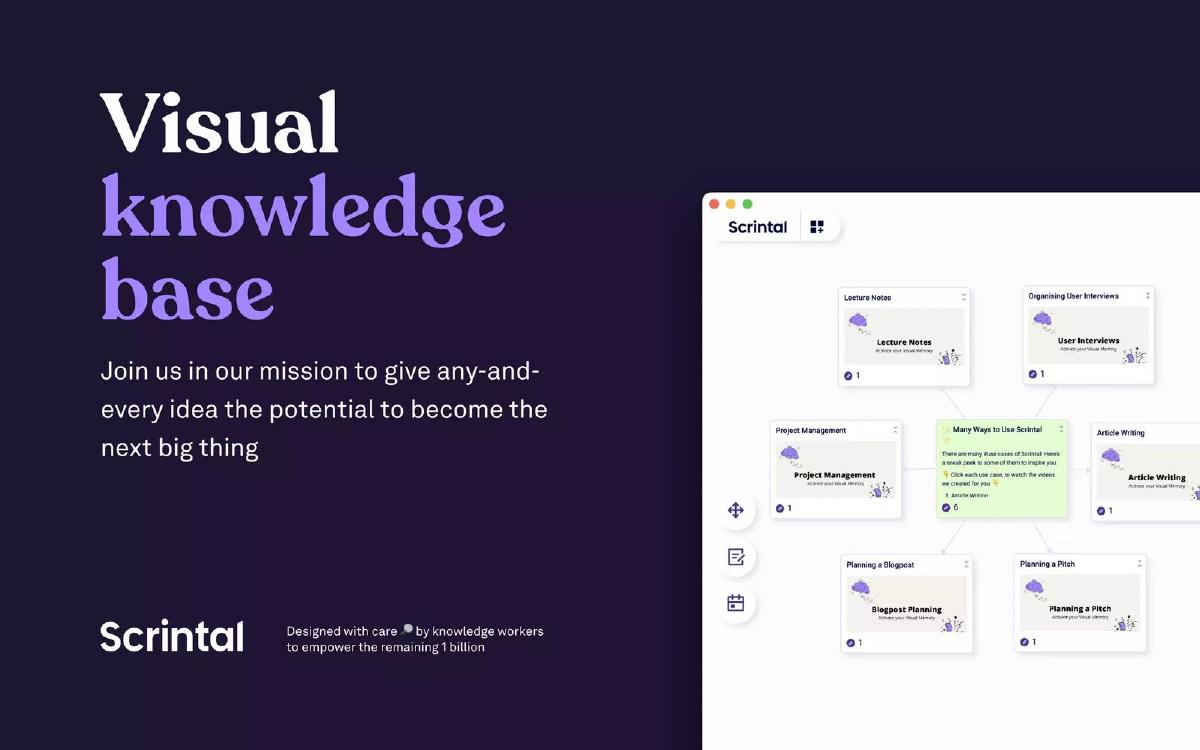
The deck opens with a bold declaration: "Visual knowledge base." The subtitle invites investors to join a mission to give every idea the potential to become "the next big thing." The slide features a clean screenshot of the Scrintal interface, showing a networked mind map of various project cards like "Lecture Notes," "User Interviews," and "Article Writing." A small note at the bottom indicates the product was "Designed with care by knowledge workers to empower the remaining 1 billion," establishing a peer-to-peer connection with the target audience.
Slide 2: The Problem Persona
Slide 2 introduces "Ece," a strategist working in a cross-functional international team. This slide quantifies the friction in her daily life: 6 apps used, 15 people involved, 20 hours of brainstorming, and 20x meeting notes created. The most damning statistic is that projects are delayed by 3 weeks, and "90% of ideas go to waste." The slide lists specific pain points like "Data duplication," "Task & brain switching across apps," and "Siloed discussions," making the abstract problem of productivity very concrete.
Slide 3: Quantifying Inefficiency
Building on Ece's story, Slide 3 presents a broader market reality: "74% of time is spent on tasks with no added value." A donut chart breaks this down: 30% on sync meetings, 23% on turning insights into presentable formats, and 21% on looking for information across apps. Only 26% is dedicated to "Actual work." This slide serves to validate the scale of the problem Scrintal aims to solve, framing it as a massive drain on organizational resources.
Slide 4: The Transformation
Slide 4 introduces the Scrintal solution with the headline "3 steps how we transform decision makers' work." It features more detailed product screenshots, showing a hybrid of a whiteboard and a note-taking tool. The visual highlights how Scrintal allows users to organize, cluster, and connect ideas with backlinks, facilitating a "creative flow" that traditional tools lack.
Slide 5: The Value Proposition
Slide 5 outlines the three-stage workflow: Think, Develop, and Share. It promises significant performance gains: "+100% More productive," "10x Faster," and "10x Cheaper." The slide explains that by developing ideas as you think and having an "instant overview effect," users can save 90% of the money typically spent using multiple apps to move from idea to shareable work.
Slide 6: The Broken Process
This slide visualizes the current "Scattered and complex" workflow. It shows a stack of logos for popular tools like Miro, Notion, Slack, and Google Drive, categorized under Think, Develop, and Share. The connecting arrows are labeled as a "Broken process," leading to a "Loss of productivity and creativity." This effectively positions Scrintal as the single layer that can replace or unify these disparate tools.
Slide 7: User Testimonials
Slide 7 provides social proof through four testimonials from different roles: Marketing Director, Senior Talent Manager, Engineering Manager, and Sales & Partnerships Manager. Each quote is accompanied by a specific metric, such as "-30% # Meetings," "5x Speed," and "-66% # Apps used." These data points from early users reinforce the value proposition stated earlier in the deck.
Slide 8: Organic Growth
Slide 8 focuses on traction, showing a graph of "Consistent organic growth." The chart compares "Actual growth" against an "Initial target," with the actual line significantly outperforming the target. Key highlights include "€0.0X spent per sign up" and a waitlist of "xx 000+." The slide also notes that a significant percentage of waitlisters came via referrals and social media shares, indicating strong product-market fit and viral potential.
Slide 9: Revenue Generation
Slide 9 addresses monetization, stating that "$X revenue" was generated in "Y weeks" following the announcement of an early access plan on September 29th. The pricing is set at "$60 per user upfront" for annual usage. While the specific revenue and user numbers are placeholders (X and Y), the slide demonstrates a clear intent and early success in converting free users to paid customers.
Slide 10: Retention Metrics
Slide 10 uses placeholders for retention data: "Power users have X% Retention after X months." It shows two empty bar charts for "Power users" and "All onboarded users" over a 5-month period. While the data is missing in this version, the slide's inclusion shows that the founders understand the importance of cohort analysis and long-term user engagement.
Slide 11: The Growth Engine
Slide 11 identifies Scrintal's "Power users" as "gatekeepers in their organizations." It provides statistics: 75% control the work tool budget, 60% work in small-mid size teams, and 44% work across organizations. By targeting strategists and consultants who handle "Business critical use cases" like strategy, planning, and research, Scrintal positions itself to spread naturally through professional networks.
Slide 12: Future Projections
Slide 12 sets an ambitious goal: "We aim to reach €X million ARR by the end of X." A bar chart shows projected growth in registered users, with milestones for the "Early Access Plan Release" and "Public Launch." Again, the specific figures are placeholders, but the trajectory is clearly upward.
Slide 13: Vision and Market Size
Slide 13 expands the vision to transforming how "1b+ people create ideas." It identifies a "€119b market in 2026" in Europe alone, with a goal of 10% market share. The slide also lists "Comparable Platform Models" like Atlassian ($2.1b revenue), Lynda.com ($1.5b acquisition), Notion ($10b valuation), and Miro ($17.5b valuation), placing Scrintal in a high-value peer group.
Slide 14: The Ask
Slide 14 outlines what Scrintal is looking for: "A partner, with global mindset and connections, expertise in product-led growth, and a strong SaaS focus." The funding goal is "€X million" to launch and expand the product, build enterprise foundations, and develop a public API. A small circle at the bottom indicates a target "Total headcount by the end of 2023" of "X."
Slide 15: Contact Information
The final main slide features the company's mission statement again: "Give any-and-every idea the potential to become the next big thing." It includes contact details for Ece Kural, the company's email, phone number, and website, accompanied by a simple illustration of a head filled with ideas.
Slide 16-19: Appendices
The deck concludes with an "Appendices" section. Slide 17, titled "Why now?", notes that 1+ billion professionals work in knowledge-heavy jobs and that productivity management software is growing at 14% yearly. It also cites a "159% growth in remote work in the last 12 years." Slide 18 is a competitive landscape matrix, placing Scrintal in the top-right quadrant for "Visuality" and "Final work," contrasting it with tools focused only on brainstorming or text-based work. Slide 19 summarizes the "defensible and scalable business" model, citing factors like "Visual knowledge base – a hard to build product," "network effects," and "switching costs within repos."
What Scrintal Does Well
Scrintal excels at framing a complex productivity problem through a relatable persona. By starting with "Ece's life," the deck makes the abstract concept of a "visual knowledge base" immediately understandable. The use of specific, quantified pain points (e.g., 74% time wasted, 3-week delays) creates a strong sense of urgency. Furthermore, the deck's focus on "gatekeeper" users is a sophisticated growth strategy, showing investors that the company has a clear plan for efficient, viral acquisition within high-value professional segments. The visual design is consistent and clean, mirroring the product's own value proposition of clarity and organization.
What Is Missing from the Scrintal Deck
The most significant omission in this version of the deck is the actual data for key metrics. Placeholders like "$X revenue," "X% Retention," and "€X million ARR" are used throughout slides 9, 10, and 12. While this is common in public-facing teardowns to protect sensitive information, a real investor deck would need these figures to be precise and verified. Additionally, there is no dedicated "Team" slide in the main sequence, although a photo of a team appears briefly on Slide 4. Investors typically want to see a clear breakdown of the founders' backgrounds and their specific expertise in building SaaS or productivity tools. Finally, while unit economics like CAC and LTV are hinted at through the "€0.0X spent per sign up" metric, a more formal breakdown of these figures would strengthen the case for a $1M seed round.
What Other Founders Should Copy
Founders should emulate Scrintal's use of a "Broken Process" slide (Slide 6). By visually showing how a user has to jump between multiple well-known apps, you create a clear "before" state that makes your "after" state (your product) look like a necessary relief. The "Power User as Gatekeeper" strategy (Slide 11) is also worth copying; it shows a deep understanding of your customer and how they can drive growth for you. Lastly, the way Scrintal ties user testimonials to specific, measurable outcomes (Slide 7) is far more effective than just using generic praise. If your early users are seeing a 30% reduction in meetings, that is a powerful proof point that belongs in your deck.
Frequently asked questions
- What is Scrintal's core product value proposition?
- Scrintal defines itself as a visual knowledge base that allows users to transition from initial thinking to shareable work within a single application. By combining an infinite canvas with networked note-taking, it aims to eliminate the 'broken process' caused by switching between multiple tools for brainstorming, developing, and sharing insights. The deck claims this approach makes work 10x faster and significantly more productive.
- How does Scrintal address the problem of workplace productivity?
- The deck argues that knowledge workers spend 74% of their time on non-value-added tasks, such as looking for information across apps (21%) and turning insights into presentable formats (23%). Scrintal addresses this by providing a unified environment where information is visually organized and easily shareable, reducing the need for constant copy-pasting and siloed discussions that lead to 90% of ideas going to waste.
- Who is the target audience for Scrintal according to the deck?
- Scrintal targets 'power users' who function as gatekeepers within their organizations. These include strategists, consultants, business division heads, and tech leads. The deck notes that 75% of these users control the budget for work tools and 44% work across different organizations, providing a natural growth engine for the platform through cross-functional collaboration and high-level decision-making use cases.
- What evidence of market traction does the deck provide?
- The deck highlights 'consistent organic growth' with a waitlist of over XX,000 users and a cost of €0.0X per sign-up. It also mentions an early access plan launched in September with a $60 upfront annual price point. Testimonials from various roles, such as Marketing Directors and Engineering Managers, cite specific improvements like a 50% reduction in time spent on strategic planning.
- What are the key components of Scrintal's future roadmap?
- Scrintal's roadmap includes expanding the product into live collaboration and a broader ecosystem. Key technical milestones mentioned are achieving cross-platform operability, building a public API, and developing enterprise-ready integrations. The long-term vision involves evolving from a visual knowledge base into a 'Visual Operating System' enhanced by machine learning insights to serve over 1 billion people.