The Securitize Series B deck is a study in institutional positioning. Rather than focusing on the hype of blockchain technology, the deck frames the company as a necessary infrastructure layer for the massive, illiquid private capital markets. By highlighting significant regulatory milestones—such as being the first to register with the SEC as a digital transfer agent—Securitize builds a moat of credibility. The deck effectively uses macro trends, such as the 50% decline in U.S. publicly traded companies since 1996, to justify the need for their solution. While it lacks granular unit economic…
Key takeaways
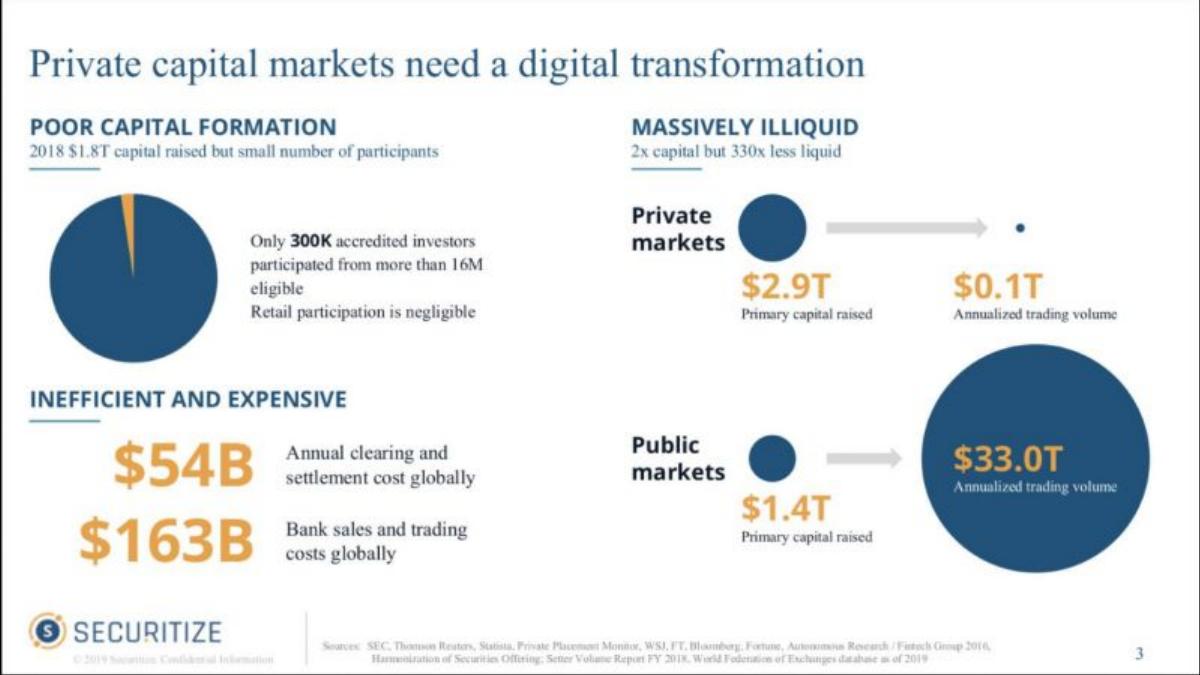
- The deck identifies a massive liquidity gap: private markets raised $2.9T but had only $0.1T in trading volume, compared to $33T in public markets (Slide 3).
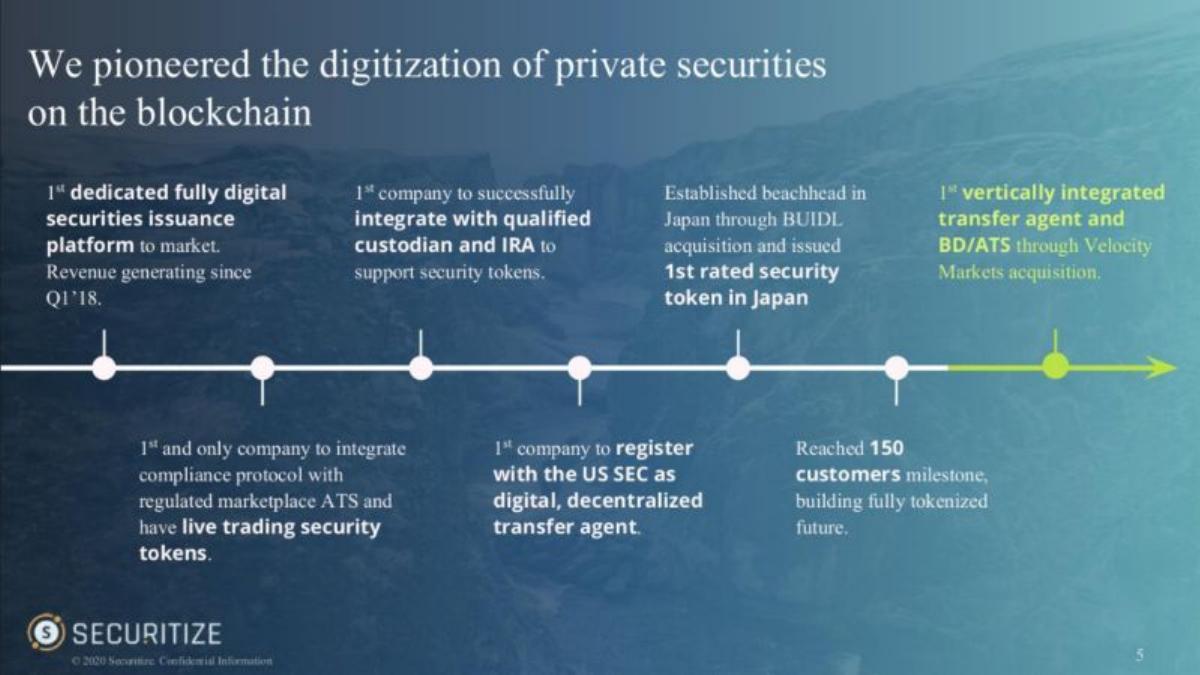
- Securitize positions itself as a regulatory pioneer, noting it was the first company to register with the SEC as a digital, decentralized transfer agent (Slide 5).
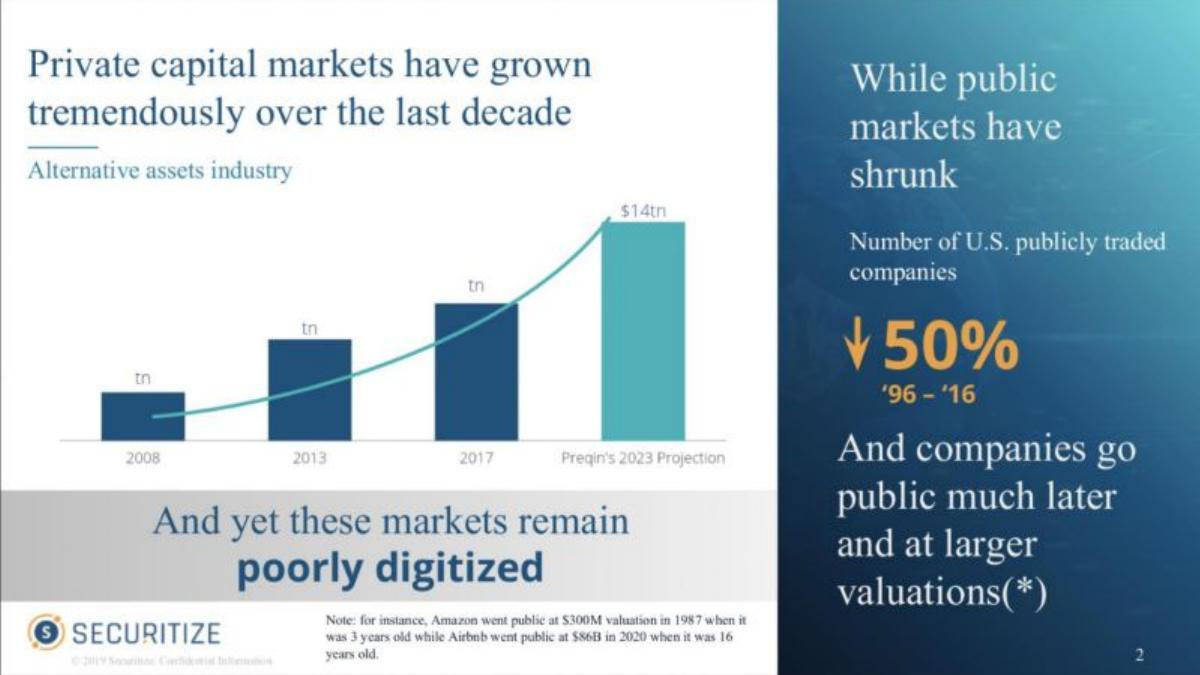
- The company highlights a significant market shift, noting that the number of U.S. publicly traded companies fell by 50% between 1996 and 2016 (Slide 4).
- The management team is a core asset, featuring 100+ years of combined experience from firms like the SEC, Morgan Stanley, and AT&T (Slide 9).
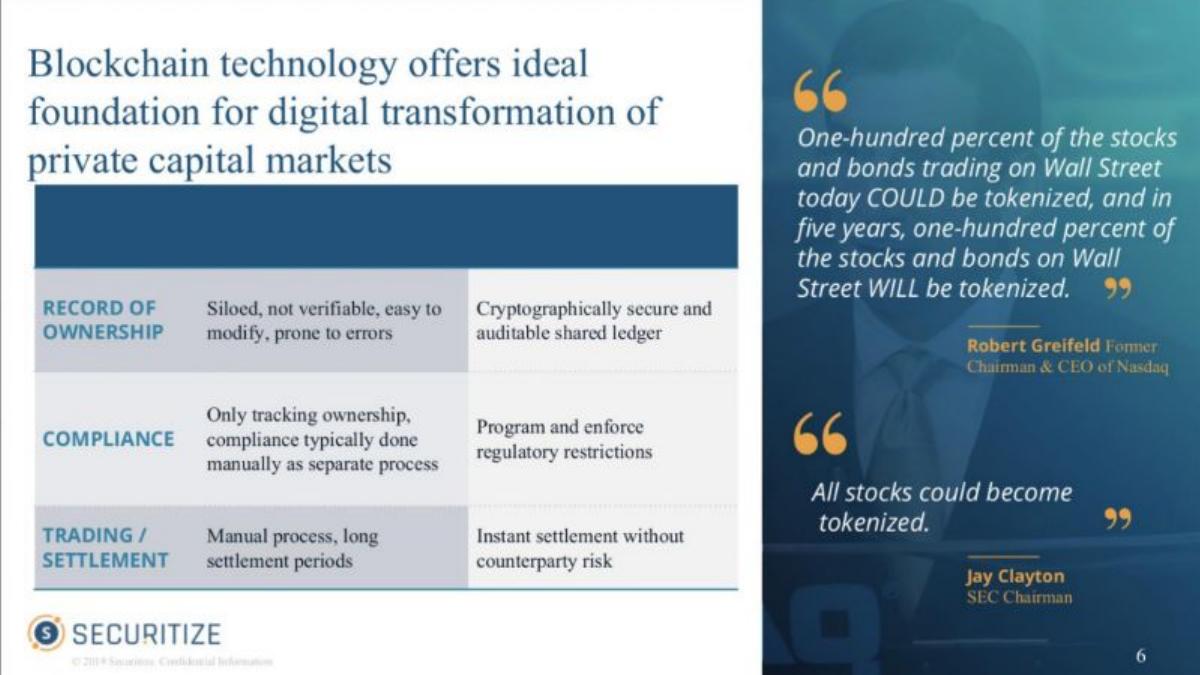
- The deck uses social proof from high-level authorities, quoting the former CEO of Nasdaq and the SEC Chairman to validate the inevitability of tokenization (Slide 6).
- Securitize demonstrates global reach and vertical integration, citing acquisitions like BUIDL in Japan and Velocity Markets for BD/ATS capabilities (Slide 5).
- The investor slide shows a strategic mix of crypto-native firms (Coinbase, Ripple) and traditional financial giants (Morgan Stanley, Nomura) (Slide 10).
- A clear analogy is drawn between the digitization of music and the digitization of securities to explain the evolution of private markets (Slide 7).
Introduction and High-Level Vision
Slide 1: Title Slide
The deck opens with a clean, professional title slide featuring the Securitize logo and the tagline: "Re-inventing private capital markets." It is dated January 2021 and includes the company website. The aesthetic is corporate and understated, signaling a focus on institutional finance rather than retail crypto hype.
Slide 2: Mission Statement
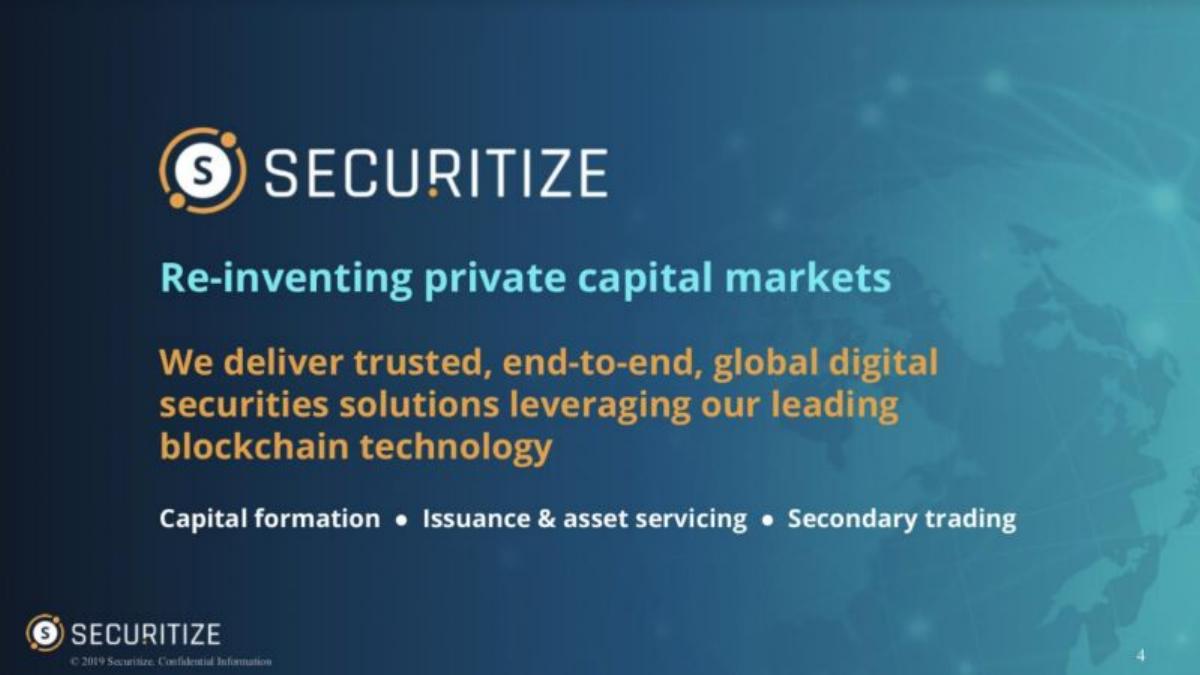
Slide 2 expands on the title, stating: "We deliver trusted, end-to-end, global digital securities solutions leveraging our leading blockchain technology." It breaks the business down into three core pillars: Capital formation, Issuance & asset servicing, and Secondary trading. This slide establishes the company as a full-stack infrastructure provider for the entire lifecycle of a security.
The Market Opportunity and Problem
Slide 3: The Liquidity Gap
This is a critical data slide titled "Private capital markets need a digital transformation." It highlights three main pain points: Poor Capital Formation (only 300K accredited investors participated out of 16M eligible), Inefficient and Expensive ($54B in annual clearing costs and $163B in bank sales costs), and Massively Illiquid . The most striking visual is the comparison between primary capital raised and trading volume. Private markets show $2.9T raised but only $0.1T in trading volume, whereas public markets show $1.4T raised but $33.0T in trading volume. This 330x liquidity difference is the core of the Securitize value proposition.
Slide 4: Macro Trends in Private Markets
Slide 4 argues that the market is moving in Securitize's direction. It shows a bar chart of the alternative assets industry growing toward a $14tn projection by 2023 . Conversely, it notes that the number of U.S. publicly traded companies shrunk by 50% between 1996 and 2016. A footnote compares Amazon going public at a $300M valuation in 1987 (3 years old) to Airbnb going public at $86B in 2020 (16 years old), illustrating that value creation is staying private longer.
The Solution and Technology
Slide 5: Execution Timeline and Milestones
This slide serves as a combined traction and credibility builder. It lists several "firsts," including being the first dedicated fully digital securities issuance platform (revenue generating since Q1 '18) and the first company to register with the US SEC as a digital, decentralized transfer agent. It also mentions the acquisition of BUIDL in Japan and Velocity Markets, which provided the vertically integrated transfer agent and BD/ATS capabilities. The slide notes they reached 150 customers by the time of this deck.
Slide 6: The Blockchain Advantage
Securitize explains why blockchain is the right tool for the job. It compares traditional methods to blockchain across three categories: Record of Ownership (Siloed vs. Cryptographically secure), Compliance (Manual vs. Programmatic), and Trading/Settlement (Long periods vs. Instant settlement). To add weight, the slide includes quotes from Robert Greifeld (Former CEO of Nasdaq) and Jay Clayton (SEC Chairman) , both of whom suggest that tokenization of all stocks is a likely future.
Slide 7: The Digitization Analogy
This slide uses a horizontal timeline to compare the evolution of Music, Public Securities, and Private Securities. It moves from Paper Certificates to Book entry (eShares/Carta) and finally to Blockchain-based security tokens . The goal is to make the shift to blockchain feel like an inevitable technological progression rather than a speculative experiment.
Slide 8: Private vs. Public Value Creation
This slide features a bar chart showing the ratio of private vs. public value creation for major tech companies like Apple, Microsoft, Google, and Facebook. For newer companies like Facebook and Twitter, the dark blue bars (private value creation) are significantly taller than the light blue bars (public value creation), reinforcing the idea that investors need access to private markets to capture significant returns.
Team and Institutional Support
Slide 9: Management Team
The team slide is exceptionally strong for a Series B company. Carlos Domingo (CEO) is highlighted for his 25+ years of experience and his role as former CEO of Telefonica R&D. The slide lists other executives with backgrounds from Computershare, Morgan Stanley, the SEC, and AT&T. A logo cloud at the bottom includes Stanford, Accenture, Google, and Fidelity, emphasizing the pedigree of the staff.
Slide 10: Investor Base
Securitize categorizes its investors into two groups: VC/Blockchain Investors (Blockchain Capital, Coinbase Ventures, Ripple) and Financial Service Investors (Morgan Stanley, Nomura, MUFG, Sony Financial Ventures). This dual support from both the crypto world and the traditional financial world is a powerful signal of the company's role as a bridge between the two. It notes total capital raised over $60M.
Slide 11: Board of Directors
The final content slide showcases the Board of Directors, which includes the CEO and President alongside Brad Stephens (Blockchain Capital) , Pedro Teixeira (Morgan Stanley) , and Tal Elyashiv (SPiCE VC) . Having a Managing Director from Morgan Stanley on the board provides a level of institutional validation that few startups can match.
Analysis of the Deck
What Works
Institutional Framing: The deck avoids the typical "disruptive" language of crypto and instead uses the language of capital markets: "liquidity," "compliance," "transfer agents," and "settlement risk." This is perfectly calibrated for a Series B round targeting institutional investors.
Regulatory Moat: By emphasizing their SEC registration and their status as a registered transfer agent, Securitize addresses the biggest concern in the space: regulatory risk. They don't just say they are compliant; they show the milestones that prove it.
The "Why Now" Slide: Slide 4 and Slide 8 do an excellent job of explaining the macro shift. If value creation is moving to private markets, but private markets are broken and illiquid, then an infrastructure solution is a mathematical necessity.
What Is Missing
Unit Economics: There is no mention of how Securitize actually makes money on a per-transaction or per-customer basis. While they mention being revenue-generating since 2018, the specific revenue model (SaaS fees vs. transaction fees) is not detailed.
Financial Projections: For a Series B deck, the absence of a forward-looking financial slide is notable. There are no projections for revenue growth, customer acquisition costs, or path to profitability.
The "Ask": The deck does not explicitly state how much money they are raising in this specific round or how they plan to spend it. While the catalogue facts state $48M was raised, the deck itself is a general overview rather than a specific pitch for a set dollar amount.
What Founders Should Copy
The Use of Authority Quotes: If you are in a highly regulated or skeptical industry, use quotes from established industry leaders (like the SEC Chairman) to validate your market. It shifts the burden of proof from the founder to the industry experts.
The Evolution Graphic: Slide 7 (the music/securities analogy) is a brilliant way to explain a complex technological shift. Comparing a new, scary concept (blockchain tokens) to a familiar, successful shift (MP3s and streaming) reduces the cognitive load for the investor.
Strategic Investor Categorization: If you have a mix of investors, categorize them to show breadth. Securitize showing both "Crypto" and "Traditional Finance" investors proves they have successfully navigated both ecosystems.
Frequently asked questions
- How much did Securitize raise with this deck?
- According to the catalogue facts, Securitize raised $48M in a Series B round in 2021. Slide 10 also notes that the company had raised over $60M in total capital at the time the deck was finalized.
- What is the core problem Securitize is solving?
- The deck identifies that private capital markets are 'massively illiquid' and 'poorly digitized.' Slide 3 points out that while $2.9T is raised in primary private markets, the annualized trading volume is only $0.1T, representing a 330x liquidity gap compared to public markets.
- Does the deck include a product demo or screenshots?
- No. The deck is high-level and strategic. It focuses on the 'what' and 'why' of the business model—capital formation, issuance, and secondary trading—rather than the specific user interface of the platform.
- Who are the key people behind Securitize?
- The team is led by CEO Carlos Domingo, who has 25+ years of experience and was formerly the CEO of Telefonica R&D. Other key members include President Jamie Finn and Scott Harrigan, the CEO of Securitize Markets, who previously worked at Computershare and Carta (Slide 9).
- What regulatory milestones has the company achieved?
- Securitize emphasizes its compliance-first approach on Slide 5, noting it was the first company to register with the SEC as a digital transfer agent and the first to integrate a compliance protocol with a regulated ATS (Alternative Trading System).