Oklo’s SPAC presentation is a masterclass in 'hard tech' storytelling, leveraging the high-profile involvement of Sam Altman to de-risk a pre-revenue energy play. The deck moves away from the typical utility-scale nuclear narrative, focusing instead on 'Aurora' powerhouses—small, 15 MWe liquid metal fast fission plants designed for rapid deployment (<1 year construction) and low land use (<2 acres). With a pre-money equity value of $850 million, the company positions itself as a cheaper, more agile alternative to competitors like NuScale. Beyond power generation, Oklo introduces a significant…
Key takeaways
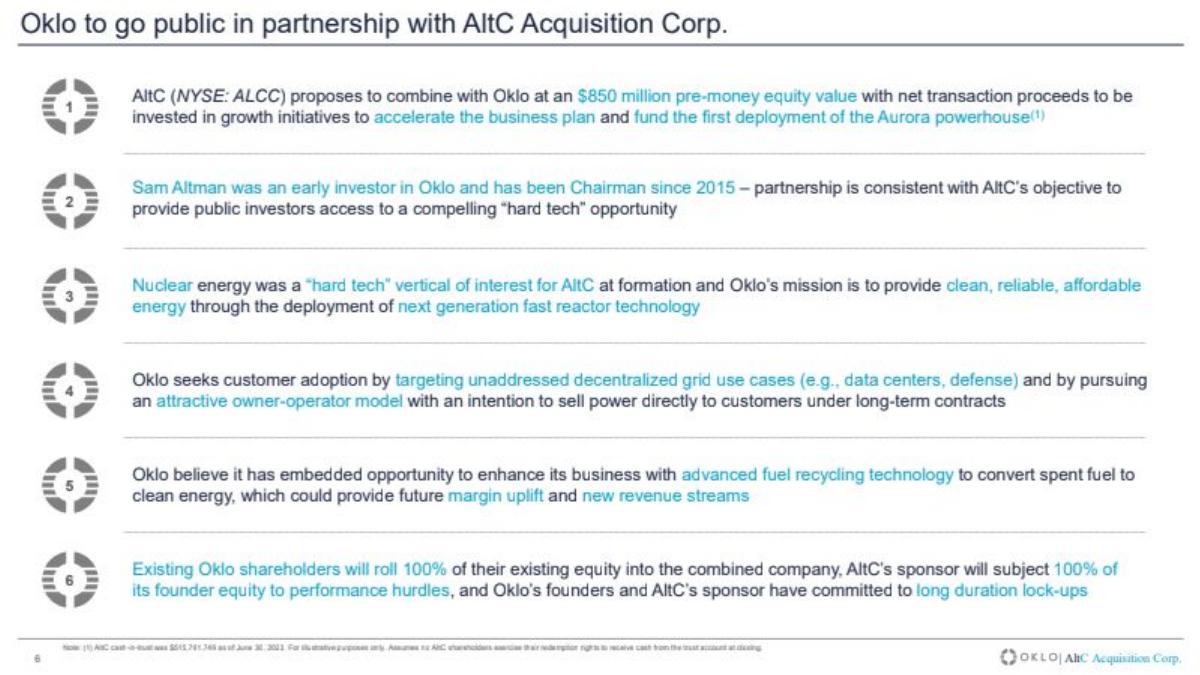
- The transaction values Oklo at a pre-money equity value of $850 million, which the deck claims is roughly half the value of comparable clean energy transactions (Slide 7).
- Oklo targets a first plant deployment by 2026 or 2027, with site and fuel already secured at the Idaho National Laboratory (Slide 7, 19).
- The 'Aurora' powerhouse is designed as a 15 MWe plant with an estimated construction cost of <$60 million and a construction time of <1 year (Slide 21).
- The business model is an owner-operator approach where customers buy power under long-term contracts rather than owning the plants (Slide 25).
- Oklo claims a strong pipeline with over 700 MWe under non-binding indications of interest across data centers, defense, and industrial sectors (Slide 25).
- Fuel recycling is positioned as a major revenue driver, noting that spent nuclear fuel still contains >90% of its energy content (Slide 13).
- The regulatory strategy is heavily emphasized, noting that nearly 10% of Oklo's employees are former NRC staff members (Slide 27).
- Unit economics for a 'Nth of a kind' (NOAK) 15 MWe plant project an annual plant cash flow of $10 million against a $24 million construction cost (Slide 37).
Executive Summary and Transaction Overview
Slide 1: Title Slide
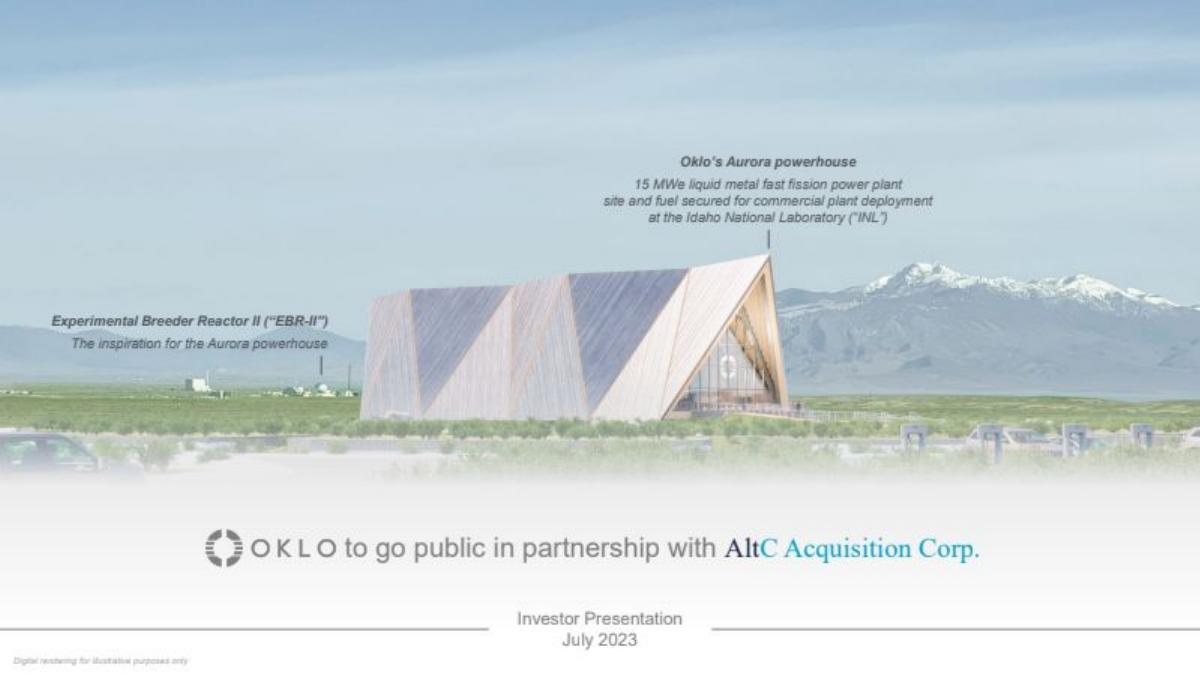
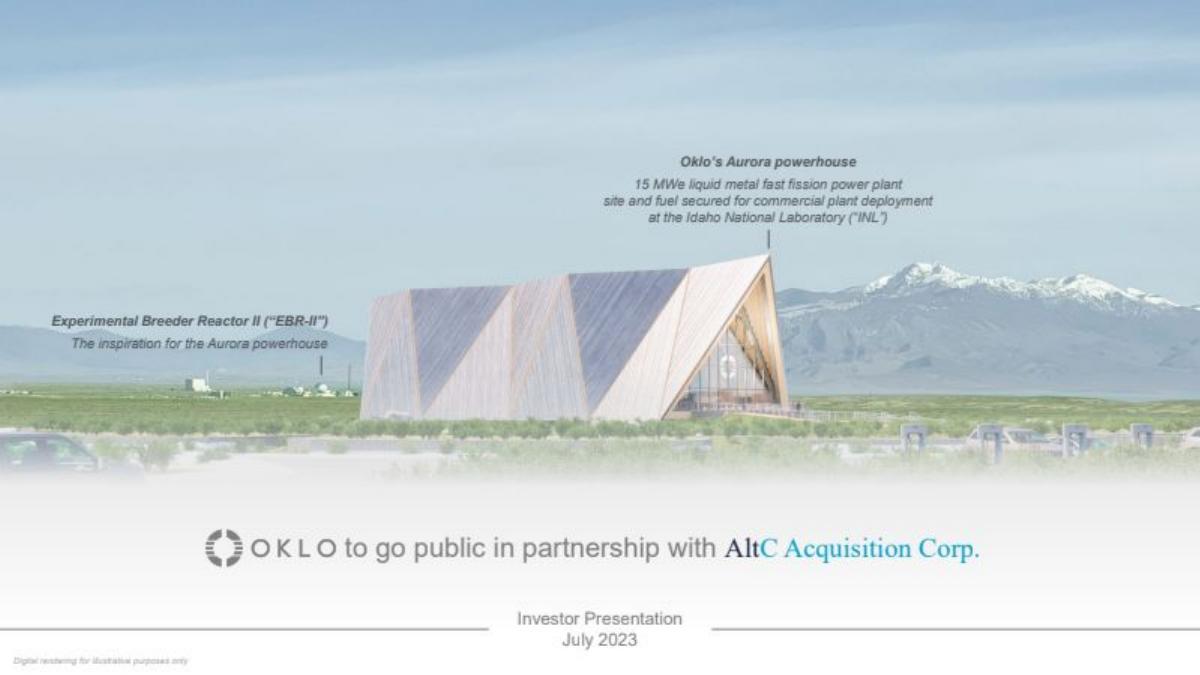
The presentation opens with a digital rendering of Oklo’s 'Aurora' powerhouse, a modern, A-frame wooden structure that looks more like a Nordic museum than a nuclear power plant. It explicitly notes that the site and fuel for the 15 MWe liquid metal fast fission plant have been secured at the Idaho National Laboratory (INL). The partnership with AltC Acquisition Corp is front and center.
Slide 3: Legal Disclaimers
This is a standard, text-heavy SPAC disclaimer slide covering forward-looking statements, unit economics, and risk factors. It notes that the unit economics were prepared for internal use and are not necessarily indicative of future results.
Slide 5: Partnership Team
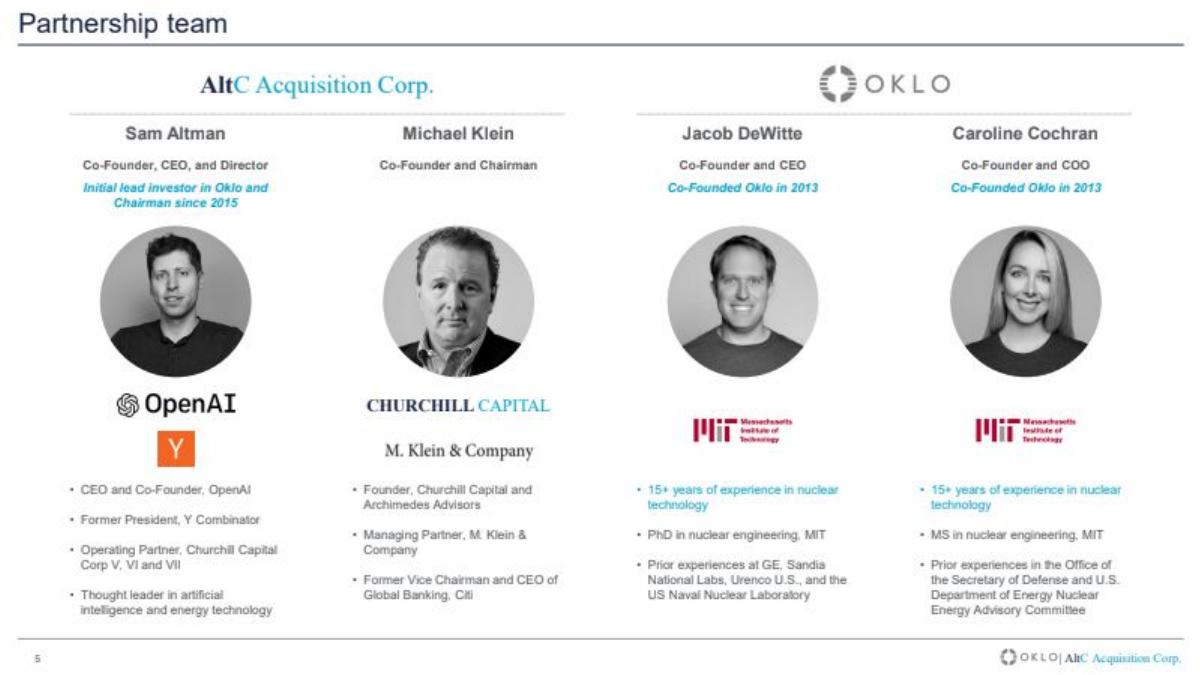
The 'Partnership Team' slide is a high-signal power move. It features Sam Altman (OpenAI, Y Combinator) and Michael Klein (Churchill Capital) on the SPAC side, and Jacob DeWitte and Caroline Cochran on the Oklo side. The founders' MIT credentials and 15+ years of nuclear experience are highlighted to establish technical authority, while Altman’s presence provides the 'visionary' capital backing.
Slide 7: Proposed Transaction Structure
This slide outlines the $850 million pre-money equity valuation. It uses a bar chart to compare Oklo’s valuation against competitors like NuScale and NetPower, arguing that Oklo is entering the market at a significant discount. Key deal terms include 100% equity roll-over by existing shareholders and a long-duration lock-up for founders, signaling long-term commitment.
Slide 9: Sam Altman’s Investment Focus
A unique slide that uses screenshots of Sam Altman’s tweets and blog posts dating back to 2014. It establishes a narrative of 'long-standing investment focus' on atomic energy. The quote emphasizes that while many work on solar, nuclear has advantages in 'cost, density, and predictability.'
The Mission and Business Model
Slide 11: Mission Statement
A simple, high-contrast slide stating the mission: 'To provide clean, reliable, affordable energy on a global scale.' It introduces the two-pronged execution strategy: next-generation fast reactor technology and advanced fuel recycling.
Slide 13: Purpose-Built Business Model
This slide splits the business into 'Power Sales' (the base business) and 'Fuel Recycling' (the upside opportunity). It claims a targeted construction time of less than one year for the 15 MWe plant and mentions over 700 MWe of non-binding indications of interest. The recycling section notes that spent fuel still contains over 90% of its energy content.
Slide 15: The Problem
The deck identifies three drivers for energy demand: Innovation (AI data centers needing 10-50x the power of traditional offices), Daily Life (EVs and aging grid infrastructure), and Health (Climate change). It cites the U.S. energy grid’s 'C-' grade from the American Society of Civil Engineers.
Slide 17: Market Opportunity
A data-driven slide showing that U.S. nuclear capacity needs to increase 3x to reach net-zero by 2050. It projects a requirement for ~300 GW of nuclear capacity, up from the current ~100 GW. This frames Oklo not just as a startup, but as a necessary component of national infrastructure.
Technology and Deployment
Slide 19: Power Sales Strategy
This slide uses a 'locked' icon graphic to show progress across five pillars: demonstrated technology, modern design, business model, value proposition, and deployment. It reiterates that the first Aurora powerhouse deployment target is 2026/27.
Slide 21: Aurora Powerhouse Design
This is the core product slide. It lists the specs: 15+ MWe, Oklo compares its revenue model to established renewable energy giants like Orsted ($40B market value) and Brookfield Renewable ($14B). The argument is that long-term contracted revenue from power sales creates a predictable, recurring revenue stream that the public market understands and rewards.
Slide 25: Customer Value Proposition
This slide maps 'What customers want' (low capex, carbon-free energy) to 'Oklo’s proposition' (zero upfront cost, long-term contracts). It lists target markets: Data centers, Defense, Factories, Industrial, Off-grid, and Utilities. It notes 'active dialogues' are underway in all these segments.
Slide 27: Regulatory Engagement
Nuclear startups live or die by the NRC. Oklo addresses this head-on, noting they submitted the first-ever advanced reactor Combined License Application (COLA). Although the NRC denied the initial application in 2022, Oklo frames this as 'valuable experience' and highlights that 10% of their staff are former NRC employees.
Fuel Recycling and Upside
Slide 29: Nuclear Fuel Imports
A geopolitical argument for the business. It shows a chart of U.S. reliance on imported uranium, noting that 33% of enrichment services came from Russia in 2022. Fuel recycling is presented as a way to reduce these imports and increase energy security.
Slide 31: Recycling Technology Projects
Details the four cost-share awards from the Department of Energy (DOE) for recycling technologies. These include sensors for efficiency, machine learning for material accountability, and demonstrating the conversion of used oxide fuel into metal.
Slide 33: Why Invest Summary
A 7-point summary slide. It hits the high notes: policy support, simplified design, recurring revenue, secured sites, and a strong founder-led team. It is the 'closing argument' of the main presentation body.
Financials and Unit Economics
Slide 35: Development Track Record
A timeline from 2013 to 2027. It shows early seed rounds from Y Combinator and Series A led by DCVC and Mithril. It tracks the progression from fuel prototypes in 2017 to the anticipated first deployment in 2026/27.
Slide 37: Illustrative Unit Economics (15 MWe)
This is a critical slide for investors. It breaks down the 'Nth of a kind' (NOAK) economics. With a $24M construction cost and $33M fuel capex, the plant generates $13M in annual revenue. The resulting $10M in annual cash flow represents a 76.4% cash margin. The chart on the right shows a scaling plan reaching ~125 annual deployments by Year 10.
Slide 39: FOAK vs. NOAK Overview
Compares 'First of a Kind' (FOAK) to 'Nth of a Kind' (NOAK) for both 15 MWe and 50 MHe plants. For the 15 MWe plant, the capital cost drops from $34M (FOAK) to $24M (NOAK) as the company achieves manufacturing efficiencies. This slide demonstrates the path to profitability through scale.
Slide 41: Supporting Material Index
A transition slide for the appendix, featuring night-time renderings of the Aurora powerhouse under the Northern Lights.
Slide 43: Proposed Transaction Structure Details
Provides more granular detail on the SPAC merger. It mentions 85.0 million shares for existing shareholders and up to 15.0 million earnout shares triggered by share price appreciation of 20-60% within 5 years. This aligns founder incentives with public market performance.
Slide 45: Risk Factors (Continued)
A dense list of risks (items 22 through 45). It covers everything from the difficulty of building fuel fabrication facilities to the lack of a domestic supply of HALEU fuel. It is a sobering but necessary disclosure for a pre-revenue deep tech company.
What Works / What is Missing / What to Copy
What Works
The 'Small is Beautiful' Narrative: By focusing on 15 MWe plants that can be built in under a year, Oklo avoids the 'mega-project' stigma that has plagued traditional nuclear for decades. · The Altman Effect: Leveraging Sam Altman’s brand and his specific history with the company (since 2015) provides a level of credibility that most SPACs lack. · Dual Revenue Streams: Positioning fuel recycling as a high-margin 'upside' makes the company more than just a utility play; it’s a circular economy technology play. · Regulatory Transparency: Instead of hiding from the 2022 NRC denial, they frame it as a learning experience and highlight their 'in-house former NRC staff.'
What is Missing
Actual Revenue: The deck is entirely based on 'illustrative' economics and 'non-binding' interest. There are no signed Power Purchase Agreements (PPAs) with confirmed pricing shown in these slides. · Competitor Technical Comparison: While they compare valuations against NuScale, they don't provide a deep technical 'spec-sheet' comparison showing why liquid metal fast fission is superior to other SMR (Small Modular Reactor) designs. · Detailed Fuel Supply Chain: They acknowledge the HALEU shortage in the risks but don't provide a clear, slide-based solution for where that fuel comes from if domestic production doesn't ramp up in time for their 2026 target.
What a Founder Should Copy
The 'Unit Economics' Slide (Slide 37): This is a perfect example of how to present complex project finance. It clearly separates Capex, Revenue, and Opex, and shows the 'Cash Margin' over time. · The 'What Customers Want' Slide (Slide 25): This slide bridges the gap between 'cool tech' and 'market need.' It forces the founder to articulate the specific pain points they are solving for different verticals. · The 'Timeline of Success' (Slide 35): Using a chronological timeline to show consistent progress over a decade helps build trust, especially for 'hard tech' companies with long R&D cycles.
Frequently asked questions
- What is Oklo's core technology?
- Oklo utilizes liquid metal fast fission technology for its Aurora powerhouse. Unlike traditional light water reactors, this technology allows for a smaller footprint (less than 2 acres), fewer parts, and the ability to operate on either fresh or recycled fuel. The design is 'strategically small,' starting at 15 MWe but scalable to 50+ MWe, intended for decentralized grid use cases like data centers and remote industrial sites.
- How does Oklo plan to make money?
- The company employs an owner-operator business model. Instead of selling the reactor hardware to utilities, Oklo sells the electricity and heat produced by the plants under long-term contracts. This removes the upfront capital burden from the customer. Additionally, Oklo is developing fuel recycling technology to convert spent nuclear fuel into new fuel, which they describe as a high-margin 'upside opportunity.'
- What is the role of Sam Altman in this deal?
- Sam Altman is the Co-Founder, CEO, and Director of AltC Acquisition Corp (the SPAC) and has been the Chairman of Oklo since 2015. He was an initial lead investor in the company. The deck highlights his long-standing focus on 'hard tech' and his belief that cheap, abundant energy is essential for the future of AI and global development.
- What are the primary risks identified in the deck?
- The deck includes an extensive list of 45 risk factors. Key concerns include the complexity of the NRC licensing process, the fact that no powerhouse in the Aurora family has yet been approved for use, the reliance on high-assay low-enriched uranium (HALEU) which is not currently available at scale, and the potential for significant cost increases during the transition from design to construction.
- How do the unit economics look for a single plant?
- For a 15 MWe 'Nth of a kind' plant, Oklo estimates a $24 million construction cost and $33 million in fuel capex. It projects $13 million in annual revenue from power sales with only $3 million in annual expenses, leading to $10 million in annual plant cash flow. Over a 40-year design life, the company expects cumulative cash flow to exceed 2.5x the cumulative capital costs.