Oii AI (formerly Orchestrated Intelligence) secured $1.85M in seed funding by positioning their platform, Optii, as a non-disruptive intelligence layer for existing supply chain infrastructure. The deck emphasizes a 'proactive model' over traditional reactive planning, citing significant efficiency gains such as a 75% reduction in planner activities and a 30% reduction in total costs. While the deck uses placeholders for specific revenue and funding figures, it effectively communicates value through a clear 'Before vs. After' framework and a heavy emphasis on the founders' PhD-level expertise…
Key takeaways
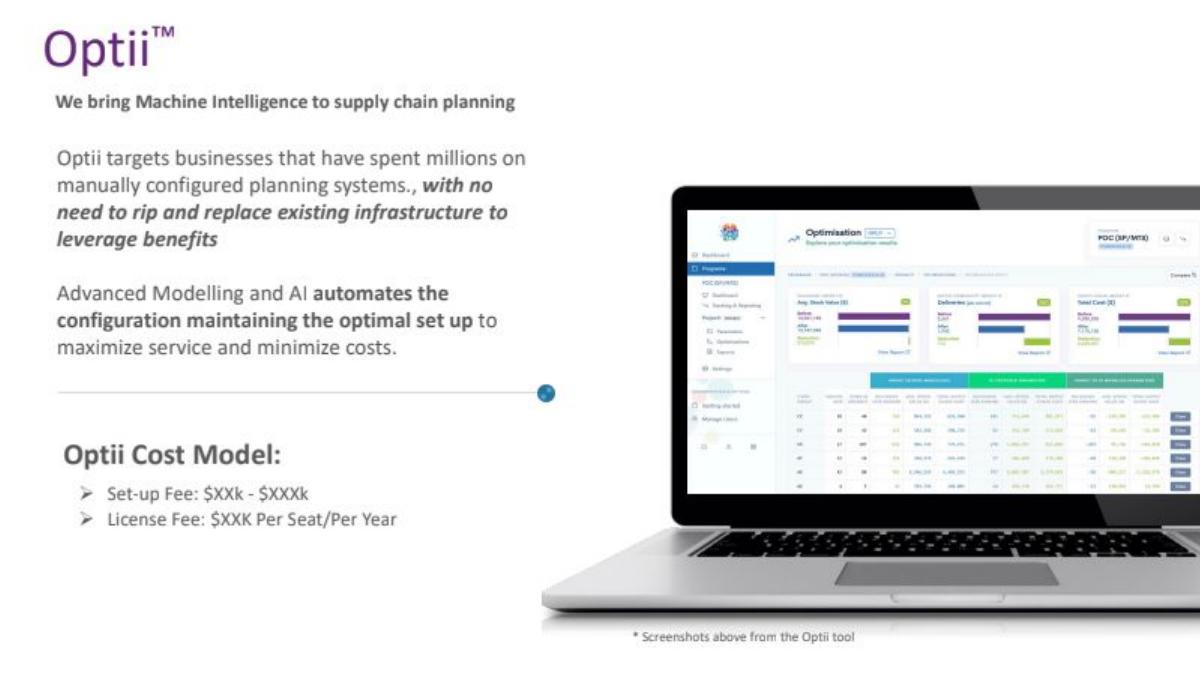
- The platform, Optii, is designed to work with existing planning software without requiring a 'rip and replace' of infrastructure (Slide 5).
- Oii claims to reduce total supply chain costs by 30% and planner activities by 75% based on pilot data (Slide 8).
- The business model includes a one-off set-up fee ranging from $XXk to $XXXk and an annual license fee per seat (Slide 5).
- The founding team features two PhDs with over 60 years of combined experience in physics, supply chain management, and astrophysics (Slide 9).
- Oii targets a $118M annual recurring revenue opportunity in the Pharma sector alone, based on 419 large and medium companies (Slide 10).
- The competitive landscape positions Oii as a high-savings, high-ROI alternative to legacy providers like Oracle and SAP (Slide 12).
- The roadmap outlines a transition from the Optii MVP to 'Autii,' a fully automated end-to-end supply chain planning system (Slide 15).
- The seed round is intended to build a production-ready version of the software, onboard an operational team, and scale sales capacity (Slide 17).
Oii AI: The Intelligence Layer for Global Logistics
Oii AI (formerly Orchestrated Intelligence) entered the market at a time when global supply chains were reeling from volatility. Their 2023 seed deck, which helped secure $1.85M, focuses on the transition from 'reactive' to 'proactive' planning. The deck is a classic example of a technical 'wedge' strategy: selling a high-value optimization layer that doesn't require the customer to abandon their existing multi-million dollar ERP investments.
Slide 1-4: The Vision and Paradigm Shift
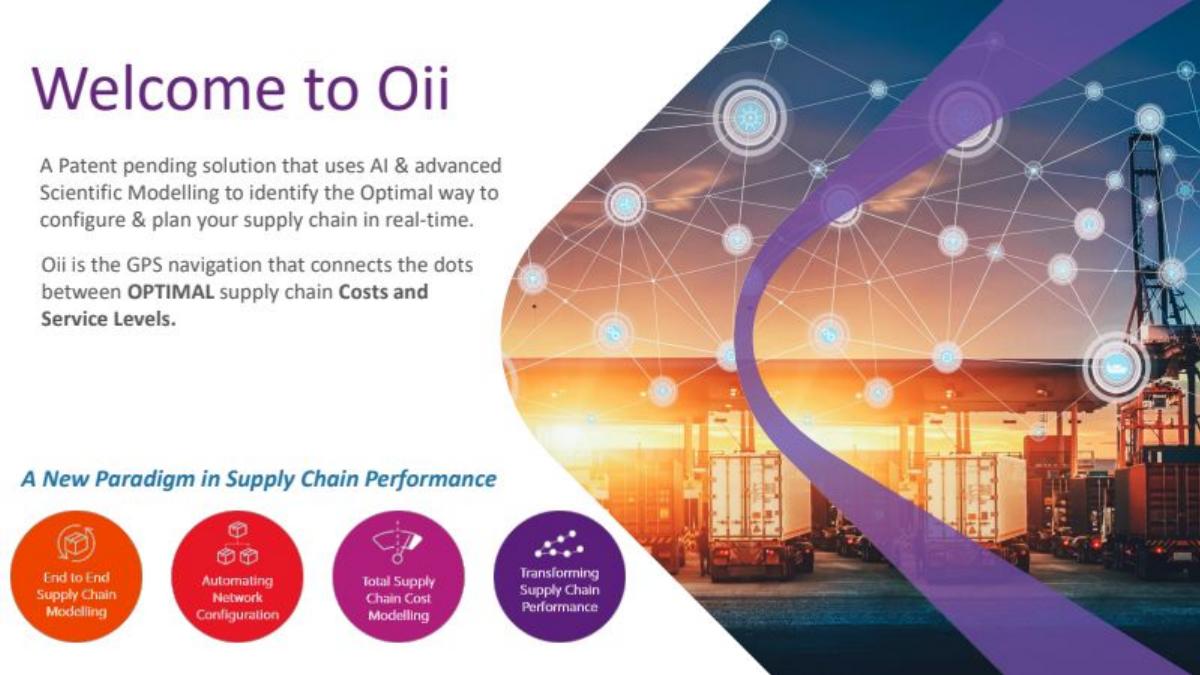
The deck opens with a strong branding statement: "The Cognitive Self Modelling Supply Chain." Slide 2 defines their vision as bringing "Machine Intelligence to Supply Chain Planning." This is a high-level pitch aimed at executives who are tired of manual spreadsheets and rigid legacy systems.
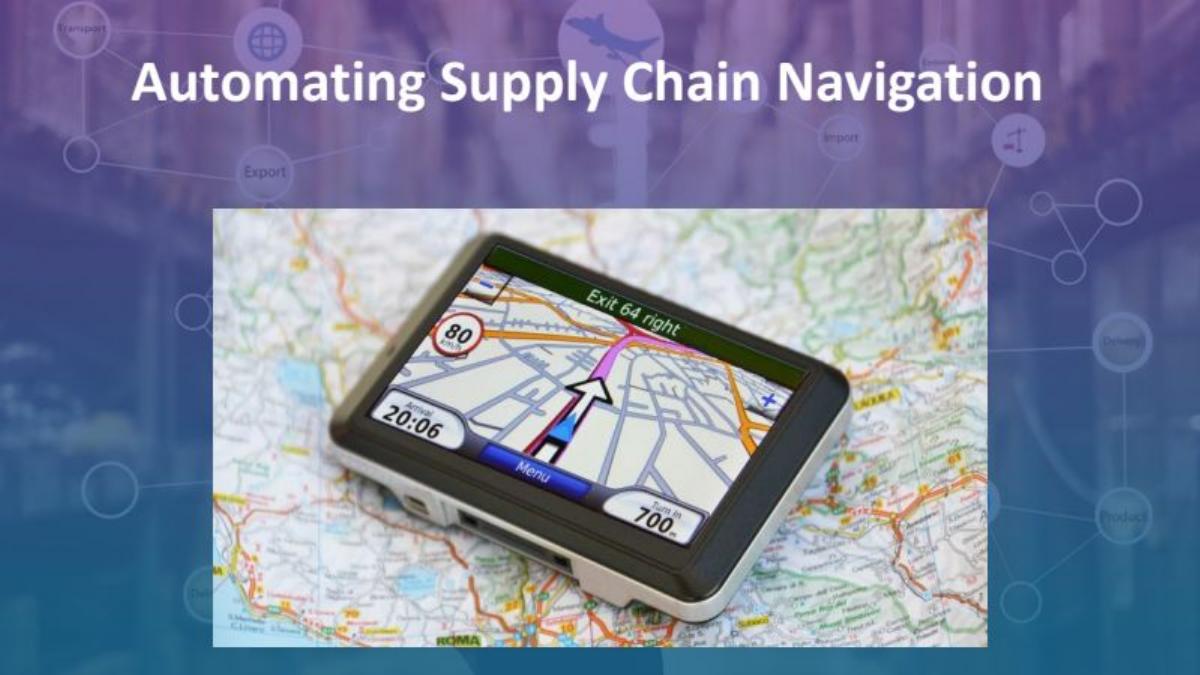
Slide 3 uses a relatable metaphor—GPS navigation—to explain a complex technical product. By comparing supply chain management to a GPS, they simplify their value proposition: they aren't the car (the supply chain) or the road (the infrastructure); they are the intelligence that tells you the best way to get to your destination. Slide 4 reinforces this, claiming a "New Paradigm" that connects the dots between optimal costs and service levels.
Slide 5-6: Product and The 'Before vs. After'
Slide 5 introduces "Optii," the core product. A crucial selling point is highlighted in bold: "no need to rip and replace existing infrastructure." For B2B SaaS, this significantly lowers the barrier to entry and shortens the sales cycle. The slide also outlines the cost model, consisting of set-up fees and per-seat annual licenses.
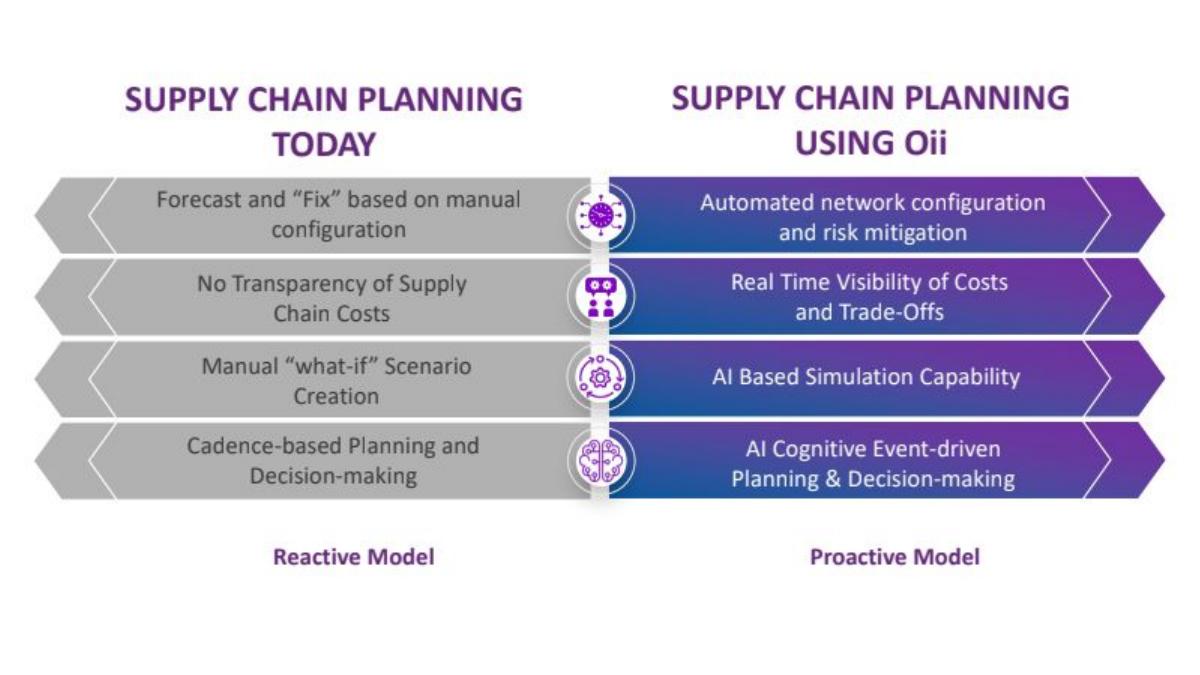
Slide 6 is the most important strategic slide in the deck. It contrasts "Supply Chain Planning Today" (Reactive Model) with "Supply Chain Planning Using Oii" (Proactive Model). It lists four specific transitions: from manual configuration to automated risk mitigation, from no transparency to real-time visibility, from manual what-if scenarios to AI simulation, and from cadence-based decisions to event-driven planning.
Slide 7-8: Market Trends and Traction
Slide 7 is a dense "bubble" chart of digital trends, citing AI as the #1 trend in supply chains. While visually overwhelming, it serves to ground the company's mission in broader industry tailwinds, such as the 80% of manufacturers expecting improved connectivity to increase output.
Slide 8 provides the 'proof.' It lists impressive pilot logos including Gilead, Merck, and GSK. The metrics cited are substantial: 30% total cost reduction, 25% inventory reduction, and a 75% reduction in planner activities. These figures are the 'hook' for investors, showing that the product delivers measurable ROI in a short timeframe.
Slide 9: The Founder Advantage
In a seed round, the team is often more important than the product. Oii leans heavily into their academic and professional pedigree. CEO Bob Rogers is a Harvard PhD in Physics with a previous successful exit. COO David Evans is a dual-master's supply chain visionary. Advisor Lee Clewley is an Astrophysics PhD. This "PhD-heavy" team suggests that the underlying AI isn't just a wrapper around a basic LLM, but a sophisticated scientific model.
Slide 10-12: Market Size and Competitive Landscape
Slides 10 and 11 break down the Total Addressable Market (TAM) by sector. For Pharma, they estimate a $118M ARR opportunity; for Retail, a massive $3.8B ARR opportunity. By showing the math (419 large pharma companies x license fees), they make the billion-dollar potential feel grounded in reality.
Slide 12 is a standard 2x2 matrix, positioning Oii in the top-right quadrant for "Fast Return on Investment" and "High Savings." They place themselves ahead of legacy giants like Oracle, SAP, and Infor, as well as specialized competitors like Llamasoft.
Slide 13-14: Competitive Advantage and Pipeline
Slide 13 provides a direct feature comparison with Llamasoft. The key differentiators are "Operational" vs. "Project Based" usage and a "1-3 Months" setup time vs. "8-12 Months." This emphasizes speed-to-value, a critical metric for enterprise software. Slide 14 is a placeholder for the sales pipeline, indicating that the company has a structured process for moving leads from "Strategic Fit" to "Contracting."
Slide 15-17: The Roadmap and The Ask
The roadmap on slide 15 shows a clear evolution. It tracks the progress from the first MVP in 2020 to the planned "Autii" launch in 2022/2023. This shows investors that there is a long-term vision beyond just a single optimization tool.
Slide 16 and 17 cover the funding request. While the specific dollar amounts are redacted in this version of the deck (using $X M), the "Use of Funds" is clearly categorized: building the production version of Optii, onboarding an operational team, and scaling sales and marketing. This demonstrates a disciplined approach to capital allocation.
Slide 18-21: Appendix and Exit Strategy
The deck concludes with deep dives into their primary competitor, Llamasoft (Slides 19-20), showing that Llamasoft focuses mainly on large $1B+ companies in the US. This suggests a gap in the market that Oii can exploit. Finally, Slide 21 lists "Multiple Acquisition Possibilities," categorizing potential buyers into Automation, Planning, and Modelling sectors. This gives investors a clear picture of how they might eventually realize a return on their investment.
What Oii AI Does Well
1. The Metaphor: Using the "GPS" analogy for supply chains is a masterclass in simplifying a complex B2B product. It immediately explains the product's role without getting bogged down in technical jargon.
2. Non-Disruptive Value: The emphasis on working with existing systems rather than replacing them is a powerful sales and fundraising hook. It addresses the biggest fear of enterprise buyers: the failed implementation of a new core system.
3. Credibility through Pedigree: The team slide is exceptionally strong. Having multiple PhDs from top-tier institutions (Harvard, Imperial) in relevant fields (Physics, Astrophysics, Supply Chain) builds immediate trust in the "Scientific Modelling" claims.
What is Missing from the Oii AI Deck
1. Unit Economics: While the deck mentions set-up and license fees, it lacks data on Customer Acquisition Cost (CAC) or Lifetime Value (LTV). Even at the seed stage, some indication of the cost to acquire these large pharma pilots would be beneficial.
2. Case Study Detail: Slide 8 lists impressive percentage improvements, but it doesn't provide a narrative case study. Investors often want to see exactly how one specific customer went from "Problem" to "Solution" to "Result."
3. Specific Financials: The use of placeholders ($XXXk, $X.XM) is common in public versions of decks, but the lack of historical burn rate or specific revenue milestones makes it harder to judge the company's capital efficiency to date.
Founder Takeaways: What to Copy
1. The 'Before vs. After' Table: Slide 6 is a perfect template for any founder trying to displace a legacy process. Clearly defining the old "Reactive" way versus your new "Proactive" way makes the value proposition undeniable.
2. Sector-Specific TAM: Instead of just showing one giant, unbelievable number for the whole world, Oii breaks their market down by sector (Pharma, Retail). This makes the numbers feel calculated and achievable.
3. Exit Strategy Mapping: Slide 21 is a great addition. Many founders are afraid to talk about exits, but mapping out exactly which categories of companies would want to buy you (and why) shows that you understand the broader ecosystem and your place within it.
Frequently asked questions
- What is Oii AI's core product offering?
- Oii AI offers a platform called Optii, described as 'The Cognitive Self Modelling Supply Chain.' It acts as a GPS-like navigation layer that sits on top of existing supply chain planning systems. Instead of replacing legacy software, it uses AI and scientific modeling to identify the optimal configuration for costs and service levels in real-time, moving companies from reactive to proactive planning models.
- How does Oii AI generate revenue?
- According to slide 5, the company utilizes a B2B SaaS business model. Revenue is generated through two primary streams: a one-off set-up fee (ranging from tens to hundreds of thousands of dollars depending on complexity) and an annual recurring license fee charged per seat. This hybrid model allows for upfront cash flow while building long-term recurring value.
- Who are the key people behind Oii AI?
- The team is led by CEO Bob Rogers, a Harvard PhD in Physics and former Silicon Valley entrepreneur who previously sold a startup in 2020. He is joined by COO David Evans, a supply chain expert with Master's degrees in Computer Science and Supply Chain Management, and Advisor Lee Clewley, an Imperial PhD in Astrophysics. Together, they claim over 60 years of domain expertise.
- What specific traction does the deck show?
- Slide 8 highlights pilot and Proof of Concept (PoC) engagements with major global brands including Gilead, Merck, GSK, and Neom. The deck reports validated outcomes from these pilots, such as a 25% reduction in inventory and the elimination of 25% of service risk. It also mentions development and distribution partnerships with MarkLogic and Trigyn Technologies.
- What is the long-term vision for the company?
- The roadmap on slide 15 indicates a progression from manual optimization tools to full autonomy. The company plans to evolve its current Optii product into 'Autii,' which is envisioned as a fully automated end-to-end supply chain planning system. The ultimate goal stated on slide 16 is to become the #1 supply chain optimization software within 4 to 6 years.