Ohalo’s Series A pitch deck from 2017 is exceptionally lean, consisting of only nine slides. The narrative focuses heavily on the regulatory pressures facing the financial sector, specifically highlighting the 'biggest regulatory change in 20 years' on slide 3. The deck positions Ohalo as a 'Data Protection Router' that makes data aware of its own regulations. While the deck is light on technical architecture and competitive analysis, it compensates with strong early traction metrics, reporting $125K in POC revenue and a $3.2M pipeline on slide 7. The team slide (slide 8) is a standout, lever…
Key takeaways
- The deck uses a high-contrast, minimalist design with large-format text to drive a narrative of urgency in the banking sector (Slide 2).
- Ohalo identifies a specific market catalyst, citing the 'biggest regulatory change in 20 years' as the primary driver for their solution (Slide 3).
- The problem is quantified by stating there are 'billions at risk' due to banks' inability to manage data effectively (Slide 3).
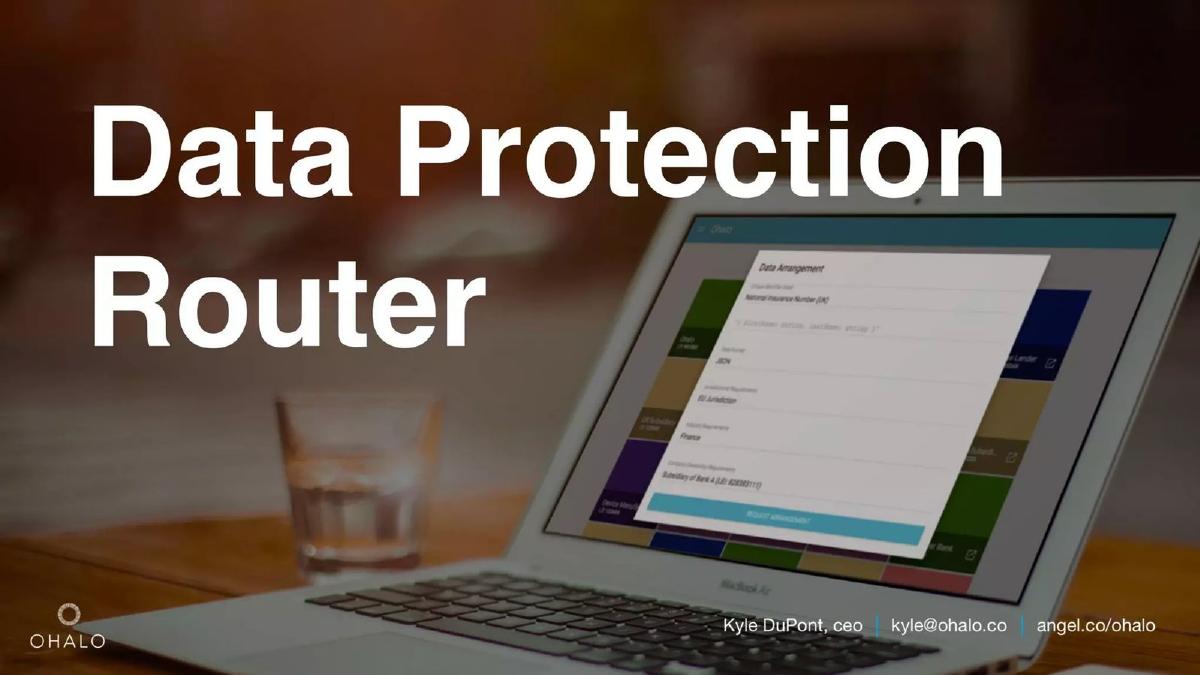
- The solution is branded as a 'Data Protection Router,' a conceptual bridge between raw data and regulatory compliance (Slide 6).
- Early commercial validation is clear, with $125K in Proof of Concept (POC) revenue already secured at the time of the pitch (Slide 7).
- The sales pipeline is valued at $3.2M, providing a forward-looking growth indicator for Series A investors (Slide 7).
- The team slide emphasizes institutional credibility, featuring experience from major banks like HSBC and Credit Suisse, plus academic ties to MIT and Georgia Tech (Slide 8).
- The deck completely omits a formal 'Ask' slide, leaving the specific funding amount and use of proceeds to the catalogue data or verbal discussion.
The Minimalist Enterprise Pitch
Ohalo’s 2017 pitch deck is a fascinating example of the 'less is more' philosophy in venture capital. At just nine slides, it bypasses the traditional 20-slide slog of market graphs and feature lists. Instead, it focuses on a singular, high-stakes narrative: banks are in trouble because of new regulations, and Ohalo has the institutional pedigree to fix it. This deck was used for their Series A, a stage where investors typically demand deep metrics, yet Ohalo relies on the sheer gravity of the problem and the credibility of their team.
Slides 1-2: The Provocation
Slide 1 is a standard title slide featuring the Ohalo logo—a blue, textured circle—and contact information for CEO Kyle DuPont. It establishes a clean, professional aesthetic that carries through the rest of the presentation.
Slide 2 immediately goes on the offensive. Over a black-and-white image of a Wall Street sign, the text asks: "Why are banks so bad at building things?" This is a classic 'challenger' opening. It identifies a known pain point in the industry—the inefficiency of internal bank IT projects—and positions the startup as the necessary external expert. It sets the stage for a solution that the target customers (banks) cannot build themselves.
Slides 3-4: The Regulatory Catalyst
Slide 3 defines the 'Why Now?' of the investment. It lists three punchy points: "Banks suck at managing data," "Biggest regulatory change in 20 years," and "Billions at risk." In 2017, this was almost certainly a reference to the impending GDPR and MiFID II regulations. By framing the problem as a multi-billion dollar risk, Ohalo moves the conversation from 'nice-to-have software' to 'mandatory compliance infrastructure.'
Slide 4 dismisses the current market landscape with a single sentence: "Today's solutions are incomplete." The background image of server racks suggests that legacy hardware or software isn't keeping pace with the complexity of modern data flows. This slide serves as the 'gap' in the market that Ohalo intends to fill, though it lacks specific details on why competitors are failing.
Slides 5-6: The Conceptual Solution
Slide 5 introduces the core value proposition: "Data aware of its regulations." This is a sophisticated way of describing automated metadata tagging and policy enforcement. Instead of humans checking data against a rulebook, the data itself carries the rules. It is a high-level vision slide that appeals to the desire for automation in a labor-intensive compliance sector.
Slide 6 gives the product a name and a face. It introduces the "Data Protection Router." The slide includes a photo of a laptop showing a UI for 'Data Arrangement.' The fields visible in the screenshot include 'National Insurance Number (UK),' 'EU Jurisdiction,' and 'Subsidiary of Bank A.' This is the only technical glimpse in the deck, showing how the software categorizes unstructured data to ensure it stays within legal boundaries.
Slide 7: The Traction Metric
Slide 7 is the 'proof' slide. It is remarkably simple, featuring a single dollar bill in the background. The text states: "$125K in POC revenue" and "$3.2M pipeline value." For a Series A, $125K in revenue is modest, but in the context of enterprise banking, Proof of Concepts (POCs) are the standard gateway to multi-million dollar contracts. The $3.2M pipeline suggests that the sales cycle is moving and that there is significant interest from other institutional buyers.
Slide 8: The Pedigree
Slide 8 is arguably the most important slide in the deck. In enterprise fintech, the team is the product. Ohalo lists four key leaders and three advisors. Underneath their headshots is a 'wall of logos' including Deutsche Bank, HSBC, Credit Suisse, Ethereum, MIT, and Georgia Institute of Technology. This slide tells the investor that the founders aren't outsiders trying to disrupt a market they don't understand; they are insiders who have lived the problem at the world's largest financial institutions. This level of credibility often offsets a lack of detailed financial projections in a deck.
Slide 9: The Conclusion
Slide 9 is a repeat of the title slide. It offers no 'Ask,' no 'Thank You,' and no summary. It simply leaves the logo and contact info on the screen, presumably to facilitate a Q&A session.
What Works in the Ohalo Deck
Urgency and Stakes: The deck does an excellent job of highlighting the 'Billions at risk.' In the enterprise world, fear of loss is often a stronger motivator than the hope of gain. By tying their product to the 'biggest regulatory change in 20 years,' Ohalo makes their success seem inevitable as long as the regulations are enforced.
Clarity of Vision: The phrase 'Data aware of its regulations' is a powerful hook. It distills a very complex technical process (NLP, data discovery, automated classification) into a benefit that a non-technical investor can understand and get excited about.
Institutional Credibility: The team slide is flawless for this sector. The mix of top-tier banking logos and elite technical institutions (MIT) provides the 'permission to play' in the highly regulated world of Wall Street IT.
What is Missing from the Ohalo Deck
The 'Ask': There is no mention of how much money Ohalo is raising or what they plan to do with it. While this information is often kept for the verbal pitch or a separate teaser, its absence in a formal deck teardown is notable. Investors want to know if the capital will be used for R&D, sales expansion, or international growth.
Competitive Landscape: The deck claims today's solutions are 'incomplete' but never mentions who those solutions are (e.g., BigID, OneTrust, or legacy IBM/Oracle tools). A Series A investor usually wants to see a 'Magic Quadrant' style comparison or a feature checklist showing why Ohalo is defensible.
Business Model: There is no information on pricing. Is it a per-seat license? A volume-based data ingestion fee? A flat annual subscription? Without this, it is hard to evaluate the $3.2M pipeline's long-term value.
Unit Economics: There are no details on Customer Acquisition Cost (CAC) or Lifetime Value (LTV). While these can be difficult to calculate during the POC stage, some indication of the sales cycle length and cost would be expected at Series A.
What a Founder Should Copy
The 'One Idea Per Slide' Rule: Ohalo follows this perfectly. Each slide has a clear, singular purpose. This prevents the audience from getting distracted by reading small text while the founder is speaking.
Focus on the Catalyst: If your industry is undergoing a massive shift (regulatory, technological, or social), make that the center of your deck. Ohalo didn't just say they have 'good software'; they said the world changed, and their software is the only way to survive the change.
Logo Placement: If your team has worked at prestigious firms, don't just list the names in text. Use the logos. The visual recognition of a brand like HSBC or Deutsche Bank carries more weight in a split second than a paragraph of resume text.
Final Thoughts
Ohalo’s deck is a 'narrative-first' presentation. It assumes that the investor already understands the macro-environment of banking and regulation. It doesn't waste time explaining what a bank is or why data is important. Instead, it moves straight to the pain and the pedigree. While it might be too sparse for a cold-email deck, it is an excellent 'stage deck' designed to support a compelling verbal story told by a founder who clearly knows his audience.
Frequently asked questions
- What is the core problem Ohalo is solving?
- Ohalo targets the 'data chaos' within large financial institutions. According to slides 2 and 3, banks are historically poor at building internal tools and managing data, which creates significant risk during major regulatory shifts. The deck suggests that existing solutions are 'incomplete,' leaving billions of dollars in potential fines or losses at risk due to non-compliance.
- How does Ohalo describe its product functionality?
- The deck uses the term 'Data Protection Router' (Slide 6) and describes the outcome as 'Data aware of its regulations' (Slide 5). A brief screenshot on slide 6 shows a 'Data Arrangement' interface that appears to classify data by jurisdiction (e.g., EU Jurisdiction), industry (Finance), and specific legal entities (Subsidiary of Bank A).
- What traction did Ohalo have at the time of this deck?
- Ohalo demonstrated significant early-stage enterprise traction. Slide 7 explicitly lists $125,000 in revenue generated from Proof of Concept (POC) engagements. Furthermore, they claimed a sales pipeline valued at $3.2 million, which is a critical metric for a Series A company proving product-market fit in the enterprise space.
- Who are the key members of the Ohalo team?
- The team is led by CEO Kyle DuPont and CTO Victor Cook. The engineering leadership includes Alistair Jones and Andreas Olofsson. The deck places heavy emphasis on their collective background in building data tools for financial institutions, citing past associations with Deutsche Bank, HSBC, Credit Suisse, and Ethereum (Slide 8).
- What is missing from the Ohalo pitch deck?
- This is a very minimalist deck. It lacks a market sizing (TAM/SAM/SOM) slide, a detailed competitor comparison, a business model/pricing slide, and a clear 'Ask' slide detailing how much capital they are raising. It relies almost entirely on the strength of the team's pedigree and the immediate urgency of the regulatory environment.