Distrifoods Nigeria, operating under the brand Xpressbite, targets the Nigerian mass market with nutrition-dense instant snacks. The deck positions the company as a social enterprise, leveraging high repeat sales (90%) and a massive addressable demographic of 155 million people. While the deck excels at showcasing local traction through trade fairs and government-backed awards like YouWiN!, it lacks standard venture capital metrics such as specific unit economics, a clear funding ask, or a detailed competitive landscape. The strength of the pitch lies in the team's deep domain expertise in fo…
Key takeaways
- The company identifies a Total Eligible Market of 155 million people across four age demographics (Slide 4).
- Distrifoods claims a 90% repeat sales rate, indicating strong product-market fit for their Xpressbite peanuts (Slide 4).
- The market size calculation is based on a conservative 2.5% capture of the eligible market spending N100 once a year, totaling N387,500,000 (Slide 4).
- Founder Olu Awolowo brings over 10 years of experience in the FMCG sector and 5 years in agro-processing (Slide 5).
- The team includes specialized roles for Dietetics & Nutrition and Quality Control, emphasizing the 'nutrition-dense' value proposition (Slide 5).
- The deck highlights significant local validation through wins at the Jos Trade Fair (2016-2018) and the Nourish Nigeria Challenge (Slide 6).
- A specific consumer behavior metric is cited: 68% of parents in major cities spend N5000 on snacks per child per month (Slide 4).
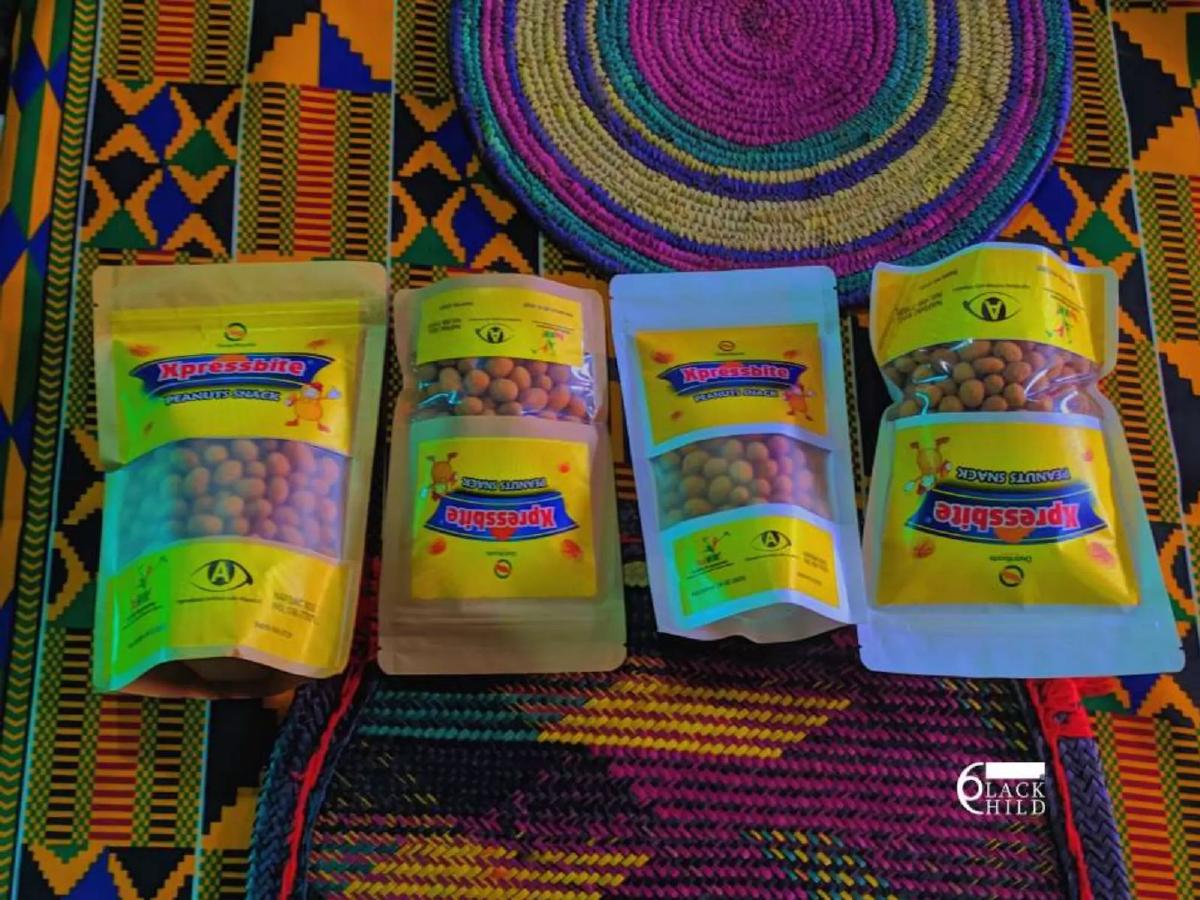
- The product portfolio focuses on Xpressbite Peanuts Snack, shown in multiple packaging formats including stand-up pouches (Slides 2 and 3).
Executive Summary: The Social Enterprise Approach to Snacking
Distrifoods Nigeria positions itself as a social enterprise rather than a pure-play commercial entity. This distinction is important in the West African context, where nutrition-based startups often bridge the gap between government initiatives and private retail. The deck, titled 'Elevator pitch deck 2019' in source listings, focuses heavily on the 'Xpressbite' brand. The core value proposition is the delivery of 'Nutrition Dense Instant Snack Foods' to Nigeria's mass market, a segment often underserved by premium international brands.
Slide 1: Mission and Brand Identity
The opening slide introduces two logos: Distrifoods Nigeria and the consumer-facing brand, Xpressbite. The use of hashtags like #healthyfoodsonly and #innovativediet signals a focus on wellness. The mission statement is clear: 'A social enterprise creating, selling & delivering a range of nourishingly tasteful Nutrition Dense Instant Snack Foods to Nigeria's Mass Market.' By explicitly mentioning 'creating, selling & delivering,' the company indicates it is a vertically integrated operation handling everything from production to distribution.
Slide 2 & 3: Product Portfolio and Packaging
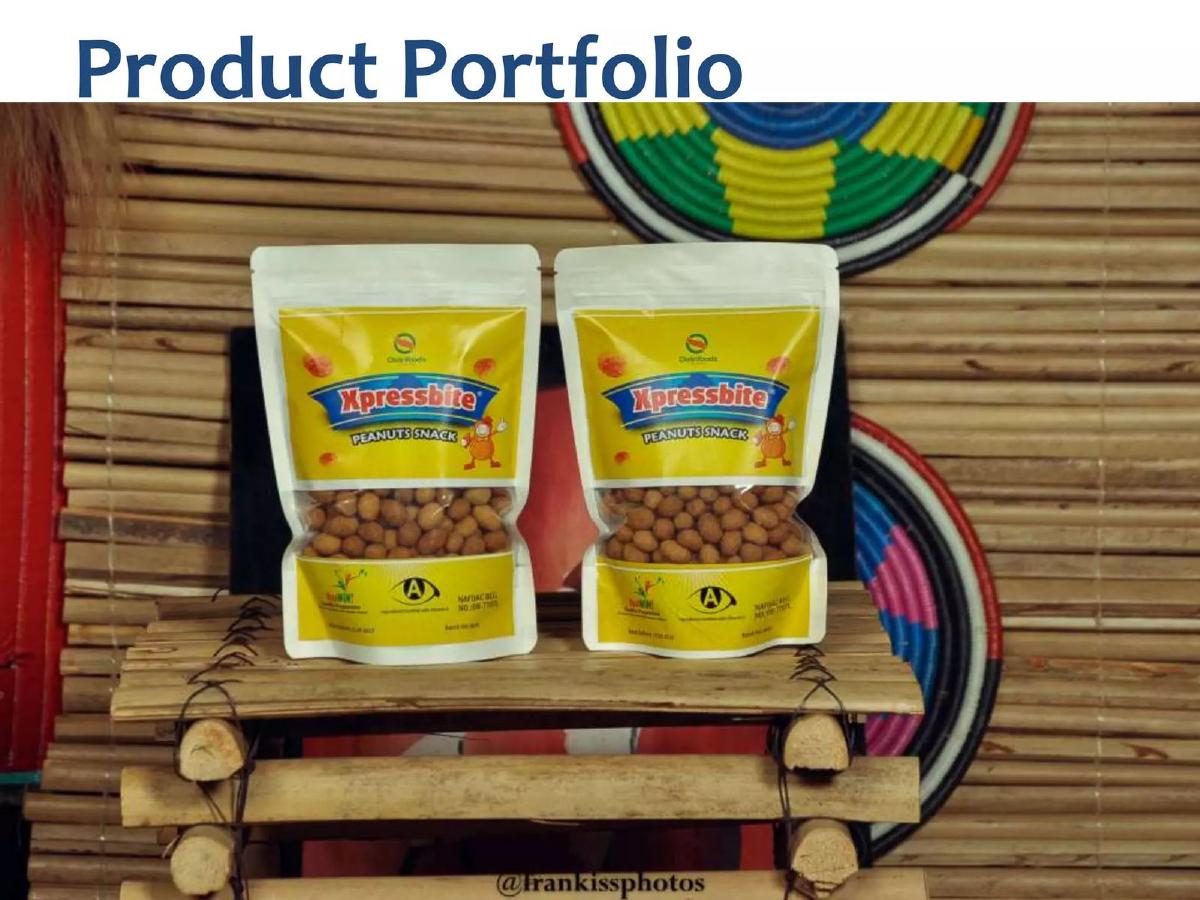
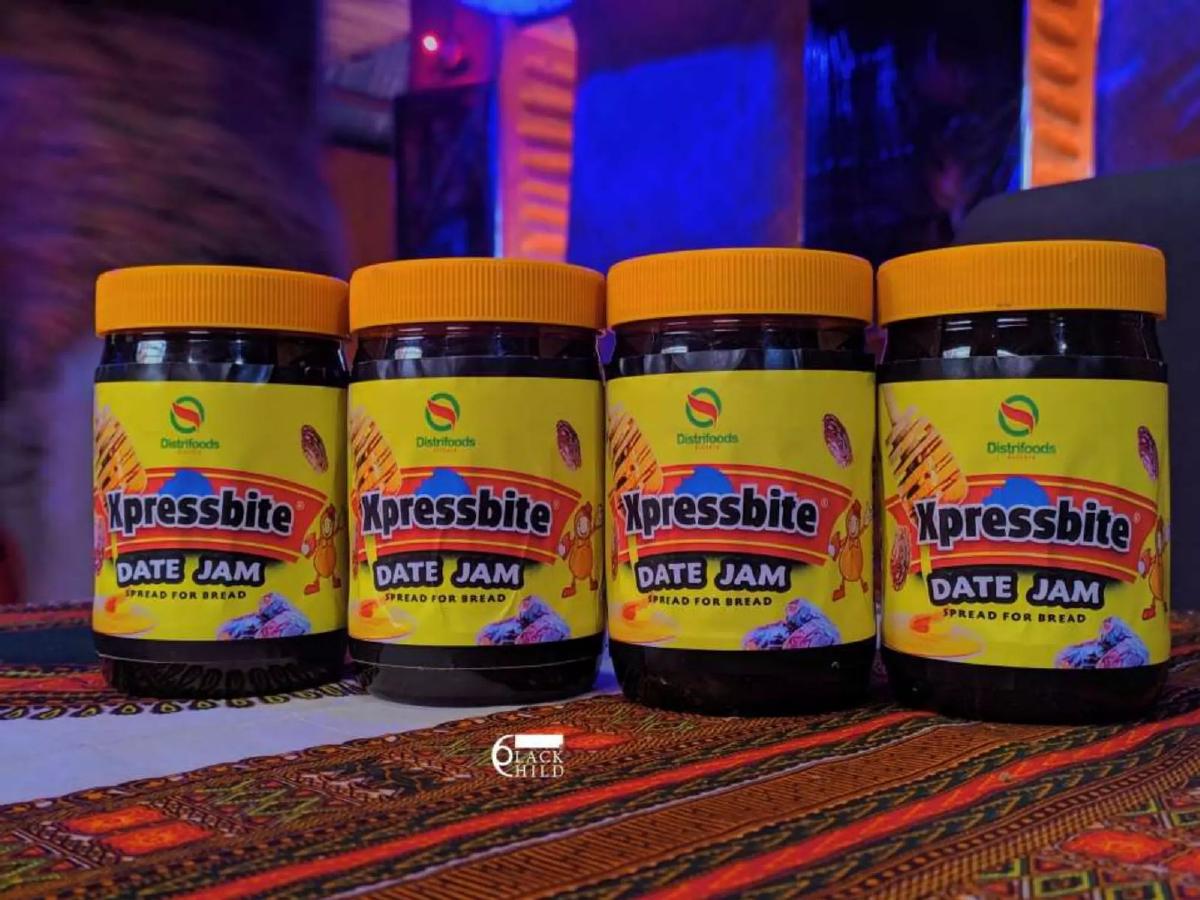
These slides provide visual evidence of the product. The focus is exclusively on 'Xpressbite Peanuts Snack.' The packaging shown is a professional, yellow-branded stand-up pouch with a clear window, allowing consumers to see the product quality. Slide 3 shows four different variations or sizes of the packaging, suggesting a strategy to hit different price points in the Nigerian market, which is highly sensitive to 'sachet-sized' pricing. The presence of the NAFDAC (National Agency for Food and Drug Administration and Control) logo on the packaging is a critical regulatory milestone for any food startup in Nigeria, though it is not explicitly called out in the text.
Slide 4: Target Population and Market Math
This is the most data-dense slide in the deck. Distrifoods breaks down the Nigerian population into four segments totaling 155 million people. The 'Total Eligible Market' is defined as these 155 million individuals. Slide 4 calculates an 'Estimated Market Size' of N387,500,000 based on capturing 2.5% of the market at a N100 price point once per year. This is a conservative and realistic way to present market share to investors.
50% of Nigeria's population is under 30 years old. · 30% of the population is considered middle class. · 68% of parents in major cities spend N5000 on snacks per child per month. · The company claims 90% repeat sales, which is a powerful indicator of brand loyalty.
Slide 5: The Team and Advisory Board
The team slide is exceptionally detailed, perhaps too much so for a standard pitch deck, but it establishes deep credibility. Slide 5 lists six team members and three advisors. The Founder, Olu Awolowo, lists a decade of FMCG experience and multiple certifications from programs like EU GIZ SEDIN and Oxfam EDC. The inclusion of a Registered Dietitian (Olubunmi Akinsanya) and a Quality Control head with 20+ years of experience (Sunday Apeji) reinforces the 'nutrition-dense' claim. The advisory board includes faculty from the Enterprise Development Center at Pan Atlantic University, a prestigious institution in Nigeria.
Slide 6: Traction and Validation
The final slide is a collage of logos and event photos. It serves as social proof. The company highlights its status as a 'Select 10' winner for both Startup Nigeria and the Nourish Nigeria Challenge. The mention of the YouWiN! program is significant; this was a high-profile Nigerian government grant program that provided capital and training to promising entrepreneurs. Participation in the Jos Trade Fair for three consecutive years (2016-2018) shows consistent operational history and local market engagement.
What Works in This Deck
Local Context and Credibility: The deck does an excellent job of rooting the business in the Nigerian ecosystem. By citing NAFDAC compliance (visually), YouWiN! awards, and specific local spending habits (N5000/month on snacks), the founders prove they understand their specific operating environment better than a generalist competitor might.
Conservative Market Modeling: Many founders inflate their TAM/SAM/SOM to billions of dollars. Distrifoods' calculation on Slide 4 —assuming only 2.5% market capture and a single N100 purchase—is grounded and believable. It shows a path to a N387 million revenue stream that feels achievable rather than aspirational.
Technical Expertise: The team slide emphasizes food science and quality control. In the Nigerian food market, where safety and nutritional standards can vary, having a Head of Quality Control with 20 years of experience is a major de-risking factor for investors.
What Is Missing
The Ask: The most glaring omission is the lack of a funding request. There is no mention of how much money the company is looking for, the valuation, or the specific milestones that the new capital will help achieve. This makes the deck feel more like a company profile than a fundraising tool.
Unit Economics: While we see the retail price point (N100), we don't see the cost of goods sold (COGS), the margin per unit, or the distribution costs. For a CPG (Consumer Packaged Goods) company, these numbers are the lifeblood of the business model.
Competitive Landscape: Nigeria has a massive informal snack market and several large-scale formal competitors (like UAC Foods or Chi Limited). The deck does not address how Xpressbite differentiates itself from these giants or the thousands of unbranded street vendors.
Financial Projections: There are no forward-looking financial statements. Investors need to see a 3-5 year projection of revenue, EBITDA, and cash flow to understand the potential return on investment.
Founder's Playbook: Lessons to Copy
Use Specific Consumer Data: The stat on Slide 4 about parents spending N5000 per month on snacks is a 'golden nugget.' It shows the founder has done primary research or has access to specific industry data that proves there is 'wallet share' available for their product.
Highlight Repeat Purchase Rates: If you have a physical product, the 90% repeat sales figure mentioned on Slide 4 is your strongest argument for product-market fit. Founders should always lead with retention metrics if they are as high as this.
Leverage Local Awards: If you have won government grants or regional trade fair awards, use them. In emerging markets, these act as a proxy for due diligence. If the government or a major NGO (like Oxfam, mentioned on Slide 5 ) has vetted you, it gives private investors more confidence.
Vertical Integration Messaging: By stating they are 'creating, selling & delivering,' Distrifoods tells the investor they control the supply chain. In markets with fragmented logistics, showing that you own the 'delivery' aspect can be a competitive advantage, provided you can prove it is cost-effective.
Frequently asked questions
- What is the primary product offered by Distrifoods Nigeria?
- Based on the product portfolio slides, the primary product is 'Xpressbite Peanuts Snack.' The deck describes their broader offering as a range of 'nutrition-dense instant snack foods' aimed at the Nigerian mass market, though the visual evidence focuses exclusively on peanut-based snacks in various packaging sizes.
- How does the company define its target market size?
- Distrifoods uses a bottom-up approach, totaling 155 million people across school-age children (50m), adolescents (35m), working adults (30m), and older ones (40m). They estimate a market size of N387,500,000 by assuming they capture 2.5% of this market with a single N100 purchase per year.
- What evidence of traction is provided in the deck?
- Traction is demonstrated through three channels: high repeat sales (90%), participation in major regional trade fairs (Jos Trade Fair 2016-2018), and winning several entrepreneurship awards, including the YouWiN! program and the 'Select 10' Early Stage Winner for Startup Nigeria.
- Who are the key members of the leadership team?
- The team is led by Founder/CEO Olu Awolowo, who has a background in FMCGs and agro-processing. Key technical staff include Olubunmi Akinsanya (Head of Production, Registered Dietitian) and Sunday Apeji (Head of Quality Control, 20+ years in food analysis).
- What critical information is missing from this pitch deck?
- The deck lacks a 'The Ask' slide, meaning there is no mention of how much capital is being raised or how it will be used. It also omits a competitor analysis, a detailed business model (margins/COGS), and a clear roadmap for future product expansion beyond peanuts.