ElevenLabs raised $2M in 2023 with a deck that prioritizes clear problem-solution dynamics over flashy design. By highlighting the extreme friction in traditional dubbing—costing ~$100 per minute and taking over two weeks for a ten-minute video—they positioned their AI as a 10x improvement. The deck is notable for its specific focus on the creator economy, using MrBeast as a primary case study to demonstrate the revenue potential of localized content. While it lacks a formal 'Ask' slide or detailed financial projections, the technical pedigree of the founders (ex-Google and Palantir) and a cl…
Key takeaways
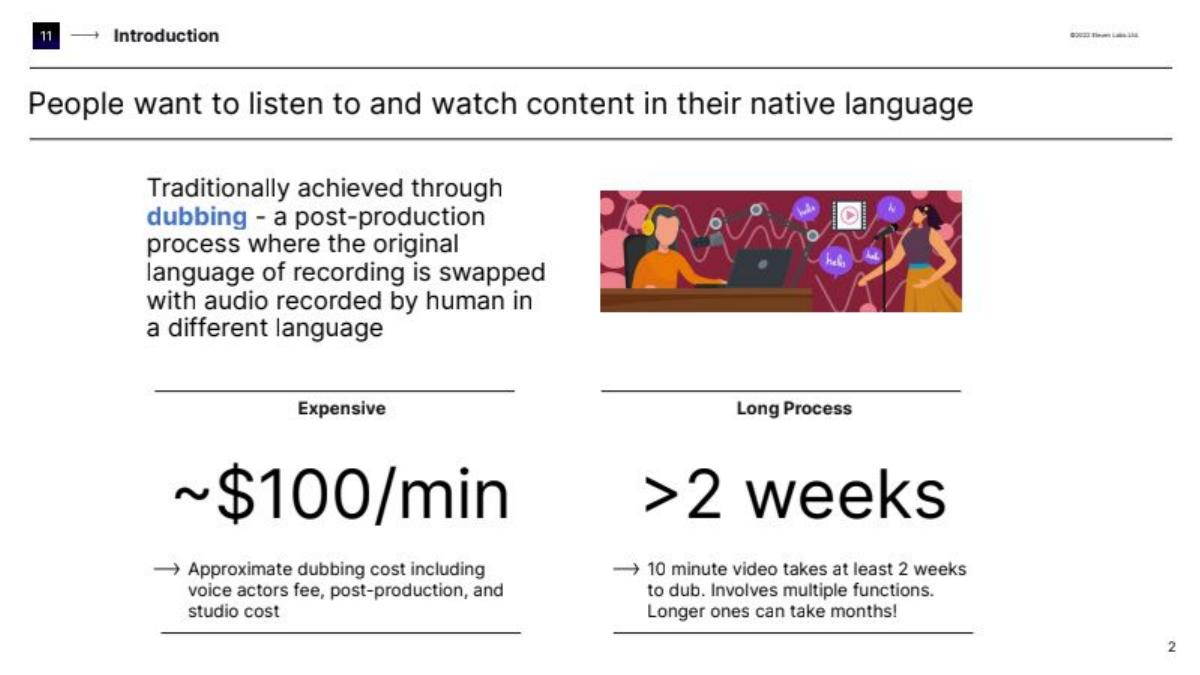
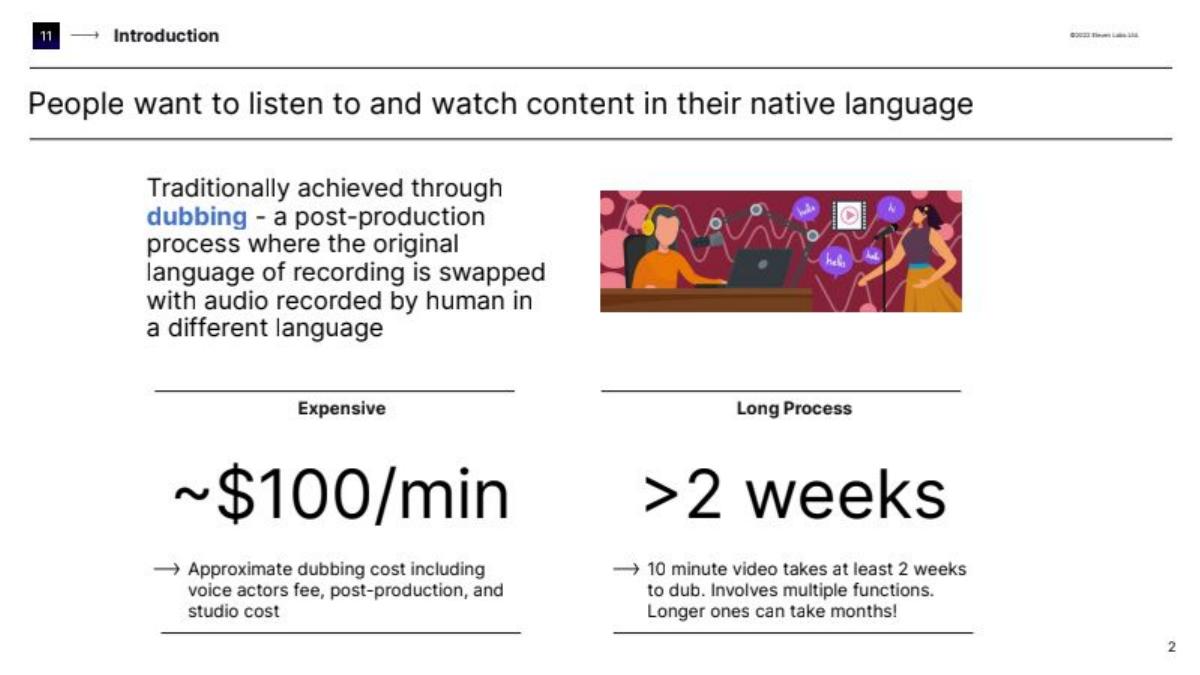
- Traditional dubbing is identified as costing approximately $100 per minute and requiring at least 2 weeks for a 10-minute video (Slide 2).
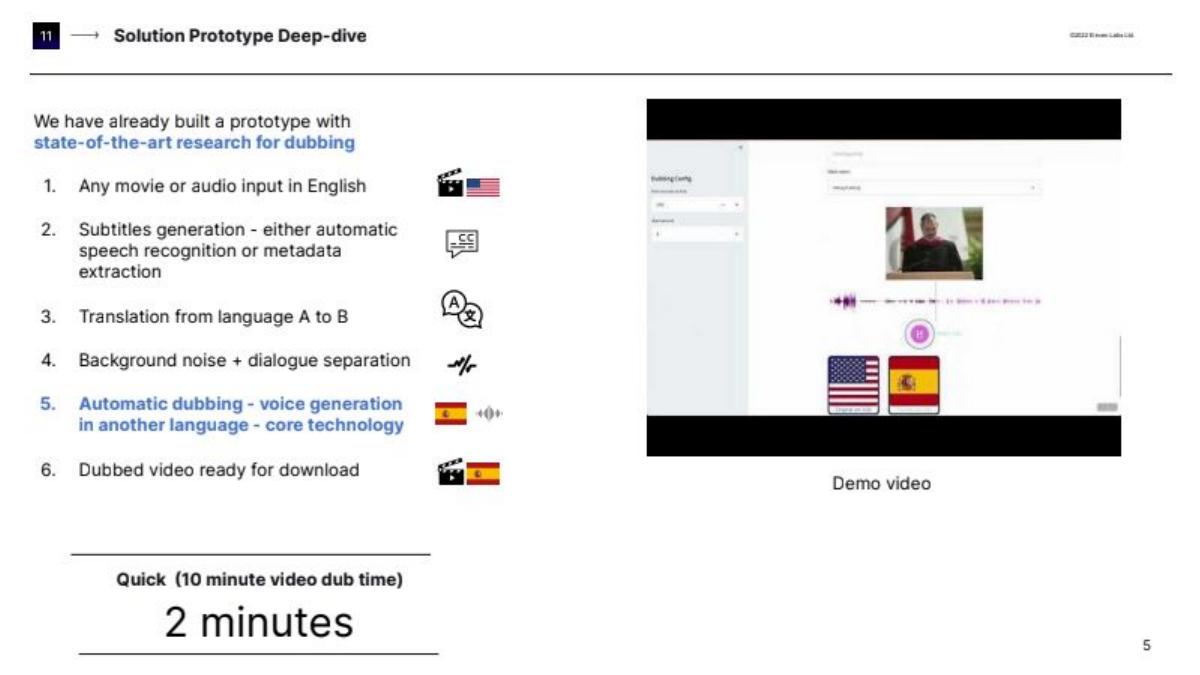
- The company claims its prototype can dub a 10-minute video in just 2 minutes (Slide 5).
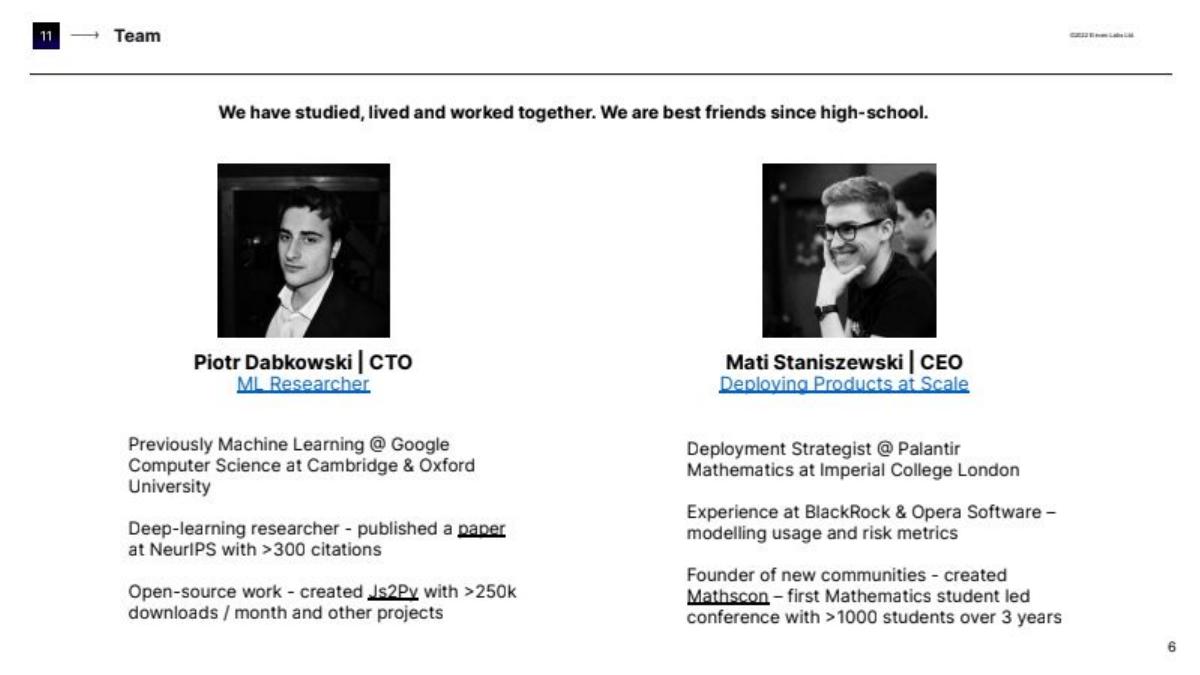
- The founders cite high-level technical backgrounds, including a NeurIPS-published researcher with >300 citations and a Palantir deployment strategist (Slide 6).
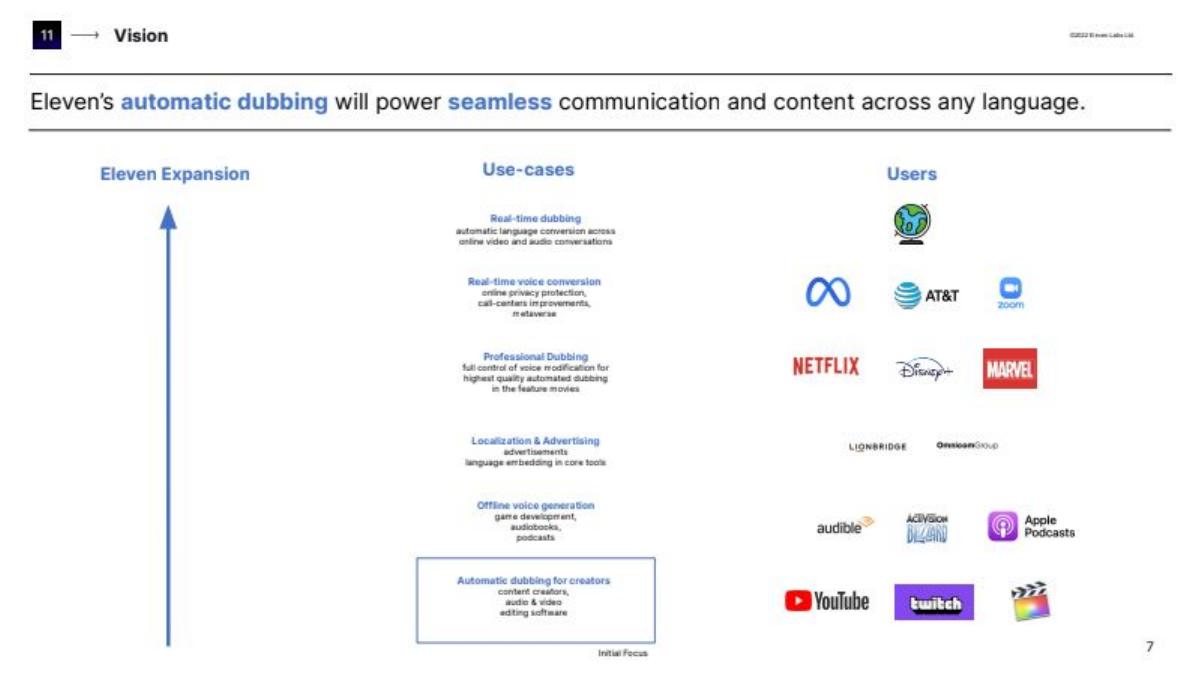
- The vision expands from creator tools to real-time dubbing for platforms like Zoom and Meta (Slide 7).
- The total market for localization, translation, and interpreting is estimated at $24B (Slide 8).
- ElevenLabs targets an 'Immediate Market' of 10,000 creators who already upload captions to their videos (Slide 9).
- The deck uses MrBeast's Spanish channel, which generates ~$50k per video, as proof of the ROI for localized content (Slide 10).
- The competitive landscape positions ElevenLabs as the only player offering high quality, high speed, and low manual intervention (Slide 12).
The ElevenLabs Pre-Seed Teardown
ElevenLabs is now a household name in the generative AI space, but in early 2023, they were a pre-seed startup pitching a faster, cheaper way to dub video content. This 11-slide deck (numbered up to 13, though two slides are missing or reordered in this sequence) is a clinical example of how to pitch a technical solution to a massive, legacy-burdened market. The deck focuses on the creator economy as a wedge, using clear ROI metrics to justify the shift from human voice actors to AI.
Slide 1-2: The High Cost of Language Barriers
The deck opens with a fundamental human desire: people want to consume content in their native language. Slide 2 immediately quantifies the friction of the status quo. It defines dubbing as a post-production process where original audio is swapped for human-recorded audio in a different language. The 'pain' is expressed through two massive figures: ~$100/min in costs and a >2 weeks turnaround time for a simple 10-minute video. By starting with these numbers, ElevenLabs sets a high bar for their own solution to clear.
Slide 3-4: The SaaS Solution
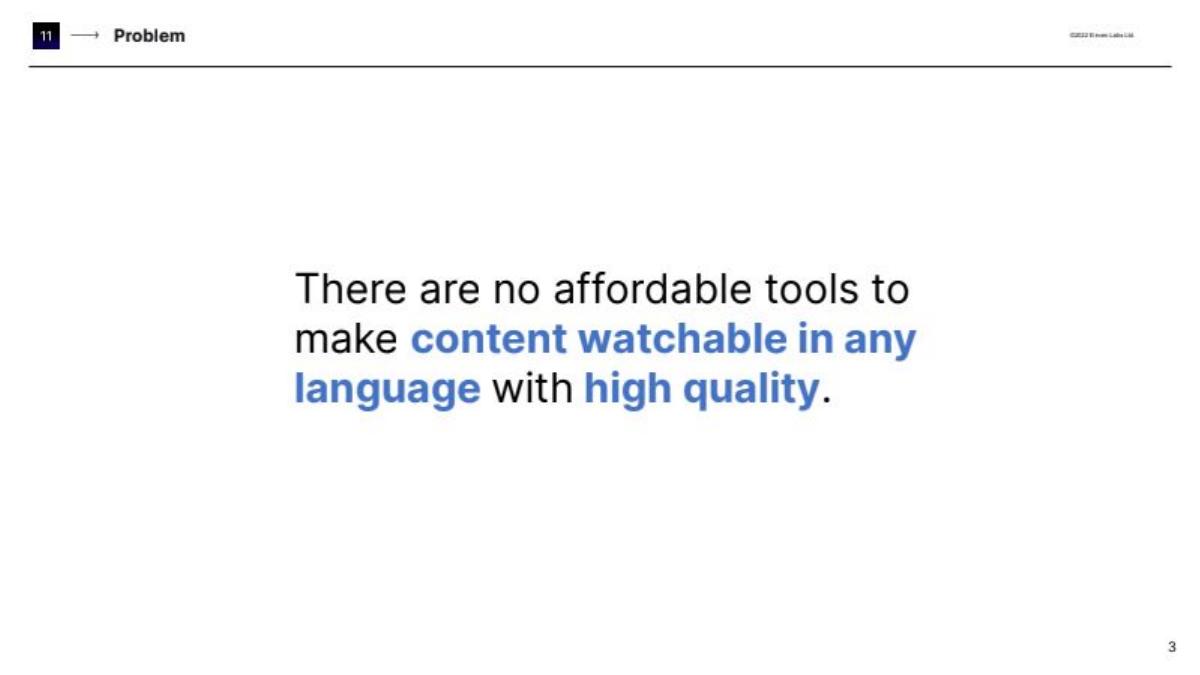
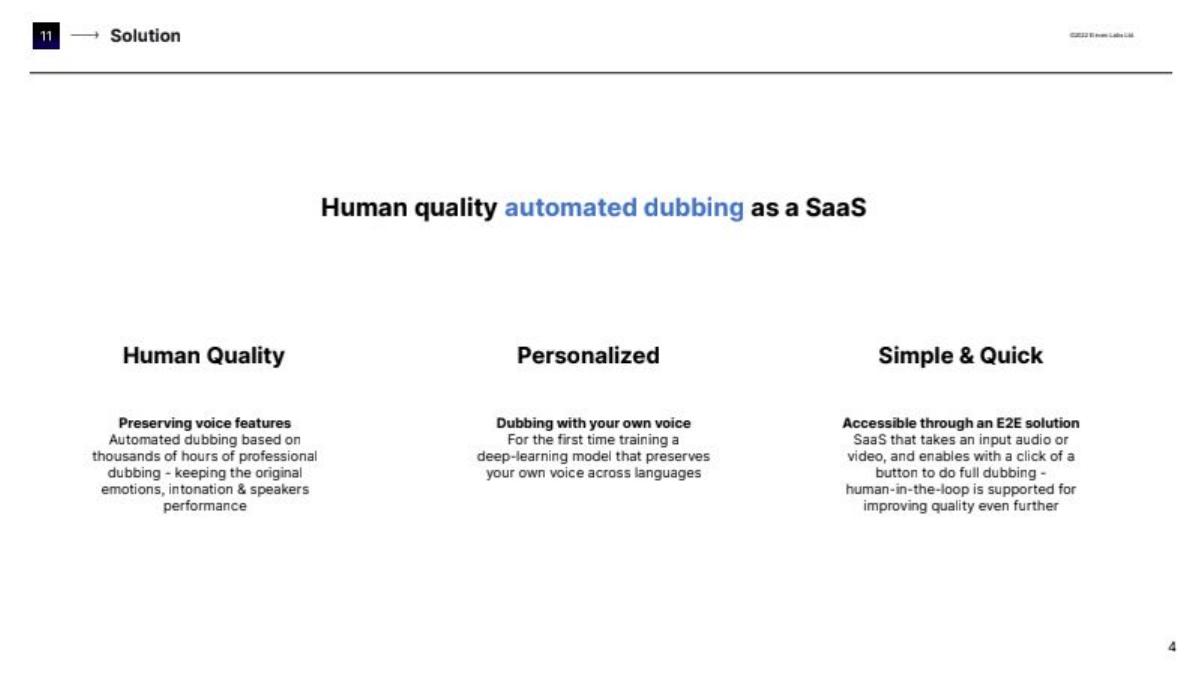
Slide 3 is a simple transition slide stating there are no affordable tools for high-quality, multi-language content. Slide 4 introduces the value proposition: Human quality automated dubbing as a SaaS . They break this down into three pillars: Human Quality (preserving emotions and intonation), Personalized (using the speaker's own voice), and Simple & Quick (an end-to-end E2E solution). This is a classic '10x better' pitch—cheaper, faster, and better quality than existing automated alternatives.
Slide 5: The Prototype Deep-Dive
Founders often spend too much time on theory; ElevenLabs spends Slide 5 on the reality of their build. They list a 6-step process from English input to dubbed video download. The most important metric on this slide is at the bottom: 2 minutes . This is the time it takes to dub a 10-minute video, compared to the 2 weeks mentioned on Slide 2. This represents a 10,000x improvement in speed, a compelling hook for any investor.
Slide 6: The Technical Pedigree
In AI, the team is often the product. Slide 6 introduces Piotr Dabkowski (CTO) and Mati Staniszewski (CEO). The credentials are high-signal: Piotr is an ex-Google ML researcher with a NeurIPS paper and a popular open-source project (Js2Py) with >250k downloads per month . Mati brings the 'scale' side, having worked as a Deployment Strategist at Palantir. The note that they are 'best friends since high-school' adds a layer of founder stability often sought in early-stage rounds.
Slide 7-8: Vision and Market Expansion
Slide 7 shows the 'Eleven Expansion' path. They start with creators (YouTube, Twitch) and move up the value chain to game development (Activision Blizzard), professional dubbing (Netflix, Disney+), and eventually real-time communication (Zoom, Meta). Slide 8 quantifies the Total Available Market (TAM), moving from a $2B creator market to a $24B total localization and interpreting market. This demonstrates that while they are starting small, the ceiling for the technology is massive.
Slide 9: The Bottom-Up Market Calculation
This is one of the strongest slides in the deck. ElevenLabs doesn't just claim a $24B market; they show how they get to their first $110M/year . They identify 10,000 creators who already upload captions as their 'Immediate Market.' By assuming these creators produce 3 videos a month, each 10 minutes long, dubbed into 3 languages, they arrive at 9 million minutes of audio. At a $1 per minute fee , the math is transparent and believable.
Slide 10: The MrBeast Case Study
To prove the ROI for their customers, Slide 10 looks at MrBeast. They compare his 96M English subscribers to his 19M Spanish subscribers. The key insight is that one video generates ~$50k on the Spanish channel. This proves that localization isn't just a cost; it's a significant revenue driver. If ElevenLabs can lower the cost of that localization, they aren't just a tool; they are a profit-multiplier for creators.
Slide 11-13: Competition and Technical Moat
Slide 12 uses a standard 2x2 matrix to position ElevenLabs in the top-right quadrant (High Quality, High Speed, Low Manual Intervention). They distance themselves from 'Text-to-speech solutions' like Amazon Polly and Google Wavenet, which they categorize as low quality. Slide 13 provides the technical justification for this claim, showing a flowchart of how they separate prosody from speaker voice . This slide is intended to satisfy the technical due diligence of a VC, explaining why their AI sounds more human than the competition.
What ElevenLabs Got Right
Extreme Quantified Pain: By citing the $100/min and 2-week delay of traditional dubbing, they made the need for their product undeniable. · The 'Immediate Market' Wedge: Targeting creators who already upload captions is a brilliant way to find 'desperate' users who are already doing 50% of the work manually. · ROI-Centric Case Study: Using MrBeast to show that dubbing creates $50k in incremental revenue per video shifts the conversation from 'cost saving' to 'revenue generation.' · Founder-Market Fit: The combination of a Google ML researcher and a Palantir strategist is a 'dream team' for a data-heavy AI SaaS.
What Is Missing from the Deck
The Ask: There is no slide stating how much money they are looking for or what the milestones for the next 18 months are. This information was likely handled in the verbal pitch or a follow-up memo. · Unit Economics: While they estimate a $1/minute revenue, they don't disclose the compute costs (COGS) associated with generating that minute, which is a critical factor for AI companies. · Roadmap: The vision slide shows where they want to go, but there is no tactical roadmap showing when they expect to move from creators to enterprise players like Netflix.
Founder Takeaways
If you are building in a crowded space like AI, follow the ElevenLabs model of specific segmentation . Don't just say 'everyone will use this.' Show the 'Immediate Market' (Slide 9) of people who are already exhibiting the behavior you want to automate. Furthermore, if your product is 10x faster or cheaper, put those numbers in a large font on your first three slides. Investors in 2023 and beyond are looking for efficiency gains that are so large they feel like a new category of software entirely.
Frequently asked questions
- What was the primary problem ElevenLabs aimed to solve?
- According to Slide 2, the primary problem is the prohibitive cost and time required for traditional dubbing. They note that professional dubbing costs roughly $100 per minute and takes over two weeks for a short video because it requires voice actors, studio time, and complex post-production. Slide 3 summarizes this as a lack of affordable tools for high-quality, multi-language content.
- How does ElevenLabs define its target market?
- The deck uses a nested circle diagram on Slide 9 to segment the market. They start with 50M+ total content creators, narrowing to 2M professional creators, then 100k YouTube creators with over 500k subscribers. Their 'Immediate Market' is identified as the 10,000 creators who already take the manual step of uploading captions, indicating a high readiness for automated dubbing.
- What is the technical 'secret sauce' mentioned in the deck?
- Slide 13 explains that unlike traditional Text-to-Speech (TTS), ElevenLabs uses both speech and text as inputs. Their model separates 'prosody' (the emotion and intonation) from the 'speaker's voice' (the unique vocal embedding). This allows them to map the original performance's emotion onto a new language while preserving the speaker's original voice characteristics.
- Does the deck include a business model or pricing?
- Slide 9 provides a preliminary revenue model. They assume a ~$1 fee per minute of audio. They specify that the actual model will be a SaaS subscription that includes a base set of 'convertible minutes.' Based on their target of 9 million minutes of content per month from professional creators, they project a $110M annual revenue opportunity.
- What information is missing from the ElevenLabs deck?
- The deck is notably missing a formal 'Ask' slide detailing how much they are raising and the intended use of funds. It also lacks a roadmap slide showing specific milestones or a slide dedicated to existing traction metrics (like current user count or revenue), likely because it was a pre-seed round focused on the prototype and founder expertise.