Tanbii is a sustainability-focused app that gamifies carbon reduction by rewarding real-world green behaviors with virtual tokens and brand discounts. The deck positions the company at the intersection of Web 2.0 and Web 3.0, a concept they label 'Web5.' By targeting Gen Z—a demographic with $143 billion in buying power—Tanbii seeks to move from simple gamification to a future where individuals can trade personal carbon credits. The 19-slide deck emphasizes a strong team with multiple exits and a high-profile advisor board. While the product vision is expansive, the deck relies heavily on fut…
Key takeaways
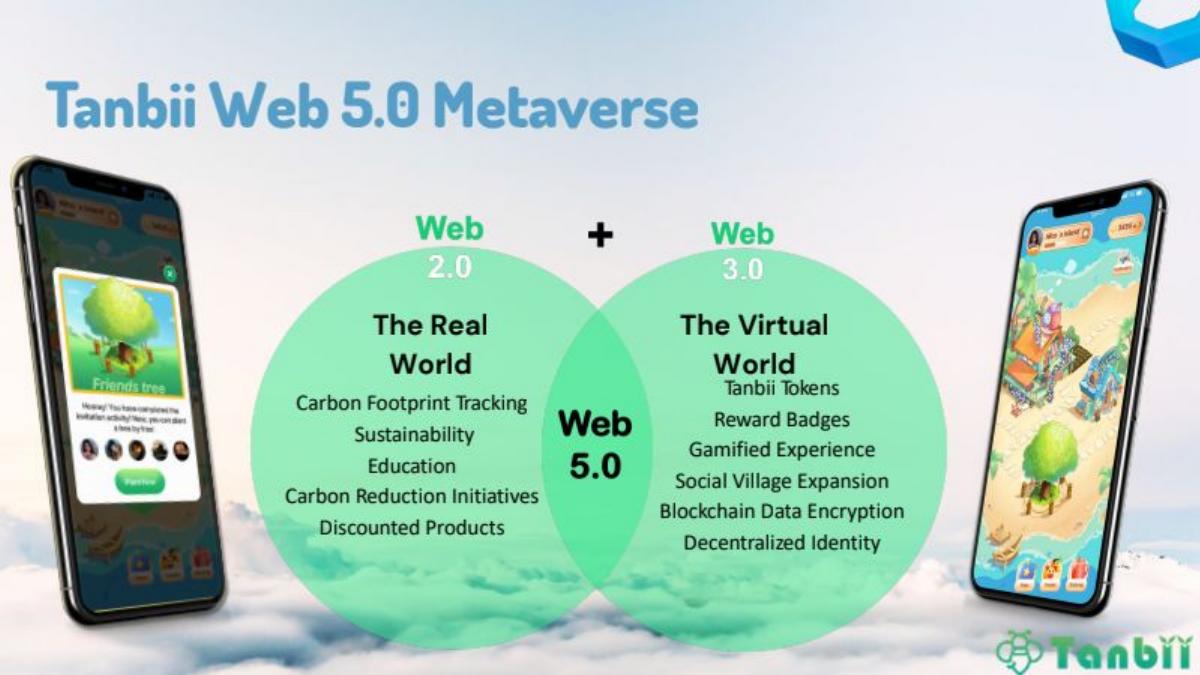
- The company defines its space as 'Web5,' a hybrid of Web 2.0 real-world tracking and Web 3.0 virtual rewards (Slide 4).
- Tanbii claims to use more than 30 real-life, EPA-verified carbon reduction activities to measure impact (Slide 3).
- The target market is Gen Z, citing that 81% are gamers and 64% favor green brands (Slide 9).
- The deck identifies a $8.91 billion Global Personal Carbon Market as its Serviceable Addressable Market (Slide 11).
- The business model transitions from affiliate marketing and in-app purchases to carbon credit trading by 2026 (Slide 15).
- The team highlights significant experience, including founders with a combined 5 successful exits (Slide 16).
- Tanbii has established a partnership with Eden Reforestation Projects to plant a real tree for every virtual one planted in-app (Slide 12).
- The roadmap sets an ambitious goal of reaching 10 million users by 2030 (Slide 15).
The Vision: Gamifying the Climate Crisis
Tanbii enters the sustainability market with a pitch centered on behavioral change through play. The deck, used to raise a $1.5M pre-seed round in 2023, attempts to solve the problem of individual inaction by providing tangible incentives. By framing the solution as 'Web5,' the company seeks to distance itself from the volatility of pure Web3 plays while retaining the engagement mechanics of blockchain-based rewards.
Slide 1: Title Slide
The deck opens with a clear value proposition: "Gamify Carbon Reduction." The subtitle, "Earn rewards by living a low carbon lifestyle," immediately identifies the benefit to the end-user. The visual style is bright and consumer-oriented, featuring 3D assets and a friendly bee logo.
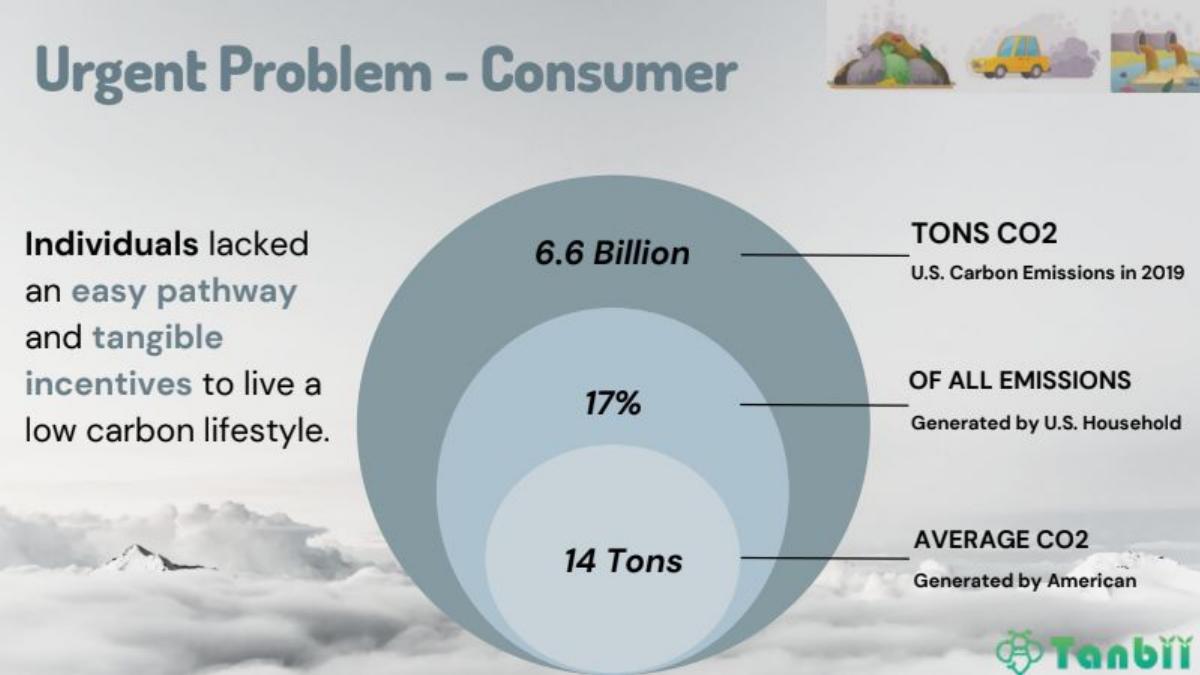
Slide 2: Urgent Problem - Consumer
Tanbii quantifies the problem using 2019 data. It notes that U.S. carbon emissions totaled 6.6 billion tons, with 17% generated by U.S. households. The slide highlights that the average American generates 14 tons of CO2. The core problem stated is that individuals lack an "easy pathway" and "tangible incentives" to change their lifestyle.
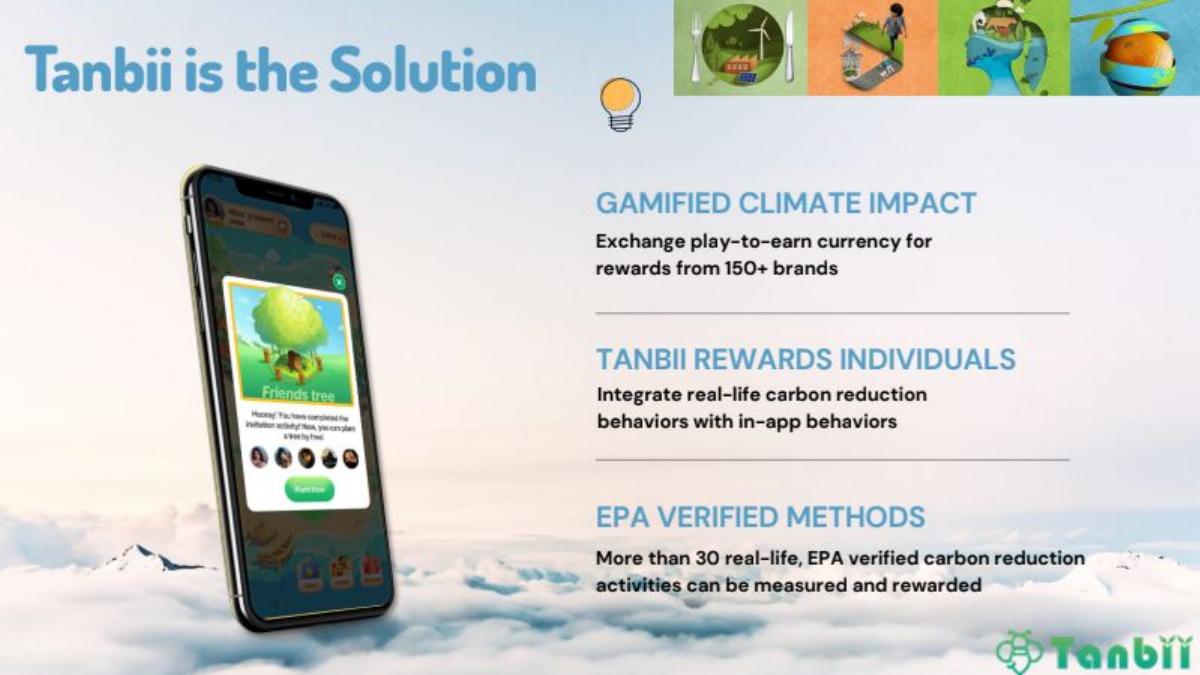
Slide 3: Tanbii is the Solution
This slide introduces the app's functionality. It mentions three pillars: Gamified Climate Impact (rewards from 150+ brands), rewarding individuals by integrating real-life behaviors with in-app actions, and the use of "EPA Verified Methods" for more than 30 activities. A mockup of the app shows a "Friends tree" feature, suggesting a social component.
Slide 4: Tanbii Web 5.0 Metaverse
The company introduces its "Web 5.0" framework via a Venn diagram. Web 2.0 represents the "Real World" (tracking, sustainability, education), while Web 3.0 represents the "Virtual World" (tokens, badges, blockchain encryption). The intersection is labeled Web 5.0, which Tanbii defines as its metaverse.
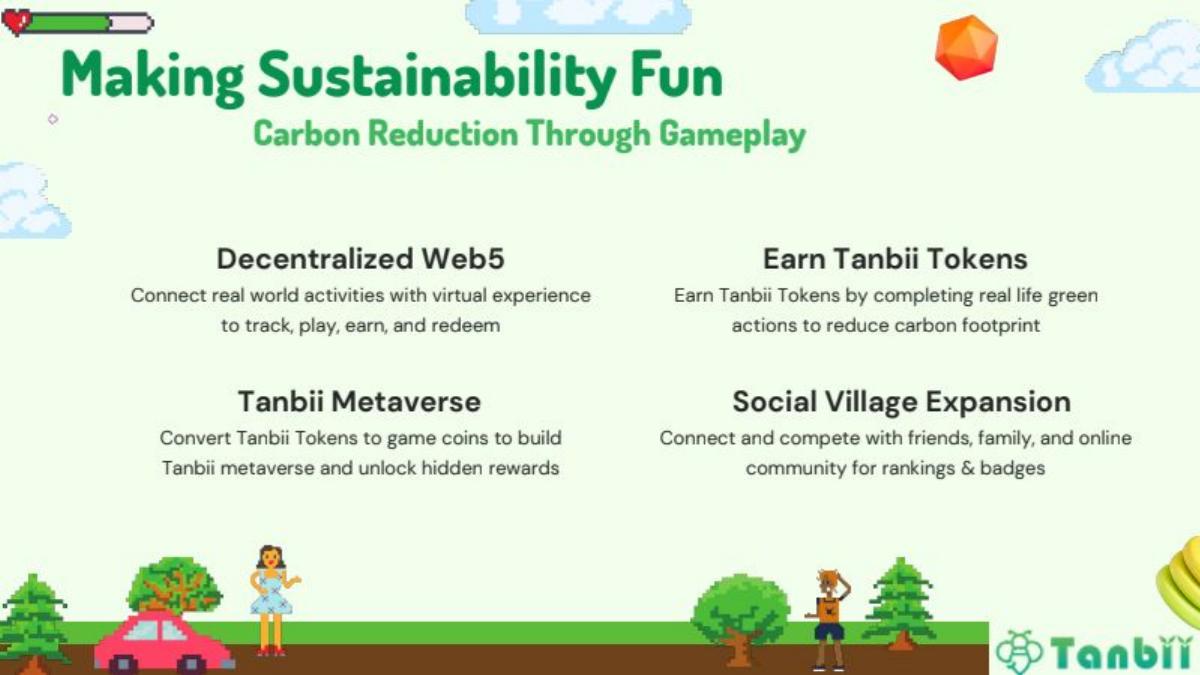
Slide 5: Making Sustainability Fun
This slide elaborates on the gameplay loop. It lists four components: Decentralized Web5 (connecting real and virtual), earning Tanbii Tokens through green actions, the Tanbii Metaverse (converting tokens to game coins), and Social Village Expansion (competing with friends for rankings).
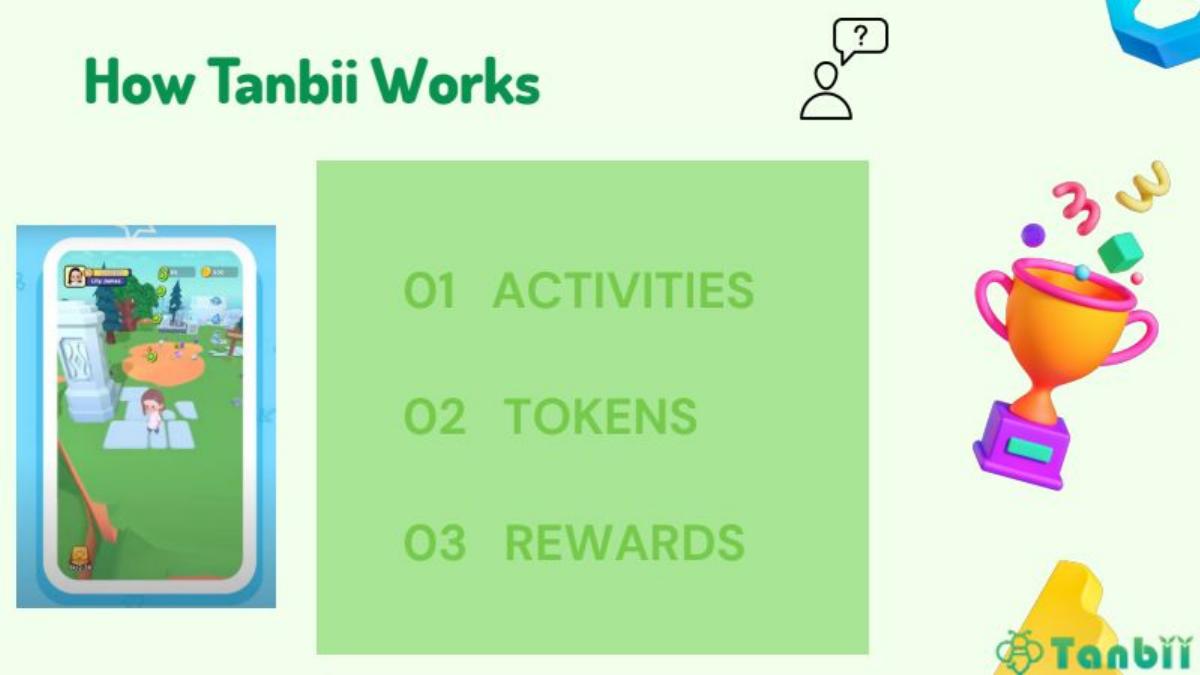
Slide 6: How Tanbii Works
A simplified three-step process is presented: 01 Activities, 02 Tokens, 03 Rewards. This is a standard "Move-to-Earn" or "Action-to-Earn" flow common in the Web3 space, though Tanbii applies it to carbon reduction specifically.
Slide 7: How Tanbii Connects Virtual & Reality
This slide is largely visual, showing a scattered pattern of dots. It serves as a transition slide but lacks specific data or explanatory text compared to the rest of the deck.
Slide 8: More Than Just Gameplay
To build technical credibility, Tanbii lists three features: AI-Powered (designing personalized gaming experiences), Security (high-level blockchain encryption), and Accuracy (ML on carbon reduction data with EPA-verified algorithms). This slide aims to reassure investors that the underlying tech is robust.
Slide 9: Target Market: Gen Z
The deck identifies Gen Z as the primary demographic. Key stats include a 2.6 billion global population, $143 billion in buying power, and the fact that 81% are gamers who play an average of 7.2 hours weekly. Crucially, it claims 64% of this group favor green brands.
Slide 10: Future: Personal Carbon Credits
This is the "big vision" slide. It outlines a three-phase evolution: Phase 1 is the gaming metaverse and e-commerce discounts; Phase 2 introduces a Personal Carbon Credit Account; Phase 3 involves Carbon Asset Trading with governments. This suggests Tanbii intends to become a financial platform for carbon, not just a game.
Slide 11: Carbon Market Size
The market opportunity is broken down into TAM, SAM, and SOM. The Total Addressable Market (Global Carbon Market) is $891 billion. The Serviceable Addressable Market (Global Personal Carbon Market) is $8.91 billion. Tanbii sets its SOM at $7.13 billion, which it describes as "80% Total of Market Share"—an exceptionally high target for a pre-seed company.
Slide 12: Our Partnerships
Tanbii showcases its ecosystem. For reforestation, it partners with Eden Reforestation Projects. For business, it lists logos including Amazon, Apple, Disney+, Nike, and Adidas. The slide claims 150+ sustainable partners, though it is unclear if these are direct partnerships or affiliate-based relationships.
Slide 13: Tanbii vs. Competitors
A comparison table pits Tanbii against Joro/Common, Aerial, Carbn, Capture, Klima, and Liquidation.com. Tanbii claims to be the only one offering a "Web5" universe, gamification, and Decentralized Identity (DID), while others are limited to Web2 carbon management.
Slide 14: Tanbii University Ambassador Program
To drive growth, Tanbii plans to collaborate with the university community. It lists logos for USC, Harvard, UCLA, and Vanderbilt, aiming for 20+ universities in 2024. This is a classic grassroots user acquisition strategy for consumer apps.
Slide 15: Roadmap & Business Model
The timeline spans from 2022 to 2030. In the short term (2022-2023), revenue comes from affiliate marketing and in-app purchases. Mid-term (2024-2025) adds freemium subscriptions and ads, targeting 1 million users. Long-term (2026-2030) focuses on merchandise and carbon credit trading, with a goal of 10 million users.
Slide 16: Tanbii Dream Team
The team slide is a strong point. CEO Robert Luo is credited with 2 successful exits and a spot on the GreenBiz 30 Under 30 list. COO Robert Grajewski is credited with 3 successful exits and a background as a VC. CTO Kent Chen has 10+ years of experience, and Marketing Director Neil Whitney is a former Senior Manager at Apple.
Slide 17: Tanbii Advisor Board
The advisor board includes high-profile individuals from companies like ByteDance, Google, and Zara.com. This adds significant institutional weight to a pre-seed stage startup.
Slide 18: Closing Slide
The deck concludes with the logo and the tagline "Making Sustainability Fun." It provides a contact email and LinkedIn handle, alongside a final visual of the app interface.
What Works in This Deck
Strong Team and Advisor Pedigree: The most compelling part of the Tanbii deck is the team slide (Slide 16) and the advisor board (Slide 17). Founders with multiple exits and advisors from Google and Apple suggest a high level of execution capability, which is critical for a pre-seed round.
Clear Demographic Targeting: Slide 9 does an excellent job of justifying why Gen Z is the right audience. By linking gaming habits with green brand preferences, Tanbii makes a logical case for its product-market fit.
Visionary Roadmap: The transition from a simple reward app to a personal carbon credit trading platform (Slide 10) gives investors a reason to believe in a massive eventual exit, moving the company from a "nice-to-have" app to a piece of financial infrastructure.
What Is Missing
Current Traction Metrics: While the deck mentions an "Official launch" in 2023 (Slide 15), it contains no data on current user numbers, retention rates, or revenue generated to date. For a 2023 deck, investors would typically expect to see early beta results or waitlist numbers.
Unit Economics: There is no mention of Customer Acquisition Cost (CAC) or Lifetime Value (LTV). While these are often estimated at the pre-seed stage, the deck's reliance on affiliate marketing and in-app purchases requires some discussion of how the company will remain profitable.
Verification Transparency: While Slide 8 mentions "EPA Verified carbon calculation algorithms," the deck does not explain how it prevents users from gaming the system (e.g., claiming a walk they didn't take). In a reward-based system, fraud prevention is a major operational hurdle.
What a Founder Should Copy
The 'Future Vision' Slide: Slide 10 is a masterclass in showing how a small initial product can evolve into a massive market disruptor. Founders should always include a slide that shows the "end game" of their business model.
The Comparison Matrix: Slide 13 uses a feature-based comparison that clearly differentiates Tanbii from established Web2 players. It doesn't just say they are better; it identifies specific technical gaps (like DID and Gamification) that the competitors lack.
Market Sizing Hierarchy: Slide 11 uses the TAM/SAM/SOM framework correctly, narrowing down from the massive global carbon market to the specific personal carbon market they can actually serve. This shows a realistic understanding of their niche.
Frequently asked questions
- What is Tanbii's core product?
- Tanbii is a gamified app that tracks real-world carbon reduction activities. Users earn 'Tanbii Tokens' for green actions, which can be used to build a virtual metaverse or redeemed for rewards and discounts from over 150 partner brands.
- How does Tanbii verify carbon reduction?
- According to slide 8, the company uses machine learning on carbon reduction data paired with EPA-verified carbon calculation algorithms to ensure accuracy in measurement.
- What is the 'Web5' concept mentioned in the deck?
- Tanbii uses 'Web5' to describe the integration of Web 2.0 (real-world tracking, education) and Web 3.0 (tokens, blockchain encryption, decentralized identity) to create a unified metaverse experience.
- What is the long-term monetization strategy?
- While starting with affiliate marketing and in-app purchases, the company plans to expand into freemium subscriptions, advertising, and eventually a platform for trading personal carbon credits with governments and vendors.
- Who are the key competitors identified by Tanbii?
- The deck lists several Web2 competitors including Joro/Common, Aerial, Carbn, Capture, and Klima, noting that Tanbii differentiates itself through gamification and its 'Web5' architecture.