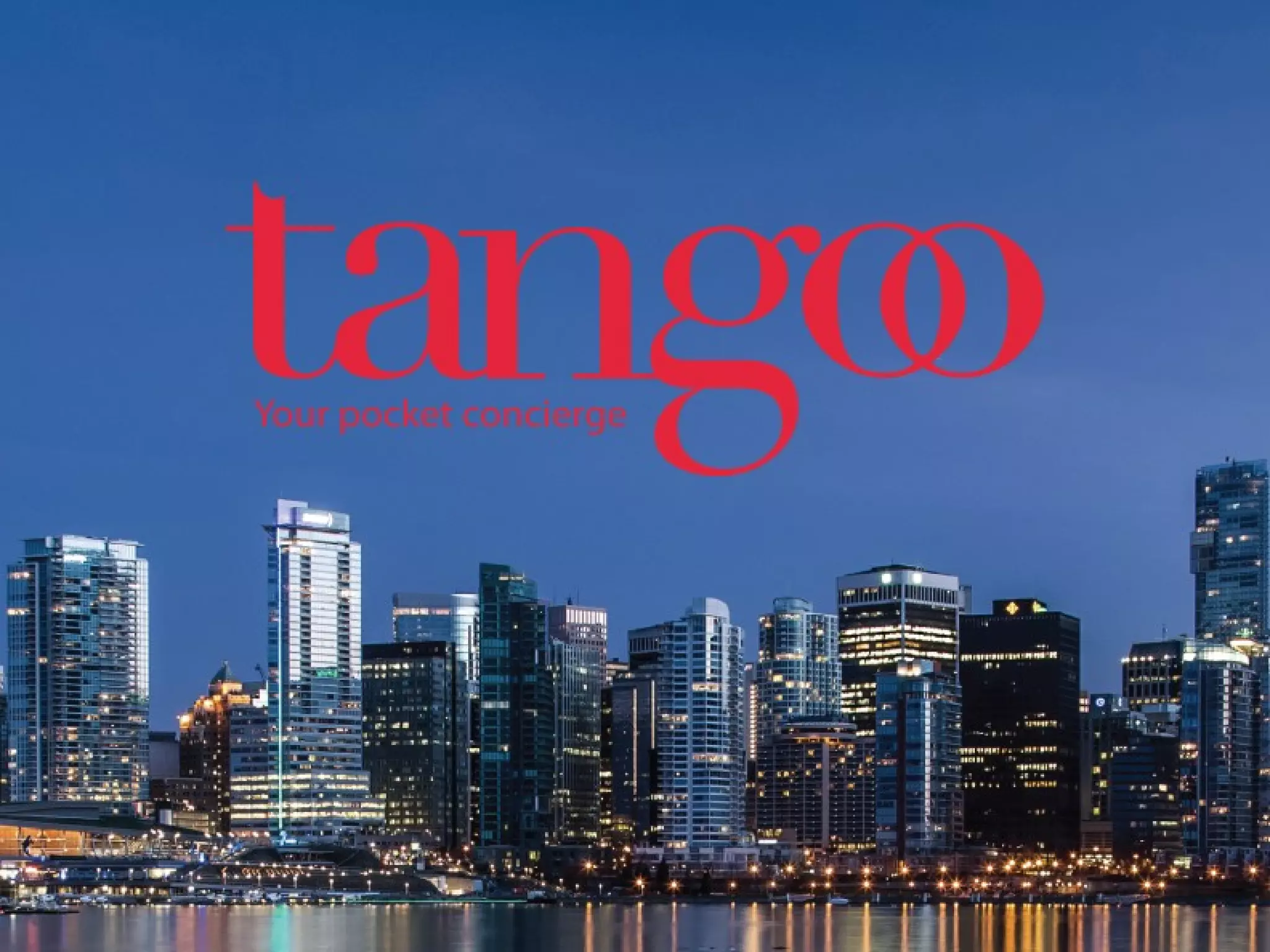
Tangoo positions itself as a personalized curation platform for social outings, described as a 'pocket concierge.' The deck highlights a significant market opportunity, citing a $537 billion annual spend in the dining sector and a $22 billion spend in nightlife. The business model relies on a B2B2C approach where users access the platform for free, while vendors pay monthly subscription fees ranging from $50 to $150. The most compelling data points in the deck are the unit economics, showing a Customer Acquisition Cost (CAC) of $4.10 for users and $307.15 for vendors, contrasted against a ven…
Key takeaways
- The company identifies a $10.7 billion target market within the $537 billion annual dining spend (Slide 3).
- Tangoo targets 75% of the $22 billion nightlife marketing budget, representing an $825 million opportunity (Slide 3).
- The revenue model is subscription-based for vendors, offering 'Profile Access' at $50/month and 'Enhanced Profile' at $150/month (Slide 4).
- User acquisition is highly efficient, with a stated CAC of only $4.10 (Slide 5).
- Vendor unit economics show a healthy 16.5x LTV/CAC ratio, with a $5,092 CLV against a $307.15 CAC (Slide 5).
- The platform has achieved early traction with 5,000 signups demonstrated on a landing page mockup (Slide 6).
- Tangoo has secured significant regional and national media coverage, including The Huffington Post and The Globe and Mail (Slide 7).
- The product value proposition centers on a '3-step process' that matches user mood to content (Slide 2).
Tangoo Pitch Deck Teardown
Tangoo presents a vision for a 'pocket concierge' that simplifies the process of planning social outings. The deck is characterized by a clean, high-contrast aesthetic and a heavy reliance on unit economics to prove the viability of the business model. By targeting the intersection of dining, nightlife, and personalized curation, Tangoo attempts to solve the 'choice paradox' for consumers while providing a measurable marketing channel for vendors.
Slide 1: Title and Branding
The cover slide establishes the brand identity with a red serif logo and the tagline 'Your pocket concierge.' The background image features a city skyline at dusk (specifically Vancouver, based on the skyline and subsequent media mentions), which immediately anchors the product in an urban, lifestyle context. The branding is professional, though the tagline is somewhat generic for the concierge app space.
Slide 2: The Value Proposition
Slide 2 breaks down the core pillars of the service: 'Personalized Curation.' The company claims to offer a 'Simple, Vibrant Design,' a 'Seamless, 3-step Process,' and a system that 'Matches Mood and Content.' This slide functions as a high-level solution overview. It tells the investor what the product feels like (simple/vibrant) and how it works (mood-matching), though it lacks a specific screenshot of the interface to prove these claims.
Slide 3: Market Opportunity
Tangoo uses a top-down approach to market sizing on Slide 3. They cite two primary sectors:
Dining: $537B annual spend, with an 8% marketing budget. Tangoo targets 25% of this, valuing their share at $10.7B. · Nightlife: $22B annual spend, with a 5% marketing budget. Tangoo targets a much more aggressive 75% of this, valuing their share at $825M.
The sources cited are the US Travel Association (2013) and QSR Magazine (2014). While the numbers are large, the 'Our Target' percentages (25% and 75%) are highly ambitious and are not supported by a bottom-up calculation of how many cities or vendors they would need to capture to reach those figures.
Slide 4: Revenue Model
The business model is clearly defined on Slide 4. Tangoo employs a B2B subscription model:
Profile Access: $50/month for vendors. · Enhanced Profile: $150/month for vendors. · Users: Free.
This is a classic marketplace strategy: remove friction for the demand side (users) to build a large audience, then charge the supply side (vendors) for access to that audience. The pricing tiers suggest a low-touch sales model, which aligns with the unit economics presented later.
Slide 5: Unit Economics
This is arguably the strongest slide in the deck. It presents a side-by-side comparison of acquisition costs:
User CAC: $4.10. · Vendor CAC: $307.15. · Vendor CLV: $5,092.
A Vendor CLV of $5,092 against a CAC of $307.15 represents a 16.5x LTV/CAC ratio. This is exceptionally high for a SaaS product and suggests that once a restaurant or bar joins the platform, they stay for a long time. However, the deck does not specify the time period over which this CLV is calculated or the churn rate used to derive it.
Slide 6: Traction and Validation
Slide 6 shows a laptop displaying the Tangoo landing page with a prominent callout for '5000 signups.' The landing page copy reads: 'Tangoo provides you the most personalized and seamless way to organize the perfect social outing.' This provides proof of early market interest, though it is unclear if these are active users or merely email signups from a pre-launch phase.
Slide 7: Media and PR
To build credibility, Slide 7 displays logos of major media outlets that have covered the company. These include Global News, CTV, CBC, The Globe and Mail, Shaw, Sonic 104.9, Vancity Buzz, BC Living, Business Vancouver, and The Huffington Post. The heavy concentration of Canadian media (specifically British Columbia) suggests that Tangoo is currently a regional player looking to expand.
Slide 8: The Insider Program
Slide 8 is a lifestyle image titled 'Our Insider Program.' It shows a group of well-dressed people dining. While it lacks text, it implies a community-driven aspect of the platform. In the context of a 'concierge' app, this usually involves a layer of human curation or a 'VIP' experience for certain users, which could be a secondary monetization route or a retention hook.
Slide 9: Closing Logo
The final slide repeats the logo and tagline. Notably, there is no contact information, no specific 'Ask' (amount of money being raised), and no 'Use of Funds' breakdown on this slide or any of the preceding slides.
What Works in the Tangoo Deck
The deck excels at presenting unit economics . By showing a clear path to profitability per vendor ($5,092 CLV vs $307 CAC), they make a strong case for the scalability of the business. If they can maintain these ratios while increasing the marketing spend, the business becomes a very attractive investment. The revenue model is also refreshingly simple; there is no ambiguity about how the company makes money.
The media validation is also impressive. For a lifestyle app, brand perception is everything, and having logos like The Huffington Post and The Globe and Mail provides the 'social proof' necessary to convince investors that the brand has legs beyond its local market.
What is Missing from the Tangoo Deck
The most glaring omission is the Team Slide . Investors invest in people, especially at the early stage. Without knowing who is building the technology or who is leading the sales effort to restaurants, the deck feels incomplete. There is also no Competitor Analysis . The dining and nightlife space is incredibly crowded (Yelp, OpenTable, Foursquare, etc.), and Tangoo does not explicitly state how it differentiates itself from these giants other than the vague 'mood-matching' claim.
Furthermore, there is no Financial Projections slide or The Ask . We do not know how much capital Tangoo is seeking, what valuation they are targeting, or what milestones they intend to hit with the new funding. This makes the deck feel more like a company overview than a formal investment pitch.
What a Founder Should Copy
Founders should emulate the visual clarity of the unit economics on Slide 5. Many decks bury their CAC and LTV in complex tables or omit them entirely. Tangoo puts them front and center in large, readable text. This forces the conversation toward the efficiency of the business model, which is exactly where a founder wants an investor's focus to be.
The market sizing slide (Slide 3) is also a good example of how to break down a massive industry into 'Marketing Budgets.' Instead of just saying 'Dining is a $500B industry,' they narrow it down to the specific portion of that spend that they can actually capture (marketing dollars). This shows a more sophisticated understanding of their revenue source.
Frequently asked questions
- What is Tangoo's primary business model?
- Tangoo operates a freemium model for consumers while charging vendors (restaurants and nightlife venues) a recurring subscription fee. According to slide 4, vendors pay either $50 per month for basic profile access or $150 per month for an enhanced profile. This allows the company to build a large user base for free while monetizing the supply side of the marketplace through predictable SaaS revenue.
- How does Tangoo justify its market size projections?
- The deck uses top-down market sizing based on 2013 and 2014 industry data. Slide 3 notes a $537 billion annual spend on dining and a $22 billion spend on nightlife. They estimate that 8% and 5% of these totals respectively go toward marketing. Tangoo then applies a target capture rate (25% for dining, 75% for nightlife) to arrive at a total addressable market of over $11.5 billion.
- What are the key performance indicators (KPIs) mentioned in the deck?
- The deck focuses heavily on acquisition and retention metrics. Slide 5 highlights a user CAC of $4.10 and a vendor CAC of $307.15. The most critical metric provided is the vendor Customer Lifetime Value (CLV) of $5,092. Additionally, slide 6 mentions a milestone of 5,000 signups, indicating early-stage validation of the consumer interest in the 'pocket concierge' concept.
- Does the deck provide information on the founding team?
- No, the provided slides do not include a team slide. This is a significant omission for an early-stage investor deck, as investors typically prioritize the founders' backgrounds and their ability to execute the vision. Without this information, it is impossible to assess the technical or operational expertise behind the platform's development and its regional expansion strategy.
- What is the 'Insider Program' mentioned in the deck?
- Slide 8 introduces 'Our Insider Program' with an image of diners in a high-end setting. While the slide lacks specific bullet points, it implies a community or loyalty layer to the product. Given the 'pocket concierge' branding, this likely refers to a network of influencers or power users who help curate the 'mood-based' recommendations that Tangoo promises in its solution overview.