Ocean Eyes is a Kyoto-based startup tackling the inefficiencies of commercial fishing through a digital transformation (DX) platform called FishersNavi. The deck highlights a significant operational pain point: fishers currently rely on intuition, leading to excessive fuel consumption and time spent searching for productive grounds. Their solution leverages a sophisticated blend of ocean numerical modeling, satellite image analysis, and AI to predict 'Potential Fishing Grounds' (PFG). With a reported revenue of 120 million JPY in FY2022 and a team rooted in JAMSTEC and Kyoto University resear…
Key takeaways
- The company reported approximately 120 million JPY in revenue for the 2022 fiscal year (Slide 16).
- Ocean Eyes was established on April 1st, 2019, and is headquartered in Kyoto, Japan (Slide 16).
- The core product, FishersNavi, provides data on temperature at 100m depth, chlorophyll levels, and current speeds to identify fishing boundaries (Slide 7).
- The problem slide identifies that fishers spend a significant portion of their working time searching for grounds based on intuition rather than data (Slide 4).
- The technical moat is built on 'Ocean Numerical Modelling' combined with 'Image Analysis / Pattern Recognition' (Slide 10).
- The startup is a spin-off involving researchers from JAMSTEC and Kyoto University, with Kyoto iCap listed as a stockholder (Slide 16).
- Future R&D focuses on long-term climate change impact modeling, projecting ocean environments 30 to 50 years into the future (Slide 22).
- The deck omits a specific funding ask, use of proceeds, and a detailed competitor comparison.
Executive Summary: Digital Transformation for the High Seas
Ocean Eyes presents a highly technical pitch deck focused on 'Fishery DX' (Digital Transformation). The company, a spin-off from prestigious Japanese research institutions, seeks to replace traditional maritime intuition with high-resolution numerical modeling and machine learning. The deck is structured to emphasize scientific credibility and technical superiority, moving from the operational pains of the fishing industry to the sophisticated data models that solve them. While the deck provides a solid company overview and product demonstration, it functions more as a technical capability statement than a traditional venture capital pitch, as it lacks a specific 'Ask' or financial roadmap in the provided slides.
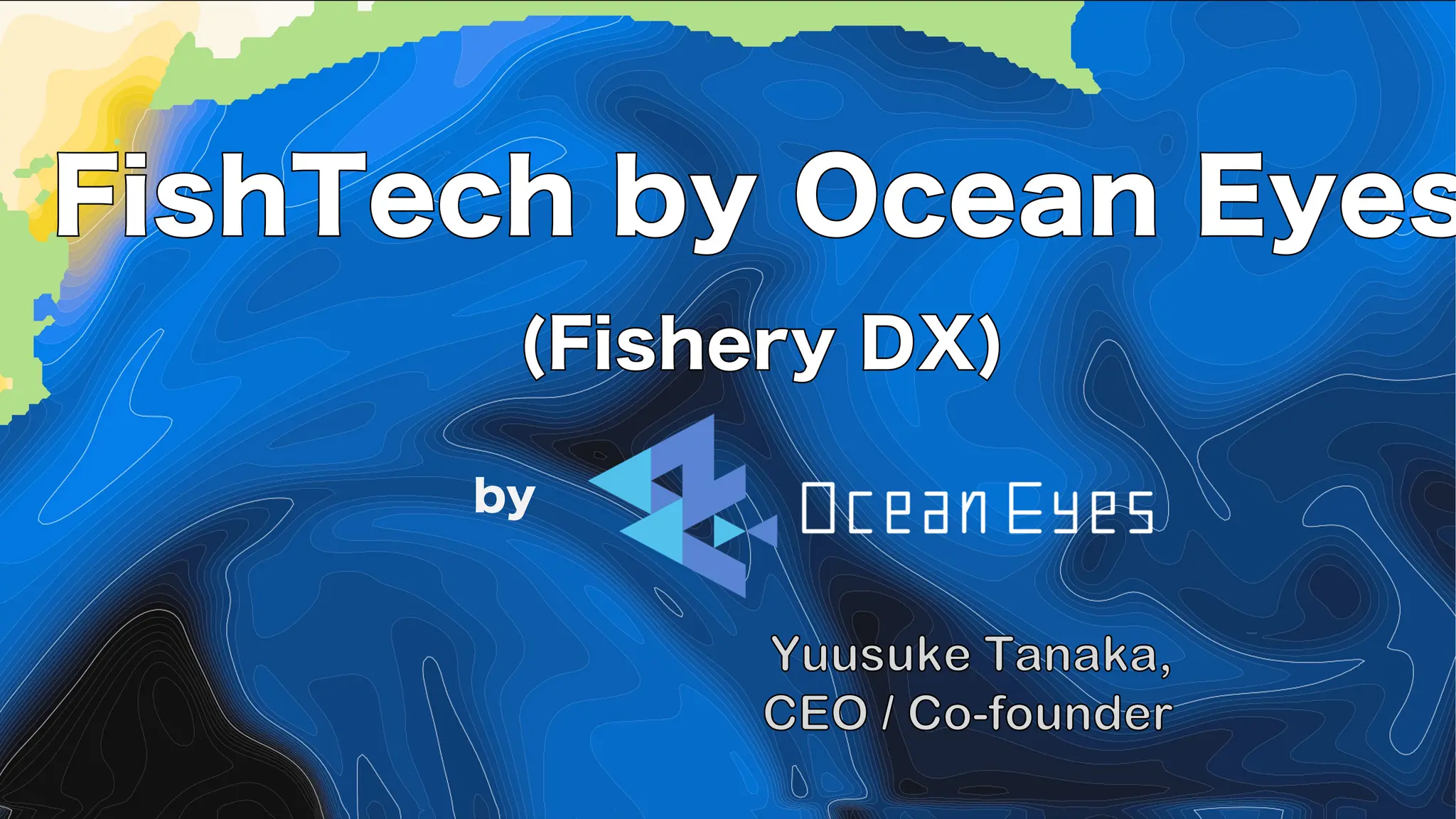
Slide 1: Title and Leadership
The cover slide introduces the brand 'FishTech by Ocean Eyes' and explicitly labels the sector as 'Fishery DX.' The background features a bathymetric map, immediately signaling the maritime focus. Yuusuke Tanaka is identified as the CEO and Co-founder. The branding is clean, though the dual naming (FishTech by Ocean Eyes) suggests that FishTech may be the specific product line or a broader initiative within the parent company, Ocean Eyes.
Slide 4: The Intuition Gap
The problem slide uses a donut chart to break down the working time of fishers. It identifies three main phases: Move, Search, and Operation. A significant portion of the chart is dedicated to 'Search.' The slide illustrates the current state of the industry: boats moving in zig-zag patterns based on 'the captains' intuition,' often resulting in 'No fish' and wasted fuel. This establishes a clear economic and environmental pain point: the high cost of uncertainty in finding productive fishing grounds.
Slide 7: Product Deep Dive - FishersNavi
This slide showcases the user interface of FishersNavi, the company's core product. It displays four distinct data visualizations: Temperature at 100m depth , Chlorophyll levels, Current at 100m depth , and Shiome . The 'Shiome' is defined as the boundary of different water masses, which the company identifies as a 'good indicator for PFG' (Potential Fishing Grounds). The maps are highly detailed, showing the coastal regions of Japan, and include UI elements for time-shifting data (e.g., +1 day, -6 hours), suggesting a predictive capability rather than just real-time observation.
Slide 10: Core Competences - The Technical Moat
Ocean Eyes defines its competitive advantage through a cross-disciplinary approach. They combine Image Analysis / Pattern Recognition with Ocean Numerical Modelling . This slide is minimalist, intended to show that their value lies at the intersection of computer science and physical oceanography. By using numerical modeling, they aren't just looking at satellite photos; they are simulating the physical properties of the water column.
Slide 13: The PFG Formula
This slide further clarifies the 'Core Competences' by providing a conceptual formula: Physical oceanography x Fisher’s intuition x AI/ML = PFG . A graphic shows how oceanographic heat maps are broken down into smaller tiles, which are then processed to categorize them as 'bad' (single fish icon) or 'good' (multiple fish icons) fishing grounds. This slide effectively explains how they translate complex scientific data into actionable business intelligence for a fishing vessel captain.
Slide 16: Company Overview and Traction
This is a standard corporate profile slide that provides significant evidence of legitimacy. Key facts include:
Company Name: Ocean Eyes Co., Ltd. · Established: 1st April, 2019. · Capital Stock: 23,485,000 JPY. · Location: Kyoto, Japan. · Revenue: About 120 million JPY in FY2022. · Stockholders: Management (Researchers of JAMSTEC and Kyoto Univ.) and Kyoto iCap. · Employees: 16.
The revenue figure of 120 million JPY (approximately $800k-$900k USD depending on exchange rates) is a strong indicator of product-market fit for a 16-person team.
Slide 19: Advanced Modeling and R&D Challenges
This slide, primarily in Japanese, discusses the development of high-resolution ocean state prediction models. It mentions a 'downscaling' process from a 1.6km resolution model to a 'hundreds of meters' resolution model. The text notes that these models can reproduce tides and coastal topography in detail, such as identifying individual bays in the Sanriku region. However, it also honestly lists current limitations: the calculation area is narrow (prefectural level), the prediction time is short (~2 days), and there is a lack of observation data for verification. This level of transparency is common in deep-tech decks originating from academic spin-offs.
Slide 22: Long-term Vision and Climate Impact
The final slide in the set focuses on Research & Development regarding future climate change. It discusses predicting coastal ocean environments 30 to 50 years into the future. By breaking down global-scale climate effects to the coastal level, the company aims to provide data for long-term risk assessment and policy planning. This suggests the company is looking beyond daily fishing operations toward larger ESG (Environmental, Social, and Governance) and governmental data contracts.
What Ocean Eyes Does Well
The deck excels at establishing technical authority . By citing affiliations with JAMSTEC and Kyoto University, and showing actual revenue from FY2022, the founders move past the 'science project' phase and into a legitimate business phase. The problem/solution fit is articulated simply: fishing is currently a guessing game; Ocean Eyes makes it a data-driven operation. The use of the term 'Fishery DX' aligns them with a broader Japanese economic trend of digitizing traditional industries, which likely resonates well with local investors like Kyoto iCap.
What is Missing from the Deck
Despite the strong technical foundation, several standard venture components are missing from these slides: 1. The Ask: There is no mention of how much capital the company is seeking or what the valuation expectations are. 2. Unit Economics: While total revenue is stated, the deck does not explain the pricing model. Is it a SaaS subscription per vessel, a licensing fee for cooperatives, or a per-report cost? 3. Competitive Landscape: The deck assumes a vacuum. It does not mention other satellite-based fishing services or traditional sonar/hardware competitors. 4. Go-to-Market Strategy: There is no detail on how they acquire customers. Do they sell to individual boat owners, large commercial fleets, or government fisheries agencies? 5. Team Bios: While the CEO is named and the academic origins are mentioned, there are no headshots or specific career highlights for the 16-person team.
Founders: What to Copy from this Deck
Founders in the deep-tech or 'hard science' space should emulate the 'Formula for Success' shown on Slide 13. Distilling a complex, multi-variable technical process into a simple equation (Science x Intuition x AI = Outcome) helps non-technical investors grasp the value proposition without getting lost in the math. Additionally, the transparency regarding R&D limitations on Slide 19 is a sophisticated move; it builds trust with technical due diligence teams by acknowledging that the technology is a work in progress rather than claiming it is a perfect, finished solution.
Frequently asked questions
- What is the primary problem Ocean Eyes is solving?
- According to slide 4, the primary problem is that commercial fishers spend an excessive amount of time and fuel searching for productive fishing grounds. Currently, this process is largely based on the captain's intuition, which leads to many 'No fish' outcomes and inefficient movement. Ocean Eyes aims to digitize this search process to increase the 'Catch!!' rate and reduce operational waste.
- What specific data points does the FishersNavi product provide?
- Slide 7 illustrates that FishersNavi offers four key data layers: water temperature at 100m depth, chlorophyll concentration, current speed/direction at 100m depth, and 'Shiome' (the boundary of different water masses). These indicators are used collectively to identify Potential Fishing Grounds (PFG), allowing captains to navigate directly to areas with higher biological activity.
- How does the company combine AI with traditional science?
- Slide 13 explains their methodology as a formula: Physical Oceanography x Fisher's Intuition x AI/ML = PFG (Potential Fishing Grounds). They use AI to analyze oceanographic maps and identify specific patterns that correlate with high fish density, essentially training machine learning models on the historical 'intuition' and success rates of experienced fishers.
- What is the current scale and financial health of the company?
- As of slide 16, Ocean Eyes Co., Ltd. has 16 employees and a capital stock of 23,485,000 JPY. They achieved a revenue of approximately 120 million JPY in FY2022. The company is backed by institutional expertise, with stockholders including management from JAMSTEC (Japan Agency for Marine-Earth Science and Technology) and Kyoto University, alongside the venture capital firm Kyoto iCap.
- What are the limitations of their current modeling mentioned in the deck?
- Slide 19 notes that while they are developing high-resolution models (hundreds of meters), there are challenges. Specifically, the calculation areas are currently narrow (limited to the scale of individual prefectures), the prediction window is relatively short (approximately 2 days), and there is a scarcity of observation data available for verifying the reproducibility of these high-resolution models.