Talkable (formerly Curebit) utilizes a 17-slide deck that is remarkably sparse on text but heavy on social proof. The deck relies on high-impact slides featuring single data points—such as '$2M ARR' and '$2 Billion'—to command attention. By showcasing recognizable e-commerce brands like Shutterfly, Gymboree, and TOMS, the company establishes immediate credibility in the referral marketing space. While the deck lacks traditional sections like a detailed competitor matrix, market size breakdown, or a formal 'Ask' slide with valuation, it effectively communicates a high-growth SaaS engine. The v…
Key takeaways
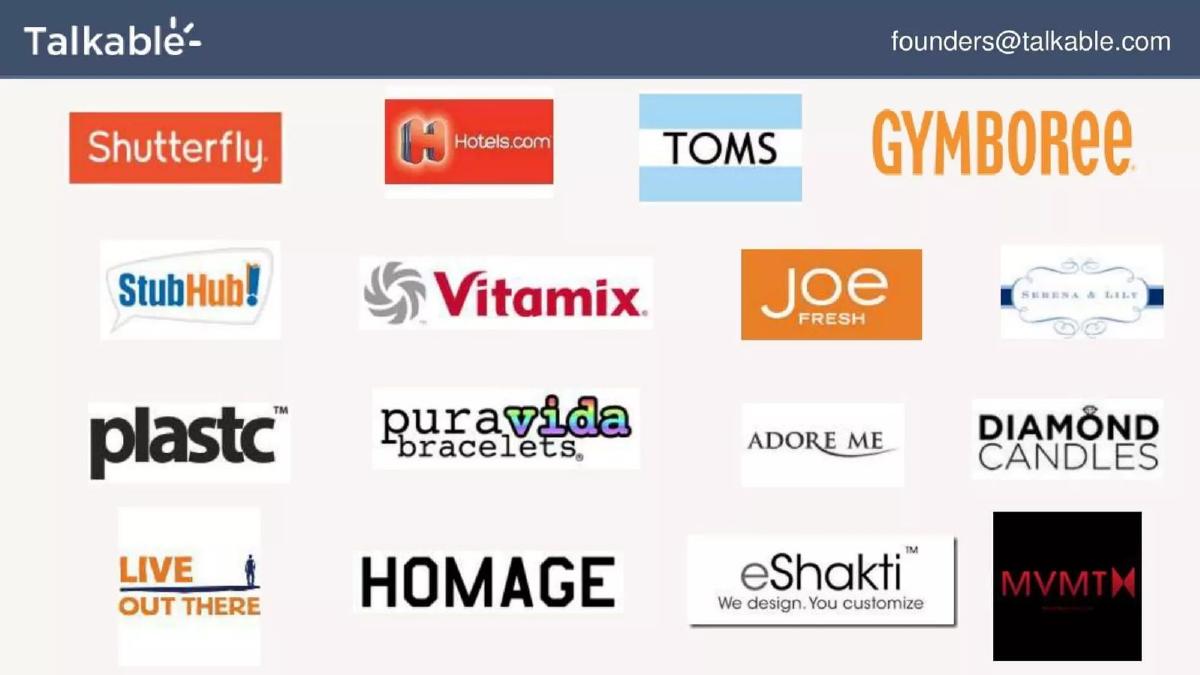
- The deck leads with a massive social proof slide featuring 16 major brand logos including StubHub and Vitamix (Slide 2).
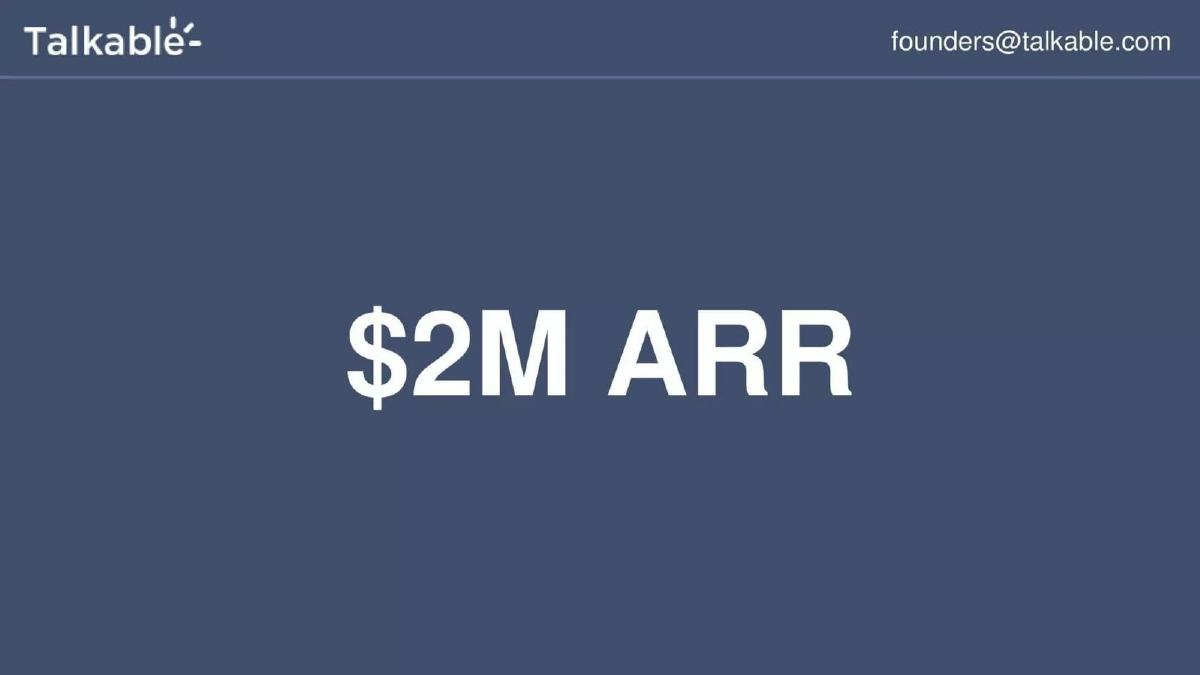
- Traction is presented with extreme clarity, highlighting '$2M ARR' on a single, dedicated slide (Slide 4).
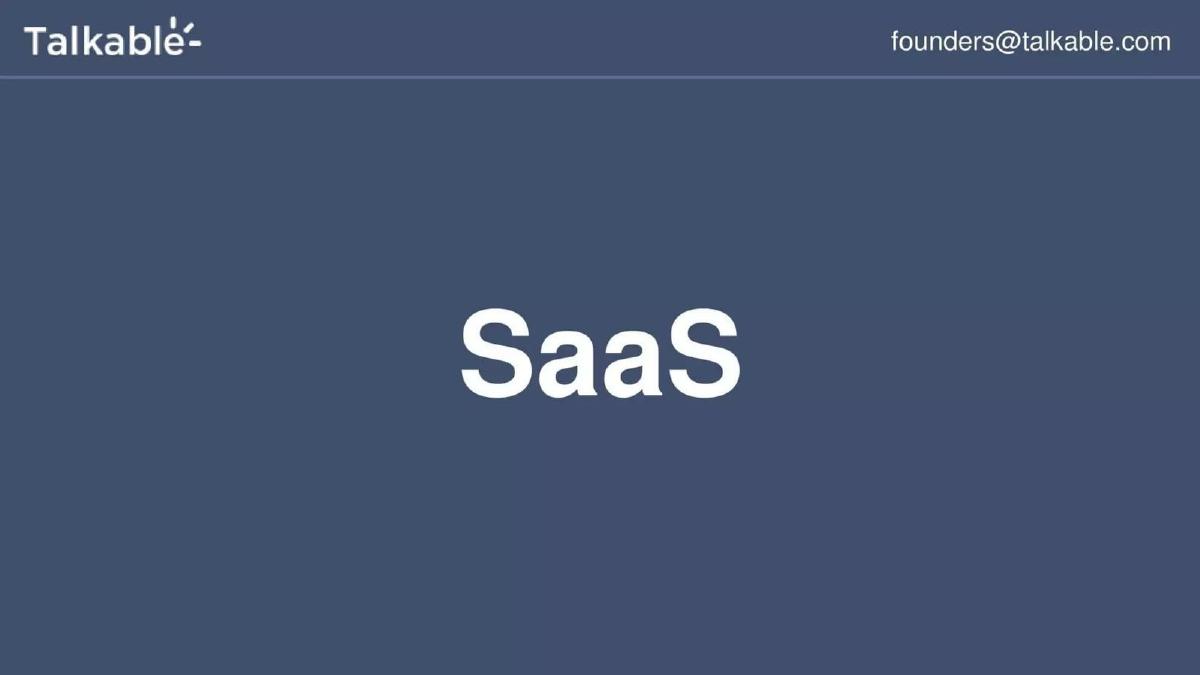
- The business model is simplified to a single word: 'SaaS' (Slide 5).
- Product functionality is demonstrated through real-world implementation screenshots from Hotels.com, Shutterfly, Gymboree, and TOMS (Slides 7-10).
- A dashboard screenshot quantifies performance with metrics like '11% Referral Contribution' and '$26K Lift in Sales' (Slide 13).
- The market opportunity or total volume processed is hinted at with a '$2 Billion' figure, though the specific context is not defined on the slide (Slide 15).
- The team slide consists of a single informal group photo without names, titles, or professional backgrounds (Slide 16).
- The deck concludes by reinforcing its current scale with a '$2M Run Rate' call-out (Slide 17).
The Minimalist Power of Talkable’s Pitch Deck
Talkable’s pitch deck is an anomaly in the world of fundraising. While most founders feel the need to cram every slide with data, charts, and competitive matrices, Talkable takes the opposite approach. This 17-slide deck is almost entirely visual, using large-format text and screenshots to convey a sense of inevitable success. It is a deck that doesn't ask for permission; it presents a moving train and invites investors to jump on.
The Hook: Social Proof and Big Numbers
Slide 1: Title The deck opens with the Talkable logo and the simple descriptor: "Referral Marketing Platform." It is clean, professional, and sets a corporate tone immediately.
Slide 2: The Logo Wall Before explaining how the product works, Talkable establishes credibility. This slide features 16 logos, including heavyweights like Shutterfly, Hotels.com, TOMS, Gymboree, StubHub, and Vitamix. For a B2B SaaS company, this is the strongest possible opening. It tells the investor that the product is already integrated into the workflows of multi-billion dollar retailers.
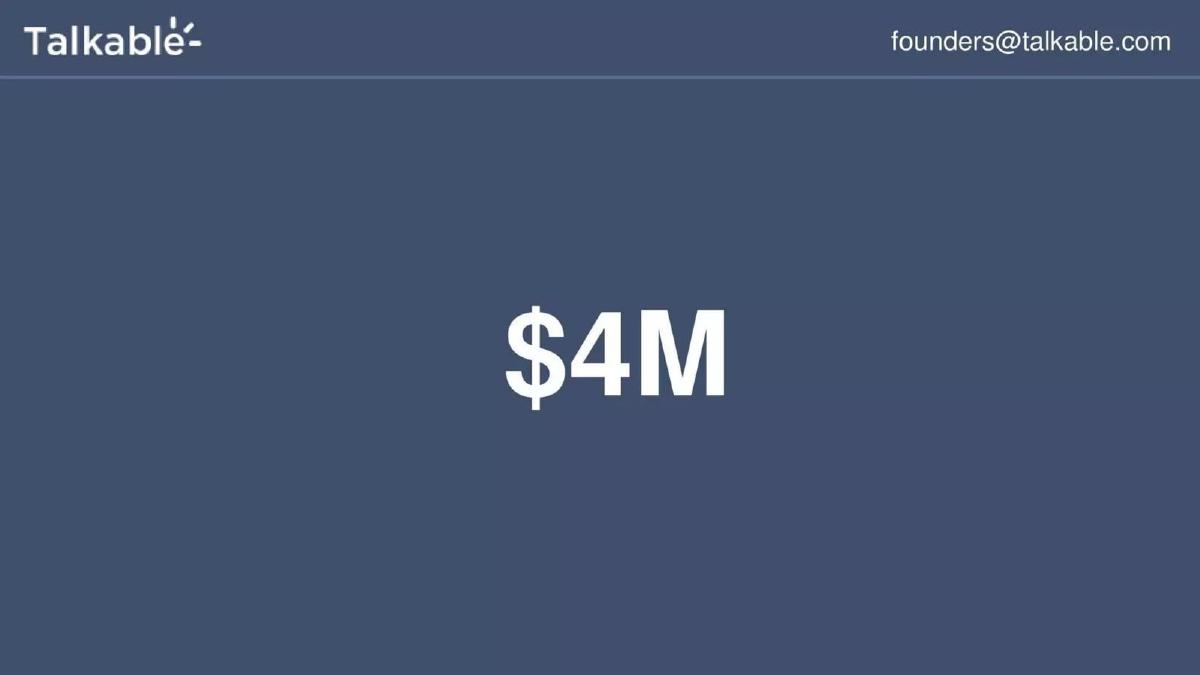
Slide 3: $4M This slide contains only the text "$4M." Given the context of the following slides, this likely refers to a previous funding milestone or a specific volume metric, though the lack of a label is a bold choice that requires the presenter to provide the narrative.
Slide 4: $2M ARR Talkable hits the most important metric for a SaaS investor early. By putting "$2M ARR" on its own slide, they ensure the figure is not lost in a sea of other data. It signals that the company has moved past the experimental phase and has found true product-market fit.
The Business Model and Product in Action
Slide 5: SaaS The business model is summarized in four letters. This tells the investor everything they need to know about margins, recurring revenue, and scalability without needing a complex breakdown of pricing tiers.
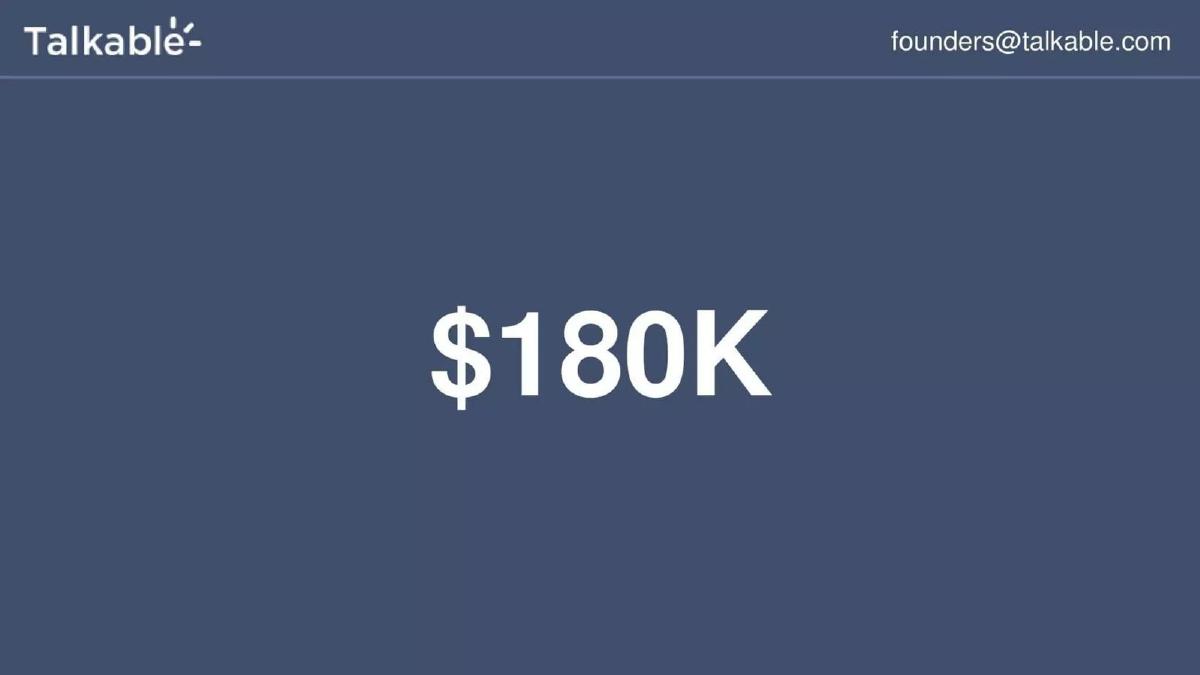
Slide 6: $180K Following the ARR slide, this likely represents the Monthly Recurring Revenue (MRR) at the time of the deck's creation ($180,000 x 12 = $2.16M). It reinforces the consistency of the revenue stream.
Slide 7-10: Product Implementations These four slides show the product in the wild.
Hotels.com (Slide 7): Shows a "You get $40, Your friends get $40" referral overlay. · Shutterfly (Slide 8): Demonstrates a "Refer a friend, Get $10 off" mobile-optimized share screen. · Gymboree (Slide 9): Shows a "Sharing is Caring" pop-up offering 25% off for friends and $20 for the advocate. · TOMS (Slide 10): Highlights a "Be a go-giver" campaign with a $20 credit incentive.
These slides are crucial because they show that Talkable isn't just a backend tool; it is a visible, branded part of the customer journey for famous brands.
The Strategy and Backend
Slide 11: The Road Ahead A metaphorical image of a businessman walking down a road with many diverging signs. This is the only "fluff" slide in the deck, likely used by the founders to discuss the complexities of the marketing landscape and how Talkable provides a clear path forward.
Slide 12: Channels A simple visual representation of the ecosystem: Desktop/E-commerce, Email (Gmail logo), Social (Facebook/Twitter), and mobile users. It illustrates that the referral engine works across all digital touchpoints.
Slide 13: The Merchant Dashboard This is a high-value slide. It shows the analytics Talkable provides to its clients. Key metrics visible include:
11% Referral Contribution: Proving the impact on the bottom line. · 160 New Customers: Quantifying acquisition. · $26K Lift in Sales: A direct ROI calculation. · Reward Fulfillment: A chart showing "Authorized," "Unauthorized," and "Suspicious" activity, highlighting Talkable's fraud prevention capabilities.
Slide 14: Campaign Management This slide shows the administrative side of the platform, with a timeline for "Instant Reward," "Invite," and "Post Purchase" campaigns. It demonstrates that the software is a sophisticated management tool, not just a simple plugin.
Market Scale and Team
Slide 15: $2 Billion Another single-metric slide. In the e-commerce context, this likely refers to the Total Addressable Market (TAM) or the total Gross Merchandise Volume (GMV) processed through the platform's clients. It serves to remind the investor of the scale of the opportunity.
Slide 16: The Team The team slide is a casual group photo of nine men. There are no names, no titles, and no mention of previous exits or prestigious universities. While this fits the minimalist aesthetic, it is a missed opportunity to highlight the technical or sales pedigree required to close the enterprise clients shown on Slide 2.
Slide 17: $2M Run Rate The deck ends as it lived: with a large, bold number. It leaves the investor with the final impression of a company that is generating significant, consistent revenue.
What Works in the Talkable Deck
1. Unassailable Social Proof: By leading with massive brand names and showing exactly how those brands use the product, Talkable bypasses the need to explain "why" the product is valuable. The market has already decided it is.
2. Extreme Focus: The deck doesn't waste time on market trends or the history of advertising. It focuses entirely on Talkable’s traction and product. This is highly effective for a mid-to-late-stage company where the numbers matter more than the vision.
3. Visual Evidence: The inclusion of the dashboard (Slide 13) is vital. It proves that Talkable is a data-driven platform that provides actionable insights to CMOs, rather than just a "nice-to-have" marketing widget.
What is Missing from the Talkable Deck
1. The Competitive Landscape: Referral marketing is a crowded space (with competitors like Friendbuy or ReferralCandy). The deck makes no mention of why Talkable is the superior choice or how its technology (like the fraud detection shown on Slide 13) creates a moat.
2. Unit Economics: While we see ARR, we don't see Customer Acquisition Cost (CAC), Lifetime Value (LTV), or churn rates. For a SaaS company at $2M ARR, these are the metrics that determine the valuation multiple.
3. The Ask: There is no slide indicating how much money is being raised or what the primary use of funds will be (e.g., scaling the sales team, international expansion, or R&D).
What a Founder Should Copy
1. The "Single Metric" Slide: If you have a number you are proud of—whether it’s ARR, user growth, or a retention rate—give it its own slide. Don't bury your lead in a bulleted list.
2. Show, Don't Tell: Instead of describing your features, show screenshots of your product integrated into a customer's workflow. It makes the abstract concrete.
3. Use Logos as a Shield: If you have notable customers, use them early. Social proof is the most effective way to lower an investor's perceived risk.
Frequently asked questions
- What is Talkable's primary value proposition?
- Based on the product screenshots (Slides 7-10), Talkable provides a referral marketing platform that allows e-commerce brands to offer 'Give X, Get Y' incentives. For example, the TOMS slide shows a 'Give your friends $20 OFF' offer which earns the advocate a $20 credit. The platform automates the sharing, tracking, and reward fulfillment of these peer-to-peer recommendations.
- How does Talkable demonstrate its market traction?
- Talkable uses two primary methods: revenue and social proof. It explicitly states it has reached '$2M ARR' (Slide 4) and a '$2M Run Rate' (Slide 17). It complements these figures with a dense logo wall of high-tier enterprise and mid-market e-commerce clients, signaling that the product is battle-tested by major retailers.
- Is there a detailed financial breakdown in the deck?
- No. The deck is devoid of traditional financial tables, P&L statements, or projections. It only lists three specific financial milestones: '$4M' (Slide 3, likely total funding or previous volume), '$2M ARR' (Slide 4), and '$180K' (Slide 6, likely monthly revenue). This suggests the deck is intended to hook investors on growth velocity rather than unit economics.
- What does the product interface look like for the merchant?
- Slides 13 and 14 provide a glimpse into the merchant dashboard. It includes 'Revenue Impact' tracking (referral contribution, new customers, sales lift), 'Reward Fulfillment' monitoring (authorized vs. suspicious activity), and a campaign 'Timeline' for scheduling different referral triggers like 'Post Purchase' or 'Instant Reward' campaigns.
- What are the most notable omissions in this pitch deck?
- The deck omits several standard venture components: there is no problem/solution narrative, no competitor analysis, no go-to-market strategy, and no 'Ask' slide detailing how much capital is being raised or how it will be spent. Additionally, the team slide (Slide 16) lacks any biographical information, which is unusual for a 'Later' stage round.